A salute to mosses and lichens

For the past few years I have been working on Moss and  Lichen, which will be available this week in the US (Reaktion Books, 2025), having appeared in the UK at the end of December, 2024. Reaktion Books is a London-based publisher whose books are distributed in the US by the University of Chicago Press. Moss and Lichen appears in Reaktion’s Botanical Series. The goal of the series is to convey social and cultural history as well as botanical and horticultural background for each title. The mosses and lichens of Vinegar Hollow prepared me for writing this book many years ago.

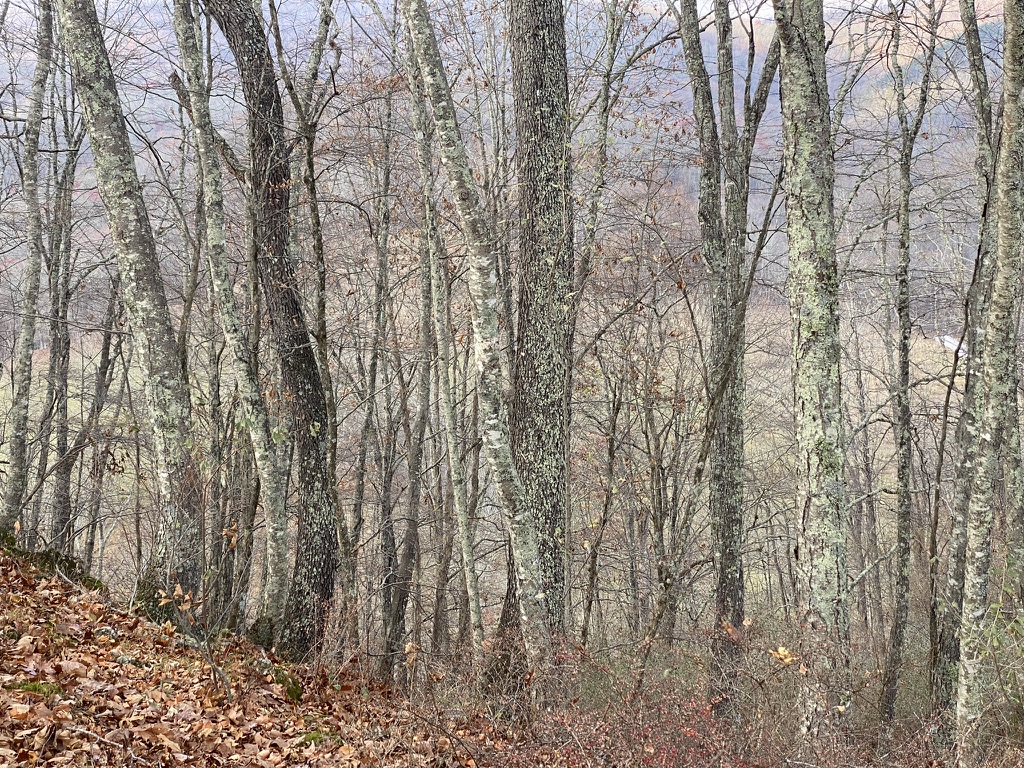
A view through moss-and-lichen covered trees of Back Creek Mountain to Big Valley in the distance (Highland County, Virginia).

As a young girl I scoured our farm in Vinegar Hollow, Highland County, for wildflowers, but I was in competition with cows and sheep who grazed the fields, and even the forest, incessantly and methodically. When failing to find wildflowers to identify with my trusty Margaret McKenny and Roger Tory Peterson’s Field Guide to Wildflowers: Northeastern and North-central North America, I would turn my attention to mosses and lichens. I had no guides, but I was happy just observing. The farm was isolated, and I was desperate to see things. I realize now that mosses and lichens taught me to see everything better. They were everywhere, but I had to peer, often kneel, and look very closely. And marvels appeared if I was patient.

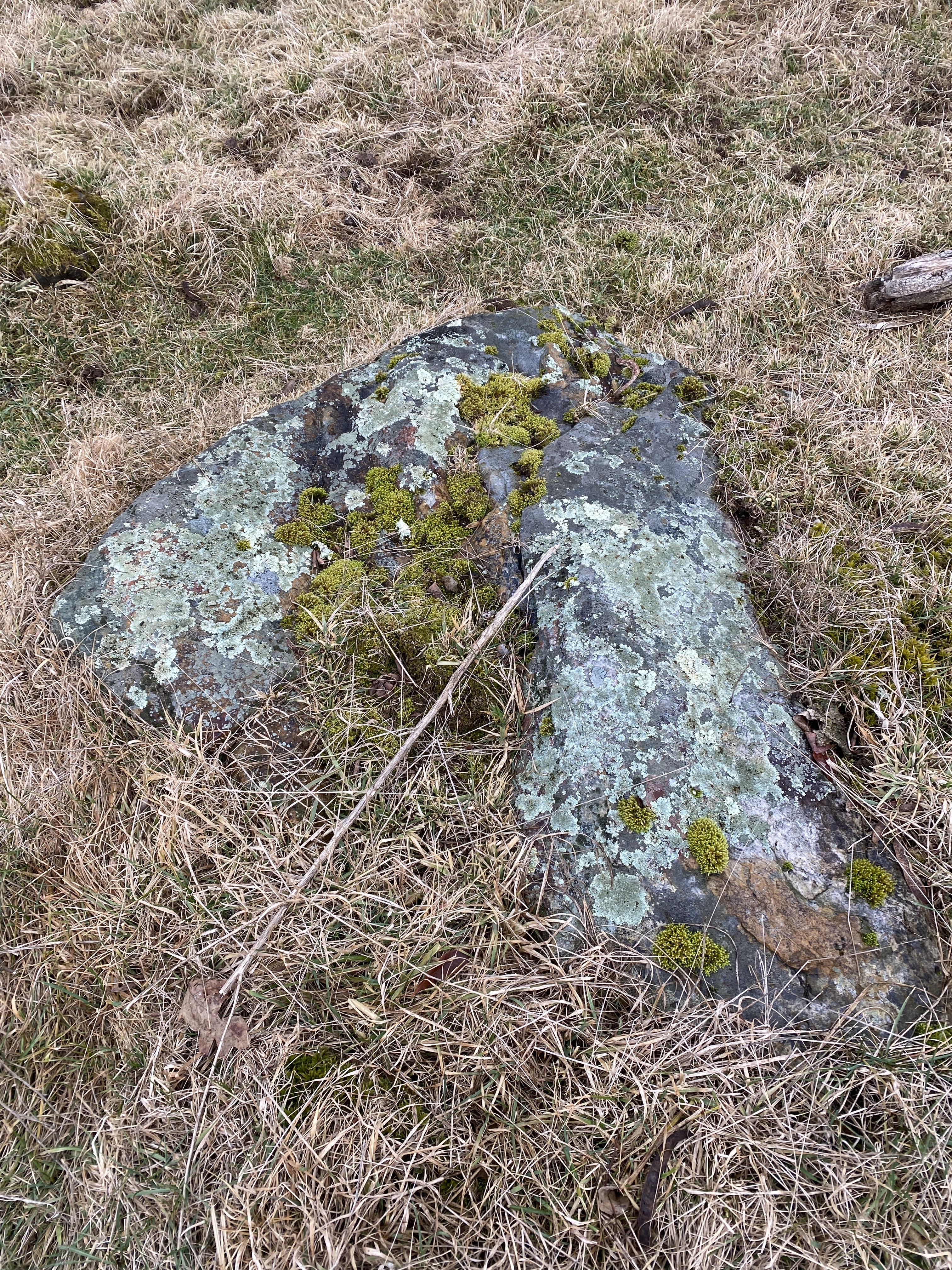
Mosses and lichens have overtaken this rock.

The landscape here is deeply textured by the mosses and lichens that bring life to so many surfaces—of fence posts and rails, rocks, boulders, bark, soil, and even metal farm gates. In winter the trees reveal bark tinted impressionistically by innumerable mosses and lichens that have found habitat in the wrinkles and fissures of bark. The effect is otherworldly. From a distance the ridges of these very old Appalachian Mountains seem populated by an army of ghost trees. After a rain the landscape would shimmer in moss-and-lichen shades of green, gold, blue green, gray green, yellow green, and more. Rock piles and fence posts come alive. Sometimes I would notice a pop of bright-green fuzz on the hillside, a tiny moss too small for a cow to eat. 

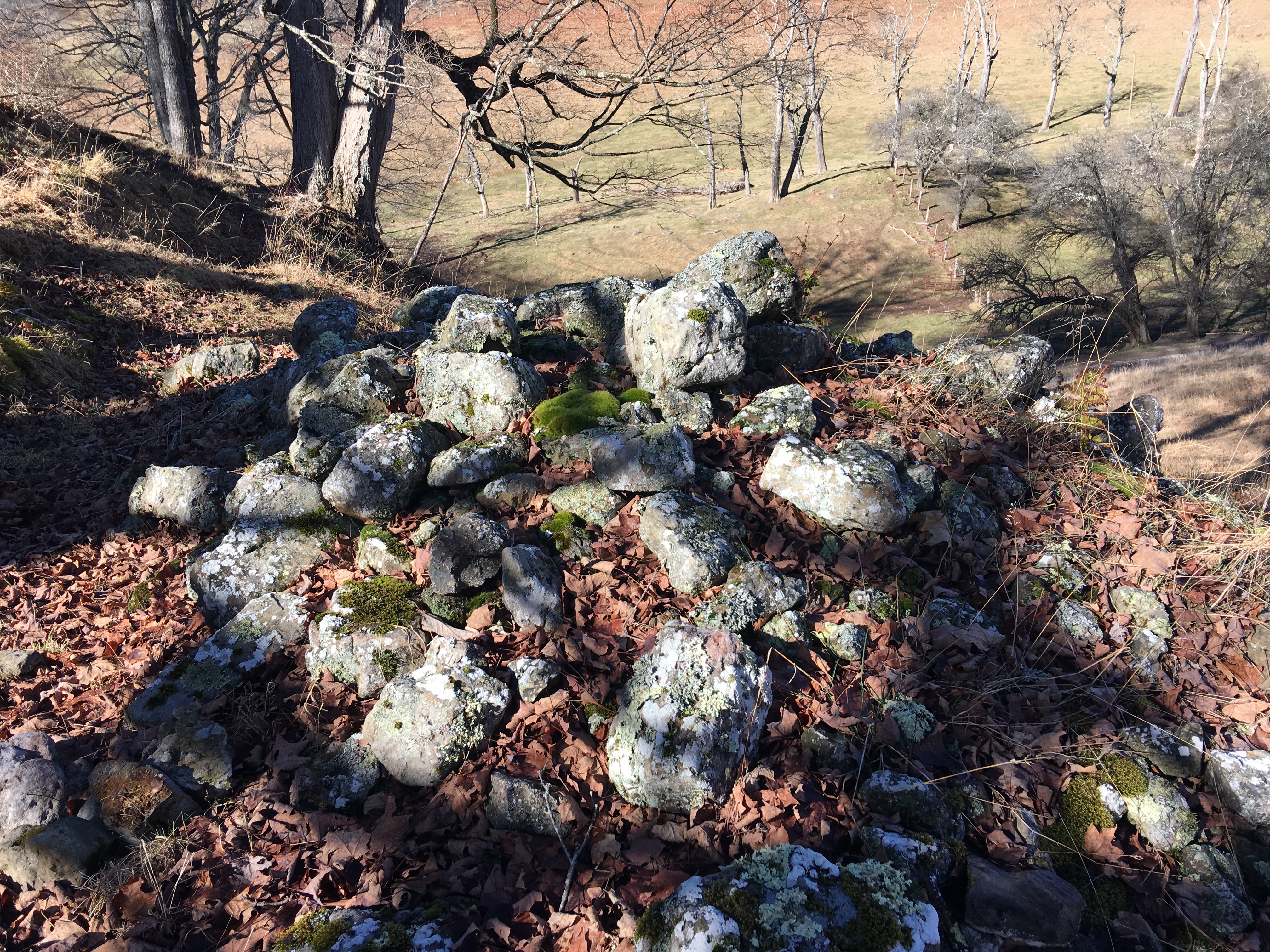
A rock pile is perfect habitat for mosses and lichens. Here, undisturbed, they live–fixing carbon and releasing oxygen through photosynthesis.
Moss and lichens find habitat on the vertical face of this stone wall in Vinegar Hollow. The bright green “threads” are mosses, while the blue-gray and golden splotches are lichens.
A rock tripe type lichen and moss share room on this boulder.
Boulders in the pasture that never made it to the rock piles are also covered with moss and lichen carrying on the business of living.

While not a field guide, I hope Moss and Lichen will introduce readers to their history and presence in our lives and to an understanding of their biology and diversity. There are stories about fascinating people, men and women, professionals and amateurs, who have dedicated their lives to studying these elegant, sophisticated organisms. I also draw on the words and images of writers and artists who offer other perspectives..  Mosses and lichens repay attention. They accompany us wherever we go. They bring us closer to the Earth, literally, spiritually, and imaginatively. They move us to ask questions about how they survive in extreme conditions and about what we value in our world. Yes, they are hard to see—but because they are minimalists, they are also survivalists, who will find habitat on this Earth to the very end, despite our misguided attempts to usurp space for ourselves.

A dramatic group: the ruffled black “thing” (thallus) on the right is a lichen as are the yellow dots on the upper left and blue-green splotch on the bottom left, while the bright-green patch is easily recognizable as a moss.

I am grateful to Reaktion Books for the chance to write this book. Its team of publishing professionals (art editor, copyeditor, proofreader, book designer, and more) is relentless in the search for flawless production of a beautiful book. 

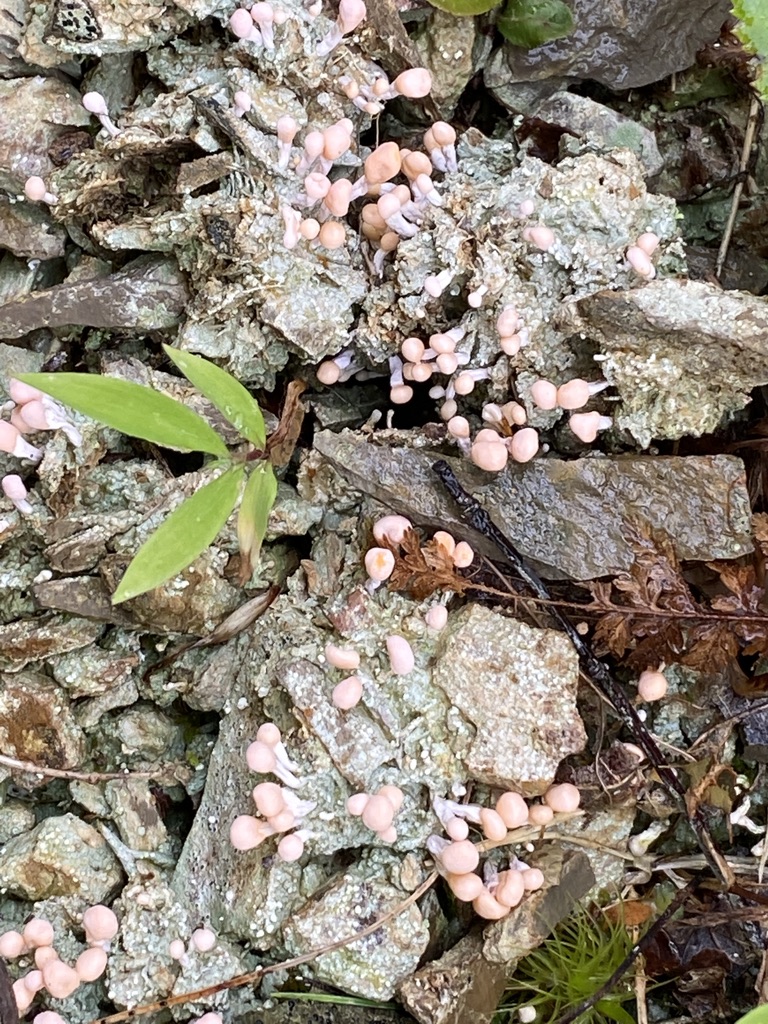
The pink earth lichen always adds a light touch to the landscape, and moss is never far away (lower
right corner).
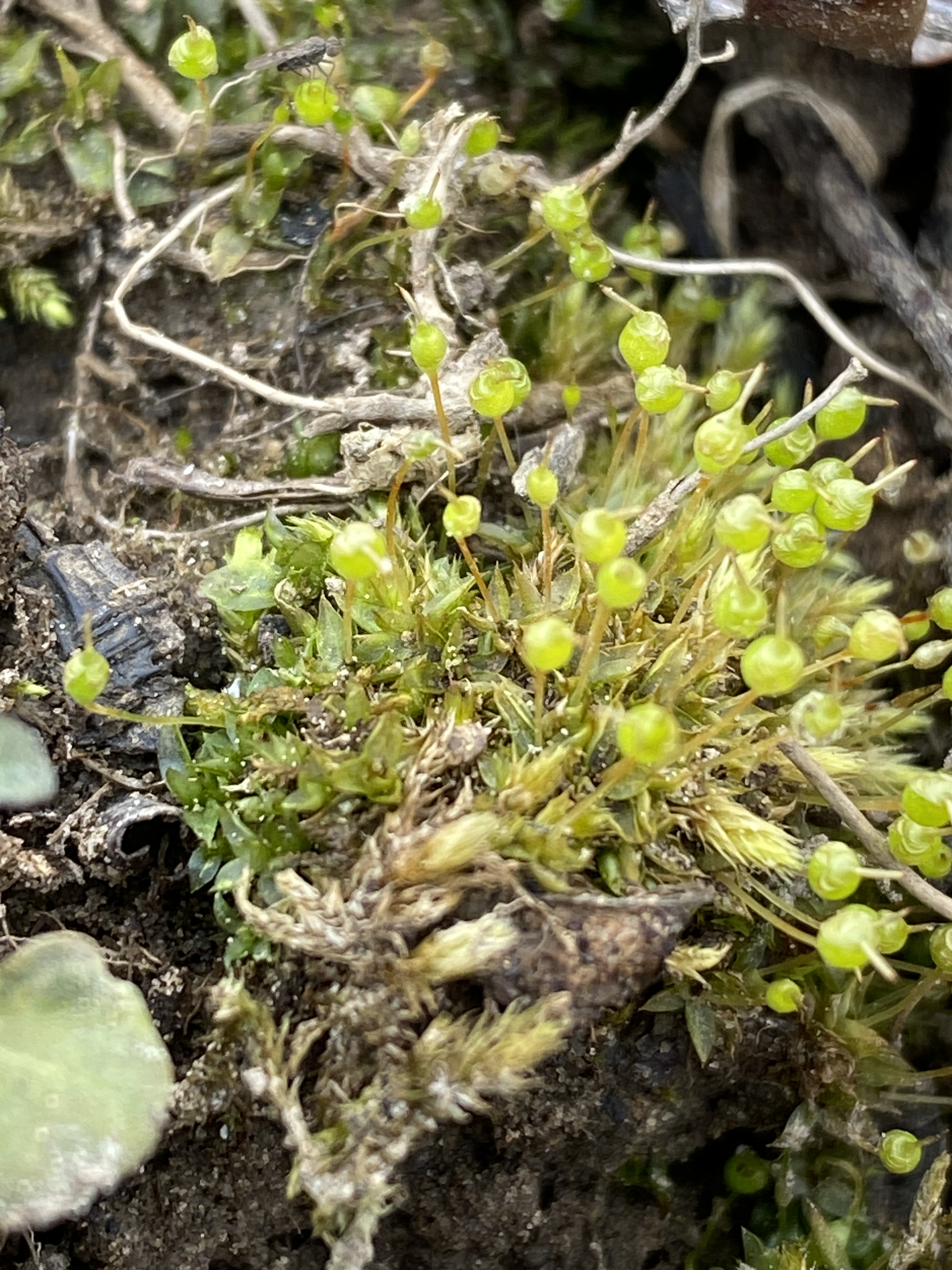
The cows missed this earth moss, about half the size of a small fingernail, found on the flank of Stark’s Ridge. I almost missed it too!

For more images of the mosses and lichens of Vinegar Hollow, see Vinegar Hollow: 2019 (mist) ends and 2020 (sun) begins!

A New Year’s reset in Vinegar Hollow

The view from the top of the Peach Tree Hill looking south. The Pine Tree Hill is first on the left with the graveyard just visible to the right of two red maples my mother planted, the Hill with No Name is in the middle, and Stark’s Ridge stretches south with the blasted cucumber at the end of the hilltop pasture.

We are in Vinegar Hollow for our New Year’s reset. The mountains are quiet, the stars are multitudinous at night, and one can wander, browsing the Earth–like cows, finding nourishment from the landscape. The woodchopper and the naturalist writer lean in to their favorite activities, all the while keeping the fire going.

Fire made by David Fernandez.

I like to observe the waking up of the day here in the hollow from my desk in front of the sliding glass doors. Although it’s a cold spot in the winter, I can survey the scene as I take my first sips of coffee. The cloud cover on January 1st was a moody blue-gray (not unlike the shoulder feathers of the Blue Jay, see below) intermixed with eyelets of blue. The first visitors to the garden yard are Blue Jays. I have never been particularly attentive to Blue Jays, dismissing their squeaky voices in favor of the smaller more delicate songbirds. However, after several mornings of Blue Jay watching, I become full of admiration for their grace and energetic behavior. Each morning a flock of about 9-10 birds arrive in a great hurry. They forage around the yard, pecking like chickens at leaf piles. Each peck tosses up a dance of leaves. They may be searching for remaining beechnuts because 2023 was a mast year, meaning there was a bumper crop.

The beech on the right and the red spruce on the left. The lawn between and beyond is the foraging ground of the Blue Jays (Photograph: Douglas Fernandez).

After a certain amount of ground-level activity they swoop up onto the slenderest branches of the beech and the wispy dangling branches of the red spruce, pause a bit, and then plummet to the ground for more foraging. Their choreography is erratic and hectic. Three or four of them visit the small watering hole/bird bath formed by the roots of the beech. Usually there is water in it, which small songbirds regularly visit in the summer, but now after a droughty fall, it is dry. After the Blue Jays are well into their morning routines, European Starlings in small murmurations appear in the background swooping en masse over the garden yard into the orchard meadow. My eyes are dazzled by the almost vertical falls of the Blue Jays in the forefront of my field of view and the horizontal movements of the European Starlings in the background. The arrivals and departures of the Blue Jays are sudden. In one moment I see them in the distance swirling together into the walnut tree in the sinkhole by the driveway, an astonishing display of speedy choreography. In the next they are off, with the European Starlings following in the same direction. And soon they are all back for round 2, sometimes round 3, but after these excursions they are gone for the day, probably off to the various water troughs placed around the farm, which are gravity fed by overflow from the spring on the mountain.

The plumage of the Blue Jay is best admired when the individual is caught at rest (Cyanocitta cristata, Corvidae) (photographic source: Wikimedia Commons, photographer Jongsun Lee).

The Blue Jays looked identical to me, which I knew was a failure in discernment. Nature does not create generic organisms. Every individual is uniquely different. So I decided to study, with the aid of the photograph above, the plumage of the Blue Jay. On the photograph I could observe at my leisure the dramatic feather patterns–the black bars that separate rectangles of the different shades of lavender-blue, the white belly and “underpants” ( birder term), and the white accents at the ends of certain feathers. Google helped me find a youtube video called “How to Tell Blue Jays Apart,” which beautifully illustrates how the black markings around the eyes and on the head enabled “Lesley the Bird Nerd” to distinguish the individuals at her bird feeder. She also noticed idiosyncratic traits like wing flicking. In other research I learned that Blue Jays communicate via a huge number of calls, among them 1) the jeer, 2) the pump handle, 3) the bell, and 4) various alert calls, like the toolili, which sounds quite melodious. Discerning bird calls by ear has never been my forte, however.

The days pass quickly. On the first day we visit the graveyard on top of Pine Tree Hill, which needs a lot of maintenance for the next round of inhabitants. We find strands of rusty barbed wire that have broken and are flopping about, certainly a hazard for the cows. We see the evidence of one cow who has made inroads into the plot searching for forbidden fruit. With fingers frozen in the cold, we try to fasten strands of barbed wire into the gaping holes. I have ordered primrose seeds (the common primrose, the oxlip, and the cowslip) and look forward to bringing the seedlings in the spring. On day 2 we walk to Stark’s Ridge to see the remaining cucumber tree of the pair that dominated the hilltop for so long.

The cucumber tree (Magnolia acuminata) at dawn (Photograph: David Fernandez).

Its partner is on the ground. On day 3 we walk straight up the Peach Tree Hill and then down into the snake woods, always a place of mystery and discovery. The path winds around sink holes filled with leaves, and vines climb to the tops of slender trees reaching for the light, threatening to and in some cases dragging them down. As a partisan of trees, I am dismayed by the power of wild grape vines to dominate trees. Sometimes two or three trees are tied together at their tips by vines.

The New Year’s reset is brief. On day 4 we have household maintenance issues and must go to town on errands. Day 5 is departure time. It is best to leave early for the 9-hour drive back to Ithaca, but there is a snafu. A pick-up truck with a large attachment has blocked the driveway by the barn. My husband went out to investigate and I continued indoor tasks. When he did not reappear and I heard animated conversation, I investigated. The large attachment was a cattle hoof trimming apparatus. It is a unique structure, partly devised by the owner himself, an exuberant person who went about his work while chatting enthusiastically despite the frosty air.

Pickup truck with unique apparatus attached for trimming hooves of cattle, more frequently used in dairy cattle than in beef cattle.

Mike’s cows do not in general need hoof trimming, a practice more common in dairy cows. This cow belonged to his grandson and had been transported from Stanton to Mustoe to be closer to the owner of the device. I missed the actual ‘operation’ but apparently the cow is coaxed into the apparatus, fastened in tightly, and then turned on her side so that the hooves are presented to the trimmer for easy trimming. The cow walks off eventually, presumably feeling much more stable on her feet. 

Sadly I missed this drama, but I noticed something that I would not have seen if the cow trimming machine had not been blocking our path. As I opened the gate from the garden area to the pasture, I observed that the lichens that copiously colonize  fence rails (epiphytic lifestyle) on the farm were covered in frost. In my research for a book called Moss and Lichen to be published by Reaktion Books in winter/spring 2024, I came across several studies about the ability of lichens to harvest water through ice nucleation. At higher temperatures formation of ice crystals requires nucleating particles, in this case those found on the ruffled surface of the lichens. It was about 28–30 degrees F.

Soon I was going from one fence rail to another trying to capture the beauty of the ice-crystal-encrusted lichens. Lichens are often described as “encrusting” their substrates, but here they were being encrusted themselves with little turrets of crystals showing the etch lines of their construction. There are biological reasons why nature specializes in encrusting topographies. Lynn Margulis, famous for greatly expanding our view of symbiosis, offered the statistic that the world contains 1014  tonnes of lichens (Symbiotic Planet, 1998), though noting that it is “notoriously” hard to provide an accurate estimate of the total mass of lichens in the world. They live everywhere on many substrates, natural and manmade, and frequent places not easily visited by humans. Although adapted for drought tolerance, lichens need water to photosynthesize and grow. Soon the morning sun would be hitting the fence rails, melting the ice crystals and immersing the lichens in films of water.

Sometimes I learn about the hollow through the eyes of Mike, who as I have mentioned grazes his cattle at the farm. This trip he tells me that he was near the top of the Peach Tree Hill on his four-wheeler checking on his cows, when he observed a curious tableau. A mama bear was halfway down the hill on the eastern flank with several cubs, heading over to a convenient gate into the Stanley Hiner place. Several calves began chasing the cubs, who, seemingly enjoying the chase, would stop and start. Each time the cubs stopped, the calves stopped. Meanwhile Mama bear left her cubs to play and headed over to Stanley’s place. Mike said that Mama bear would find her cubs in due time after the play date.

I could come here for a thousand years and always find something arresting to observe in the beauty and behavior of the multitudinous life forms on Earth.

The rural life: Vinegar Hollow in June

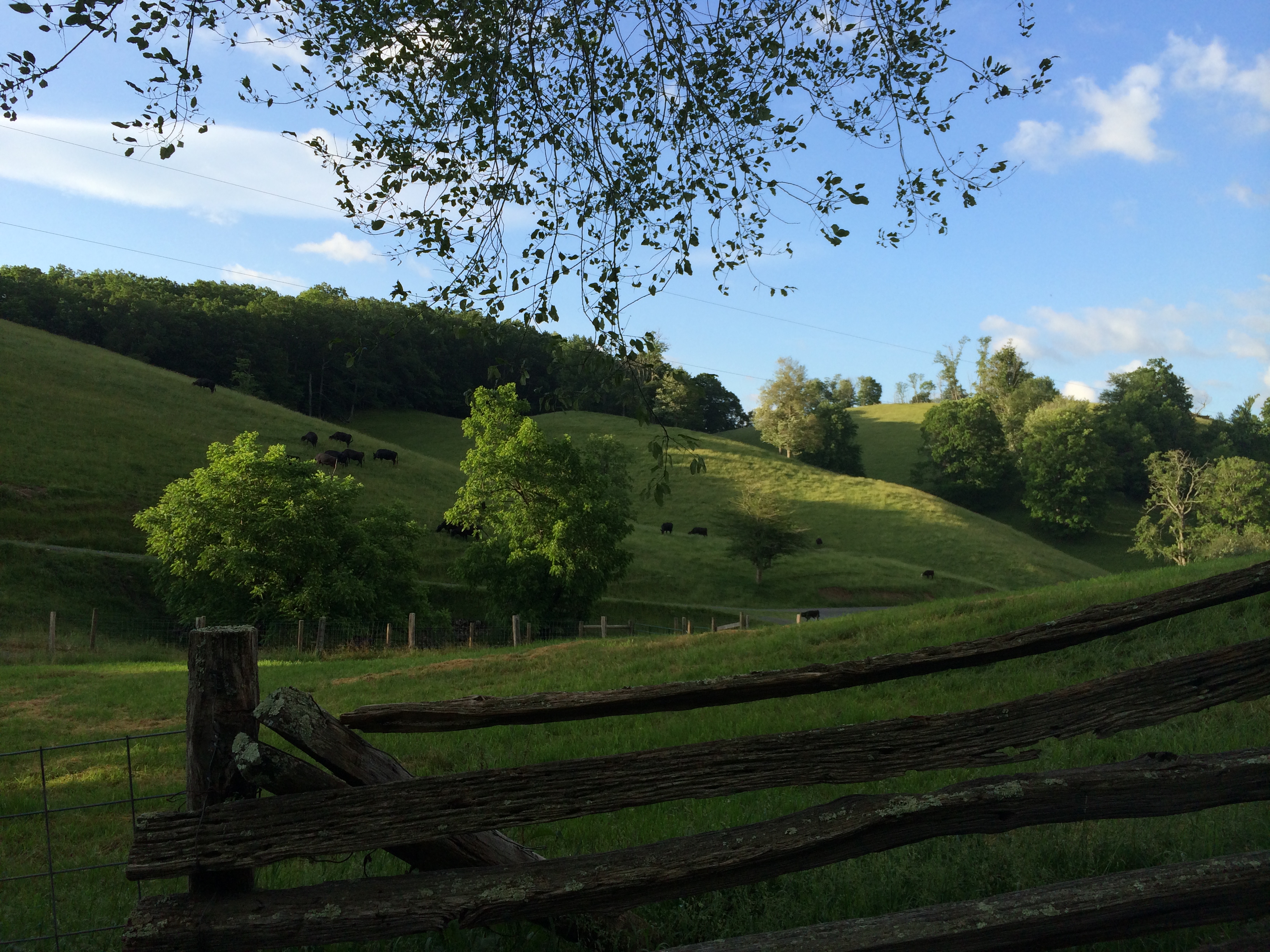
Cows eating their way to Starks Ridge.

Cows eating their way to Starks Ridge in the cool of early morning.

I arrive back in Vinegar Hollow to experience  a week of June in Highland County, Virginia, at the farm that my parents bought in 1948. Things seem tranquil on the first morning as the cows move slowly across the hills chomping at the new grass, but soon enough a news story develops.
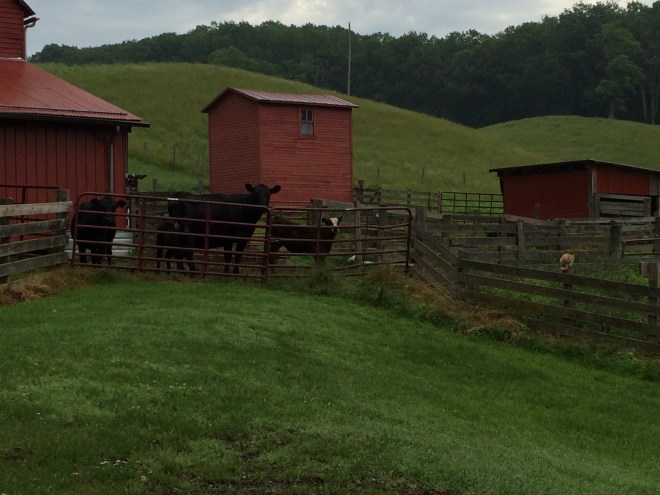
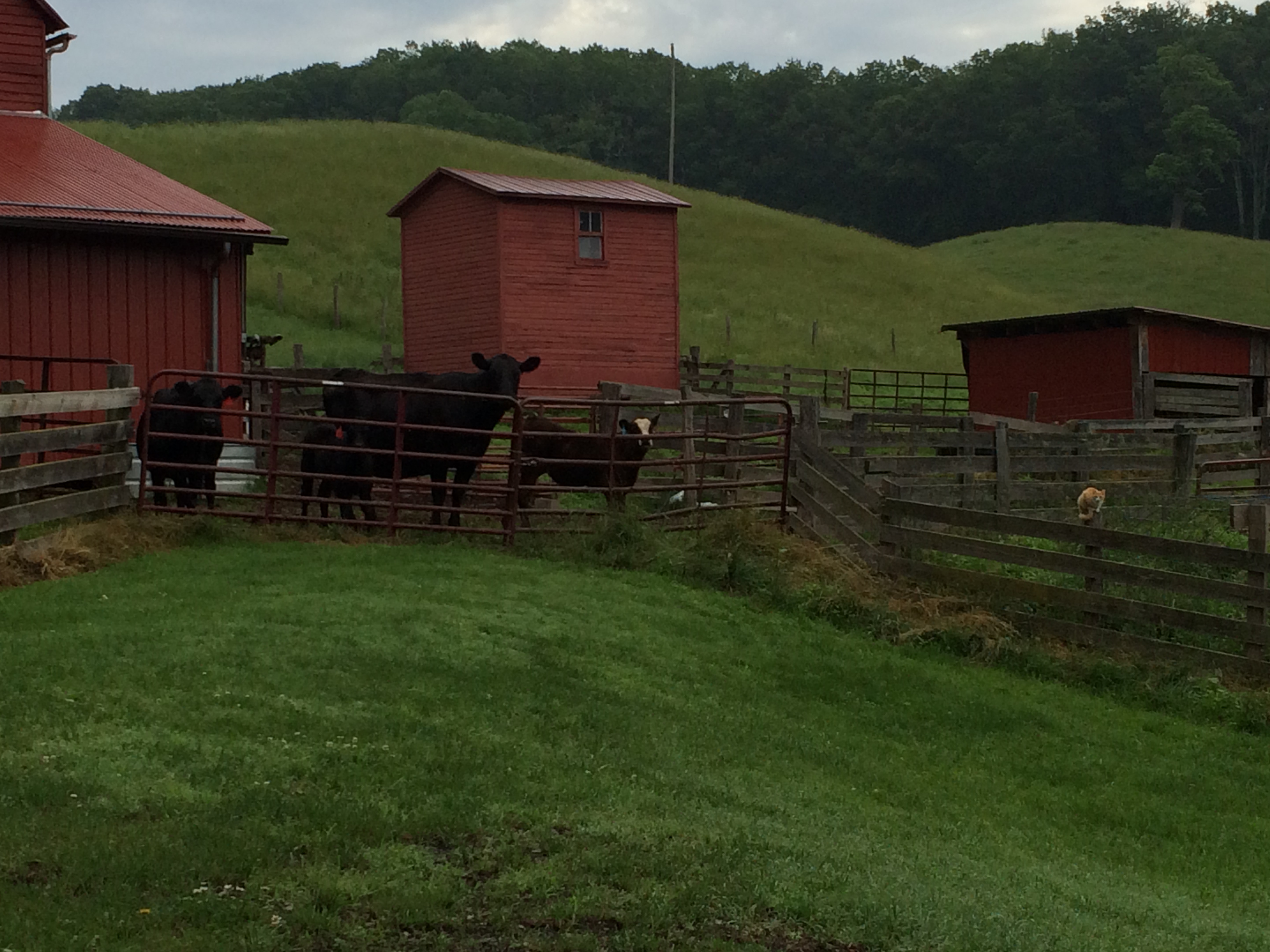
Four incarcerated cows and a cat on a fence post.

Early morning: four incarcerated cows and a cat on a fence post.

When Mike came to feed the barn cats the next morning, he noticed ear tags that didn’t match those of his herd. Two cows and two calves, not necessarily belonging to each other, which is problematic for all concerned, had strayed through an open gate from a neighboring property the day before, setting off quite a kerfuffle in the home herd. There was a tremendous bellowing by the trough all day as the cattle tried to figure out who belonged where. In the evening the owners rounded up the strays  but couldn’t get them back over the Peach Tree Hill before dark so they spent the night cooped up, like chickens you might say, which did not agree with them. They had plenty of water in the trough, but the grasses on the other side of the fence smelled so sweet. Their longing for freedom intensified over night and they stared at me intently as I strolled with my morning coffee, hoping I was the one who would free them. I told them Corey and Miranda would come soon.

I remembered the time my sister and I slept overnight outside in our sandbox, which had been converted into a tent. We woke up in the early morning when the large head of a large deer poked through the blanket over the sandbox, sniffing, nuzzling, and terrifying us. It turned out be to a pet deer that had escaped its owner. This is what I mean by news stories on a farm.

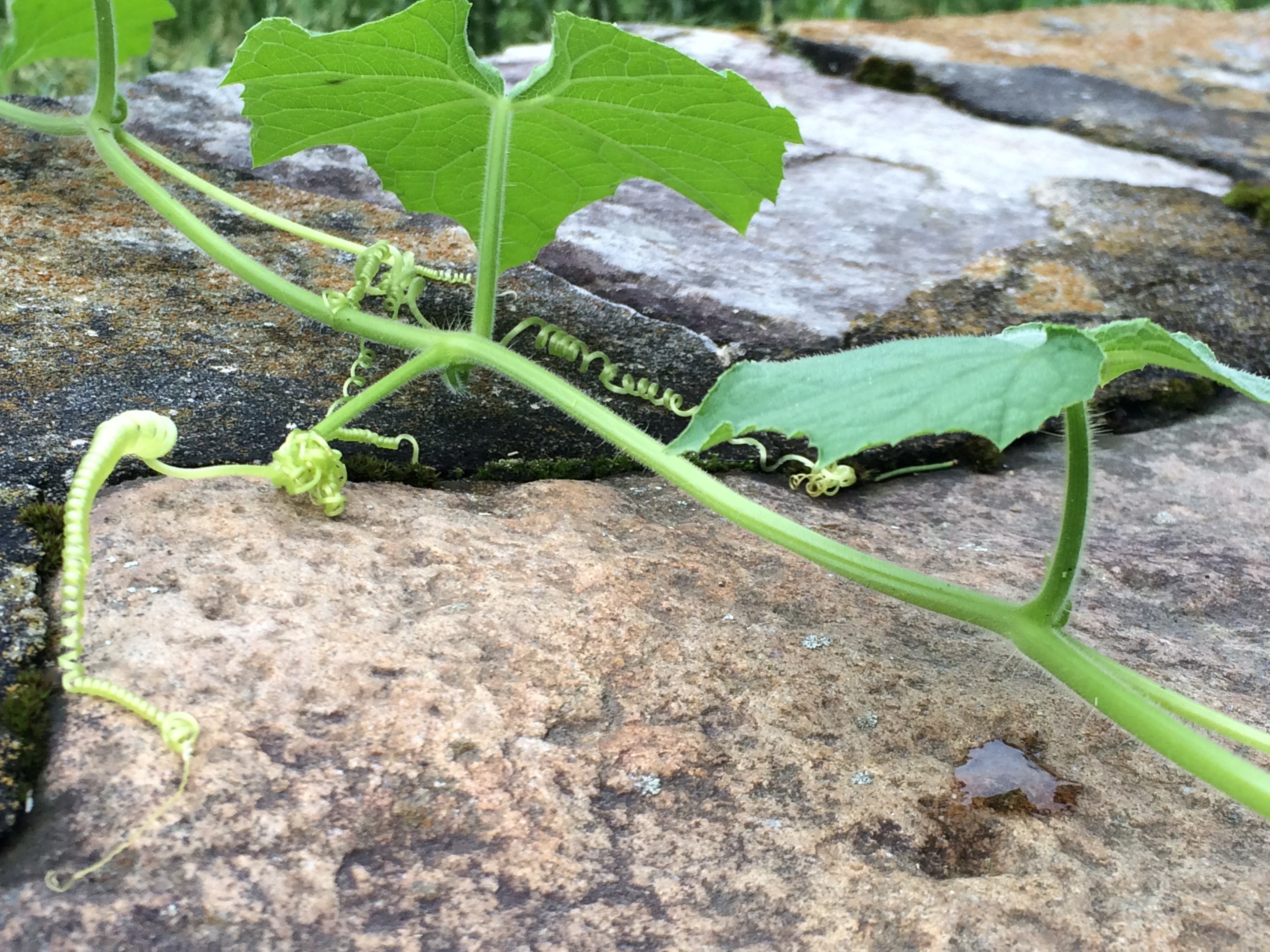
Nearby I watch the daily progress of the wild cucumber creeping out of the gone-wild calf nursery. This enclosure, my mother’s old vegetable garden, has metal hoops that are covered in winter with canvas to protect newborn calves that have been booted out of the barn to make way for new arrivals–in the too-cold of their birthing season.
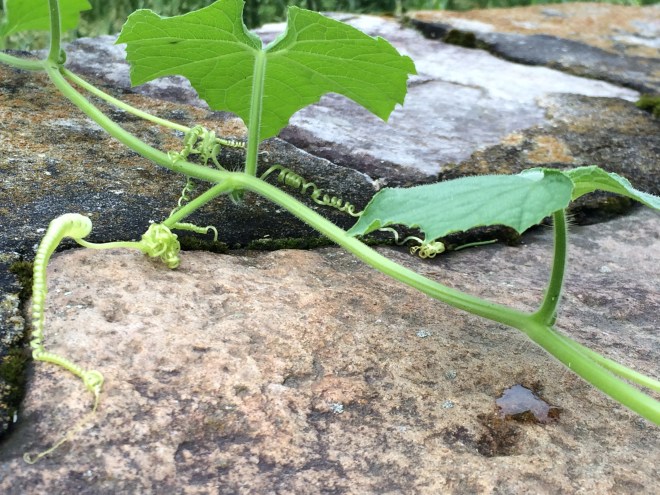
Wild cucumber vine creeping over the wall, tendril by tendril.
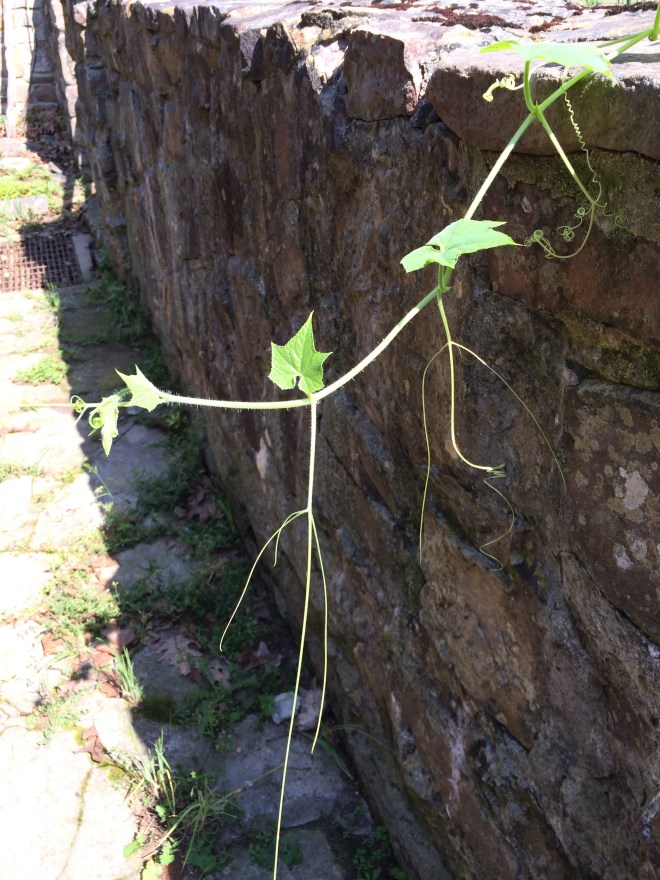
Wild cucumber vine creeping over the wall, tendril by tendril.

It's over the wall!

It’s over the wall!

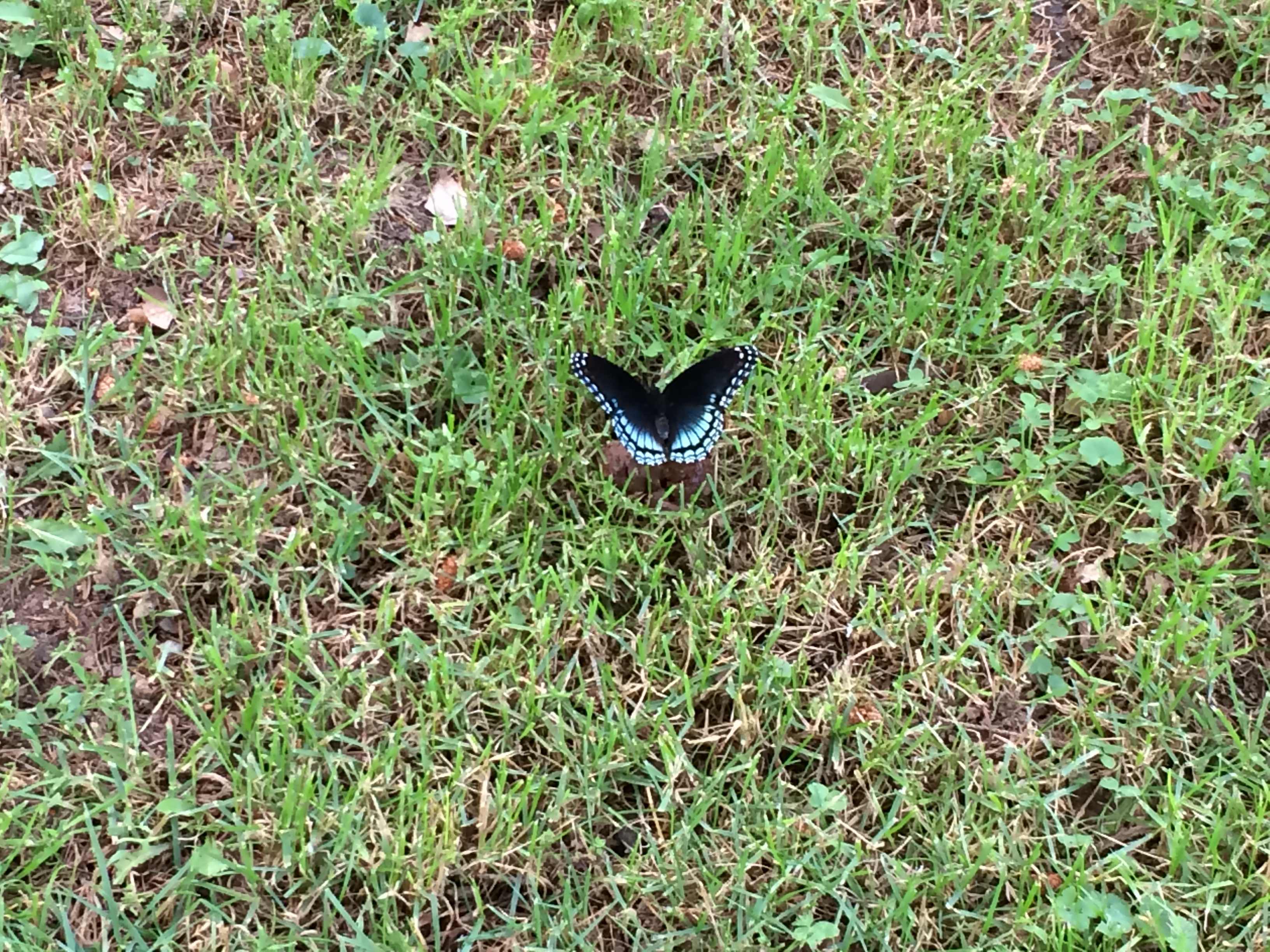
Still drinking my coffee, I watch the blue-black butterfly that comes jogging around the house every morning and afternoon visiting the same patch of scat, which has been rained on so often that it must seem fresh.  This is probably the black swallowtail mimic that has no tails, the Red-spotted Purple (Limenitis arthemis astyanax).
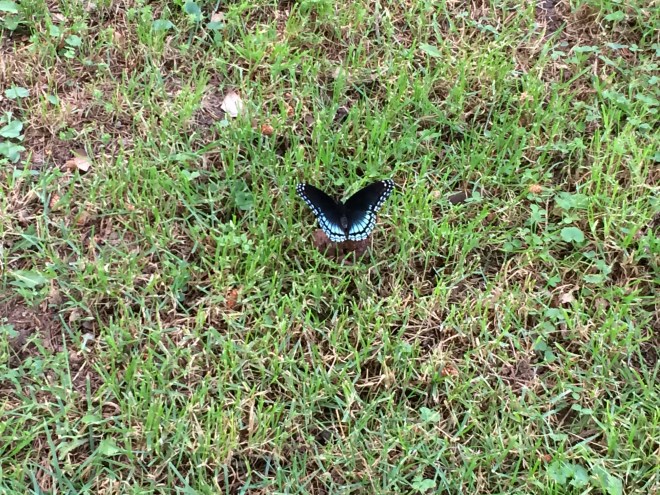
Red-spotted Purple on scat in garden lawn.

Red-spotted Purple on scat in garden lawn.

This individual has come to seem like my personal friend. I have chased around after it and found that its behavior fits that described for this species–it enjoys scat, gravel roads, and roadsides.
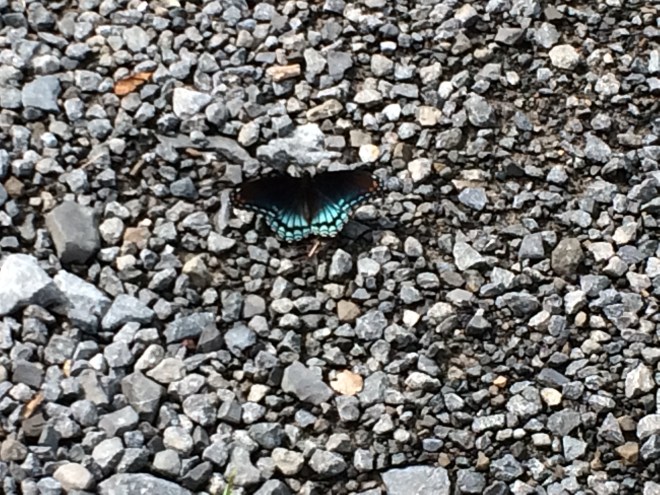
IMG_9289

The butterfly has made its way to our gravel driveway. Photographing butterflies is frustrating for the amateur. This is not sharp, but finally I see the “red” spots at the extremities of the upper wings. I didn’t notice them at all while observing the constantly moving “flutterby.”
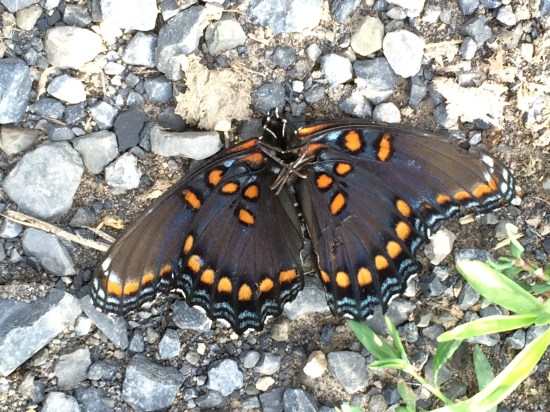
Underside of the Red-Spotted Purple found by the side of the road by the apple orchard in Vinegar Hollow.

Underside of the Red-Spotted Purple found by the side of the road near the apple orchard in Vinegar Hollow. It was killed, mostly likely, by my car or Mike’s as very few others travel this road. Soon I started noticing dead Red-spotted Purples on Route 220 north and south to Monterey. Their penchant for frequenting gravel and roads is not healthy.

The Red-spotted Purple has found fame in the hands of writer May Swenson, author of the poem “Unconscious Came a Beauty” written  in the shape of the butterfly that alighted on her wrist while she was writing one day. It is a delicate poem full of stillness until the last line, “And then I moved.” She was fortunate to have this experience, and we are fortunate to have her poem. The hollow seems to be full of Red-spotted Purples this year, and there is much to learn about them. There are good observers out there, like Todd Stout, who offers a youtube video on identifying the hibernacula of this species. A hibernaculum is the overwintering curled-leaf-like home of the caterpillar, beautifully camouflaged to avoid notice. It is hard for me to imagine that I can ever learn to spot a hibernaculum, but I do know black cherry trees, a preferred host, so that’s a start.
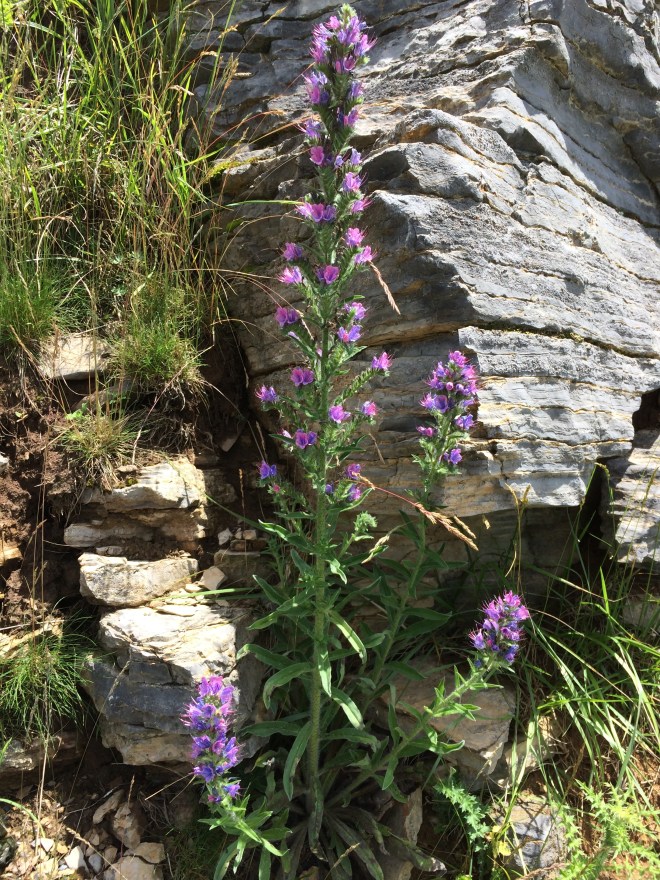
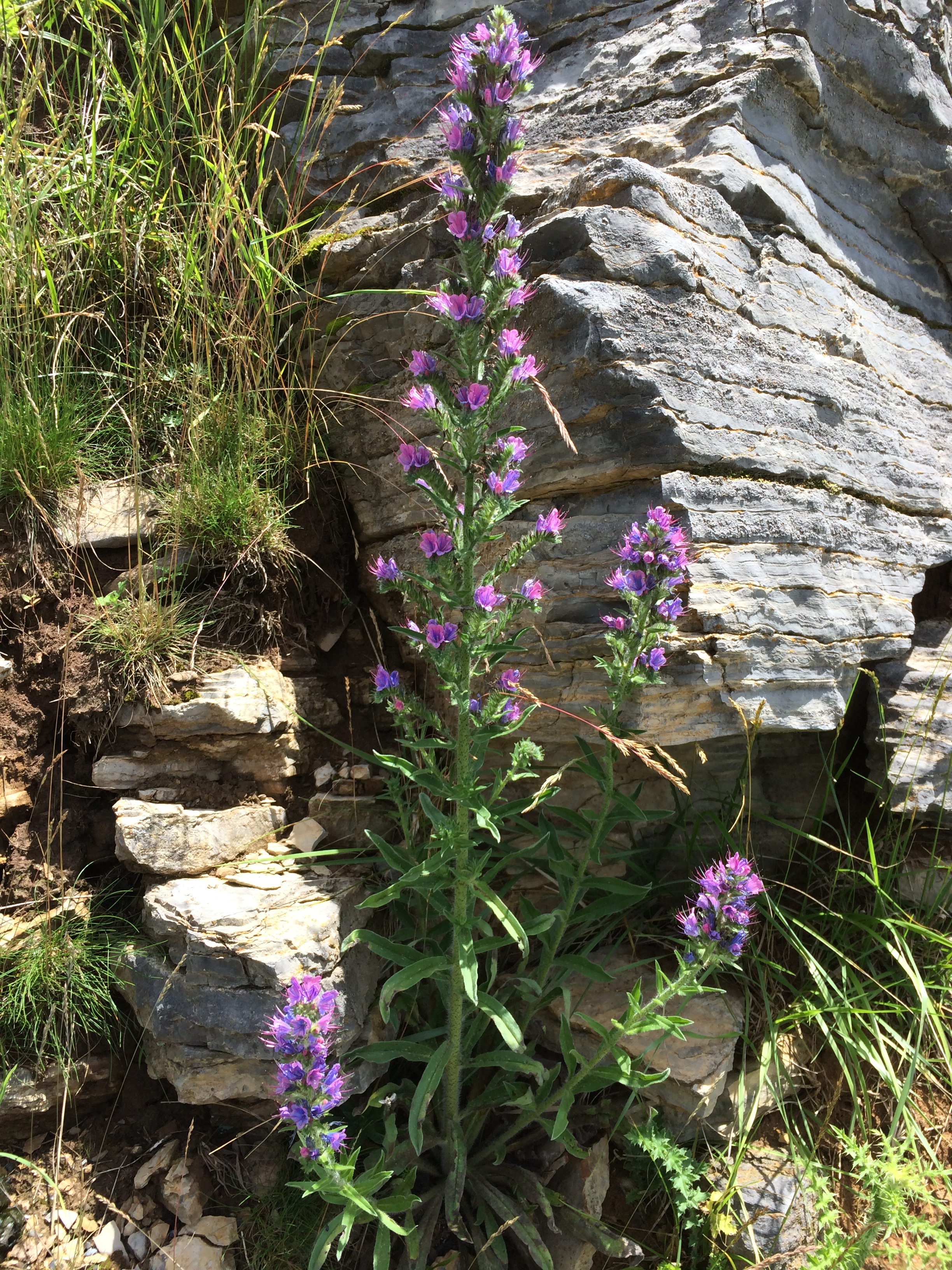
The viper's bugloss (Echium vulgare), a member of the forget-me-not family.

The viper’s bugloss (Echium vulgare), a member of the forget-me-not family.

I am happy to find viper’s bugloss, my mother’s favorite wildflower, abundant along the cliff road, nestled against the limestone outcroppings, as impressionistic a combination of pink and blue as one can imagine. The pollen is blue, while the stamens are red. Margaret McKenny and Roger Tory Peterson in A Field Guide to Wildflowers: Northeastern and North-central North America describe it as “bristly.” Yes, it’s the right word. The flowers may look a little fluffy, due to their exserted stamens, but the plant rebuffs touching. It is definitely a porcupine in flowery dress.  “Bugloss” derives from two Greek words meaning head of a cow and tongue, the import of that being that the leaves are as coarse as a cow’s tongue.
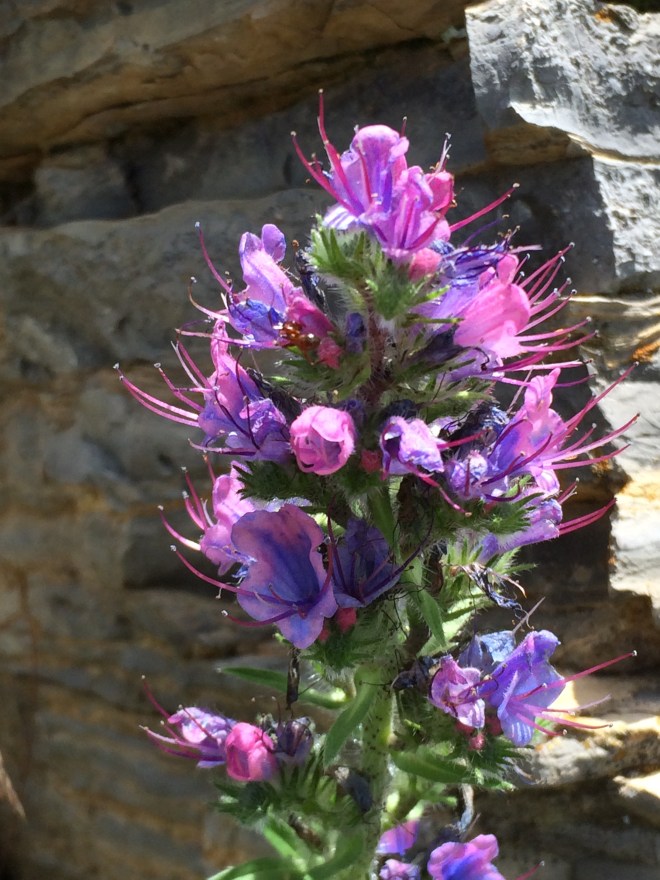
Close-up of viper's bugloss, also known as blueweed, showing exserted stamens.

Close-up of viper’s bugloss, also known as blueweed, showing exserted pink stamens with slate-blue pollen .
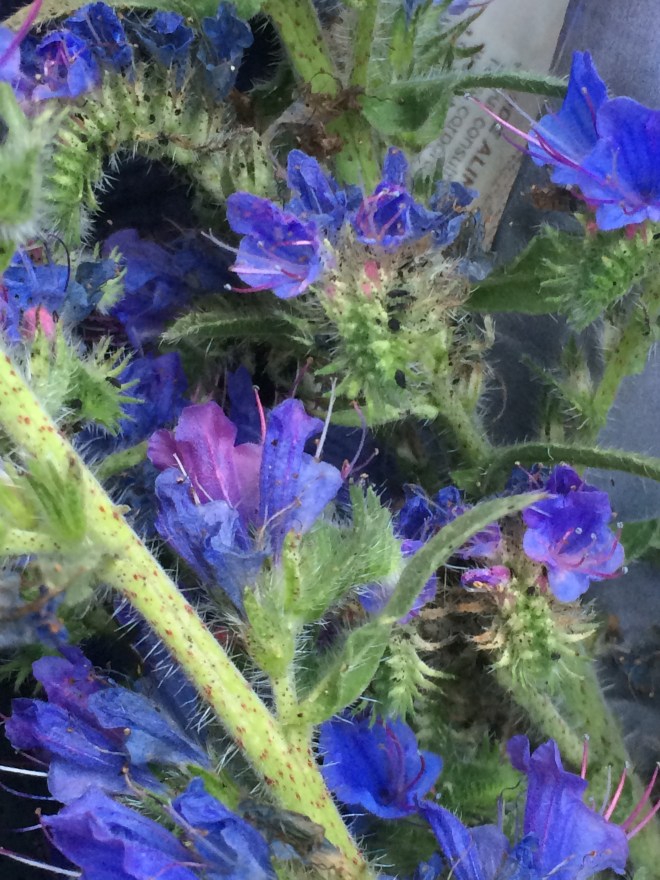
Close-up

Close-up showing bristly nature of the plant.

My mother had a passionate attachment to viper’s bugloss, tucking little sprays of it into vases in her kitchen whenever she could. Maybe it was the blueness that attracted her, because she loved the indigo bunting and the bluebird as well, but I suspect she also sympathized with its bristlyness.

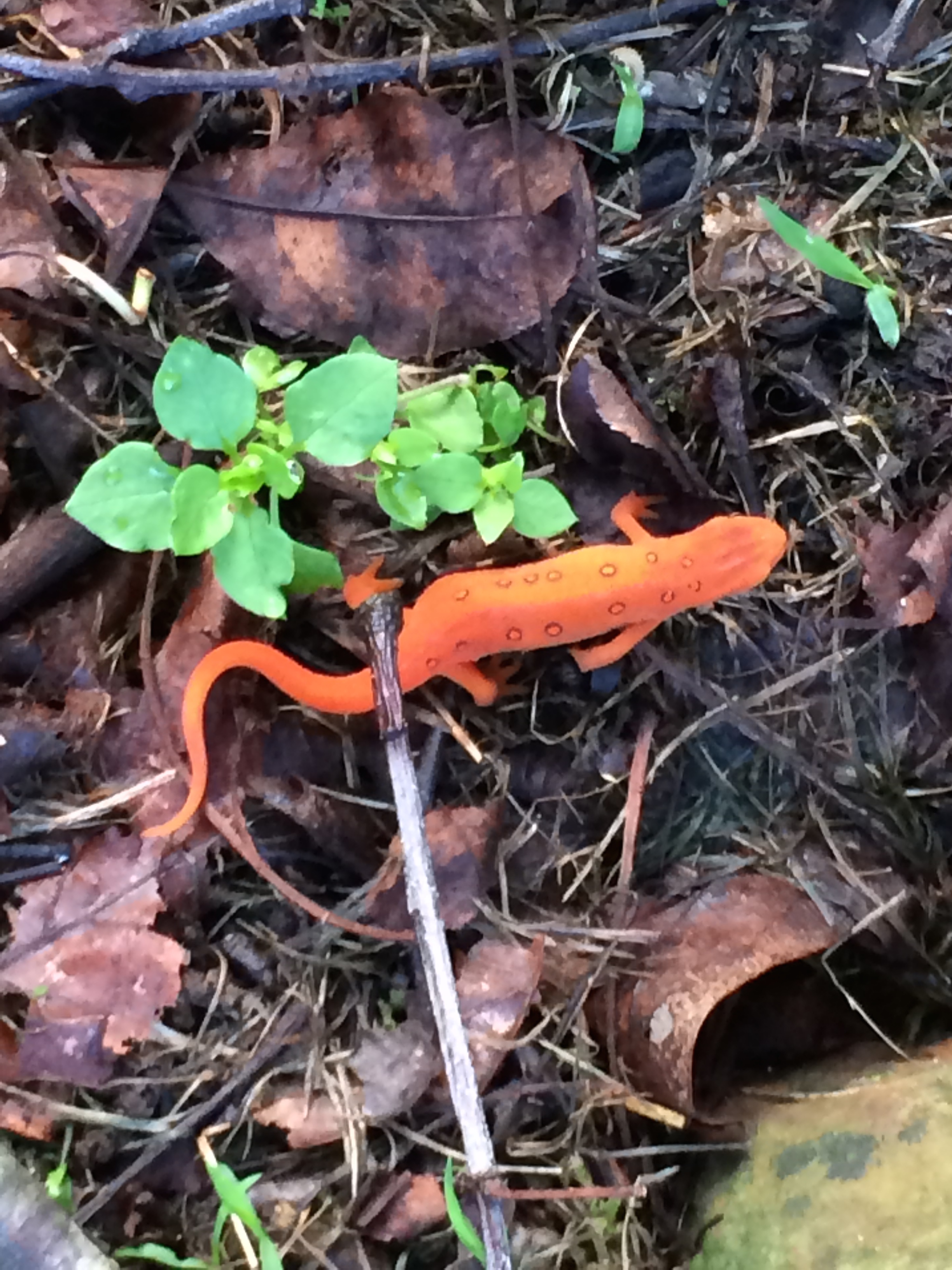
It rains every day, which brings the red eft out of hiding. Once years ago as a child I found one that had been stepped on by me or one of my family members near the garden gate as we arrived for the summer, one of its feet flattened, looking so childlike that I felt like crying. I watched this one undulate noiselessly to safety.
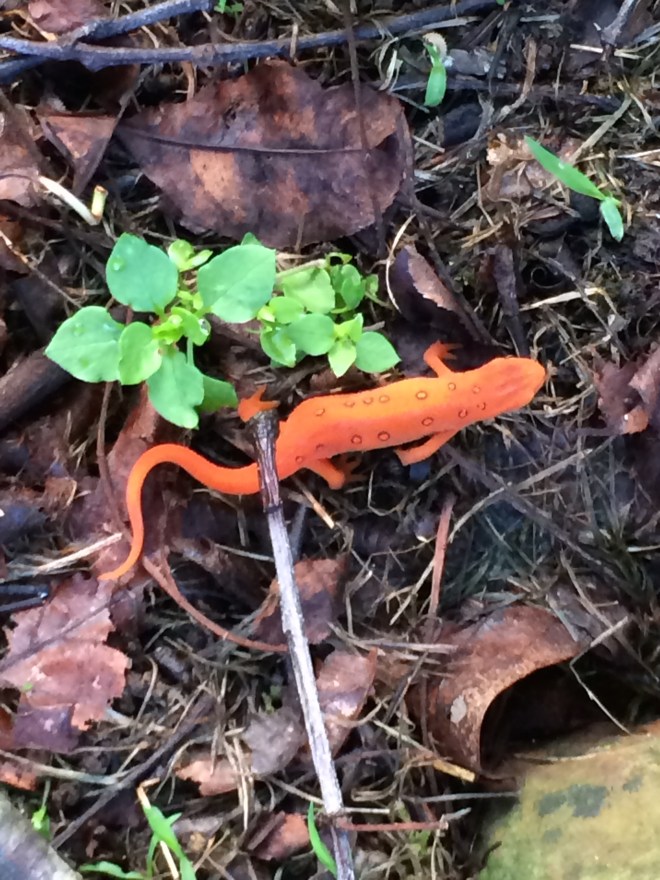
The red eft stage of the eastern newt.

The red eft stage of the eastern newt (Notophthalmus viridescens).

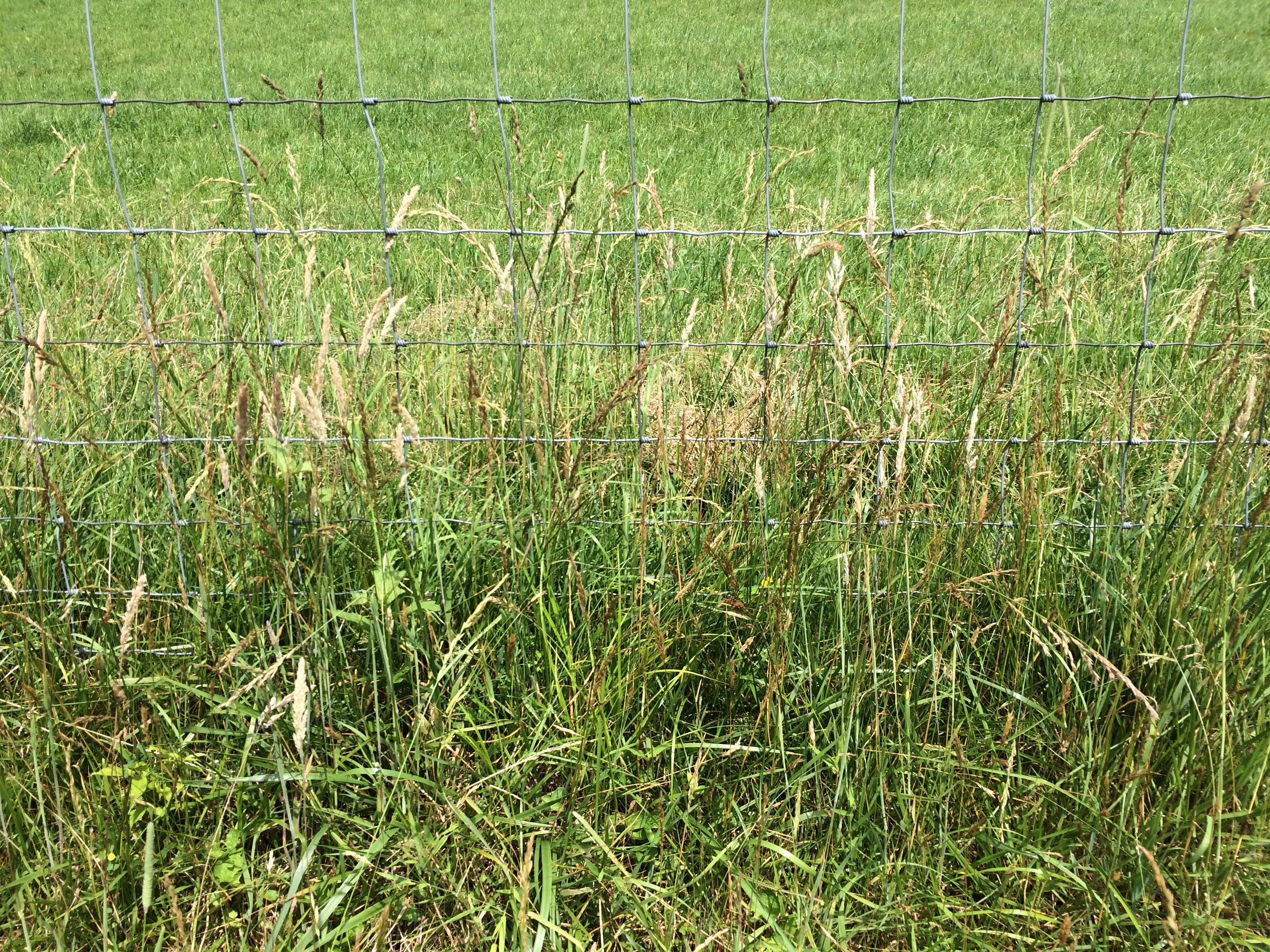
June is hay-making season, and the air in Vinegar Hollow is sweet with the scent of flowering grasses, native and nonnative.  I remember helping to make hay stacks in the Big Meadow in the old days when a pitchfork was the preferred tool. Then rectangular bales came along, which were easy to lift, though prickly, but with the advent of  the huge round bales of today the farmer needs sophisticated machinery to make and maneuver them into storage. Now I just walk among the grasses on the hills, admiring the delicacy of the myriad grass “florets,” trying to remember what I learned in Agrostology, the study of grasses, as a graduate student in botany at the University of Texas at Austin. I loved the course, but we worked almost entirely with herbarium specimens which took some of the romance out of the enterprise. A floret is a little floral package, which includes a very small flower lacking petals and sepals, but surrounded by two protective scales, the lemma and the palea. Much in the study of agrostology depends on the lemma and the palea. And the awn. The specialized vocabulary needed to described the intricacy of grasses is remarkable.

While each floret may seem too modest to admire, many florets grouped together make stunning inflorescences. Grasses in flower argue for a special kind of beauty. Their feathery stigmas and dangling anthers float and shiver in the breezes, and entire hillsides seem to shift when wind moves through the knee-high grasses.

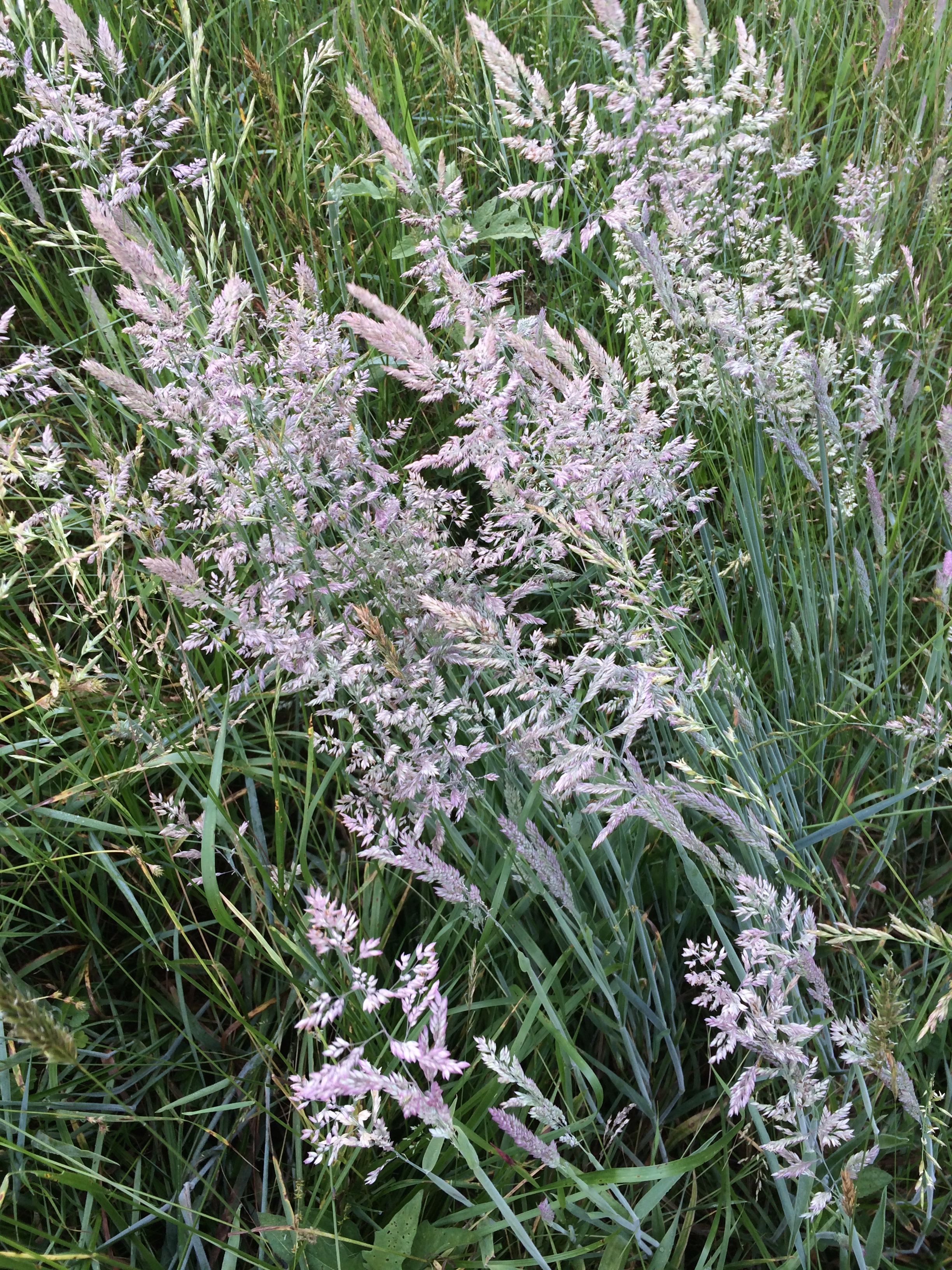
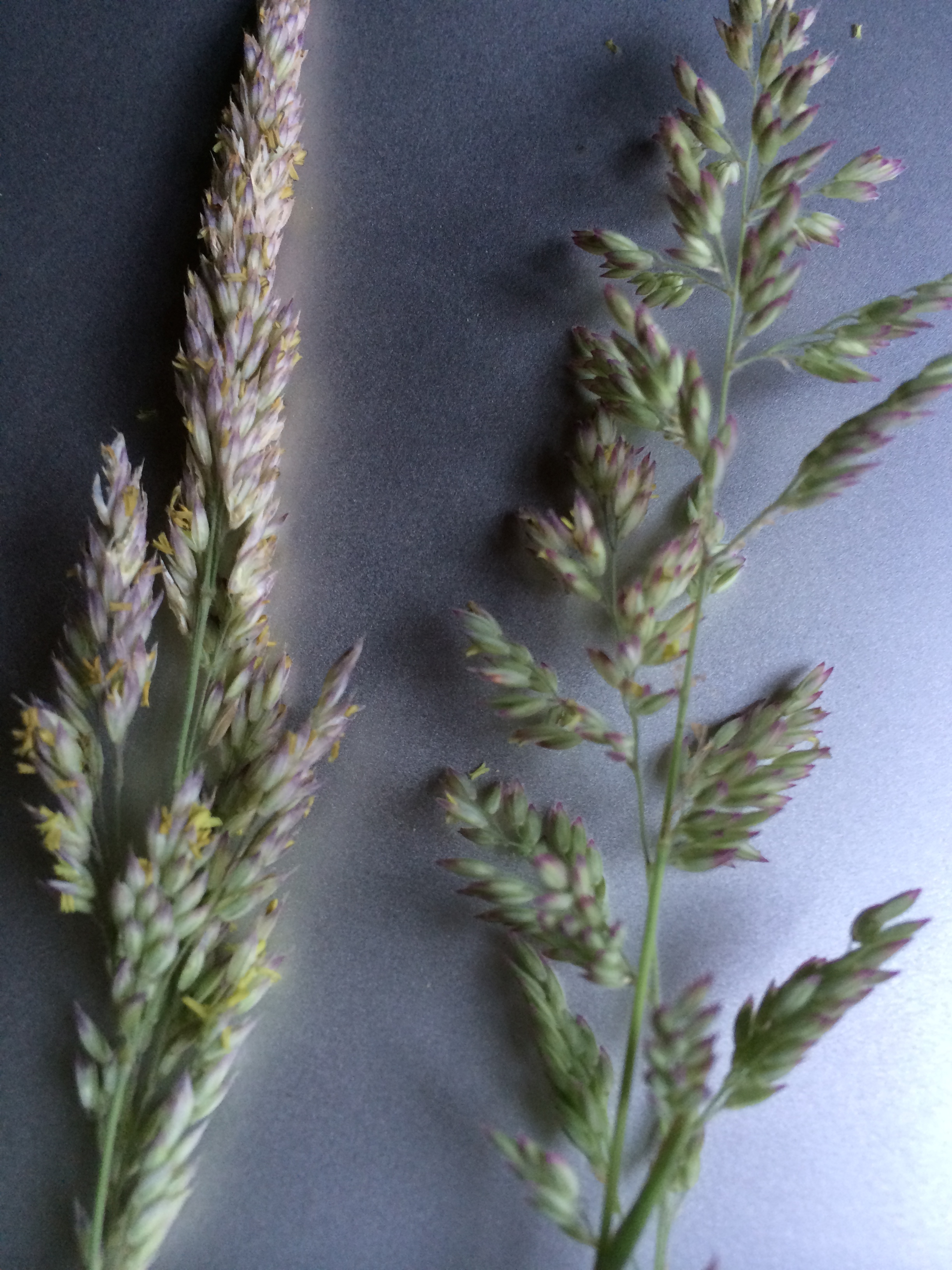
This week I fell in love, again, with a grass I know by sight but whose name I had never learned.  It’s downy, pinkish-purplish above and bluish-greenish lower down. Let’s call it the Mystery Grass.
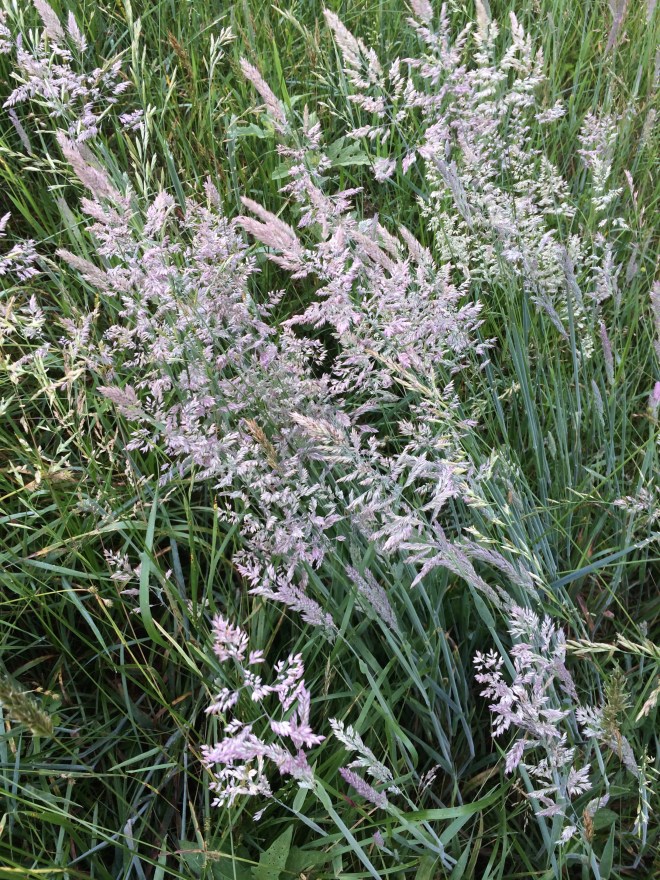
My mystery grass, which turned out to be Nuttall's reed grass (Calamagrostis ....).

Mystery Grass. Mike said that he’s always called it feather grass and that it’s one our native grasses.

Helen Macdonald, author of H is for Hawk, in her recent “On Nature” column for the New York Times, titled “Identification, Please,” writes that

There’s an immense intellectual pleasure involved in making identifications, and every time you learn to recognize a new species of animal or plant, the natural world becomes a more complicated and remarkable place, pulling intricate variety out of a background blur of nameless gray and green.

She’s right.
A

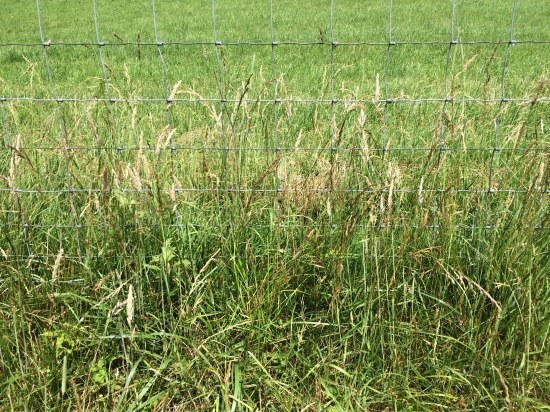
A “blur of nameless” grasses flowering in June in Vinegar Hollow.

I decided to try to name  the sweet-smelling, soft feather grass. I have spent almost a lifetime identifying plants in Vinegar Hollow using Virginia McKenny and Roger Tory Peterson’s field guide, but they don’t include grasses in their book, though grasses are wildflowers. My father taught me the easy forage grasses, like timothy and orchard grass, so distinctive that they can’t be mistaken for anything else, but I don’t remember him naming the mystery grass.
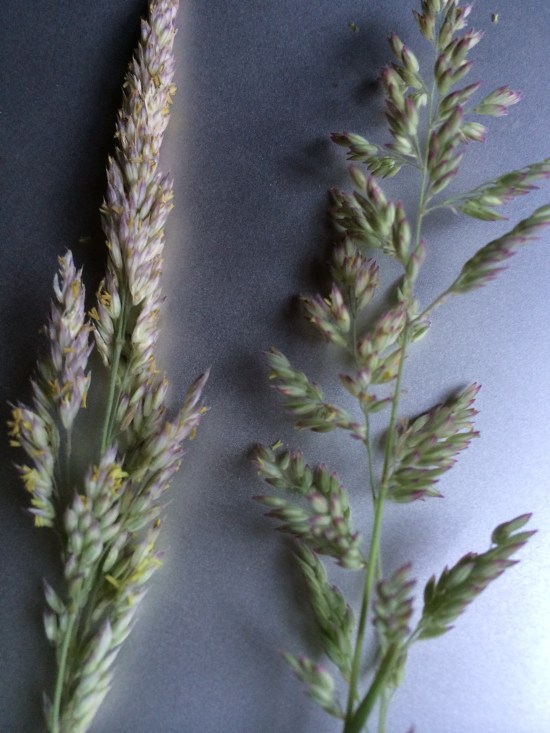
Mystery Grass. Inflorescences open as they mature, spreading out their pollen to the wind.

Mystery Grass. Inflorescences open as they mature, allowing anthers to dangle, offering pollen to the wind.
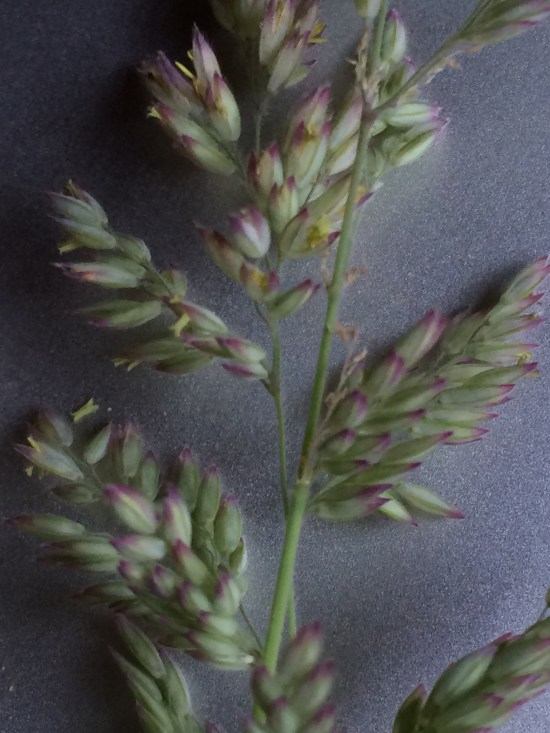
Mystery Grass, showing the purple tips of the inflorescence.

Mystery Grass, showing the purple tips of the inflorescences and a few anthers just peaking out of florets.

Lacking a field guide, I set off into the vast world of the Internet, which after three or hours yielded an answer through a combination of sources: Nuttall’s Reedgrass or Calamagrostis coarctata (synonym Calamagrostis cinnoides). Reader: if my identification is incorrect, please let me know. If I’m right, I’d like to know that also. I never found the perfect source with a clear photograph.

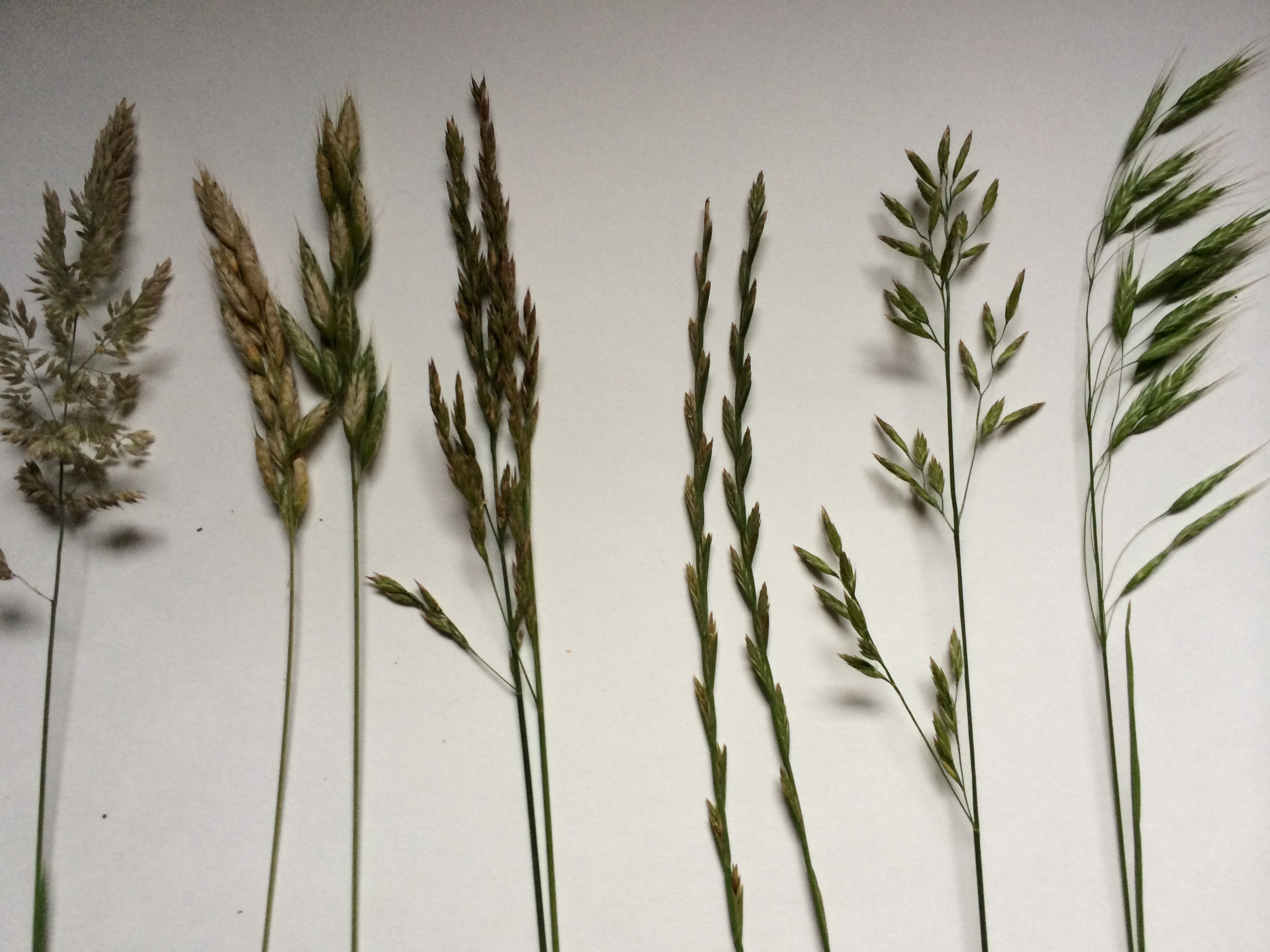
Grasses are hard to get to know, especially as they change through the growing season, similar to birds whose juvenile feathers have different colors and patterns than the adult ones. My “feather grass” will look different at the  end of the season, when the seed has ripened. The soft purple will have turned to a whispery tan, and the shape of the inflorescence will change as well. During my search, as I tried to differentiate the “feather grass” from the other grasses common in Virginia, I collected other grasses for comparison. Falling back upon my training in agrostology, I made a multi-species herbarium sheet to reveal the unique morphologies of the inflorescences that in the field “blur” together so beautifully.
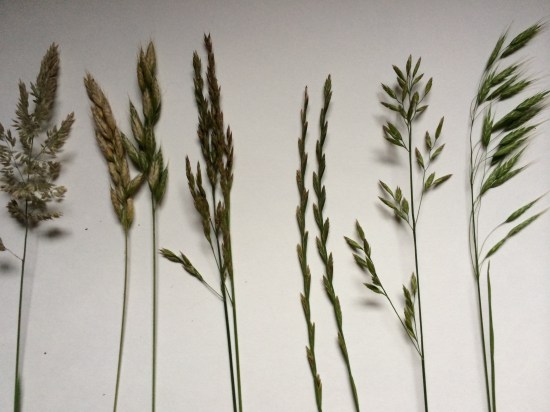
Grasses found in Vinegar Hollow, June, 2015.

Grasses found in Vinegar Hollow, June, 2015.

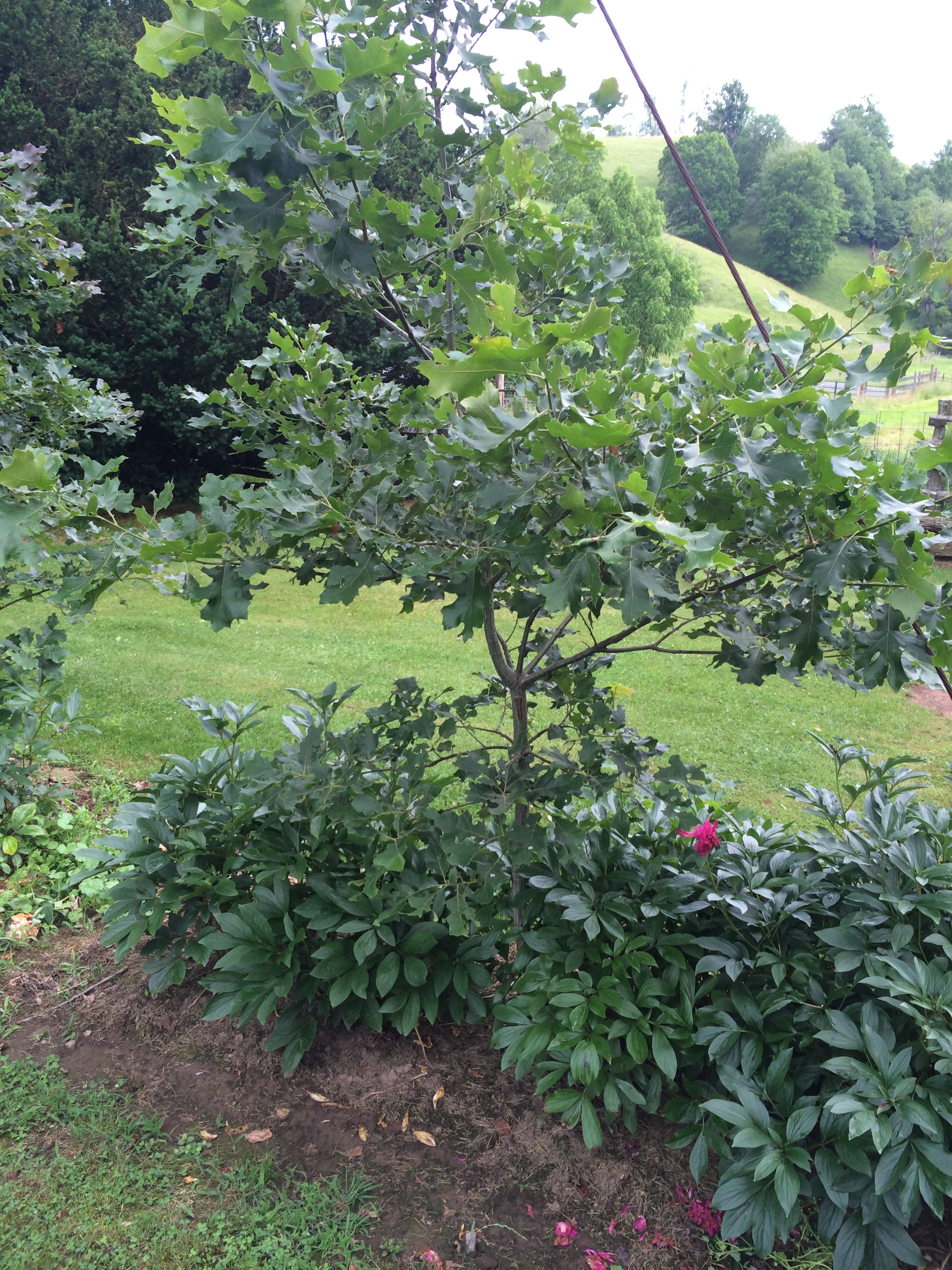
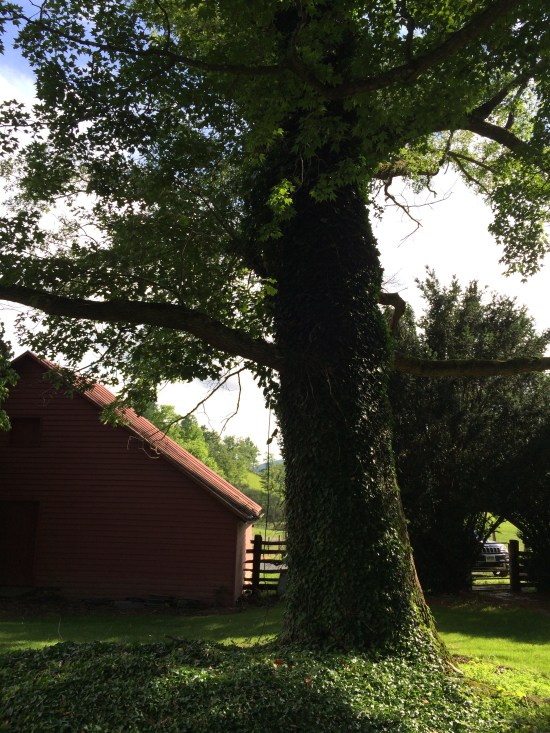
I have  other story lines here in the hollow to move forward as well. Two eminent trees, a sugar maple and a black oak, have dominated the farmyard at the end of the hollow for three generations or more. The black oak is all but dead. My father hired someone to put a lightning rod on the oak years ago, but age has overtaken it and limbs are falling steadily. Only a few slender branches have any leaves, and they are small. The granary nearby, full of valuable farm machinery, is at risk. Roy, who has lived in the hollow 91 years, says that it was in its prime when he was young. It is the kind of tree that people stand under and say, if only this tree could talk, the stories it could tell. In high school I wrote a poem for our literary magazine about the trees, which I always thought of as parental, the sugar maple like my mother and the black oak like my father. I had hoped to predecease them, but it has fallen upon me to take action. I met with the tree service this week to make the appointment for removing the oak. As I confronted my depressing role as executioner, I thought of W. S. Merwin’s remarkable piece of writing called “Unchopping a Tree.” No one should take down a tree with a light conscience.

There is good news, however. My husband and I have been protecting two seedlings of this oak in the yard under the electric pole. They must be transplanted this fall before they are too big to move and before the electric company decides to eliminate them. We are going to transplant both and hope that one at least lives for the next 300 years.
IMG_9235

Granary and black oak.

Black oak seedling.

Black oak seedling.

The last news story is that the light on the pole lamp went out. Set on top of a tall telephone-type pole, it casts a broad illumination. My mother put it up years ago. She lived at the farm alone for many years and it must have given her a welcome sense of company, and, it would have lighted her chores at night. I never liked it because in the evening it attracted luna moths that would then cling to the pole, quiescent, during the day even as birds pecked them to shreds, and it casts too much light for sleepers who like a darkened room. I wasn’t prepared for the utter darkness that night when the pole light didn’t go on. I had come to the hollow with the dog and the cat, but without the husband, children, or grandchildren.  The stars and the moon can be very bright at the end of the hollow, but there are no lights from any other sources. My nearest neighbor, Roy, is over several folds of the creased hills that make up Vinegar Hollow. On this still, overcast night, there was complete darkness without and within, when I had turned off the house lights. Paul Bogard, in his book The End of Night:  Searching for Darkness in an Age of Artificial Light, talks about how light pollution affects our relationship with the natural world. Lying in bed, surrounded by complete and utter darkness, I felt a little uneasy, but settled into it, perhaps like a Red-spotted Purple caterpillar in a hibernaculum. I let the darkness take on a natural presence around me.

Then I started thinking about the new stories of this week in June. The cows and calves, the red eft, Nuttall’s Reedgrass, the viper’s bugloss, the black oak, the tendrils exploring  the hereafter, and so on. I also remembered one of my favorite reflections about the rural life, made by Verlyn Klinkenborg in his Farewell column for the New York Times’ editorial page:

I am more human for all the animals I’ve lived with since I moved to this farm. Here, I’ve learned almost everything I know about the kinship of all life. The only crops on this farm have been thoughts and feelings and perceptions, which I know you’re raising on your farm, too. Some are annual, some perennial and some are invasive — no question about it.

But perhaps the most important thing I learned here, on these rocky, tree-bound acres, was to look up from my work in the sure knowledge that there was always something worth noticing and that there were nearly always words to suit it.

Klinkenborg kept faith with his column on rural life for 16 years. “Nearly always,” he says, there are words that suit. I pause over the “nearly always.”  The work of finding suitable words keeps pulling me forward.

“It Was Blowing a Blizzard.”

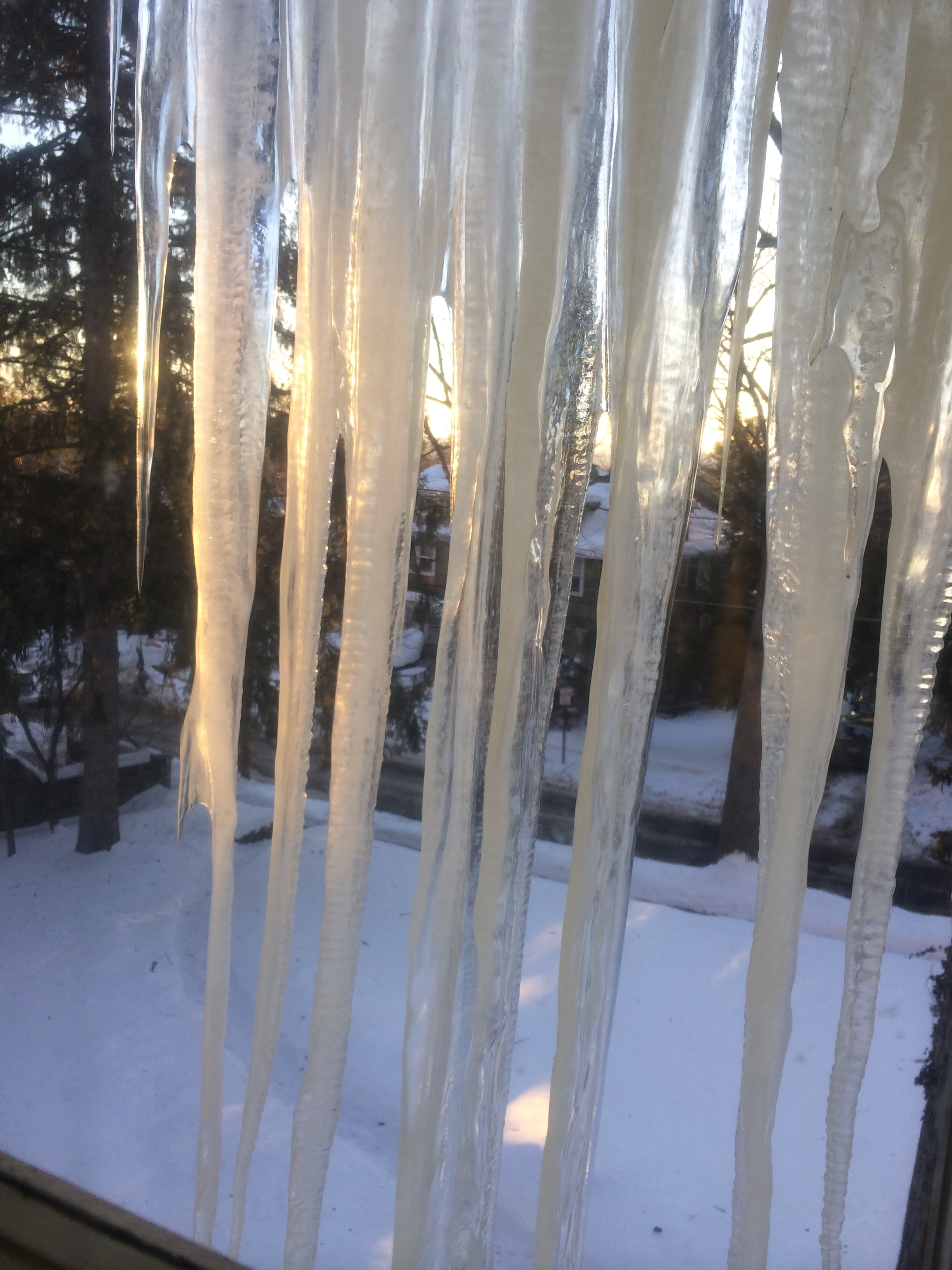
Setting sun gilds the icicles hanging outside the bathroom window.

Setting sun gilds the icicles hanging outside the bathroom window. These are relatively small.


The mantra of the naturalist is “Pursue direct experience outside every day.” I have been struggling to keep faith with the mantra, in the coldest February on record in Ithaca, New York. The temperature at 7 am a few days ago was -20 degrees F without a wind chill factored in. Houses all over town look like jails as enormous, life-threatening icicles hang from gutters. It’s a little grim, from the inside looking out.

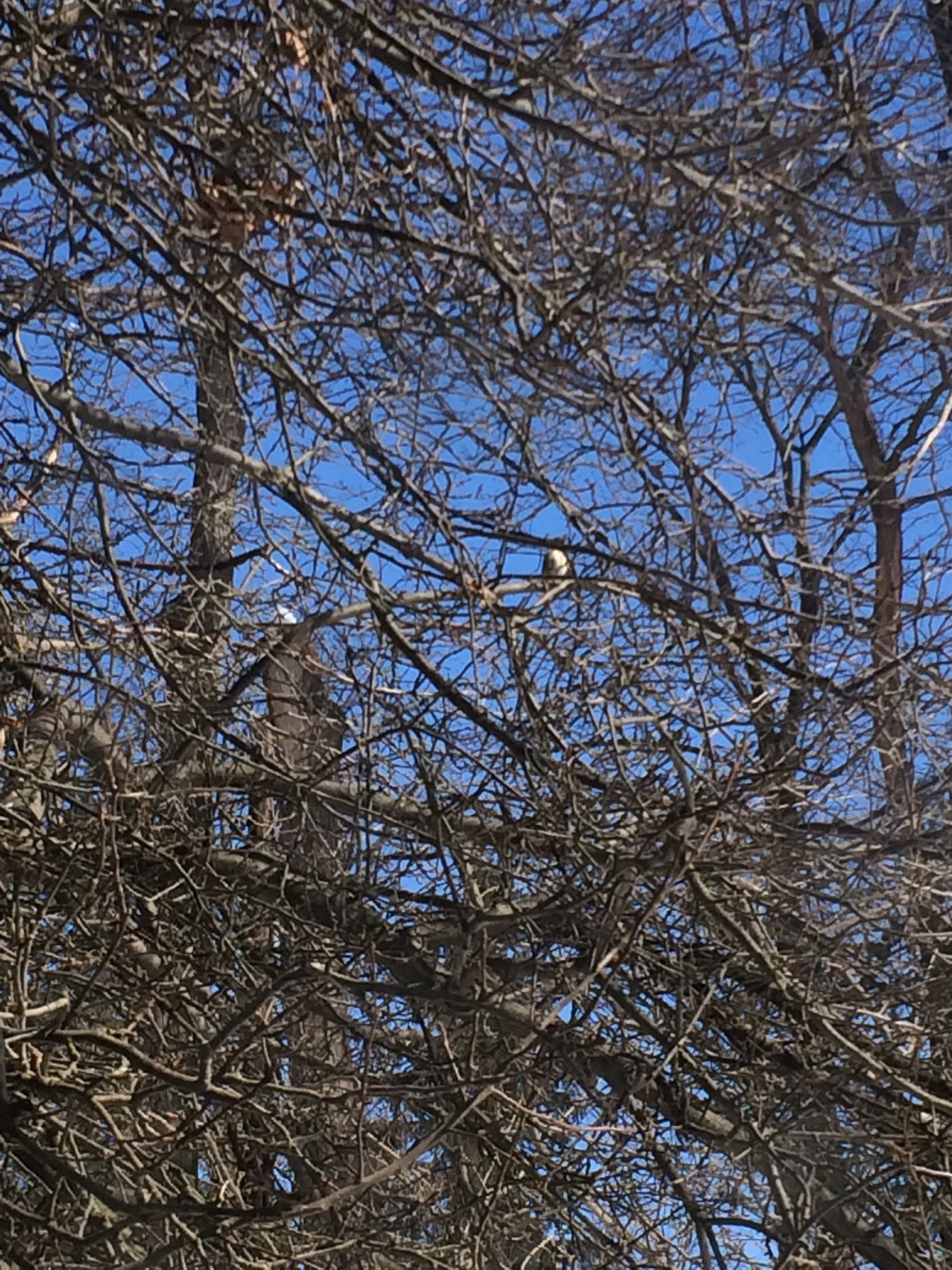
However, throughout the prolonged deep cold a tufted titmouse has been singing at dawn every morning in the apple tree outside my bedroom window. This particular individual’s whistle-like call is an insistent reminder: Go out, go out, go out. Breathe the bracing air, rejoice, and shiver to acclimate and become one with the outside.


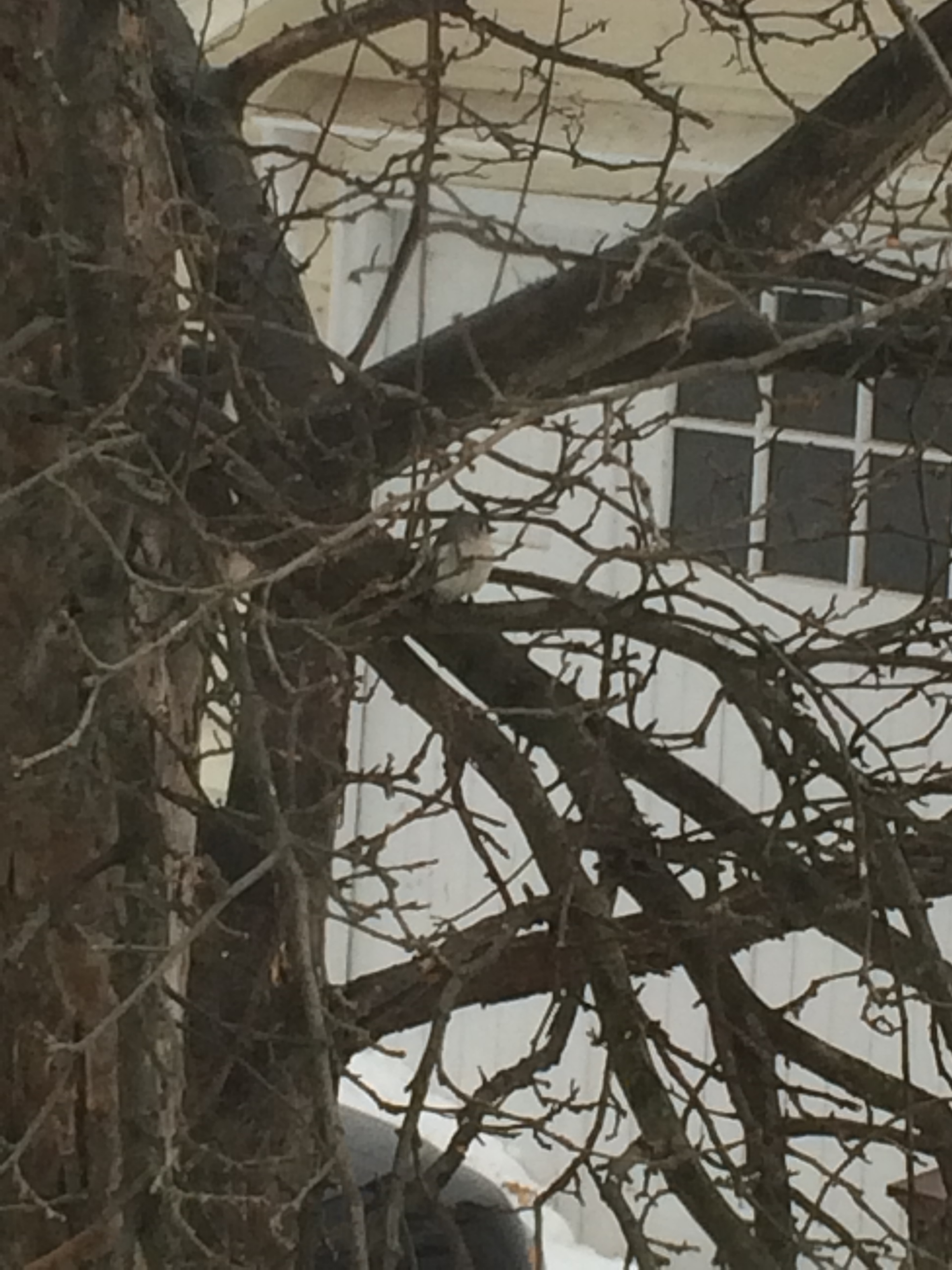
Tufted titmouse, slighting to the right and up from center, in the branches of the apple tree. Only the buff belly is visible.

Tufted titmouse, slighting to the right and up from center, in the branches of the apple tree. Only the buff belly is visible.


However, sometimes it is easier to be pulled out than to go out. My husband and I took leave of the bitter cold here in Ithaca and made a dash south to Vinegar Hollow in Mustoe, Virginia, to be with family at our homeplace. We were not expecting it to be much warmer because the Allegheny Mountains of western Virginia usually report very similar temperatures to those of upstate New York.

The end of Vinegar Hollow.

The end of Vinegar Hollow, cold but calm.

It was bitter. A brief warming trend lightened our spirits, melting much of the snow, but then a blizzard roared up from the south, filling the hollow with whirling, horizantal streams of snow. One by one the locusts, maples, and cucumber trees on top of Stark’s Ridge became ghostly, as did the hills and meadows and fence posts. In the yard the big yew and the big boxwood fluffed out like giant white owls. The cottage seemed to spin inside the whirl winding snowflakes.


The colors of winter: white on gray.

The colors of winter: white on gray.


My husband loves inclement weather. He was out there somewhere in the forest chopping wood. When poor visibility made chain sawing a hazard, I presume, he came to the sliding glass door. “Come out for a walk!” he said. “You don’t want to miss this!” I looked at the fire. I looked outside. “A walk?” The double sliding glass doors gave a full view of the white out conditions. I was no naturalist if I chose sitting by the glowing fire instead of going outside to be inside a small blizzard.
 

Author poses for husband in blizzard.
Author poses in blizzard for husband.


It was glorious. I could not see very far in front of my feet, but we walked on known land, around the Pine Tree Hill where the family cemetery awaits me. Yes, the sounds of the blizzard in the forest and the whizzing motions of the thousands of snowflakes stinging my face, ping, ping, ping, hypnotized my thoughts, commanding my attention to just one thing. Being there outside.

Trees silvered by snowflakes.

Trees polished to pewter by wind and snowflakes.


The next day I found an old paperback in my parents’ library room over the root cellar. There it was, an appropriate choice for the season–Scott’s Last Expedition: The Personal Journals of Captain R. E. Scott, CVO, RN. Found next to his frozen body, the diary is compelling reading even though we know the tragic outcome. One can read it over and over, trying to comprehend the predicament of this small group of men. Scott and his team are very near the South Pole traveling under extreme conditions when they find a black flag and sledge and dog tracks indicating that the Norwegians had made it there first. They had lost “priority.” Scott writes, “Many thoughts and much discussion have we had. To-morrow we must march on to the Pole and then hasten home with all the speed we can compass. All the day dreams must go….”

"All the day dreams must go...."

Published by Tandem Books, in the Great Ventures Series.

“All the day dreams must go….” The poignancy of this comment haunts me. But they must walk on, though emaciated and frostbitten. They do leave their mark at the North Pole proper, but then turn around in the worst blizzard they have yet encountered to head to the closest storage depot. They die just 11 miles away. But in what manner should they compose themselves for the end?

Scott makes a number of entries about his subordinate Titus Oates:

Should this be found I want these facts recorded. Oates’ last thoughts were of his Mother, but immediately before he took pride in thinking that his regiment would be pleased with the bold way in which he met his death. We can testify to his bravery. He has borne intense suffering for weeks without complaint, and to the very last was able and willing to talk about outside subjects. He did not—would not—give up hope till the very end. He was a brave soul. This was the end. He slept through the night before last, hoping not to wake; but he woke in the morning—yesterday. It was blowing a blizzard. He said, ‘I am just going outside and may be some time.’ He went out into the blizzard and we have not seen him since.

Scott himself at the time of writing has one foot so badly frostbitten that he knows it will have to be amputated should he live. The temperatures are -40 degrees F day after day. On March 22/23 he writes:

Blizzard as bad as ever–Wilson and Bowers unable to start–to-morrow last chance–no fuel and only one or two of food left–must be near the end. Have decided it shall be natural–we shall march for the depot with or without our effects and die in our tracks.

The reader hopes this is the end of the text and a merciful ending to their lives. But there is one more entry on March 29th. The last line of the diary is “It seems a pity, but I do not think I can write more.”  Roland Huntford in his book The Last Place on Earth gives an account of the interval between March 22/23 and March 29. Scott and his two remaining subordinates, too debilitated to move,  stayed in the tent in their sleeping bags writing letters to loved ones, documents that have become the subject of scrutiny by historians. Scott’s reputation as heroic explorer has been the subject of controversy.


Modern Library Edition of Roland Huntford's account of "Scott and Amundsen's Race to the South Pole."

Modern Library Edition of Roland Huntford’s account of the race to the South Pole: Britain’s Robert Scott vs. Norway’s Roald Amundsen. His critique has been challenged by subsequent historians. The photo of Castle Rock on the book cover was taken on 17 September 1911.


Huntford critiques Scott as inept, but recent evidence indicates that Scott faced harsher than usual weather and one of his orders that could have saved him was never carried out. Despite getting to the South Pole first, Amundsen lost the battle for renown, in part, Huntford says, because Scott was the better writer.

My blizzard was small. I was not at the North or South Pole, suffering the Homeric conditions that plagued the famous Arctic and Antarctic explorers, who fought their way to the poles for nation and glory. I knew exactly where I was, and it was not far from a fire, so I was no heroine. My reward was exhilaration, not renown, as I went outside to feel the weather, rather than look at it from the inside. The naturalist has a different temperament than the polar explorer, happily from my point of view, but the polar explorers have left us with diaries that exemplify heroic aspects of human beings, inept or not, under duress in the great outdoors.

I am back in Ithaca, the tufted titmouse still singing in the apple tree  at 1º F.

Tufted titmouse slightly up from center in the apple tree.

Tufted titmouse slightly up from center in the apple tree. Profile view.


Today I decided to stand at the window observing. I stood and the tufted titmouse sat, silent for once. This went on for quite a while. Sometimes the branches of the apple tree distracted me. That’s when I noticed the second tufted titmouse. There she/he was, higher up in the tree. So, silence because mission accomplished? The mate has acquiesced? I don’t know, but I will be looking into the habits and psychology of this hardy little bird.

The second tufted titmouse.

The second tufted titmouse almost dead center in the photo.


So, have I rambled? What do the tufted titmouse and the blizzard have in common? As John Muir said “When we try to pick out anything by itself, we find it hitched to everything else in the Universe.”


Wingstem Season in Highland County

image

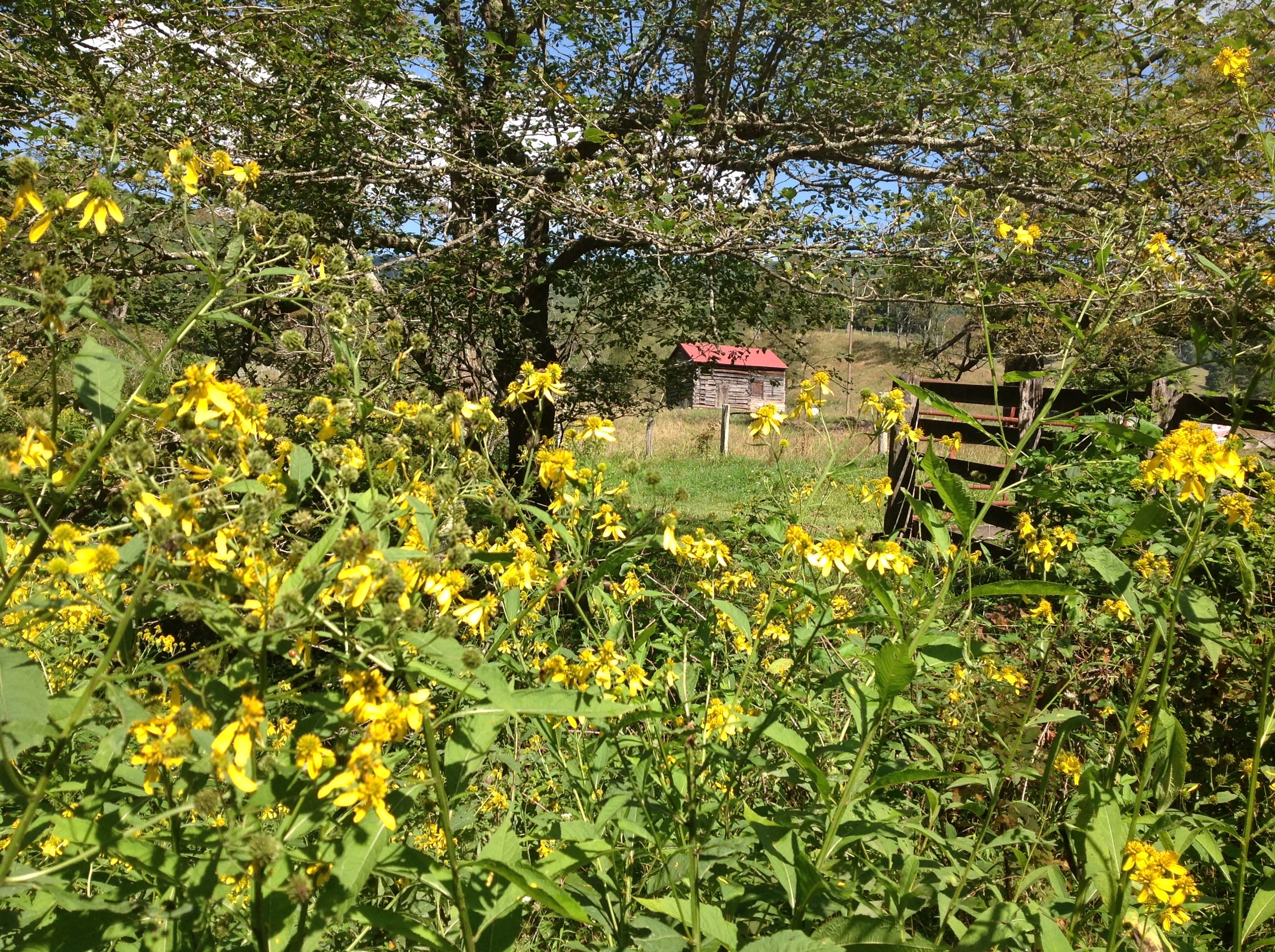
Wingstem framing view of hewn log barn in Vinegar Hollow

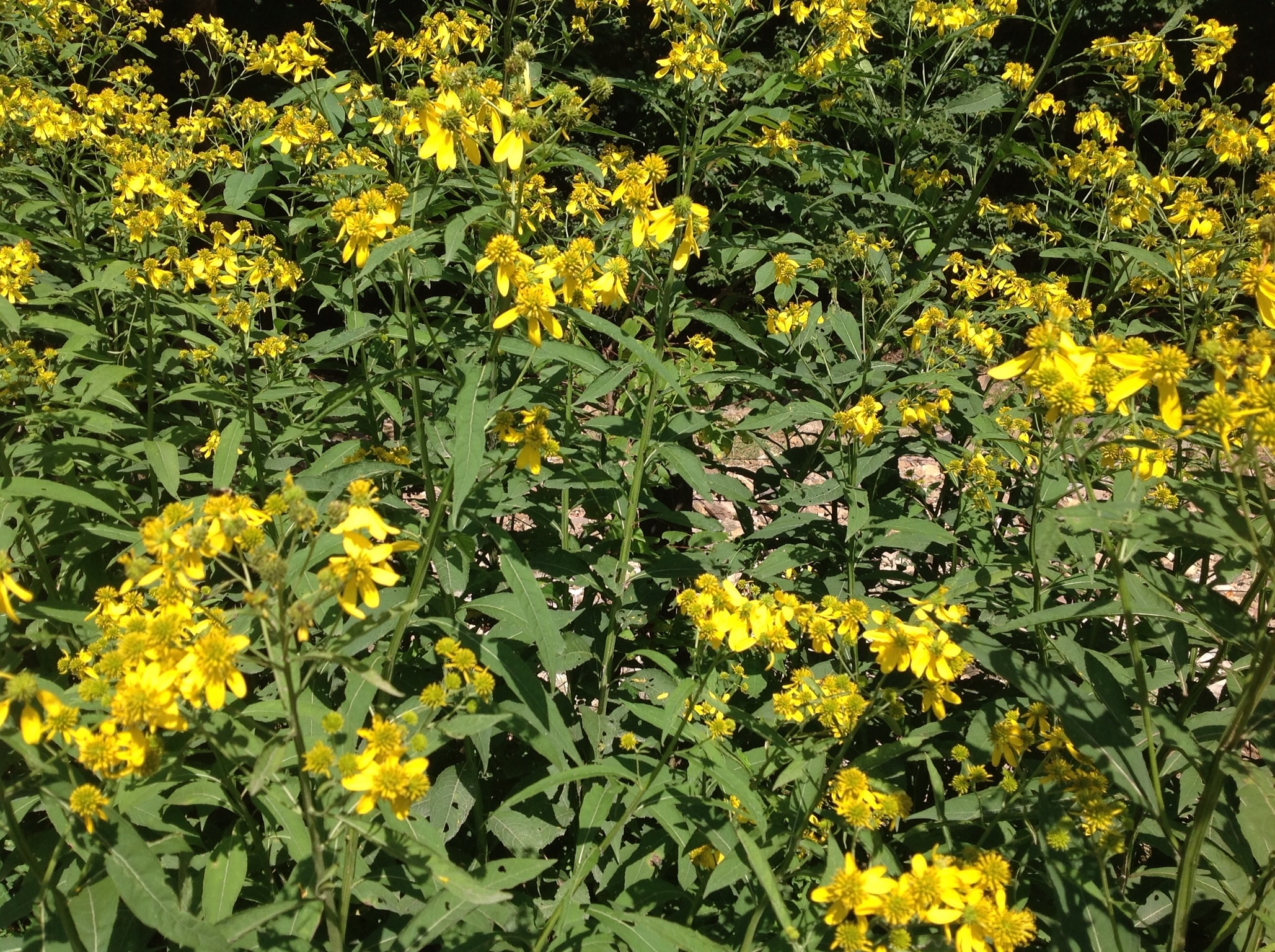
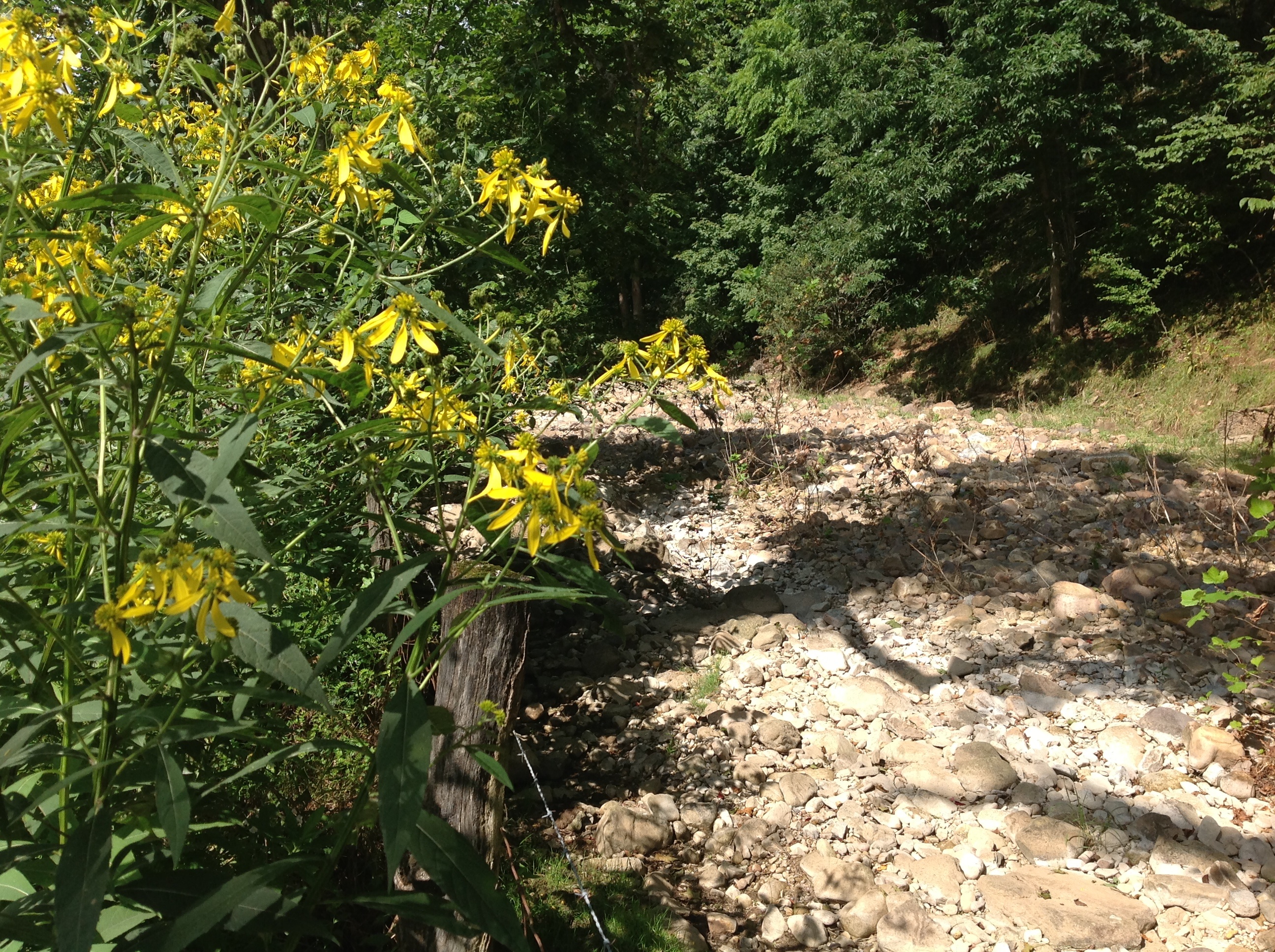
If you start following wingstem, with an intent to admire or photograph, at the end of August in Highland County, Virginia, it is hard to stop. There is always one more scenic road, one more view of hundreds of yellow petals waving haphazardly atop firm, straight stems in the sun or in a glowing shade. Tall, up to 13 feet, and unbranched, it forms dense stands in damp ditches, along waterways, and on moist hillsides. From a distance, the yellow ribbons of wingstem (Verbesina alternifolia) prominently mark changes in topography and moisture of Highland’s  five beautiful valleys.

Of course, one doesn’t necessarily follow something, unless one is fleeing another something. The last few days we have been cleaning out my parents’ old farmhouse in Vinegar Hollow, encountering mounds of dusty debris, a long-dead rodent under the icebox, many moldy, rusted things, once useful, and now difficult to salvage. It is hard to so tangibly acknowledge the termination of two passionate people’s (my parents) endeavors. So, one hits the open air and the open road to counterbalance this stressful housecleaning operation.

View of wingstem thicket

View of wingstem thicket

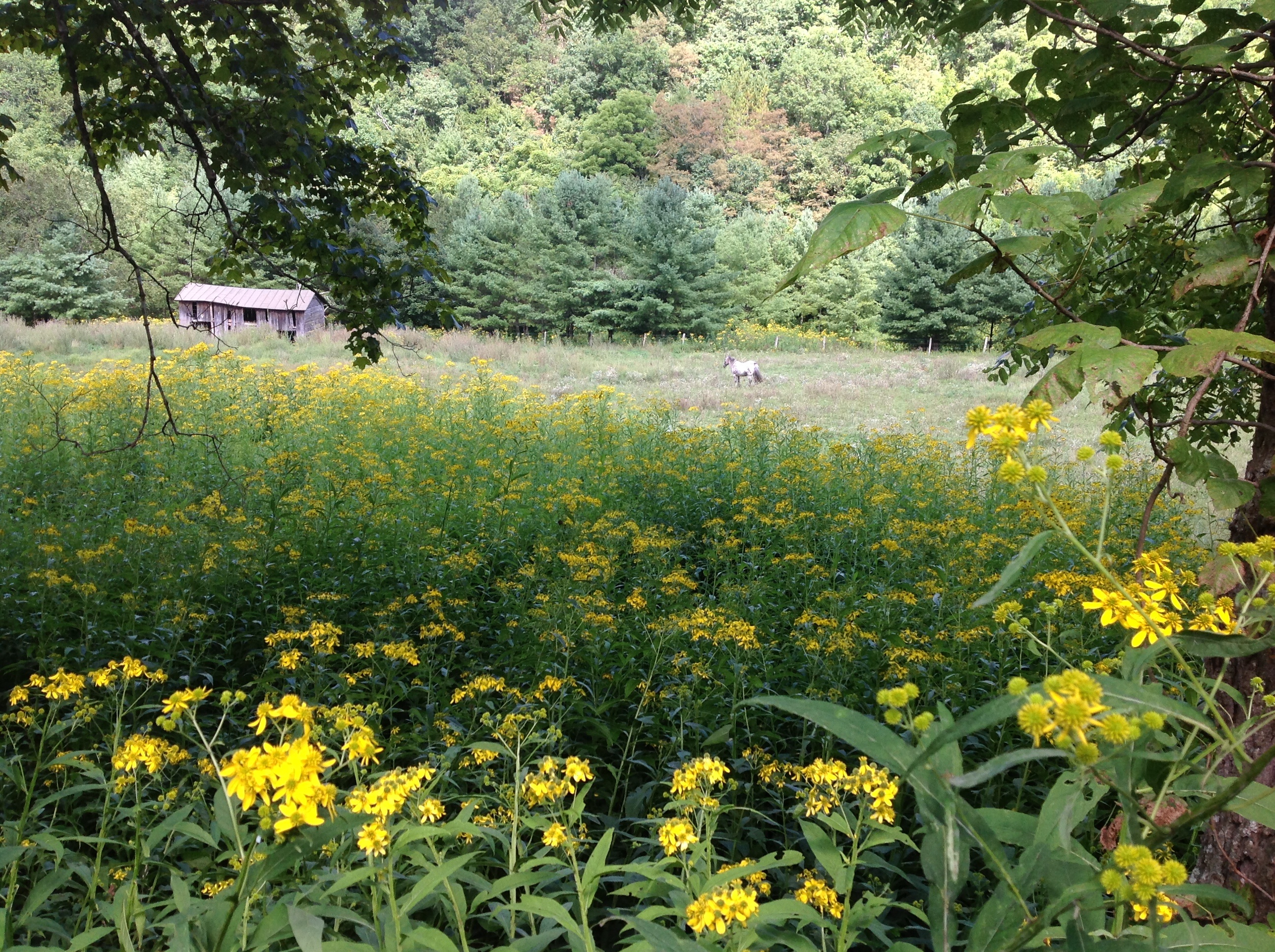
We leave the hollow, driving south on 220 toward Warm Springs. A left turn opposite Lamb’s Hollow leads us across the Jackson River, where we encounter roadsides, hillsides, and fields filled with wingstem. In one meadow along a section of the road known as Dry Branch, a dappled gray horse comes into view.

Dappled gray horse is just slightly right of center. Wingstem in the foreground.

Dappled gray horse is just slightly right of center. Wingstem in the foreground.

Sensing our presence, the solitary horse soon gallops away towards its barn. Dry Branch is aptly named because, although some of it has water, many parts are dry. This is limestone country, and water easily disappears into underground caves.

Wingstem alongside dry part of Dry Branch.

Wingstem alongside dry part of Dry Branch.

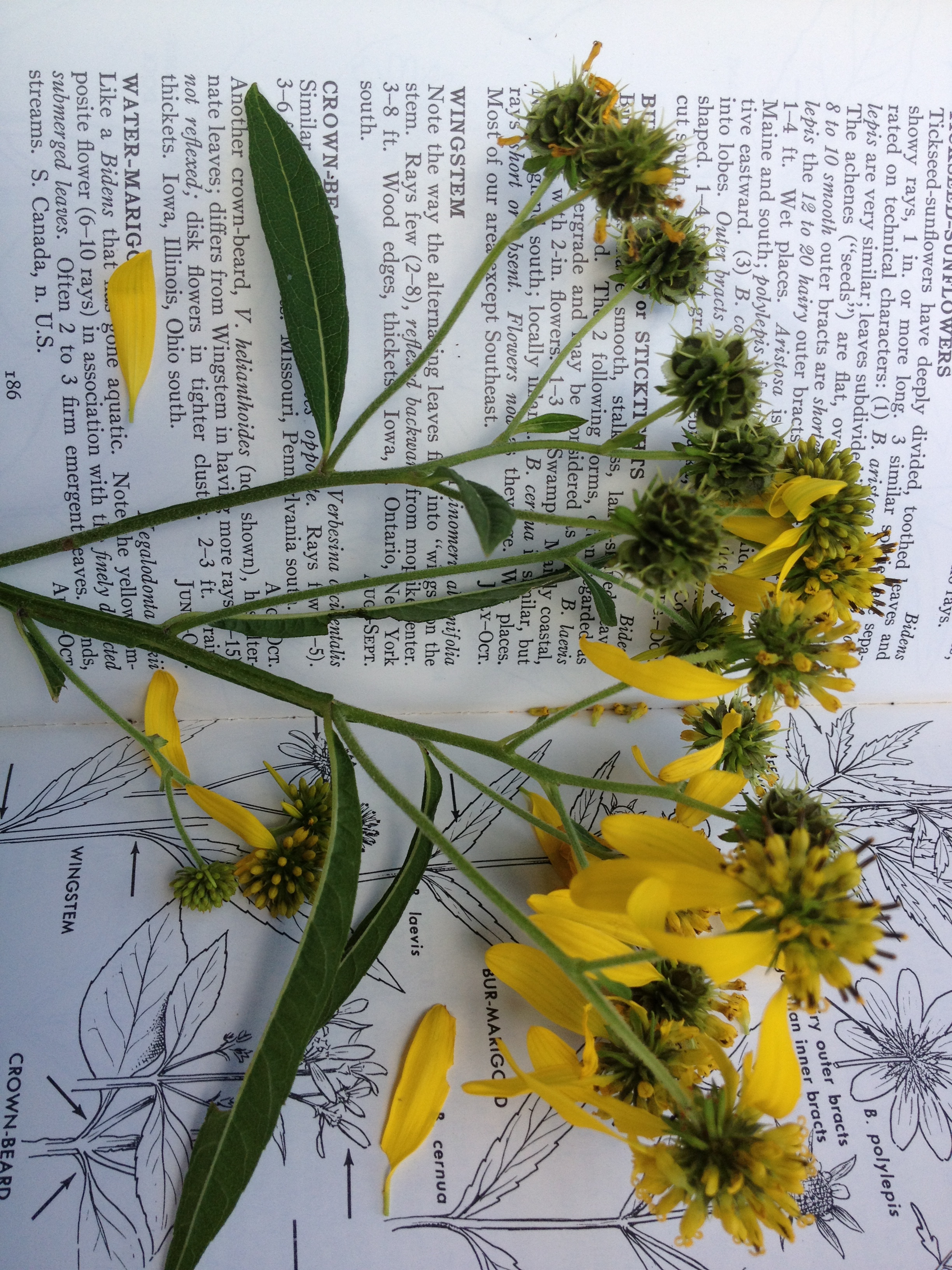
Wingstem, a member of the Compositae or Asteraceae (the daisy/sunflower family) is named for its wingedness. The petioles of the leaves lead into ridges, called wings, on the stems. This is not totally uncommon in plants. Burning bush, for example, bears prominent woody or corky wings on its stems. Wingstem has rough, sandpapery leaves that bear marks of numerous predators, but it outgrows all the chewers beautifully.

Wingstem flowers and immature fruits displayed against page from Peterson and McKenny's North American Wildflowers.

Wingstem flowers and immature fruits displayed against page from Margaret McKenny and Roger Tory Peterson’s A Field Guide to Wildflowers: Northeastern and North-central North America.

There can never be too much wingstem. Because it is so tough, so tall, and so yellow. And another admirable quality is that in the winter it vanishes, all of its abundant foliage replenishing the Earth. If only humans’ “stuff” could do so as well, vanish, without the artefacts of imperfect ownership littering the landscape.

Taking Measurements on a Cucumber Magnolia Tree

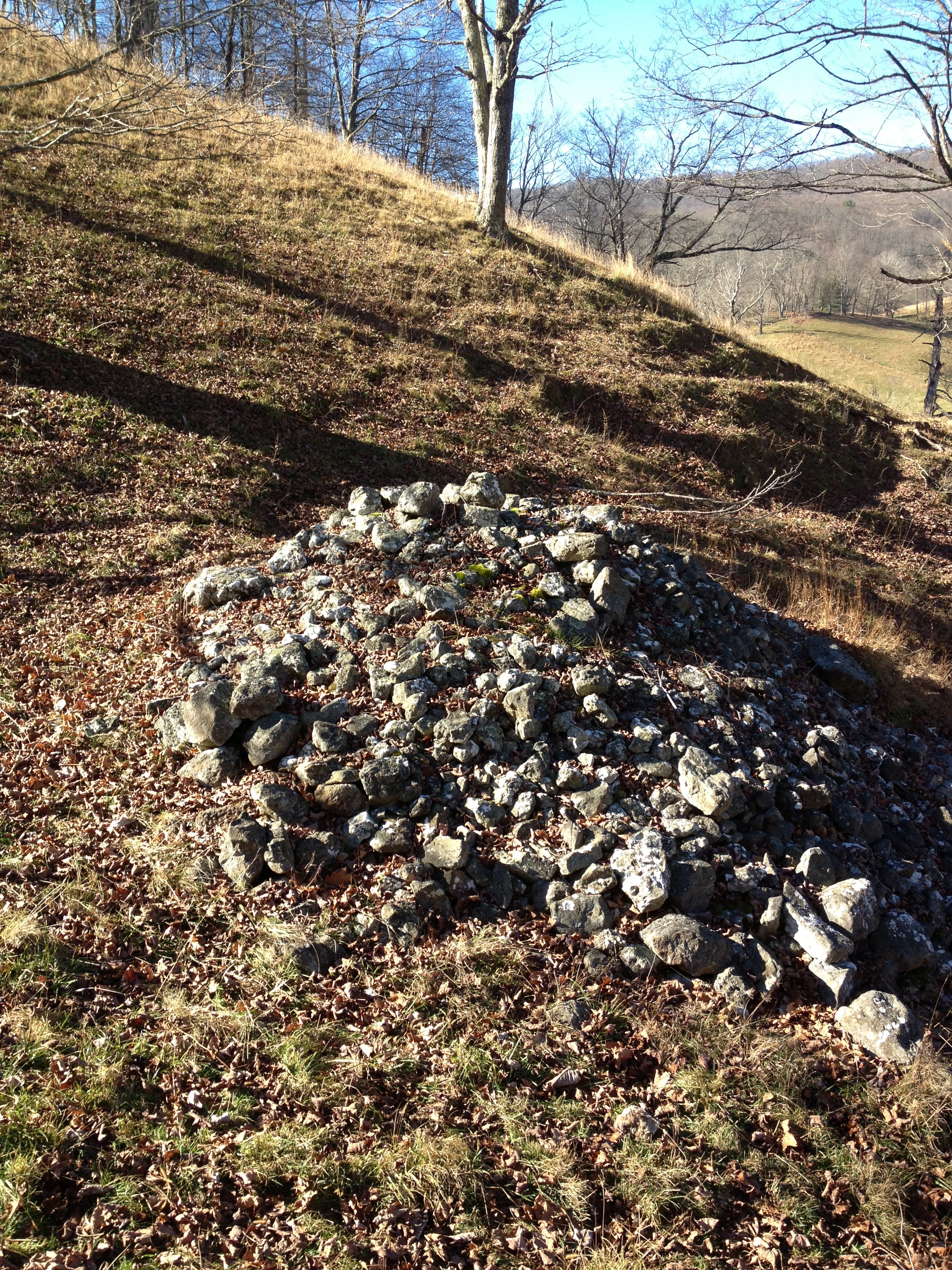
Old rockpile on the flank of Stark's Ridge.

Old rockpile on the flank of Stark’s Ridge.


“I found a ball of string. Let’s go to Stark’s Ridge and measure the cucumber tree.”

I looked at the ball of string my husband held in his hand. The string looked frail, dusty, and old, like so many of the things in my parents’ abandoned farmhouse. A ball of string, however, is always useful.

“And I found this metal tape measure,” he adds. It is the hard, roll-out kind that’s too stiff for wrapping around a tree.

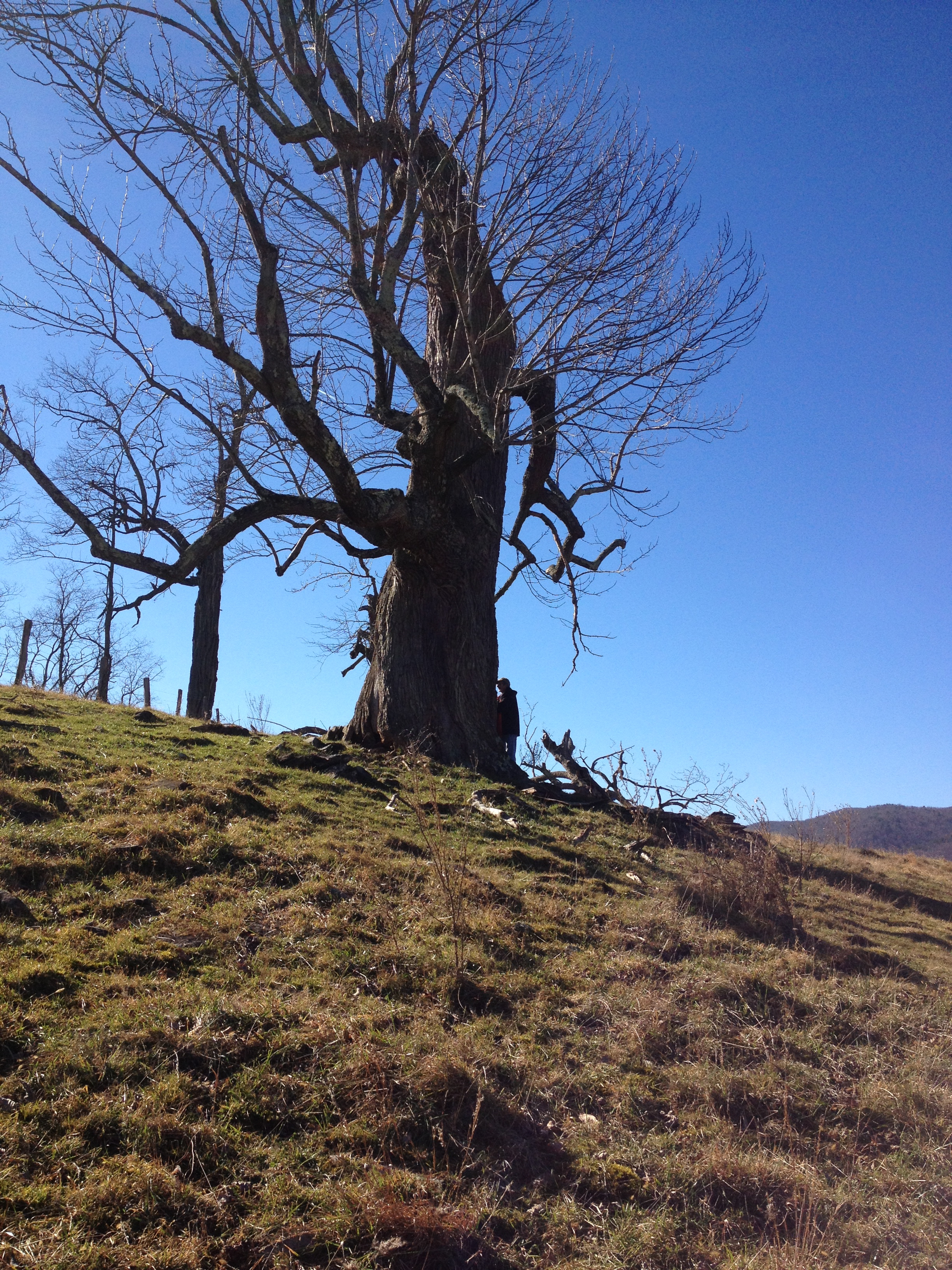
Violent windstorms in July 2012 had toppled trees out of the Earth in Highland County, Virginia, like toothpicks. The other old giant cucumber tree had lost its top, and a young giant had fallen over, its root bundle exposed to the air. Only a few cucumber trees remain on Stark’s Ridge, an elevated mountain crest full of limestone outcroppings.


Cucumber Tree

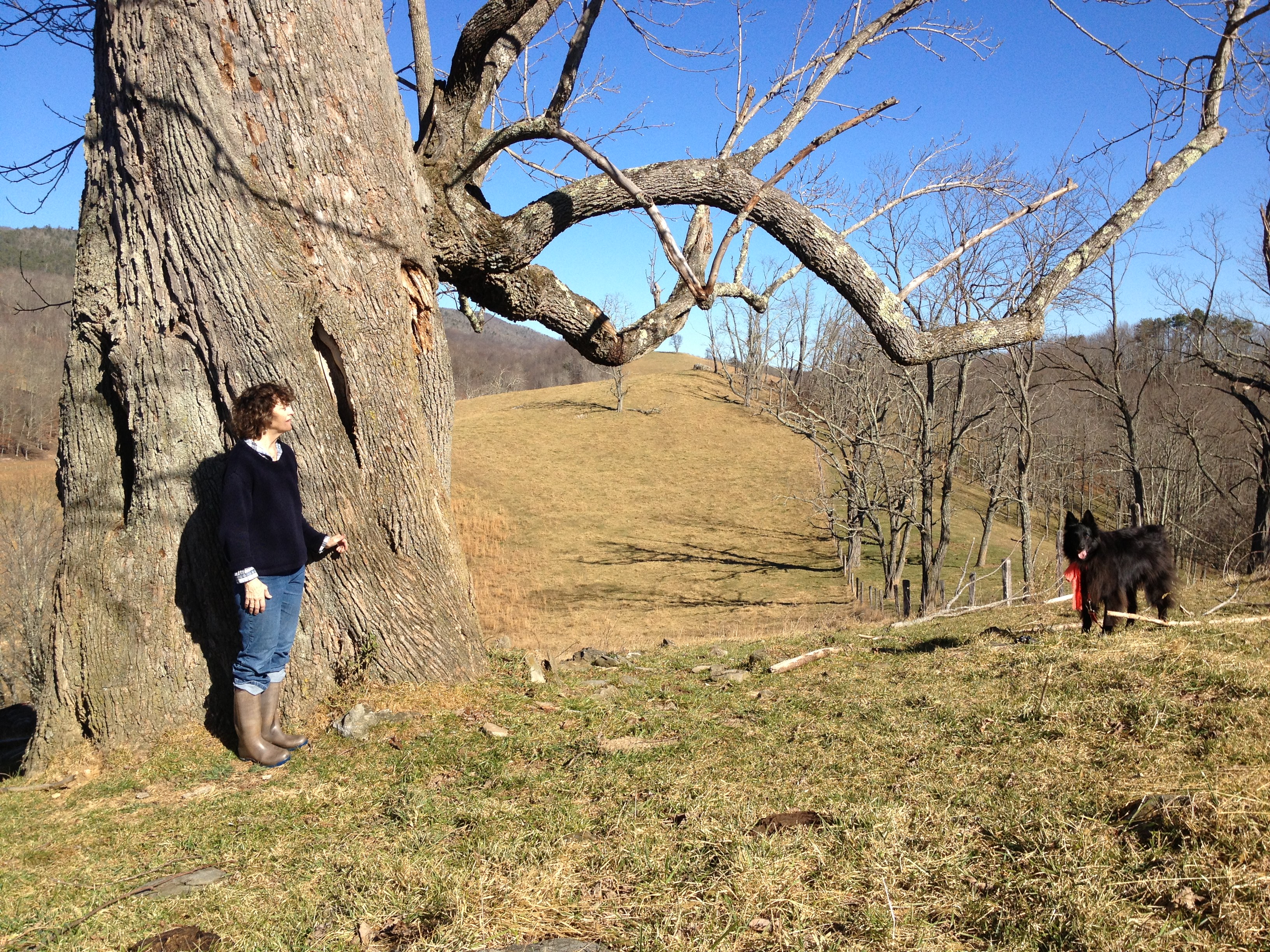
Cucumber tree with small figure of head measurer to the right of the trunk.


“Sure,” I said. My husband knows trees. He grows them from skinny little whips, He prunes them, watching their identifying features develop– leaves, flowers, buds, and bark. I think he has forgotten that I measured the tree a few summers ago and reported my measurement to him. However, I am willing to watch his methodology because I know that repeated measurements yield better data.

Getting to the top of Stark’s Ridge requires exertion, if not downright huffing and puffing. The top of the ridge, thankfully, is long, narrow, and pretty flat, interrupted only by the occasional beautiful rock pile and locust tree.  The pair of old giants stands on a gentle promontory, or undulation, of the ridge. From their trunks, one has a grand view of Vinegar Hollow and folds and folds of blue hills stretching for miles to the south and east. The view to the west is the solid flank of Back Creek Mountain.


Author measures herself against the tree. Belle the dog observes.

Author measures herself against the tree. Belle the dog observes.

In recent years I have approached the old cucumber giants with the acknowledgement that they were dying, losing long limbs faster than they were growing new leaves. The Latin, or scientific name, for the cucumber tree is Magnolia acuminata L. (L. stands for Linnaeus, the Swedish botanist who invented binomial classification). As an aging personage, akin to an old tree myself, I am interested in wrinkled, hardened beings. In order to understand the cucumber tree better, I consult my mother’s copy of Charles Sprague Sargent’s Manual of the Trees of North America in Two Volumes. The back book jacket advertises the fact that Charles Sprague Sargent is “the greatest dendrologist America has ever produced.” It further asserts that these two volumes allow the tree lover to identify any native tree in the United States through keys. Do not believe that such an assertion is easily followed.

The keys for identification of the mountain magnolia that C. S. Sargent presents are based on flower color: the cucumber tree keys out first based on its flower color. It has greenish petals vs. the canary yellow petals/white petals/pale yellow or creamy white petals of other native magnolias. Of course, there are no magnolia flowers in November. Keys are beguiling because they make identification look so straightforward, but horribly frustrating to those observers who are out of season with the keys’ chief identifying characteristics. The cucumber tree is named for its aromatic gherkin-like fruits, from which, when ripe, bright red seeds dangle on white elastic threads.

Measuring begins. I tie Belle the dog to a branch of the tree that has fallen on the ground to keep her out of the way. Trees are usually measured at breast height (dbh, diameter at breast height). My husband ties one end of the frail string to a piece of hard bark that protrudes from the cucumber tree at his breast height. He continues wrapping it around the stupendous girth of the tree adjusting its placement for dbh at each step, because there is a two-foot slope difference from one side of the tree to the other.  Then he calls for my assistance.

“Now we need to measure the string.”

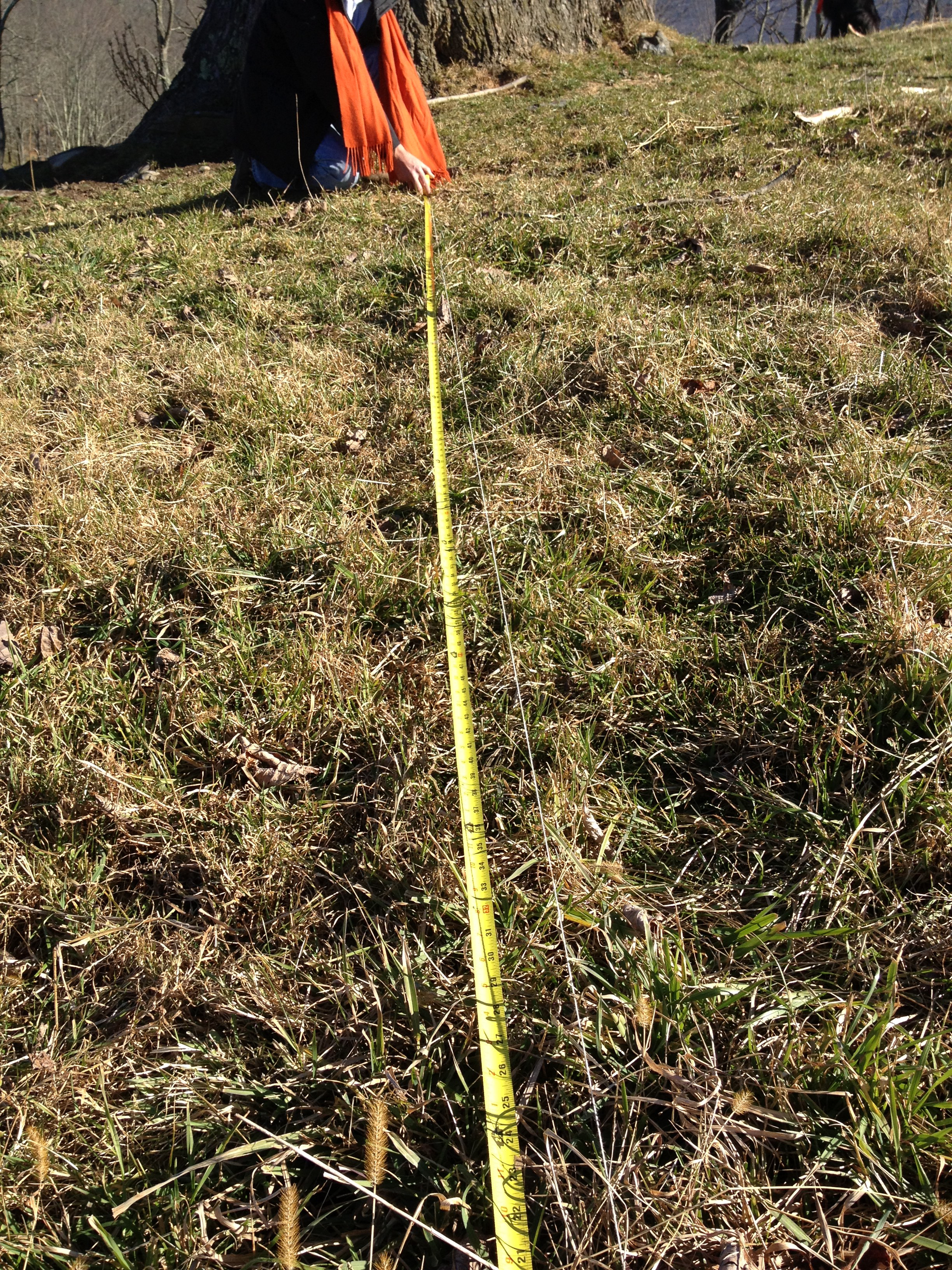
We searched for somewhat level ground so that he could stretch his string forth in a straight line. He tapped a little stick in the ground to secure the end of the string. Then he stretched the metallic tape measure alongside the string. The tape ended about two-thirds the length of the string—15 feet. A readjustment of the tape measure along the string yielded another 7 feet! So—the giant measured 22 feet in circumference. My husband, through a quick mental calculation, translated that to 7-foot diameter. Charles Sprague Sargent allows  3-4 feet as the usual diameter for mature cucumber trees in North America.


Measuring the string

Measuring the string


My measurement, taken two years ago with my husband’s orange plastic nurseryman’s tape, was 21-foot circumference. (I simply wrapped the tree with the bright orange tape, broke the tape at the full circle point, put the length in my pocket, and brought it back to Ithaca to measure with a yardstick. I don’t think I corrected my dbh for slope.) I am happy that this tree came in at 22 feet around. I was sure that it was a tree for the books. A champion. Sargent describes the ideal shape of the tree as “pyramidal.” However, because cucumber trees are weak wooded, such a tree on a mountain ridge has suffered many weather-related assaults that have twisted its growth patterns, and led to loss of limbs and subsequent clumps of dense younger growth in remaining limbs. It reminds me of the Little Prince’s baobab tree in Saint-Exupery’s book of the same name.


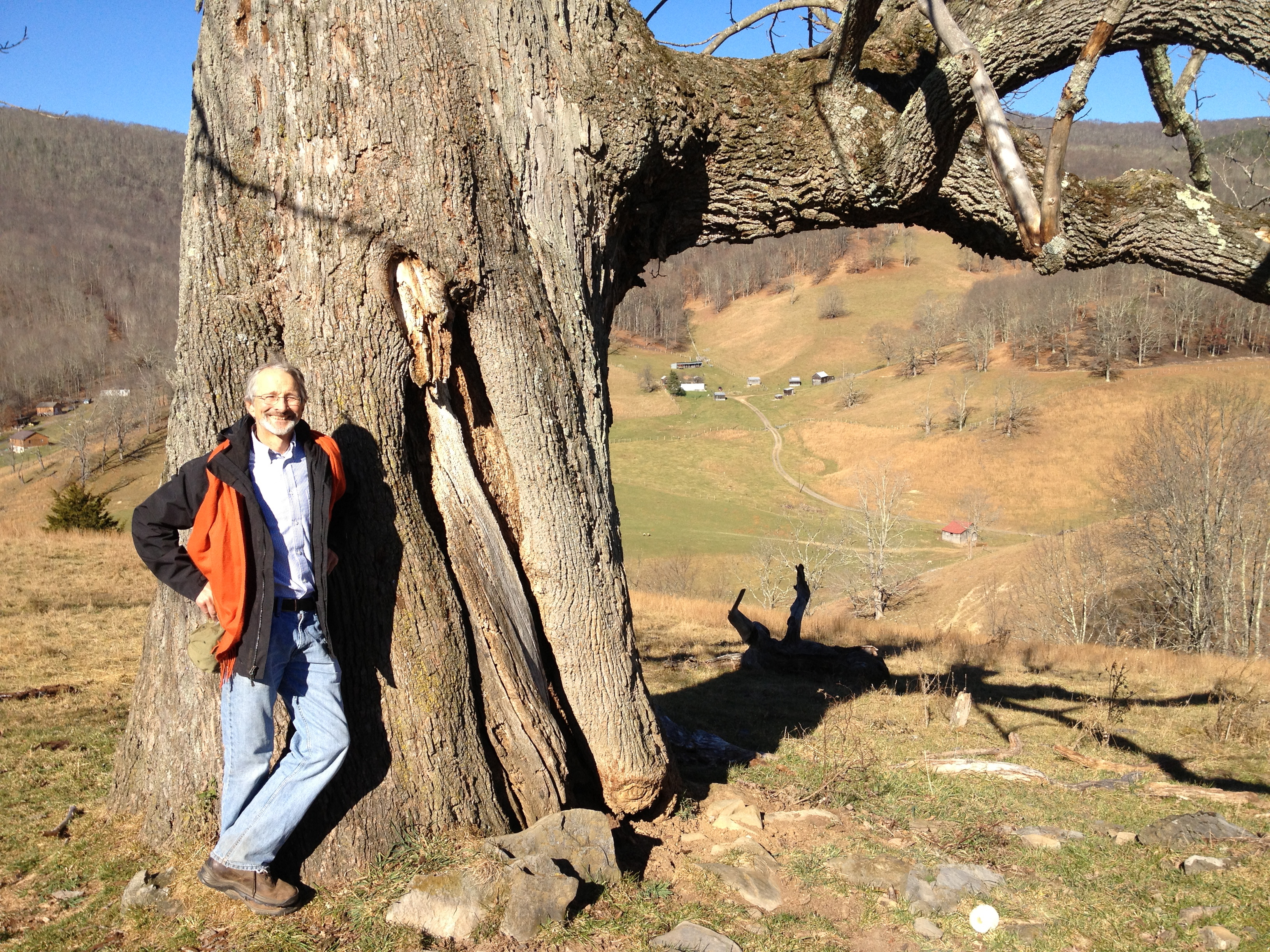
Head measurer David Fernandez stands by tree. Vinegar Hollow visible in the background.

Head measurer David Fernandez stands by tree. Vinegar Hollow visible in the background.


I am happy that we have spent this time circling the tree, honoring its girth and its presence in this small hollow. There are other cucumber tree lovers out there. Please see this thread posted on the Native Tree Society by Will Blozan (http://www.nativetreesociety.org/fieldtrips/west_virginia/cucumbertree/speaking_of_cucumbertree.htm). A scroll through the thread offers some wonderful photographs (particularly one of a tree pruner’s shadow joined into the shadow of the tree) and information on the tree and its medicinal properties.

Exploring Country Roads in Highland County, Virginia

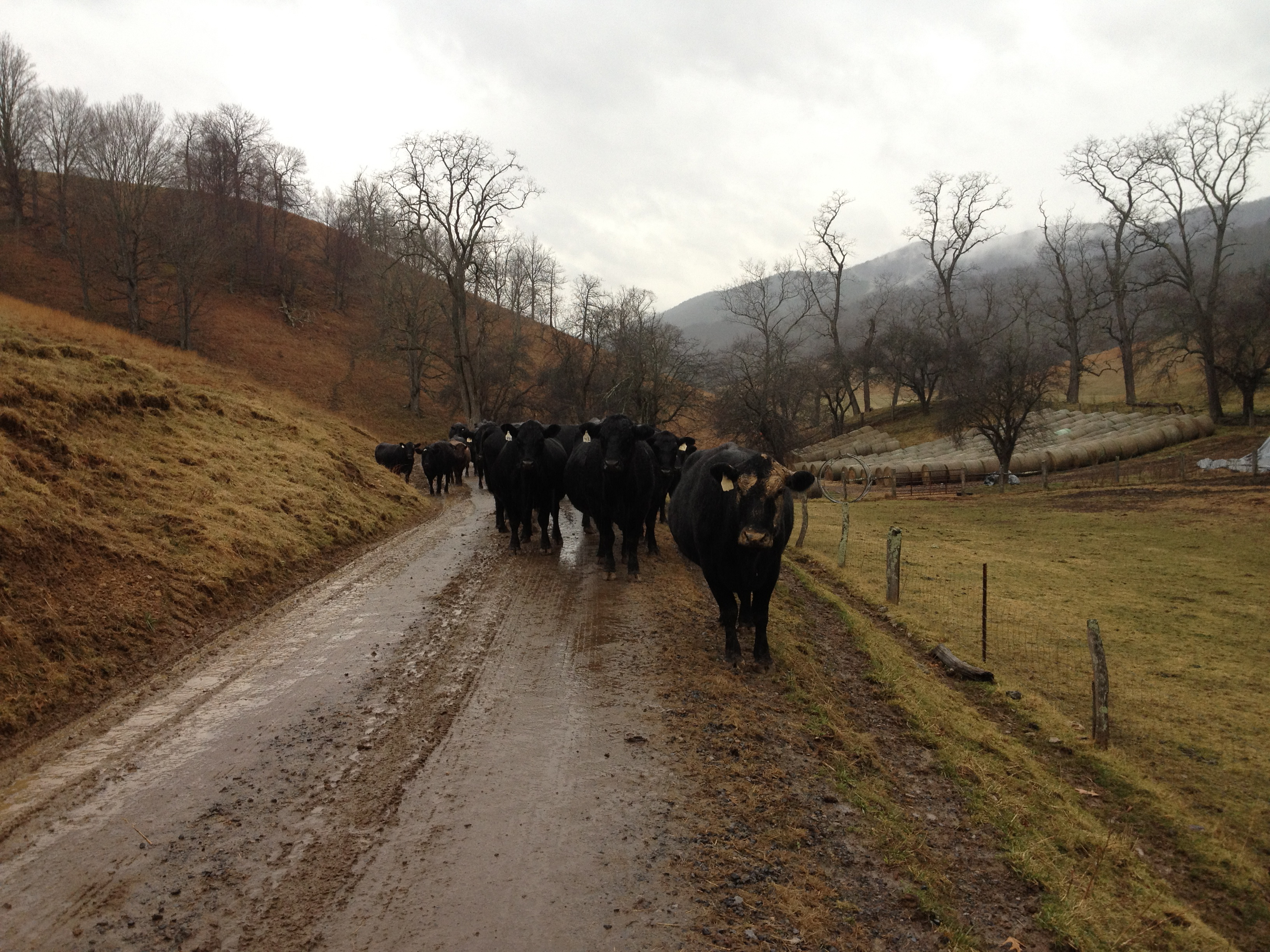
Cattle coming up to Vinegar Hollow's End

A traffic jam at Vinegar Hollow’s End

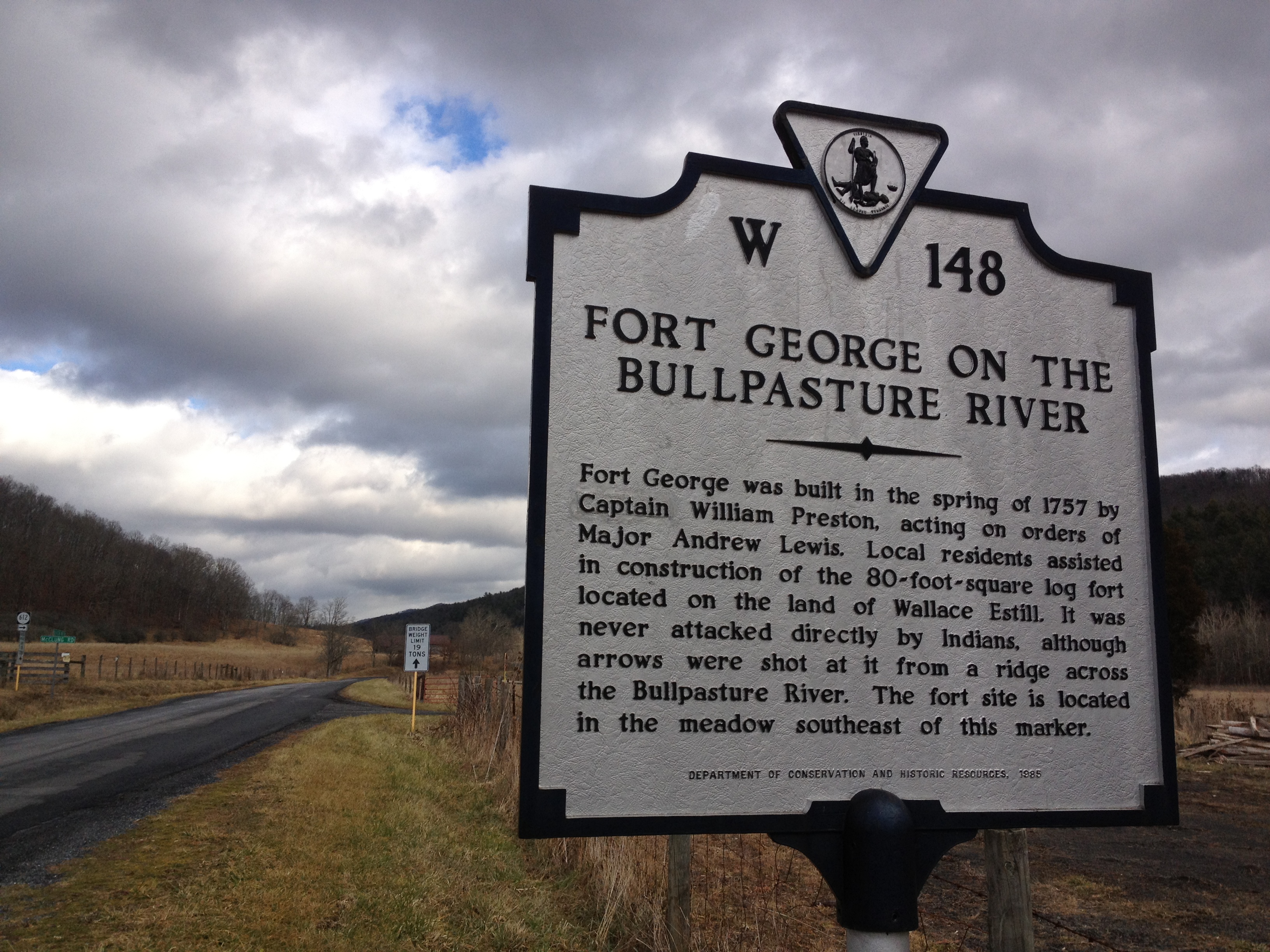
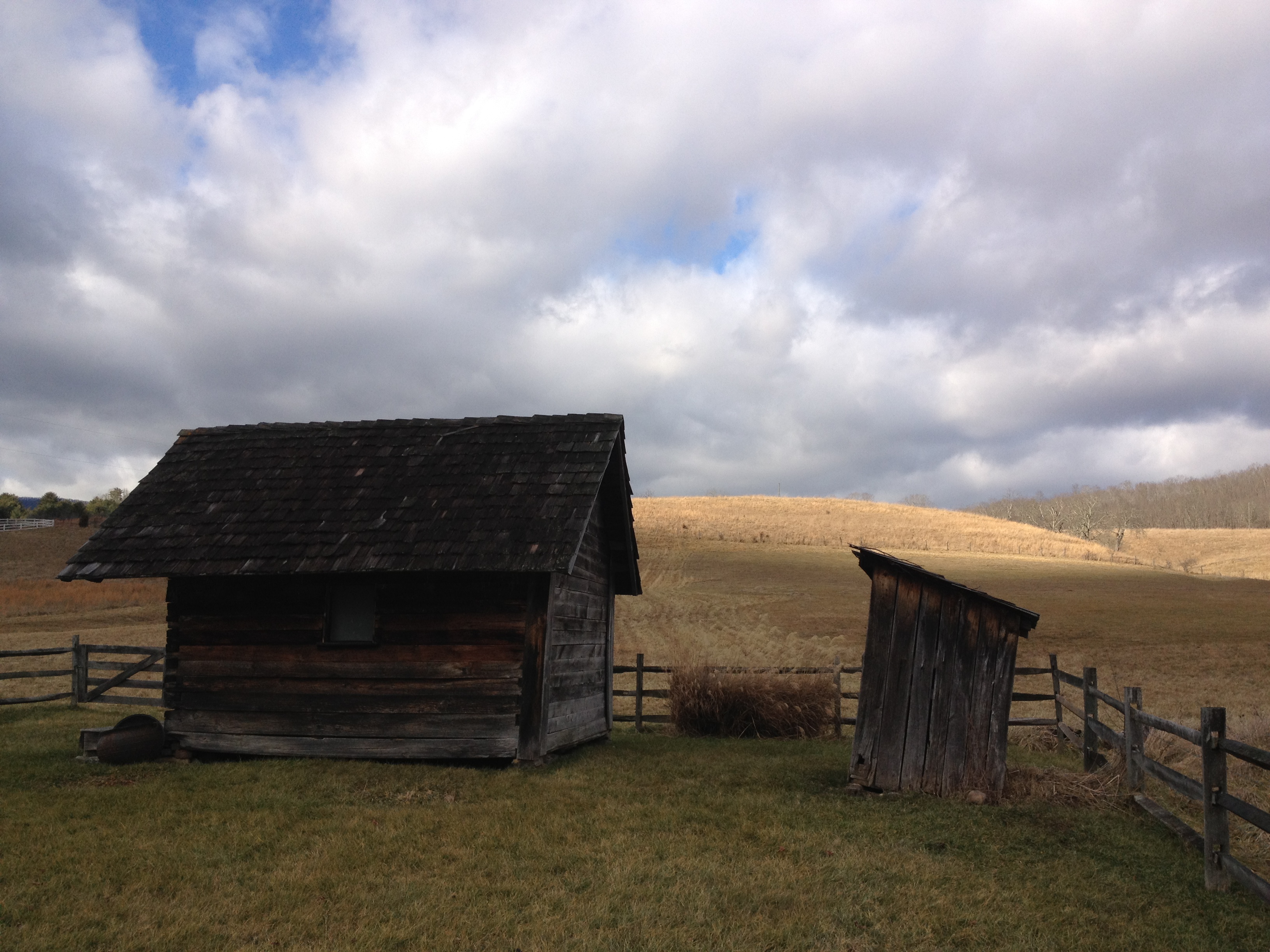
On New Year’s Day, 2012 I begin the year in Mustoe, Highland County, Virginia, tucked back in Vinegar Hollow, invisible from Mustoe proper, invisible from any other habitation for that matter. The day opens glowery, but not too cold, and glints of sunlight cause the landscape to sparkle in places. It will be a good day for a drive once we get past the cattle ambling up to the barn for their morning drink from the water trough near the house. When the cows are ambling, and they rarely do more than amble,  it is best to slow down and amble as well. I wanted to show my husband the road, which I had discovered in the summer, that follows the loops of a lovely river named Wallawatoola by American Indians, but renamed Bullpasture, Cowpasture, and Calfpasture by early settlers. The Bullpasture is big, Cowpasture less big, and the Calfpasture so modest that I always miss it. In McDowell, one takes Bullpasture River Road to Williamsville, following as it curves back on itself to become Cowpasture River Road, and then hopefully one makes the jog to Calfpasture River Road, the last loop of the river. Along the way I am charmed by an historical marker that notes the site of an early fort in a nearby field. The brave little fort was “never attacked directly by Indians” but faced the onslaught of arrows from a ridge across the Bullpasture River! I try to imagine the arrows flying, some falling into the river no doubt, almost 300 years ago. Each flight of arrow is a part of history never to be repeated, except by someone like me romancing over the message from the past found on the marker. Missing the jog to Calfpasture River Road, we take the road to Sugar Grove, in love with our journey among straw-colored stubbley fields and deep purple folds of mountain ridges in the distance. Here and there straw turns to gold as the sun pierces the cloudcover. Habitations, for humans and their livestock, in various stages of repair, catch at the heart.


IMG_0039IMG_0045

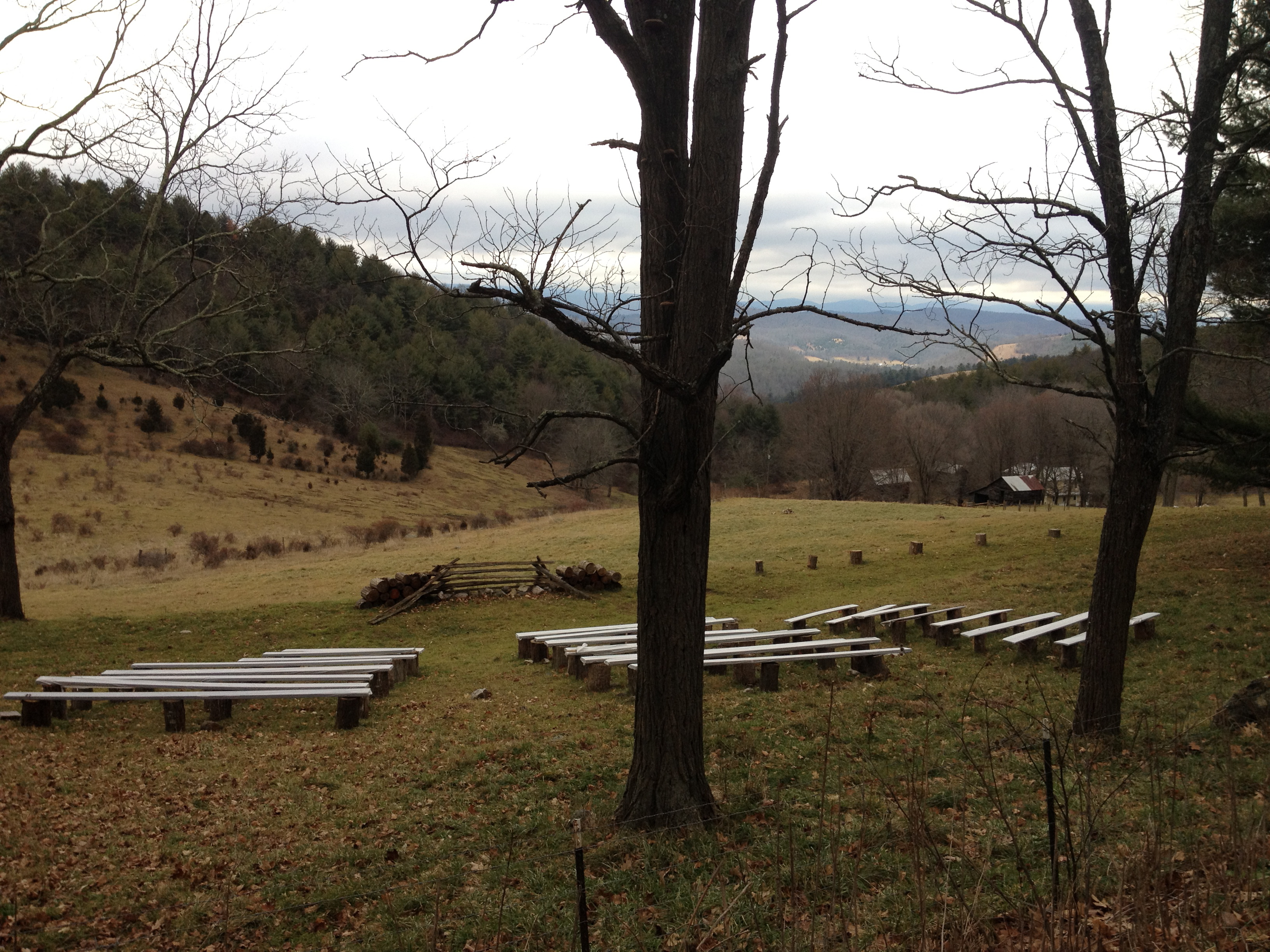
Somewhere along the road to Sugar Grove we take Crummetts Run Road to head back towards Monterey and Mustoe. Crummetts Run Road presents extraordinary views, especially near an outdoor rustic  amphitheatre situated in a field at the edge of a mountain, a place for people to be moved towards spiritual thoughts, as it seems that this must be the intent of its placement here on a high mountain fold with a view to the west. The empty seats are haunting. What souls have sat there in the past and who will sit there in the future? In that instant, pulled into the distance, I allow myself to feel there for an eternity. We do not need to take such a narrow view of where we are.
IMG_0062

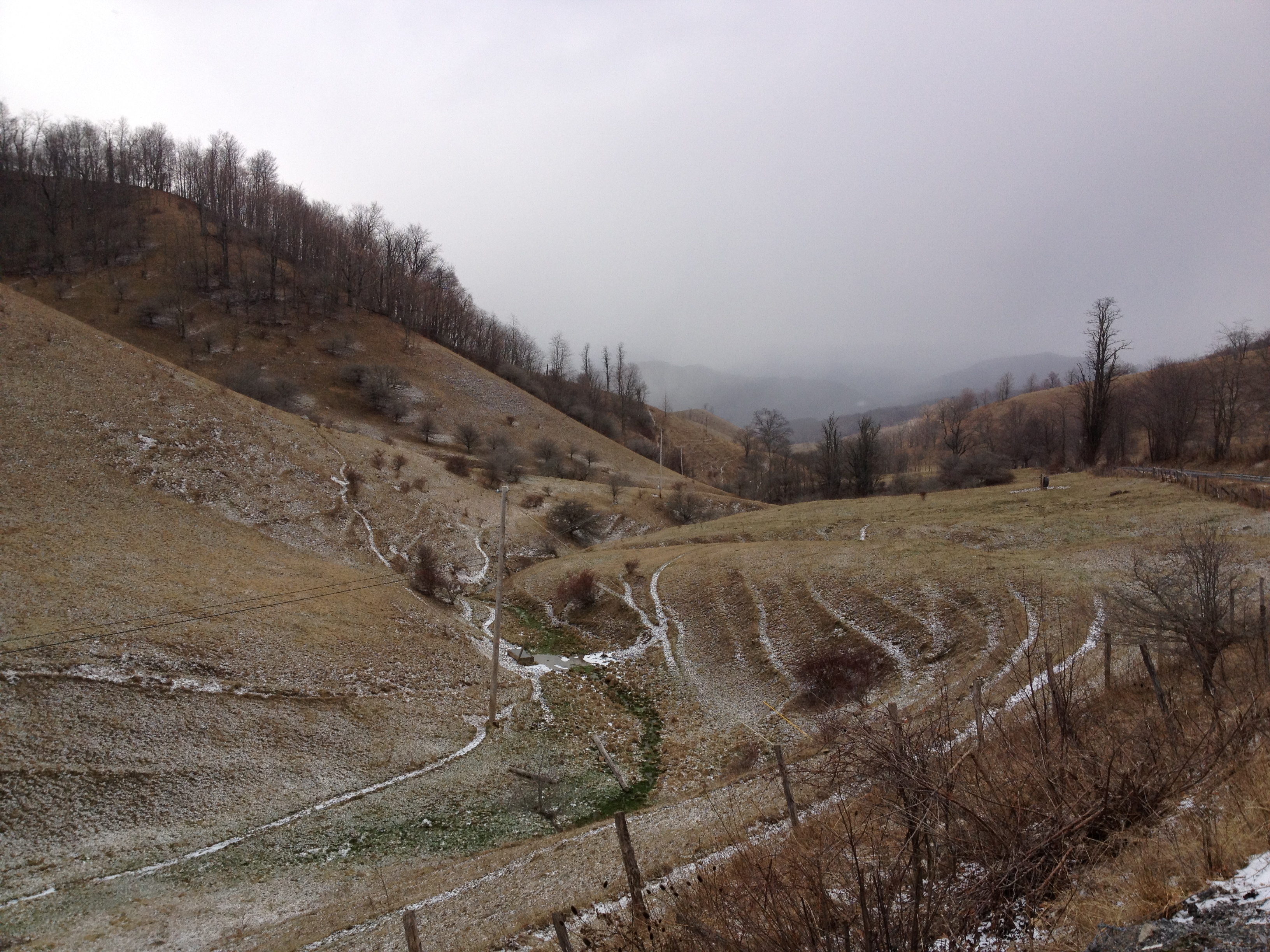
The next day it is time to leave Mustoe and head north to Ithaca. At the border of Highland County, Virginia and Pendleton County, West Virginia, we take Snowy Mountain Road. Snowflakes swirl out of a snowcloud, turning the deep purple of far mountain ridges to lavender. In the valley bottom there is still the bright green of algae and stream-loving vegetation growing yet in winter’s cold. Going over Snowy Mountain comforts my sense of departure, as its windings and views carry us from one kingdom to another, a trip we make more often than we realize–from moment to moment, day to day, year to year and  so on into the unmeasurable.


IMG_0093