A miraculous bouquet!

I know it’s winter, and I love the colors of winter, the grays of tree trunks and the white of snow and the beige of beech leaves, but I am thinking about a bouquet of flowers.

Belle surveying Enfield on February 2, 2014.

Belle surveying Enfield on February 2, 2014.

I have a big, black wolf of a dog, a Belgian Shepherd named Belle, who needs to be reminded often that she is a dog and not leader of her human pack, so I take her to doggie day care once a week. There in a pack of 17 or so dogs she learns that a pecking order is the name of the game for most creatures on Earth. Pam, who runs the doggie day care, is in my pantheon of heroines. There is no question that she is leader of the pack of 17 who run and romp and bark and snarl in the fields by the barn. It helps that she is tall. But she has the voice as well. When she says “Knock it Off,” the most overexcited, tooth-ey cat killer (there are such dogs there, but Belle is not one of them) wilts, sitting back on his or her haunches, ears back, the picture of canine contriteness. Pam understands each dog, adapting her approach to his or her strengths and weaknesses. Assertiveness blended with acceptance and compassion is an art. Even though I can’t say “Knock it Off” the way she does, I have learned from her.
Pam is also good with flowers. They abound every which way on the property, in beds along the driveway past the trailer to the barn, around trees, hanging from vintage contraptions on the barn itself. Huge barrels of dahlias guard the fence of the first pen. Though I was in a rush to get to my 8 am class, I stopped to admire a 4-foot tall dahlia, its flowers absolutely off the charts in size and pinkness.
“Hang on a sec. Let me grab a blossom for you,” Pam said. She picked the biggest, pinkest blossom, her large, work-hardened hands turning the flower to face upward.

One of Pam's dahlias.

One of Pam’s dahlias.

“But, do you like this lavender one?”

“Sure.” She plucked it.

“What about this rose one?”

“Sure.” She plucked it.

“You need this one with the ruffley edges.” She plucked it.

Soon enough I had a bouquet of 8-10 blossoms, all in different hues, pink lavender, pink white, red red, all with varying petal shapes, from frilled to square cut.
“Go, girl!” she said. I did. I dashed over hill and dale to the Writing Department at Ithaca College, found a vase in the copy room, and situated the bouquet in my office. I considered carrying the vase to my classes to freshen the blah bureaucratic ambiance of the classrooms in which I was teaching, but decided I couldn’t handle it as I am also a bag lady (a literary one, though).
Upon return to my office I found the bouquet alive and well. In fact, there was a large green and white caterpillar munching on the largest dahlia, making great inroads into a lovely pleated petal while producing sizeable chunklets of poop (technical term here is frass) one after another as I watched. And a demure ladybug, skimming lightly over an adjacent petal.

Pam's Bouquet.

Pam’s Bouquet.

Pam’s bouquet made me think of the little book I couldn’t resist buying (book jacket below) as a potential gift for someone, but have not parted with yet. I have always been attracted to the contradiction inherent in still lifes—the serene perfection of the still representation vs. the attempt to capture life in motion—the water droplet about to roll off a leaf, a caterpillar poised for the next bite.The Dutch still life painters of the 17th century, like Jan Van Huysum (1682-1749), often painted the insects that lurked on the bouquets they tried to capture so realistically. Anne T. Woollett, author of Miraculous Bouquets:  Flower and Fruit Paintings by Jan Van Huysum (The J. Paul Getty Museum) writes, “Although the brevity of life was not their primary theme, the curling petals and bent stems of Jan’s lavish bouquets, as well as the exposed fruit seeds and gnawed flesh, convey the passage of time.”
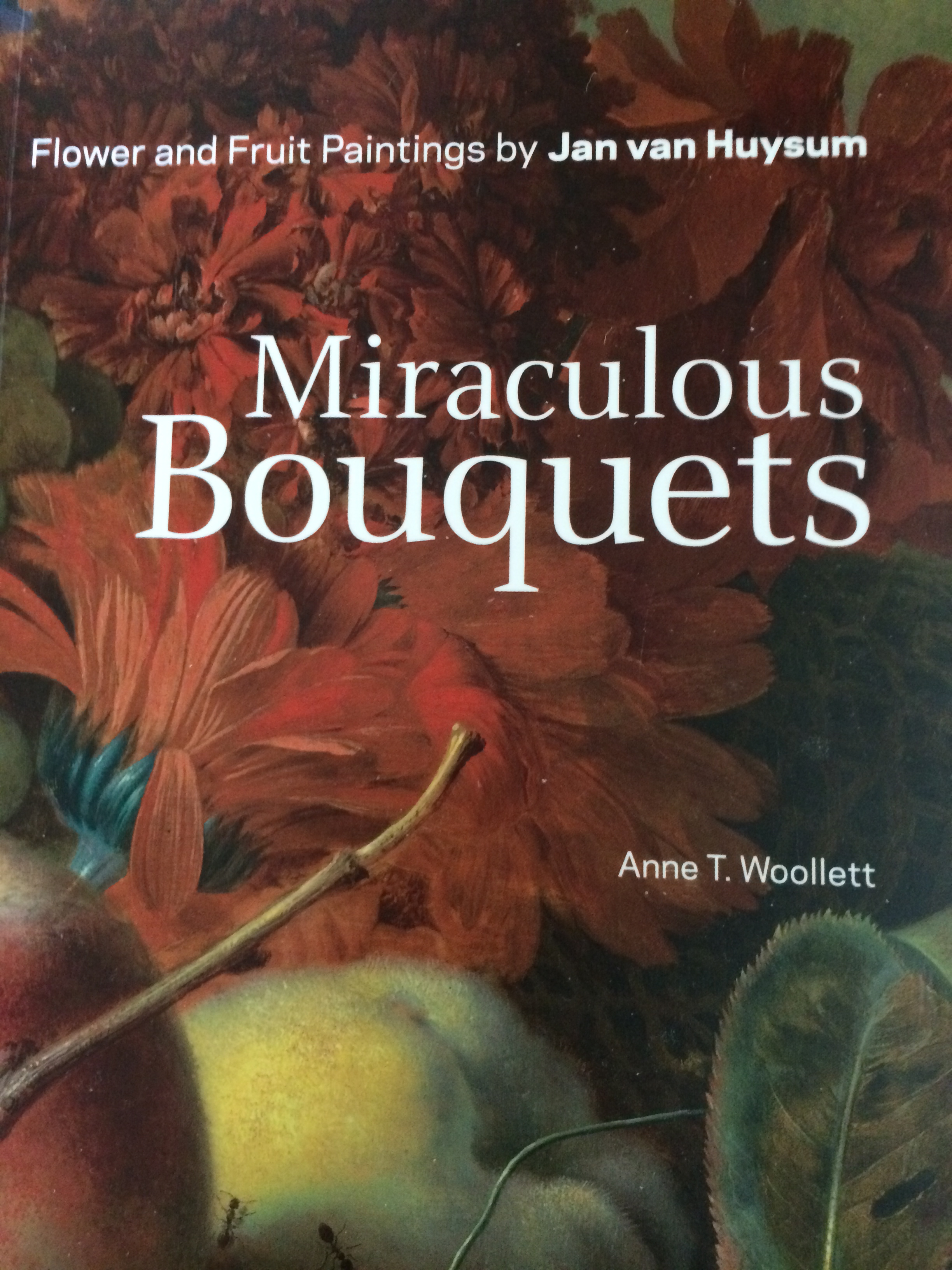
Book jacket of J. Paul Getty Museum's publication about paintings of Jan Van Husum.

Book jacket of J. Paul Getty Museum’s publication about still lifes of Jan van Huysum.

Painters from many cultures have labored over these kinds of still lifes, pushing technique to achieve ever greater perfection of representaton. Huysum painted on oak and copper, had special minerals ground for his paints, and overlay the images with yellow glazes.  James J. White and Autumn M. Farole in their commentary for the exhibition catalogue shown below (given to me by a friend, which I can’t part with either) describe how Mahaveer Swami, a painter of natural-history miniatures in Jaipur (the Pink City of Rajasthan, India), uses a paintbrush that is just a single squirrel hair to achieve precise details. I love the work of these natural-history artists, while hoping that each brush stroke is a tribute to the life form, bug or flower, that posed as model.  In writing here I realize that I am engaged in representation, when the true gift of the bouquet was life in motion.

Book jacket of exhibition catalogue published by Hunt Institute for Botanical Documentation, Carnegie Mellon University, 1994. Cover, by Jaggu Prasad, is titled "Cluster of Apples with Insects."

Book jacket of exhibition catalogue published by Hunt Institute for Botanical Documentation, Carnegie Mellon University, 1994. Cover, by Jaggu Prasad, is titled “Cluster of Apples with Insects.”

I rushed home with the bouquet, placing it in my garden to liberate the caterpillar and the ladybug. I watched it age day by day. The water grew green with algae. The petals lost color, drooped, and fell. The bouquet did not look less beautiful to me. It represented a gathering of experience: dogs scampering along the fence line trying to figure out what the humans were doing, Pam’s large but gentle hands turning each blossom this way and that, and the surprise of the caterpillar and the ladybug.
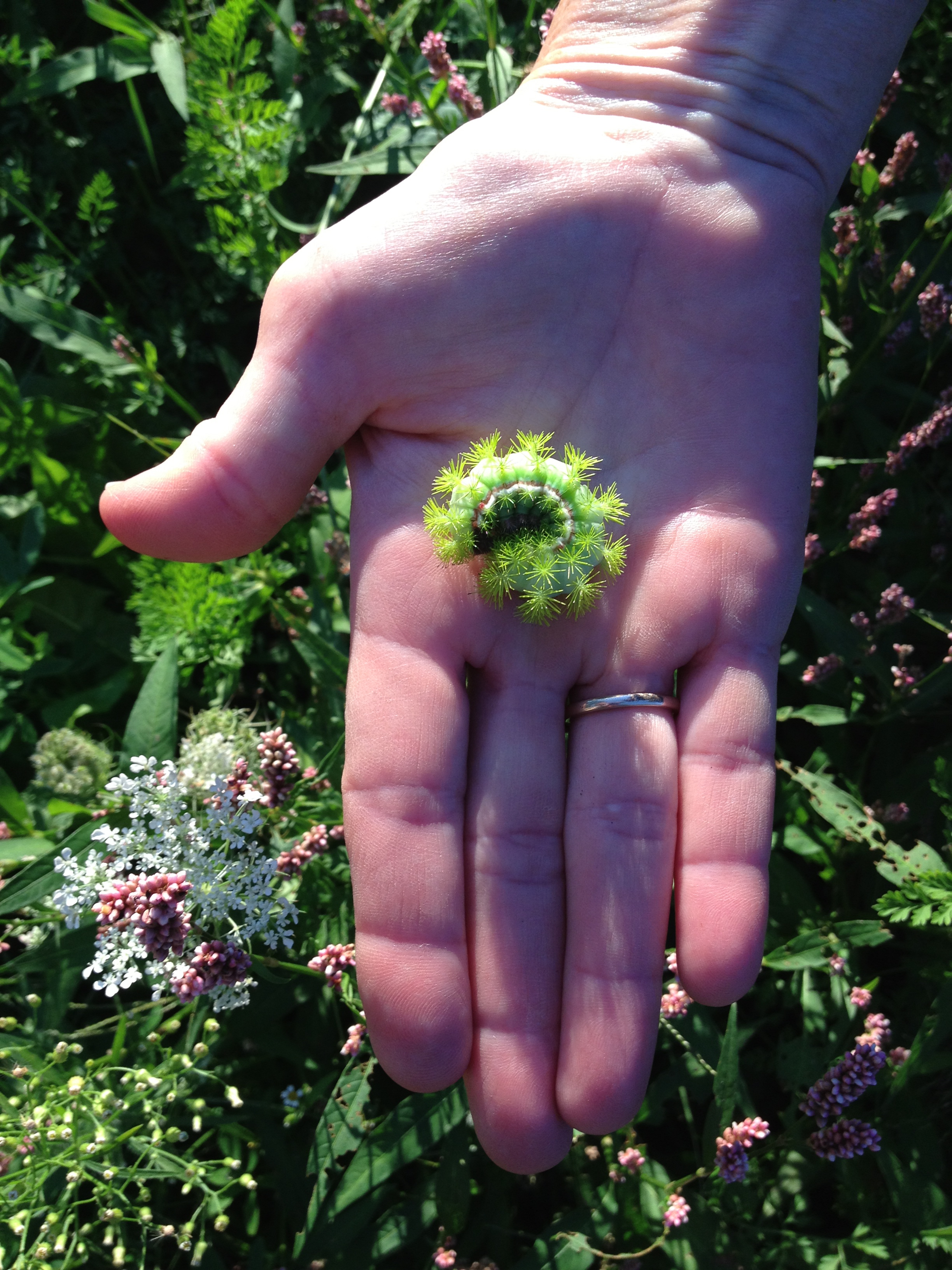
Caterpillar found on Seven Fields in Enfield, Ithaca, NY.
Caterpillar found on Seven Fields in Enfield, Ithaca, NY.

Fieldwork 101: Naturalist defers to Polar Vortex, but Pair of American Black Ducks Carries On

Cayuga Lake, one of upstate New York's Finger Lakes; Aurora, New York (photo by David Fernandez; Christmas, 2013)

View of Cayuga Lake, one of the Finger Lakes in upstate New York; Aurora, New York (photo by David Fernandez; Christmas, 2013)


A naturalist of the modern era—an experientially based, well-versed devotee of natural ecosystems—is ideally among the best informed of the American electorate when it comes to the potentially catastrophic environmental effects of political decisions. (Barry Lopez, “The Naturalist,” pp. 120-121 in Vintage Lopez, Random House, 2011)

One of my 2014 New Year’s resolutions is to devote a part of each day to living as a naturalist, observing all species and nonliving forms (like clouds), and reading and writing in response to those observations.  That means fieldwork first, wherever the field might be (even the corner of a bathroom if an interesting spider resides there), carrying on despite snow, rain, heat, gloom of night, and fear.

The contemporary naturalist, it has turned out—again, scientifically grounded, politically attuned, field experienced, library enriched—is no custodian of irrelevant knowledge, no mere adept differentiating among Empidonax flycathers on the wing, but a kind of citizen whose involvement in the political process, in the debates of public life, in the evolution of literature and the arts, has become crucial. (Barry Lopez, p. 121)

One can argue that we all, at every moment, have this opportunity, but we do not realize it. We are not in the naturalist’s “trance,” E. O. Wilson’s word for the observational state of mind of the naturalist.

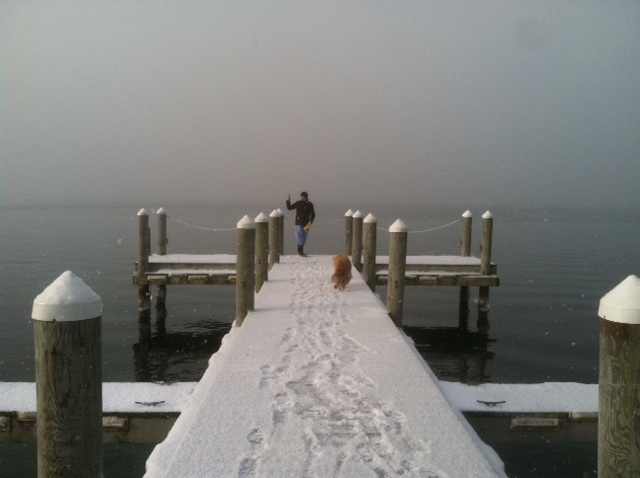
Jack and Daisy on Aurora Inn Dock (photo by David Fernandez; Christmas, 2013)

Jack and Daisy on Aurora Inn Dock (photo by David Fernandez; Christmas, 2013)


Shortly after New Year’s Day I found myself tending a house with no furnace. The house faces the western shore of Cayuga Lake in upstate New York. Like a gang of wailing banshees, the winds of the Polar Vortex  from the north swept into town, causing furnaces to fail, schools to close, and a wind chill of double digits below zero. Seven space heaters and a constant fire were keeping the house at plus/minus 52 degrees.

I set my chair up on the stone hearth to be as close to the fire as possible. When I felt toasted on the left side, I turned the chair the other way to warm my right side. Even with long underwear, a long woolen coat and hat, I needed to be about a foot from the fire. I had work to do, reading about bees in preparation for a submission to an upcoming anthology about pollinator decline.

Hearth with small fire

Hearth where “naturalist” hung out during Polar Vortex


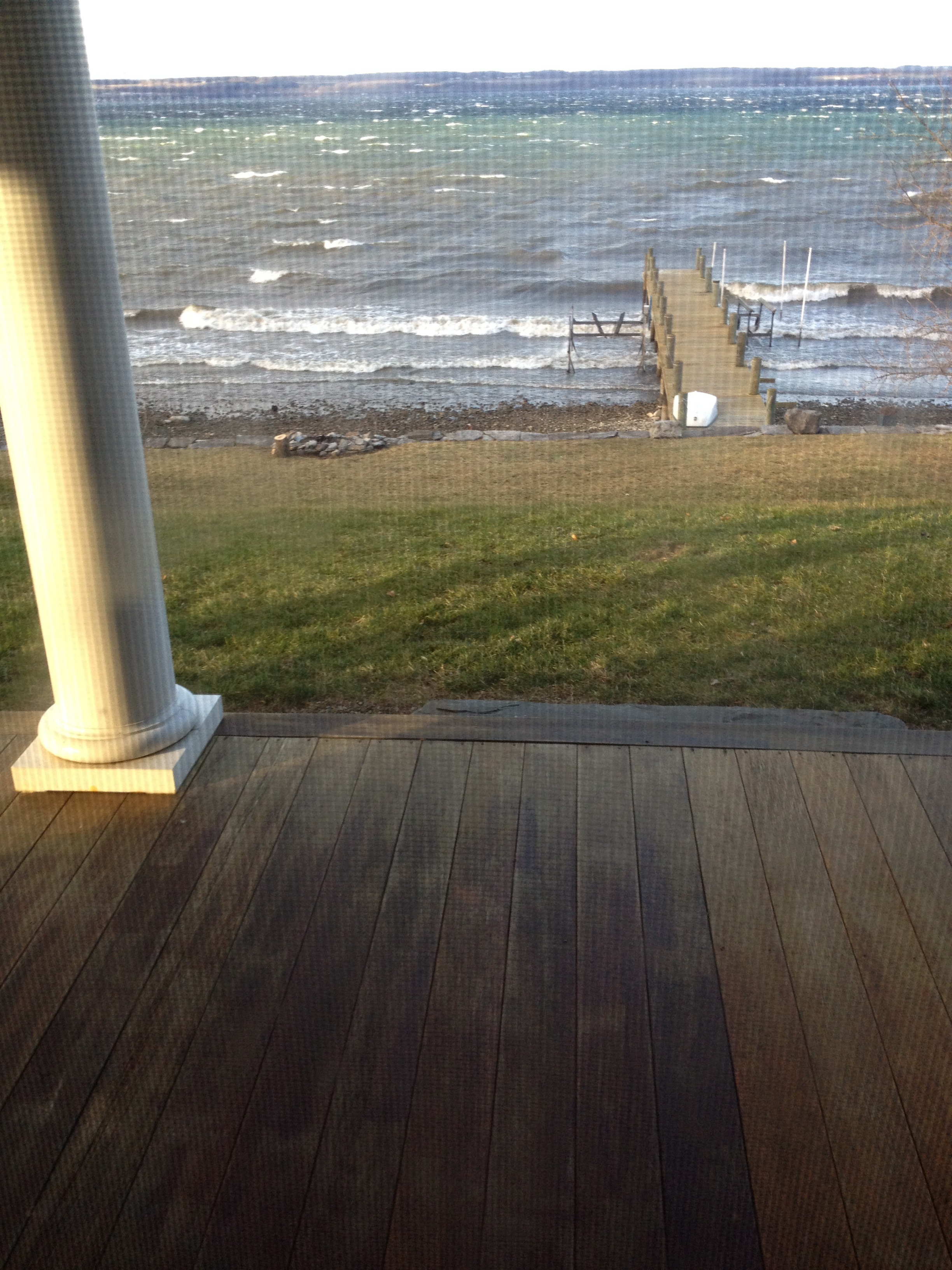
On Day 3, the furnace service technician still elsewhere (at a doctor’s office we were told), I continued my vigil, heaving wood into the fire assiduously. When toasting my left side up on the hearth, I had a good view of Cayuga Lake. Just a few weeks earlier, huge flocks of Snow Geese (called “rafts”) had settled on the lake in long, white ribbons, which parted into immense threads in the sky when they arose, alarmed by hunters’ gunshots. Now there were only two ducks, riding the tumultuous white caps side by side about two feet apart, near the dock. Although very Mallard like, their plumage was darker. I knew they were American Black Ducks (Latin species name: Anas rubripes, in French: Canard noir, in Spanish: Anade sombrio Americano). The plumage is actually dark brown, alleviated from somberness by an iridescent, violet patch (called a speculum) on the shoulder. As if sentinels or appointed companions to me, they rode the waves all afternoon within my view, side by side, until as the sun was setting they drifted under the dock, to parts unknown. The next morning the white caps had frozen into place. The ducks did not return.

Modest wintry white caps in January 2013.

Modest wintry white caps in January 2013.

The bugbear in all of this—and there is one—is the role of field experience, the degree to which the naturalist’s assessments are empirically grounded in firsthand knowledge. How much of what the contemporary naturalist claims to know about animals and the ecosystems they share with humans derives from what he has read, what he has heard, what he has seen televised? What part of what the naturalist has sworn his or her life to comes from firsthand experience, from what the body knows?  (Barry Lopez, “The Naturalist,” p. 121, Vintage Lopez)

I realize now that I failed, missing an opportunity to be a true naturalist in unusual, extreme conditions. I should have gone down to the dock, observed the American Black Ducks in the conditions that they were enduring, and photographed them. I wish I had, because I miss that particular pair.  I watched white caps pound them out of sight, but they bobbed up, again and again. American Black Ducks are “dabbling” ducks (as opposed to “diving” ducks), frequently tipping over headfirst to feed. I would distinguish their “bobbling” behavior during the winds of the Polar Vortex from what I have seen of “dabbling.” I would say it was more a matter of take-the-wave headfirst and reappear at all costs.

Cost is an important word. It “costs” in the form of energy to move any part of the body, to swim, to forage, to fly. I found a Master’s of Science thesis online entitled “Constructing a 24-hour Time-Energy Budget for American Black Ducks wintering in coastal New Jersey,”  by Orrin E. Jones III. Jones, a graduate student in Wildlife Ecology at the University of Delaware, logged in 11, 542 observations of black duck behavior to find out just how much energy it takes for an American Black Duck to get through a day and night (the DEE or daily energy expenditure). In other words, he tried to calculate their personal balance sheet for maintaining existence. Activities like flying cost a lot. A bird under stress flirts with death if stored body energy reserves cannot support the cost of flying, for example. Jones’ research was partly funded by the Black Duck Joint Venture: An International Program to Conserve the Black Duck.

I shivered just watching the ducks, moving closer to the fire each time one of the pair disappeared into a wave. Having now reassured myself about the duck’s beautiful adaptations for surviving cold weather (greasy feathers and a special countercurrent heat exchange system in their legs and feet , I know that the human being, naked in so many ways, is much more in need of sympathy in a polar vortex than a duck. However, would it be too anthropomorphic to consider that they might have been uncomfortable in duck terms? Surely, any living species can experience discomfort?

Apparently ducks are associated in many people’s minds with “silliness and humor.” Not for me. As I revisit the image in my mind of the pair of American Black Ducks bobbling in the white caps on Cayuga Lake, I think about how all species struggle with their personal balance sheet, the wonder of biological adaptation, and the pleasure of spending an afternoon en-“tranced” by a pair of ducks. I treasure Barry Lopez’s description of the naturalist. I can’t think of a better job description for every human being.

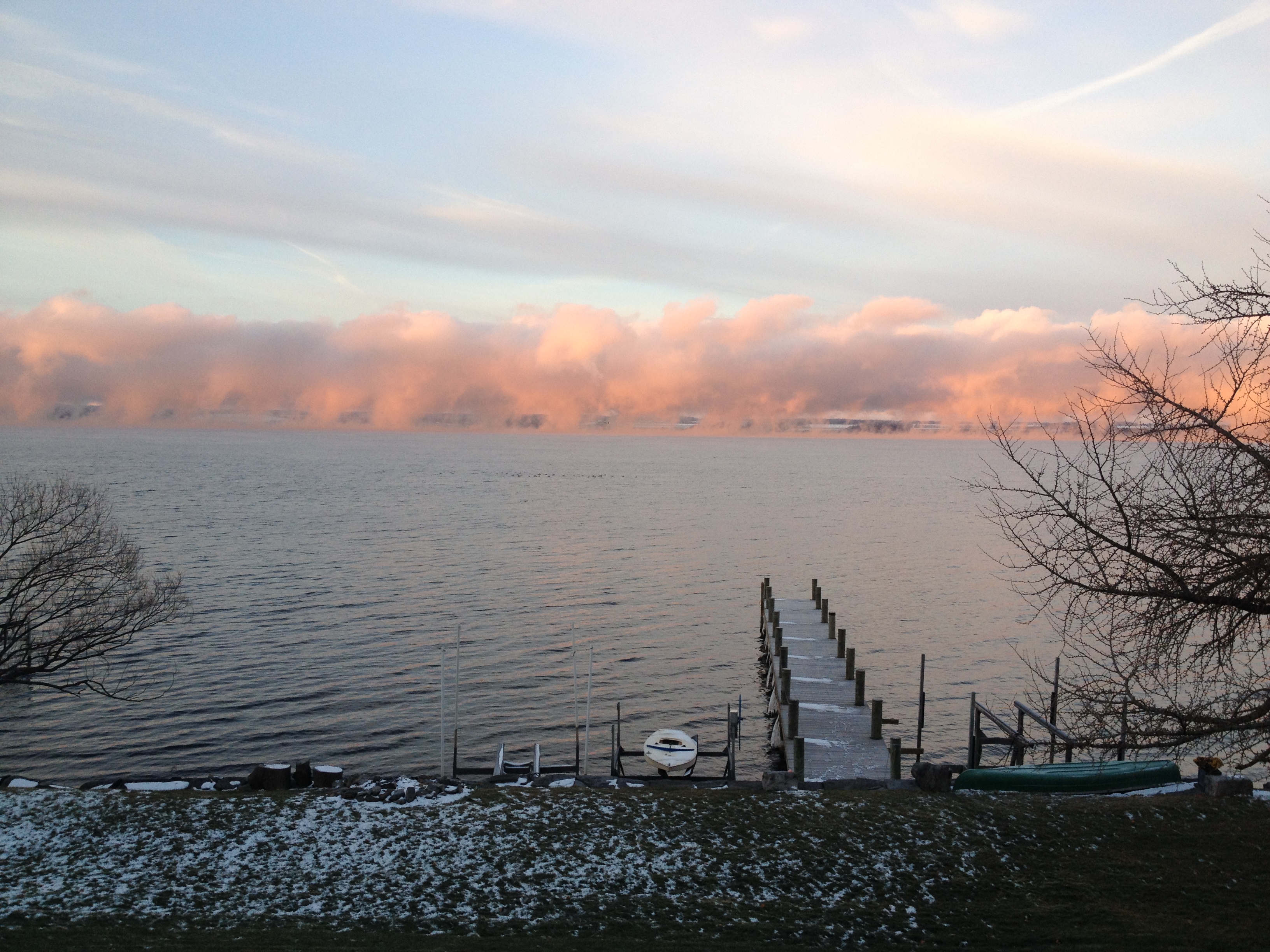
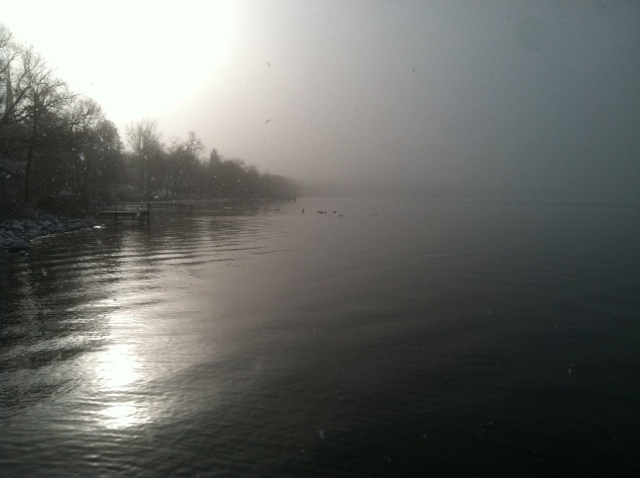
Western shore of Cayuga Lake in early morning (November 2013).

Western shore of Cayuga Lake in early morning (November 2013).


P. S. For photos of American Black Ducks “on ice,”  please visit the website of naturalist/interpreter Gerald Wykes and read his  “Naturespeak” blog post “Black Ducks on Thin Ice,” which gives information as well about their dwindling numbers. Having diverged from their “sibling” species, the Mallard, about a half million years ago, they are now converging, it seems, as a result of interbreeding. See also Gerald’s photoessay “Picture a Polar Vortex,” which shows the ferocity of the vortex and various creatures “hanging out” in it.

The Hugs

The Hugs

“It’s a pretty quiet crowd,” my husband said, surveying the many, many people waiting at JFK’s Welcome Center for their loved ones, straggling intermittently down the corridor from Baggage Claim and Customs, holding babies and wheeling suitcases, a day or so before Christmas.

“They are just tired,” I said, “as we are, aren’t we?” And we were, having driven from Ithaca in wintry rain under bleak skies through the Catskills over the George Washington Bridge into Queens, creeping for the last 40 miles.

We were late, but so was our son’s plane from Heathrow. So we wedged into position along the long rope barrier separating arriving passengers from those who waited. During the hour in which we were part of the quiet crowd, we stood behind a man with two young boys at his side. I could not identify their nationality—Israeli, Middle Eastern—I did not know. The man was slight, of medium height, his face thin, care worn, gray hair at his temples. The two young boys, seven or eight years old, fidgeted. At one point they decided to look for playthings in the pockets of his coat. He dissuaded them gently and absent mindedly, his utter distraction a deterrent to any further efforts at engaging his attention. They waited quietly. For whom was he waiting? Just when it seemed possible that loved ones would never materialize because our role was to wait endlessly, the man reached out. He grabbed the face of a man on the other side of the rope, kissed him on both cheeks, and then wrapped him arms around him in a hug, the rope still between them, their faces buried in each other’s shoulders. The hug went on forever. Forever. I looked away because it felt intrusive to continue looking at them, though only a bundle of jackets was visible, but I knew there were arms holding tightly and beating hearts nearly touching. The man who had arrived was taller; he looked better rested and nourished than the man who waited. He had a boy of about 13 with him who gazed happily at our man, who proceeded to grab this boy’s face for kisses and then embrace him in the same long hug. When the boy was released, there were tears welling out of his eyes. I could have cried. And then they left.  As we continued our wait, I wondered where the men and the boys went, in what part of the great metropolis or beyond they would eat and sleep, how they would continue going about their lives after the intensity of such hugs.

The hug is a gesture characteristic only of the human species for the most part. I carried the JFK hugs through my Christmas and into the New Year. We put up with separation, but we should not become inured to it, or at least we should fight to connect when we can. I believe I was in a position to be a proper witness because I had read this past fall Thich Nhat Hanh’s words on hugging meditation. He writes, “When we hug, our hearts connect and we know that we are not separate human beings.” This is the message of David Grossman’s new children’s book The Hug, published by Overlook Press, in which a mother hugs away her child’s feelings of estrangement. This is the message I received from standing near the hugs in JFK. Thich Nhat Hanh says that we should hug for at least three in-and-out breaths—to establish presence in the moment with the other person and connect with the Earth.

Dew drops on a tulip tree leaf.

Rain drops on a young tulip tree leaf (Ithaca, NY)

Wingstem Season in Highland County

image

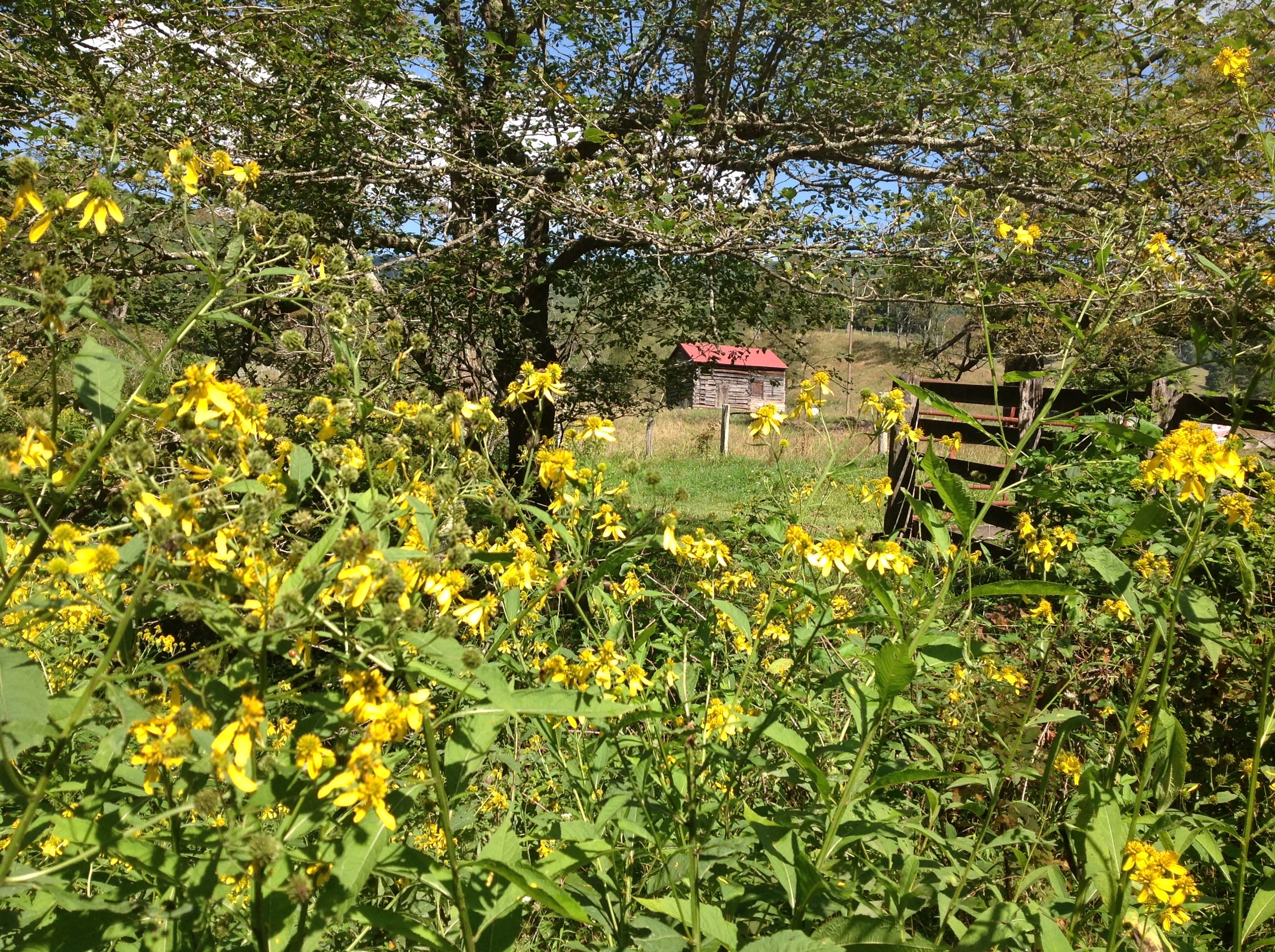
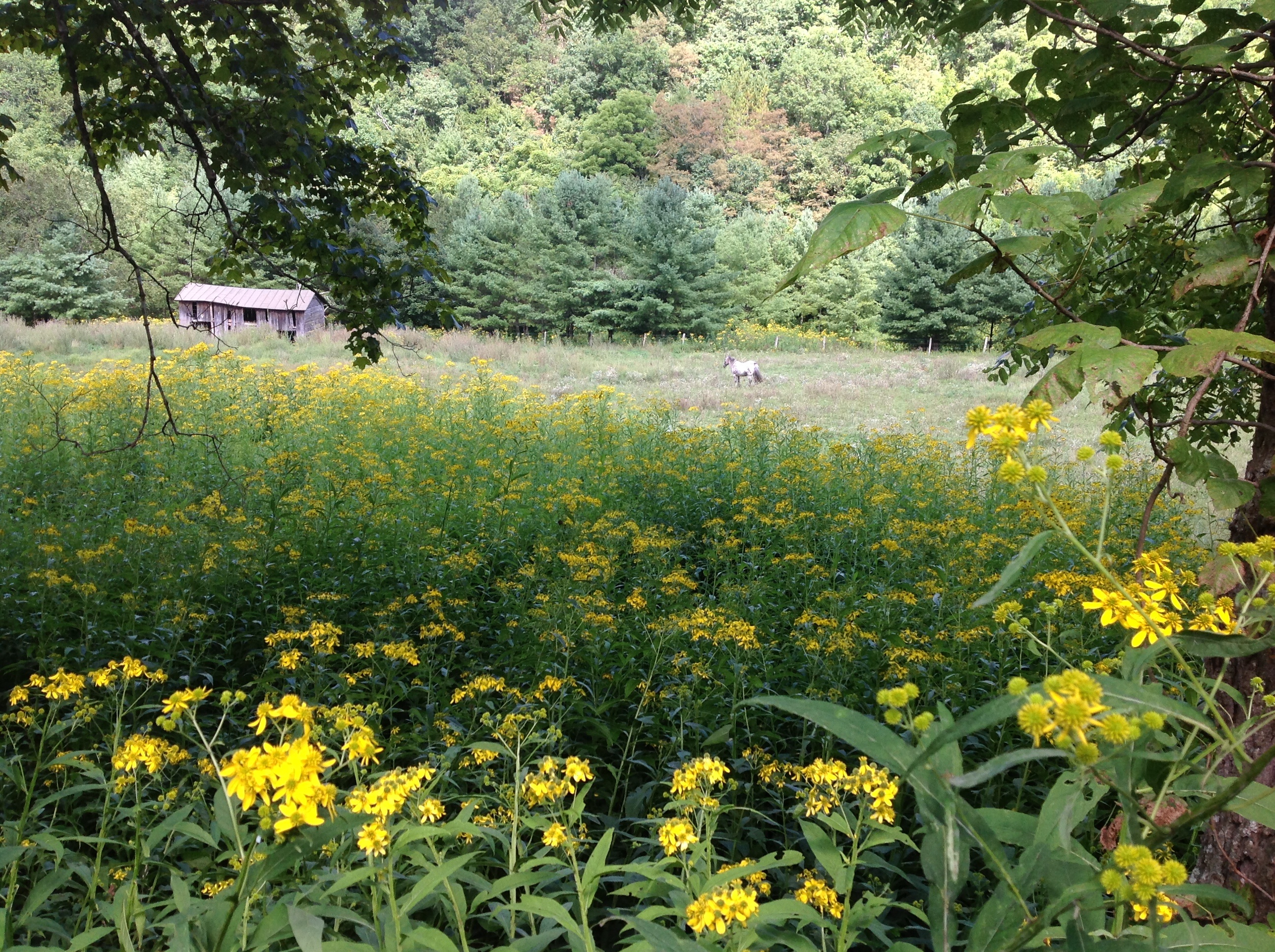
Wingstem framing view of hewn log barn in Vinegar Hollow

If you start following wingstem, with an intent to admire or photograph, at the end of August in Highland County, Virginia, it is hard to stop. There is always one more scenic road, one more view of hundreds of yellow petals waving haphazardly atop firm, straight stems in the sun or in a glowing shade. Tall, up to 13 feet, and unbranched, it forms dense stands in damp ditches, along waterways, and on moist hillsides. From a distance, the yellow ribbons of wingstem (Verbesina alternifolia) prominently mark changes in topography and moisture of Highland’s  five beautiful valleys.

Of course, one doesn’t necessarily follow something, unless one is fleeing another something. The last few days we have been cleaning out my parents’ old farmhouse in Vinegar Hollow, encountering mounds of dusty debris, a long-dead rodent under the icebox, many moldy, rusted things, once useful, and now difficult to salvage. It is hard to so tangibly acknowledge the termination of two passionate people’s (my parents) endeavors. So, one hits the open air and the open road to counterbalance this stressful housecleaning operation.

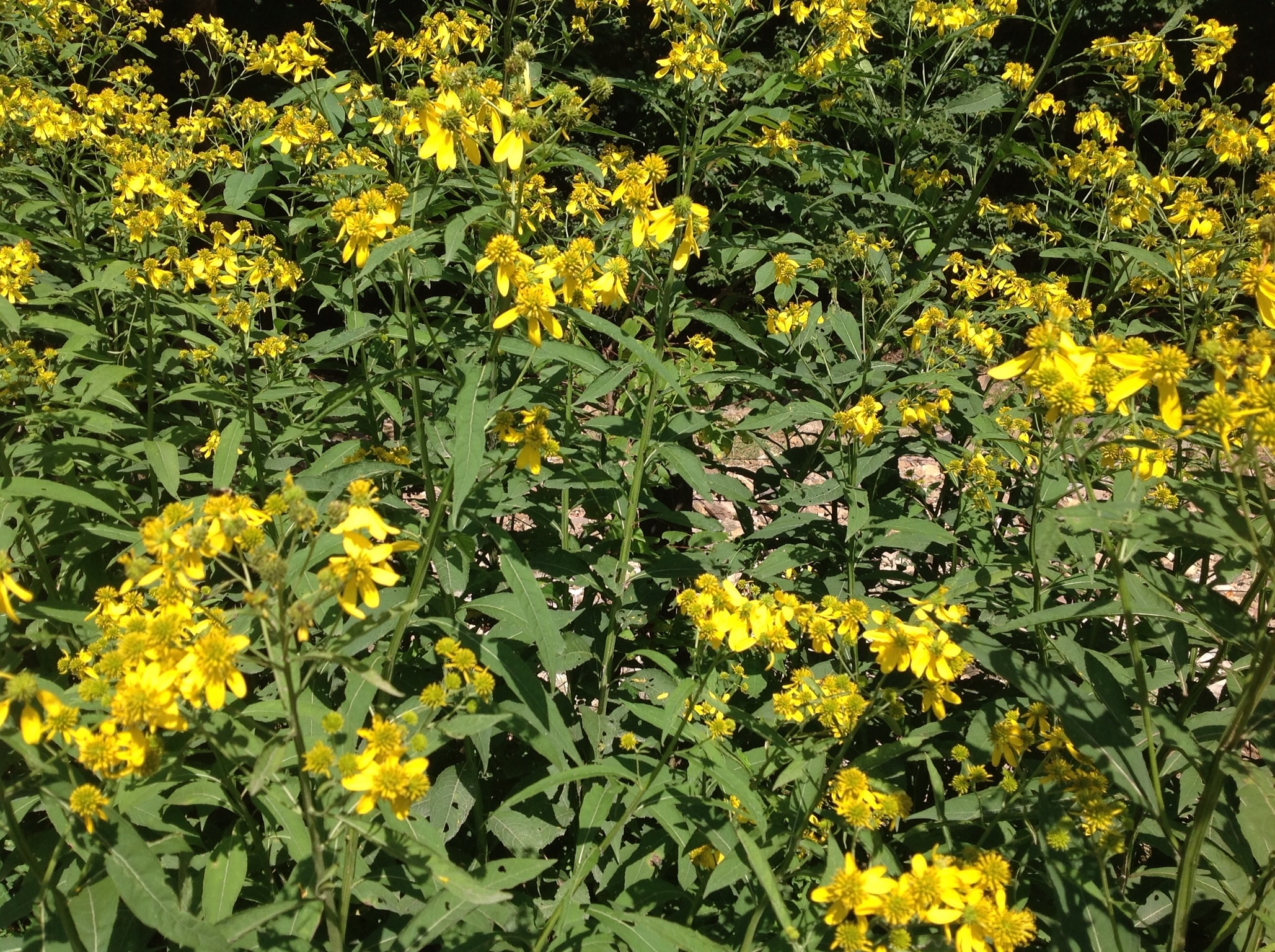
View of wingstem thicket

View of wingstem thicket

We leave the hollow, driving south on 220 toward Warm Springs. A left turn opposite Lamb’s Hollow leads us across the Jackson River, where we encounter roadsides, hillsides, and fields filled with wingstem. In one meadow along a section of the road known as Dry Branch, a dappled gray horse comes into view.

Dappled gray horse is just slightly right of center. Wingstem in the foreground.

Dappled gray horse is just slightly right of center. Wingstem in the foreground.

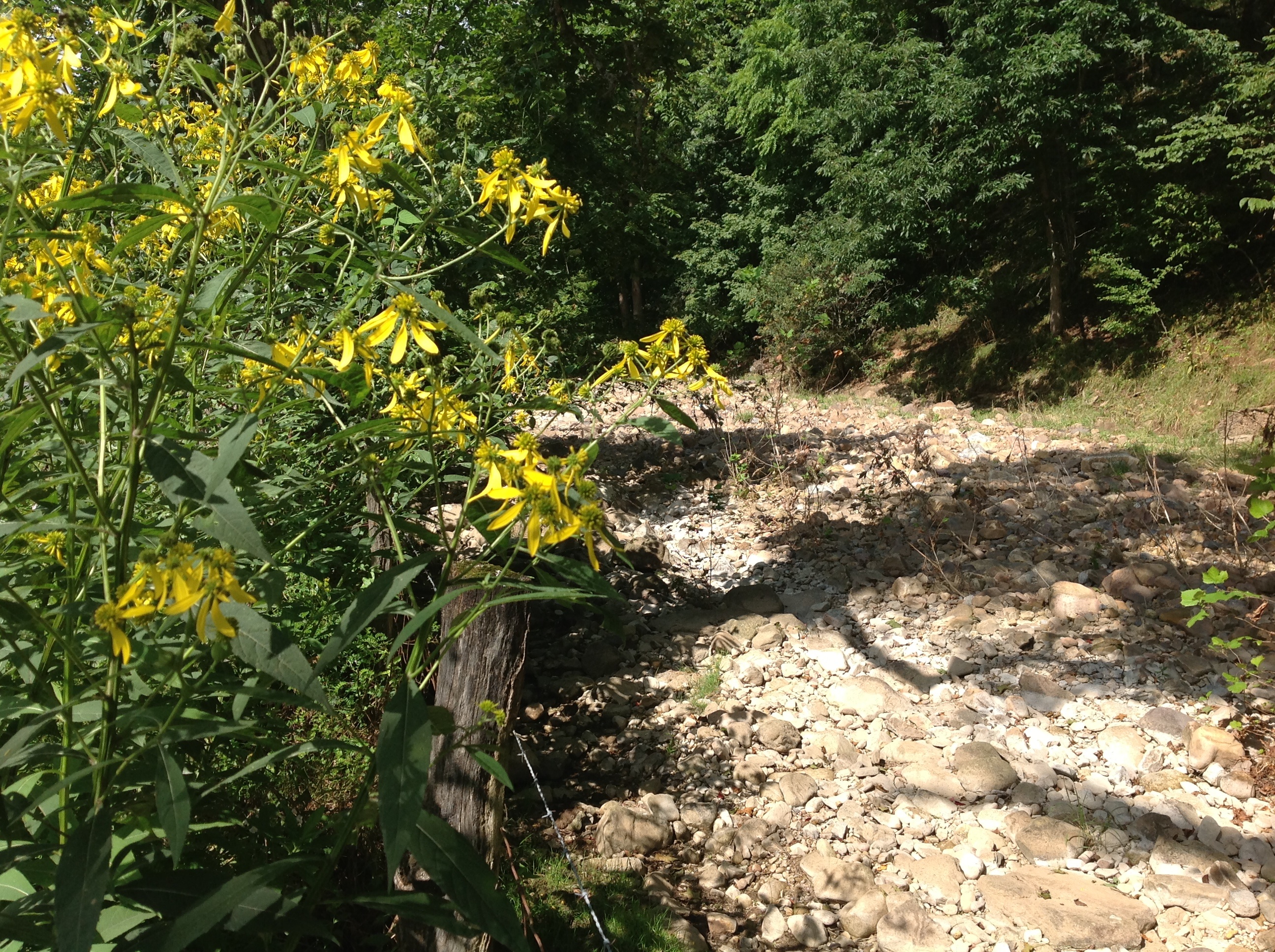
Sensing our presence, the solitary horse soon gallops away towards its barn. Dry Branch is aptly named because, although some of it has water, many parts are dry. This is limestone country, and water easily disappears into underground caves.

Wingstem alongside dry part of Dry Branch.

Wingstem alongside dry part of Dry Branch.

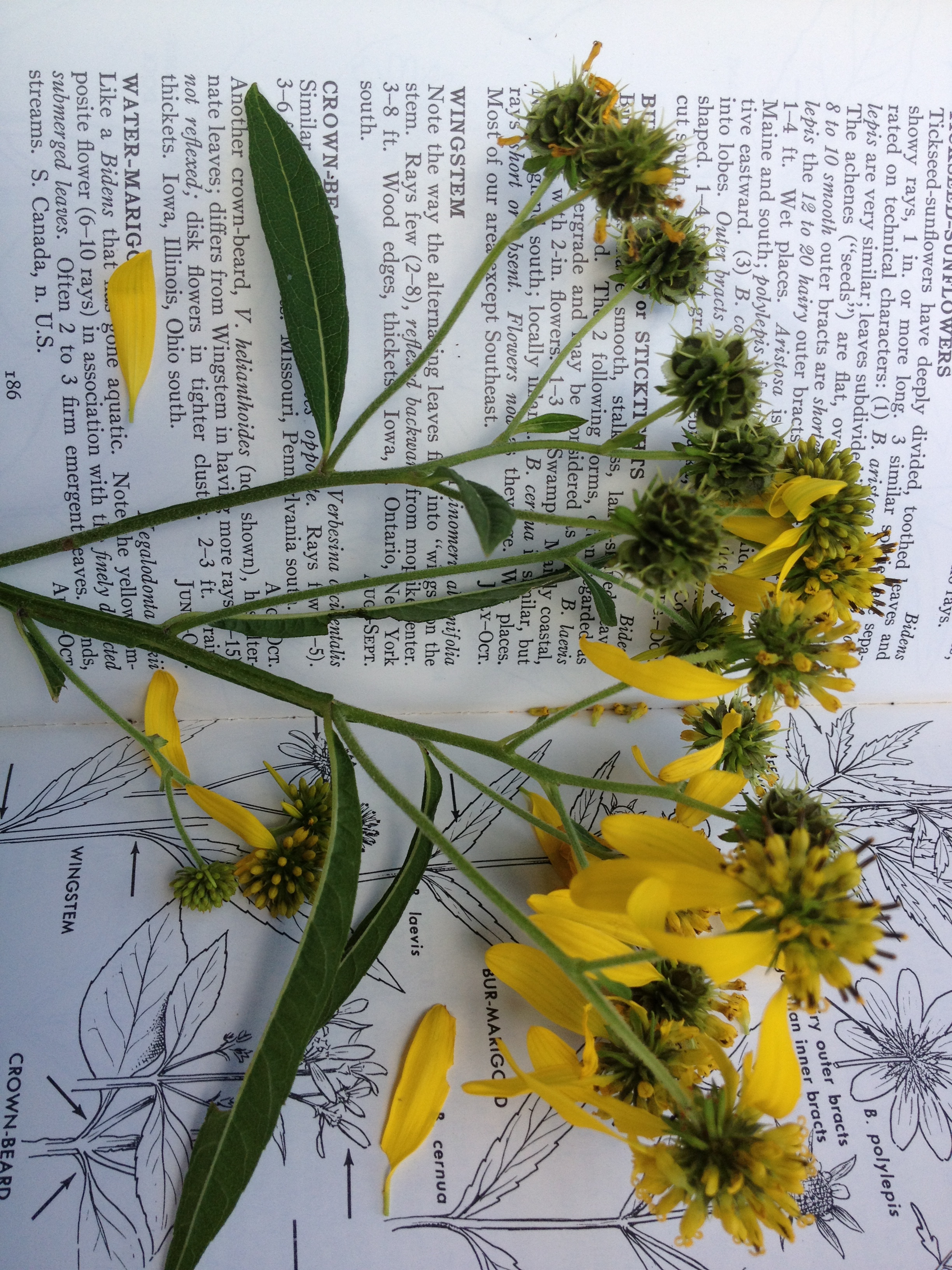
Wingstem, a member of the Compositae or Asteraceae (the daisy/sunflower family) is named for its wingedness. The petioles of the leaves lead into ridges, called wings, on the stems. This is not totally uncommon in plants. Burning bush, for example, bears prominent woody or corky wings on its stems. Wingstem has rough, sandpapery leaves that bear marks of numerous predators, but it outgrows all the chewers beautifully.

Wingstem flowers and immature fruits displayed against page from Peterson and McKenny's North American Wildflowers.

Wingstem flowers and immature fruits displayed against page from Margaret McKenny and Roger Tory Peterson’s A Field Guide to Wildflowers: Northeastern and North-central North America.

There can never be too much wingstem. Because it is so tough, so tall, and so yellow. And another admirable quality is that in the winter it vanishes, all of its abundant foliage replenishing the Earth. If only humans’ “stuff” could do so as well, vanish, without the artefacts of imperfect ownership littering the landscape.

Williwaw

I learned a new word recently. Williwaw. I like words that describe the earth’s atmosphere and geography.  It is a wind, and winds often have unusual names, like haboob or black bora. The williwaw belongs to the group known as katabatic winds, those whose swoosh is accelerated by gravity. Most specifically, a williwaw is a violent wind (120 mph or so) that blows down from the lofty mountains and glaciers looming over the Straits of Magellan. Here, in Fireland or Tierra del Fuego, at the end of the world, British sailors used the word to describe the ferocious winds that battered their little boats.


dreamstime_xs_14517561


A williwaw understood figuratively is “a state of great turmoil” according to several dictionaries and certainly it is a good word to describe Darwin’s culture shock meeting the Fuegians of Tierra del Fuego. The “calm naturalist” of the early chapters loses his dispassionate, even-handed stance. Chapter X is full of exclamation points as he describes the behavior of the “savages” or indigenous people. Readers become part of the strange, sad, and moving story of how three Fuegians were stolen from their home by Darwin’s captain, taken to England, dressed in European clothes, taught English, introduced to the King and Queen of England, where they carried themselves well, and then returned to the shores of their rugged, williwaw-swept landscape with tea cups, wine glasses, tablecloths, and seeds to spread civilization among their “savage” relatives. In order to further our understanding of Darwin’s account of “the Fuegian story,” the students and I read excerpts from Lucas Bridge’s Uttermost Part of the World: A History of Tierra del Fuego and the Fuegians and Nick Hazlewood’s Savage: the Life and Times of Jemmy Button. The Fuegians are extinct now, except for portions of their gene pool represented in the current population of South America, but they live on in books and the work of professional historians and students. In our reading we have learned how tough women can be. The Fuegians were dependent on the sea for much of their food, and the women ran that show. They paddled the bark canoes and they fished with plaited ropes made from their own hair. Men were barely able to paddle and they couldn’t swim. Nomads, the Fuegians carried their fire by boat, nestling it on a plinth of rock and sand. At night the woman would paddle close to shore, unload the man and children, and if unable to safely beach the canoe, paddle out hundreds of meters to a kelp bed, tie the canoe up with kelp fronds, and then swim back to shore in icy waters, completely naked. Darwin describes a naked woman nursing her infant in a canoe while sleet slashes down upon them. We, the students and I, are impressed by the physical fortitude of these Fuegian women (so far a cry from the near-contemporaneous delicate young women of Downton Abbey).  I admire the knowledge gained, the sensory experience earned, as the Fuegian women swam through icy kelp beds toward the fire on shore in the land of williwaws.


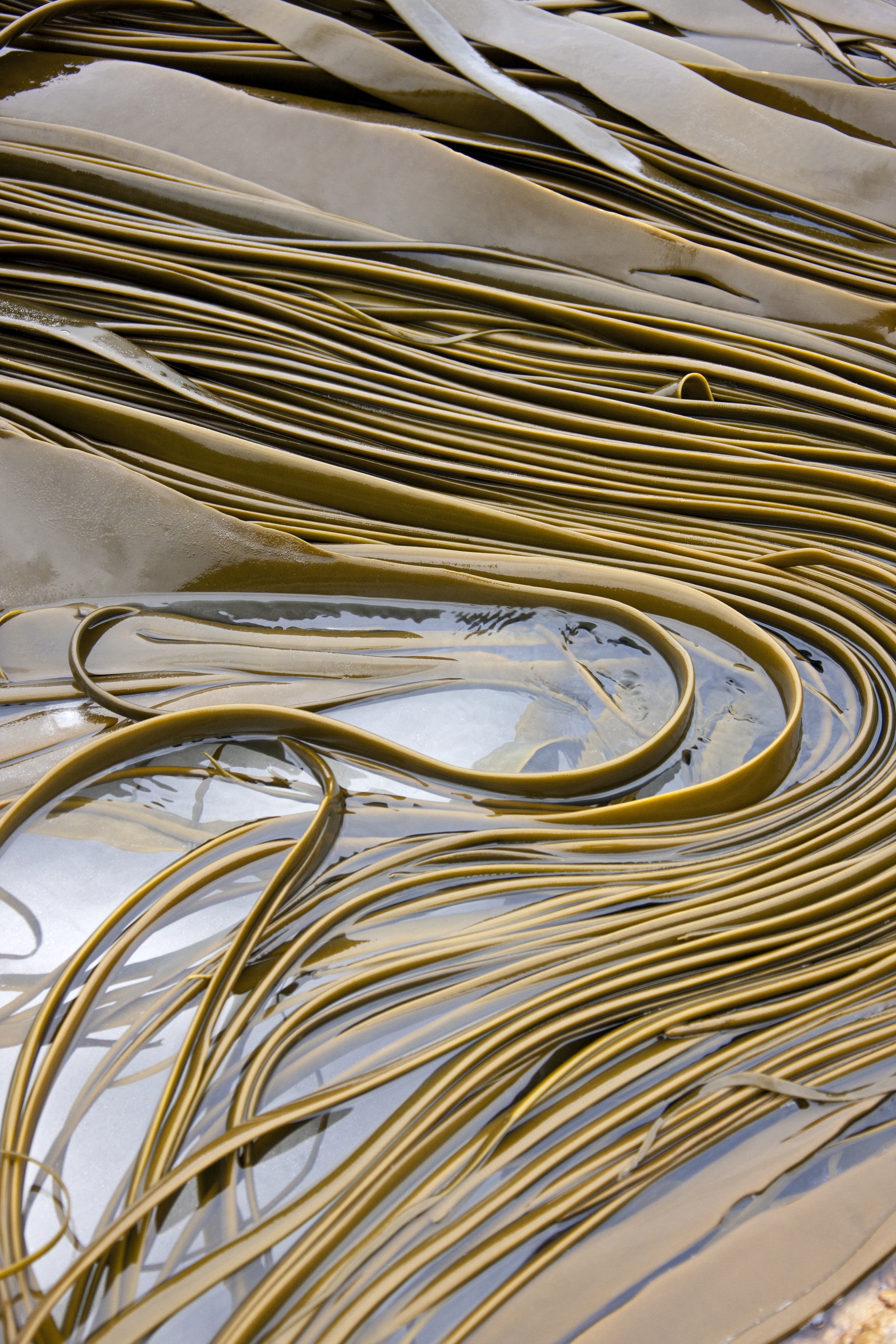
Kelp fronds

Kelp fronds

The Young Woman and the Zorillo!

It’s 7:20 am and I am rushing to work because I have a handout to prepare for my Darwin class. The roads are clear but a layer of fluffy snow covers the tree branches as billowy fast-moving clouds move across a blue sky. I proceed down Fall Creek Drive to the Stewart Avenue Bridge over Fall Creek gorge. There just completing her walk over the bridge is a stunning young woman, probably a graduate student walking up to Cornell. I gasp at how beautifully dressed she is for so early in the morning. She wears stiletto-heeled black leather boots that fit her slender calves tightly, ending at the knees where curly fringes dangle. Legs in black tights disappear beneath a short black mini skirt. Then a black jacket with postmodern styling. Silver buttons? Something sparkles. A generous swath of diaphanous black scarf tumbles artfully around her neck, intermixed with her own glossy black hair. A beautiful face beautifully made up. She strides along  eating something. It is hard to capture all the details at 10 miles per hour but my impression is that she is unwrapping a chocolate, but it could be a cough drop. So nicely put together, she looks the picture of confidence.


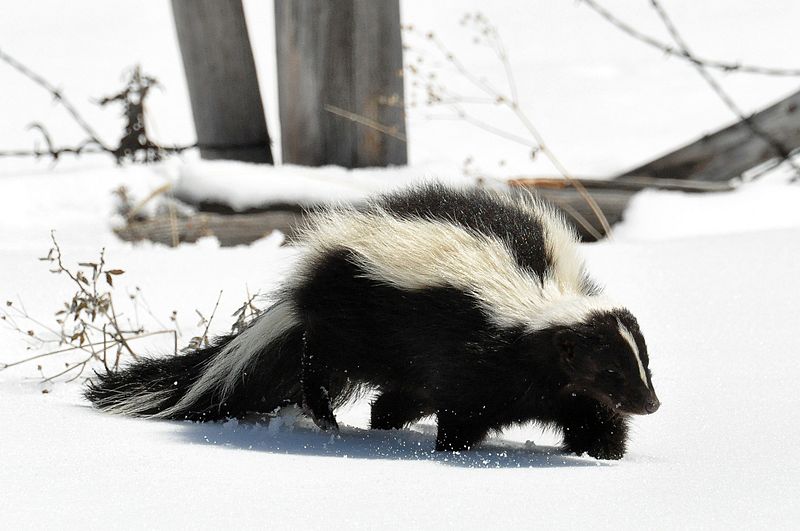
Striped Skunk (Mephitis mephitis, photo courtesy Dan and Lin Dzurisin, Wiki Commons)

Striped Skunk (Mephitis mephitis, photo courtesy Dan and Lin Dzurisin, Wiki Commons)


Then, I see a skunk maybe 15 or so paces behind her on the bridge’s sidewalk, fretful turning this way and that, appearing to feel indecisive about whether to follow in the direction of the young woman or retreat and go back to the other side of the bridge. Maybe it has just realized how deep the gorge lies below. A slightly bedraggled skunk, it still is striking for the amount of white on its back. Suddenly it runs quickly, extremely quickly for a skunk, who usually find little reason to get out of anyone’s way. In my rear view mirror I see that the skunk is now just a few feet behind the young woman. It looks as if the skunk is chasing her. How will this story end? There is no place for me to turn around, just as there is no place for the young woman and the skunk to get away from each other easily. Did the insouciant seeming young woman lose her insouciance? Did the skunk overtake her and pass by, following other urgent interests? I pose various fictional endings to myself, some amusing, others dreadful and fantastical, but am most interested in what I cannot know–the true ending of this true story.

Curiously the students and I had just been talking about skunks a propos of Darwin. We have been admiring Darwin’s lovely temperament–how unbiased and good-natured he is in his observations and encounters throughout his long voyage on the Beagle. He is painstaking in his descriptions of the Diodon (puffer fish) and the Aplysia (sea slug) and so on. He is curiosity itself–except when he comes across a skunk, which in South America is called the Zorillo: “We passed the night in Punta Alta, and I employed myself in searching for fossil bones, this point being a perfect catacomb for monsters of extinct races….In riding back in the morning we came across a very fresh track of a Puma, but did not succeed in finding it. We saw also a couple of Zorillos, or skunks,–odious animals, which are far from uncommon. …Conscious of its power, it roams by day about the open plain, and fears neither dog nor man….Certain it is, that every animal most willingly makes room for the Zorillo” (The Modern Library edition, p. 72). And so he did–Darwin, the most tenacious naturalist of all times, made way for the Zorillo. I continue to speculate on the seemingly inevitable encounter between the young woman and the skunk that I have described. Did nonchalance meet nonchalance? In other words, perhaps nothing of note occurred after I rounded the corner beyond the bridge.

An Homage to Charles Dickens on his 200th Birthday

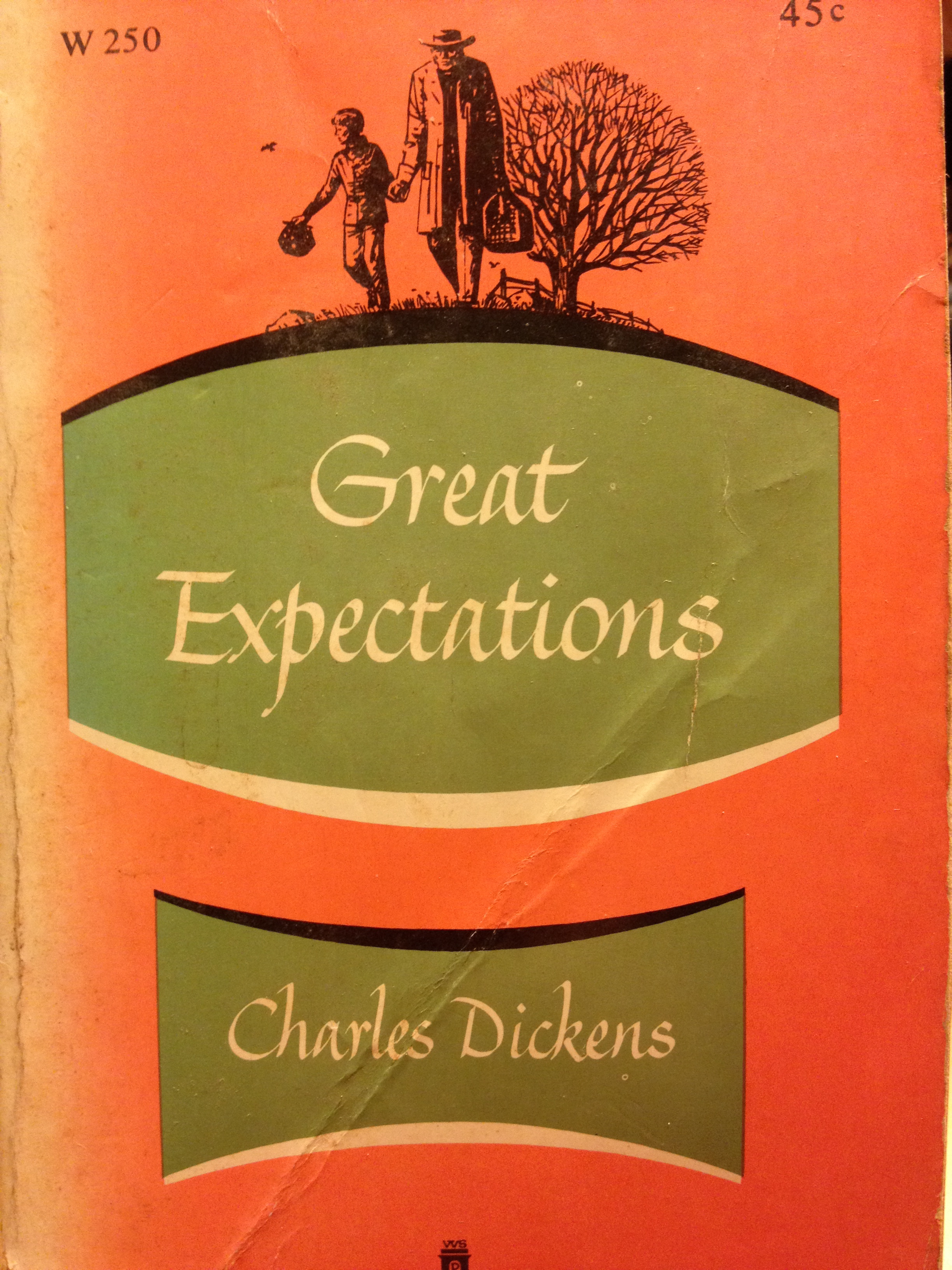
Some of my Dickens

Some of my Dickens


On February 7, 2012 I am on my way to work to meet an 8 am class with Ithaca College first-year writing students when I hear on NPR that it is Charles Dickens’ 200th birthday. My students and I are going to be discussing another great writer with initials C. D., the one with the haunted eyes and the flowing beard, Charles Darwin. We are reading The Voyage of the Beagle: Journal of Researches into the Natural History and Geology of the Countries Visited During the Voyage of H.M.S. Beagle Round the World. We call it The Voyage. I share with my students the news that Dickens birthday parties are being held worldwide, and some of them look pleased. We had discussed their tastes in literature. About half loved Great Expectations, and the other half shook their heads.

The NPR story featured an interview with Claire Tomalin, author of a new biography of Dickens called Dickens: A Life. Tomalin tells the interviewer that Dickens wrote extremely fast, and his books were published with little to no revision by him or by editors. No revision??? Revision is one of the core values of writing instructors.  So this I do not share with my students. Tomalin says that there is “bad writing” in Dickens’ books, but it is outweighed by the good. I muse that if Dickens had been as energetic a reviser as a writer, he might have found himself at square zero, i.e., no books, but more to the point, in his day sheer volume was one way of satisfying reading appetites. There were no motion pictures. While it may not be accurate or fair or useful to say that a picture is worth a thousand words, Dickens painted many scenes with thousands of words. He wrote fast, and that was the method to his madness.


Another Dickens from my library

Another Dickens from my library


After class, hurrying off to make my appointment with a propane deliverer in Aurora, 30 miles up Cayuga Lake from Ithaca, I make a dash-by stop at my local library to get a Dickens on tape for my own little Dickens birthday party. No David Copperfield. No Great Expectations. Bleak House! Oh no. I remember one of my academic debacles in college. An English major, I signed up for a semester-long Dickens course. A young visiting professor from UPenn got us off to a fast start. We were to read an entire small Dickens novel per week and a half of one of the big ones, like Bleak House, per week. I was a fast reader and I liked Dickens, especially his lengthy sentences, his word pictures. I started copying out sentences and passages that I liked as I read. My stack of note-cards grew almost as tall as Bleak House was thick. I fell behind. I stopped going to class. I foundered in the wealth of his words, like a pony in spring clover. I either failed the course, which I don’t think occurred because there are no F’s on my transcript, withdrew (but there are no W’s), or the professor had a medical emergency and the class was terminated (a faint possibility according to my memory because I remember a sense of guilt that she, the professor, had foundered because students like me couldn’t keep up). I had kept up with Henry James, but Dickens….


IMG_0171

I slip the CD into the player and prepare to re-engage with Bleak House. The Prologue is witty but dryish; when I start to drift a little I am brought to attention by the mention of a woman dying of spontaneous combustion. What? It’s too late to figure that out because the first chapter is beginning. I am attentive. The slate-blue waters of Cayuga Lake and low gray clouds are on my right and the rolling folds of Lansing fields on my left as the first chapter begins. It’s a very beautiful beginning, very grand, suitable for a big book. A slender book would not need such a beginning. The sun is dead. Fog swirls out of the nooks and crannies of England’s landscape and seascape, descending  into the heart of London, to surround the High Court of Chancery. Dickens invokes the fog, and mud, and foul weather to begin his passionate assault on this high court, “most pestilent of sinners.”  He repeats the word “fog” over and over, but it does not feel overused. We know that when it’s foggy, fog is everywhere, and fog is fog. There are not that many other words for it. Just one or two. Then Dickens uses one of the synonyms so beautifully near the end of this opening passage. We are now in the presence of the Lord High Chancellor, who sits in the court “with a foggy glory around his head.” And his minions–they are “mistily engaged” in their miserable tasks. For me, the attachment of “mistily” to the human activity is stunningly effective. Nature and chancery are one. He has brought the fog from all over England to the fingertips of these workers in a befuddled, and often malignant, bureaucracy. I reach Aurora, but I am still in the first chapter of Bleak House because I replay the opening chapter again and again. Maybe some books should be written fast, but read slowly.


IMG_0198