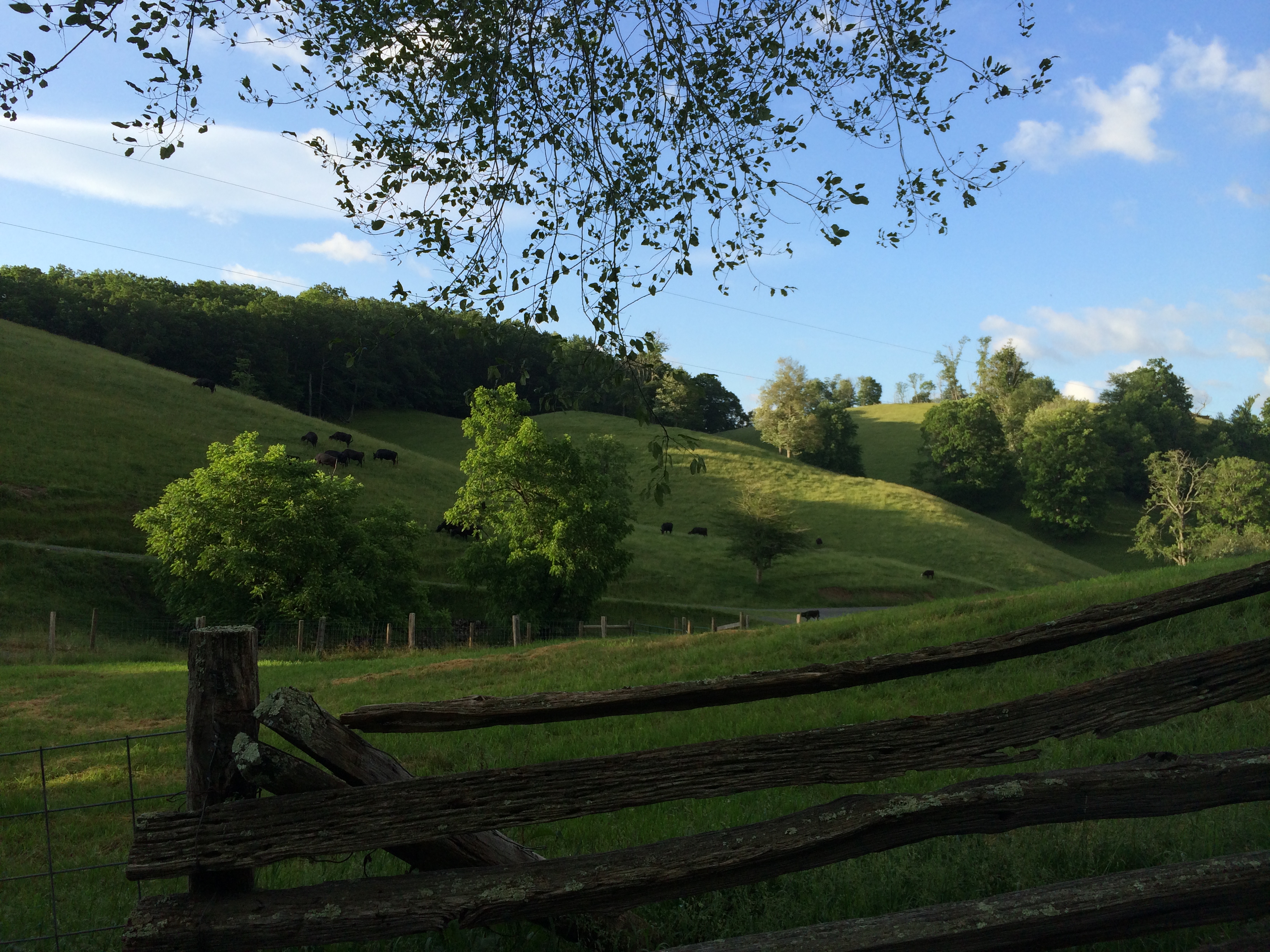
Ruminating Over the Cows and Calves of Vinegar Hollow

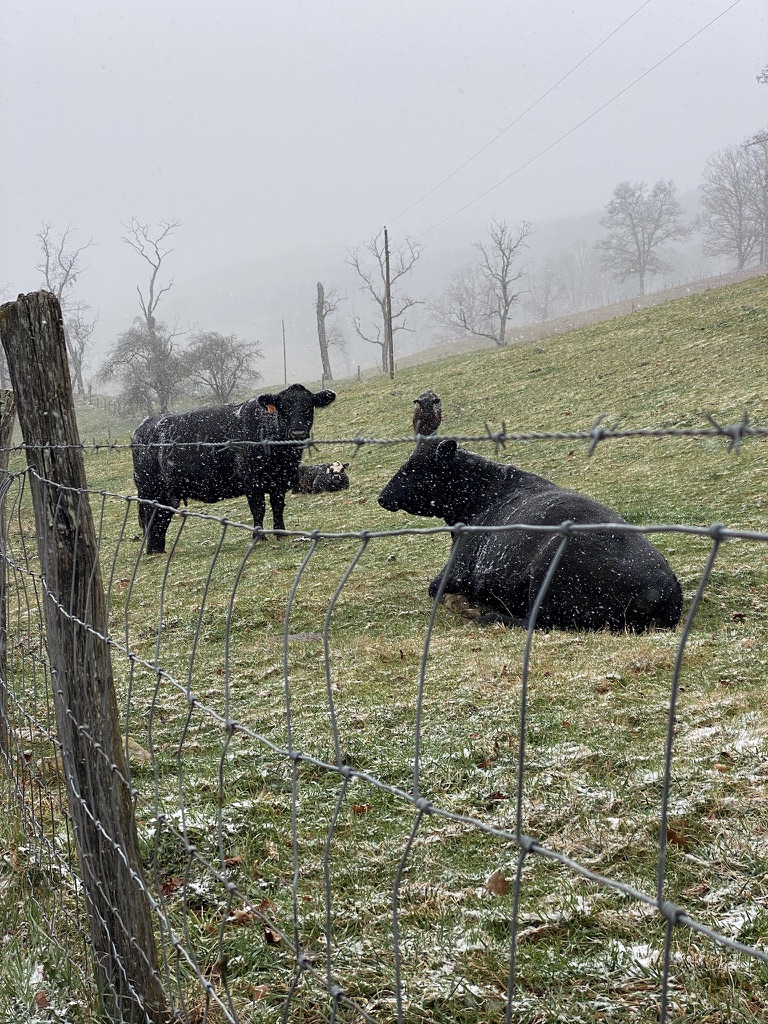
November 2024: The first snowflakes of 2024 have landed in Vinegar Hollow. They are lying in the pockets of the fallen beech and oak leaves, clinging to the rhododendron leaves, and adding frosting to the landscape. I am also cow-watching from my writing desk, between the fireplace (warm) and the sliding glass doors (cold). I am studying a cow with an orange ear tag and another one seated in profile. She is sitting as snowflakes whiten her coat. In profile she looks like a buffalo or rather a bison. (A recent discussion among biologist friends has clarified the fact that the American “buffalo” is technically a bison, whose scientific name is bison x 3, i.e.,  Bison bison bison.) A word about bovine terms: heifers are female calves, bull calves are just that, cows are adult females, and bulls are adult males.

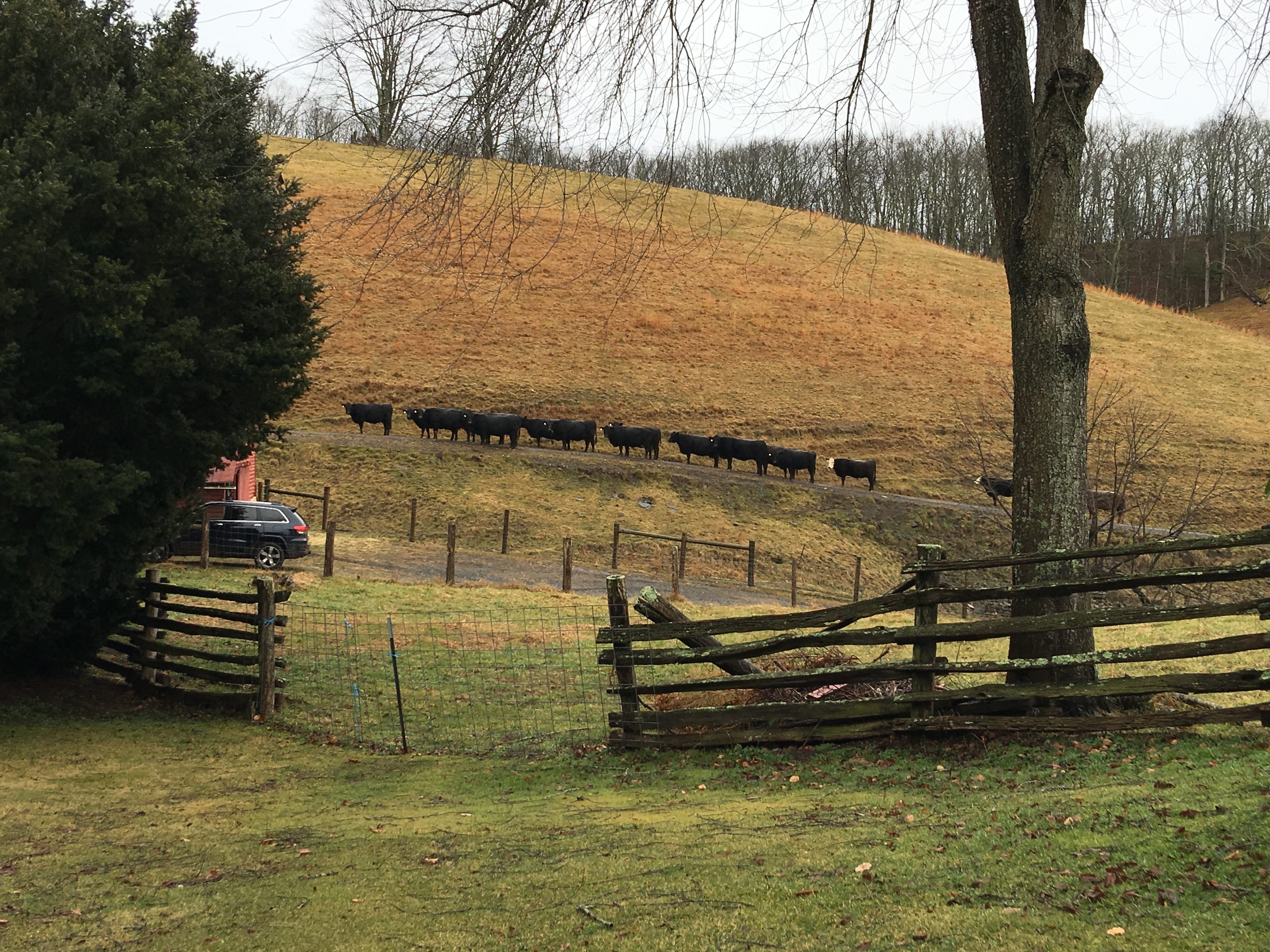
Cows in all seasons come up in the late afternoon through the orchard meadow and sit on the opposite side of the fence from garden. For me, it’s a visit that I can count on. They often just sit or stand on the other side of the fence, staring into the distance.I am developing a theory that they are ruminative creatures in more than just the literal sense. Mike, who owns the cows that graze here, says they are just like people, each with their own unique personalities. I was hoping they were a step up from humans because of their grounded lifestyle. In any event, as I eye this “buffalo”-like cow, I see she appears to be chewing in the literal ruminative sense of the word, imperturbable even though there is a winter storm advisory until 10:00 pm tonight. I am glad that she and her companions are near. We have almost constant weather advisories. Two nights ago there was a wind advisory and soon enough a whirling dervish of a storm came howling through the hollow as night fell. It groaned and moaned before abruptly leaving at dawn. I am told there were 300 power outages in the area, but I was spared and felt very grateful to be able to have my morning coffee, as on my previous visit I was without power for nearly 48 hours. 

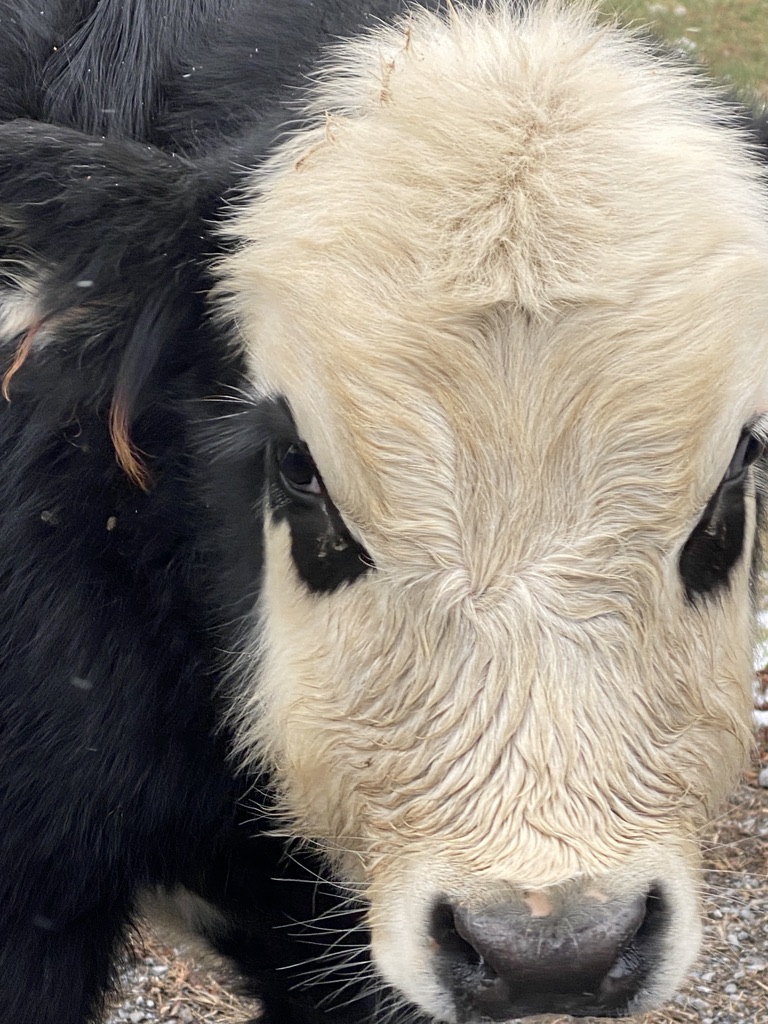
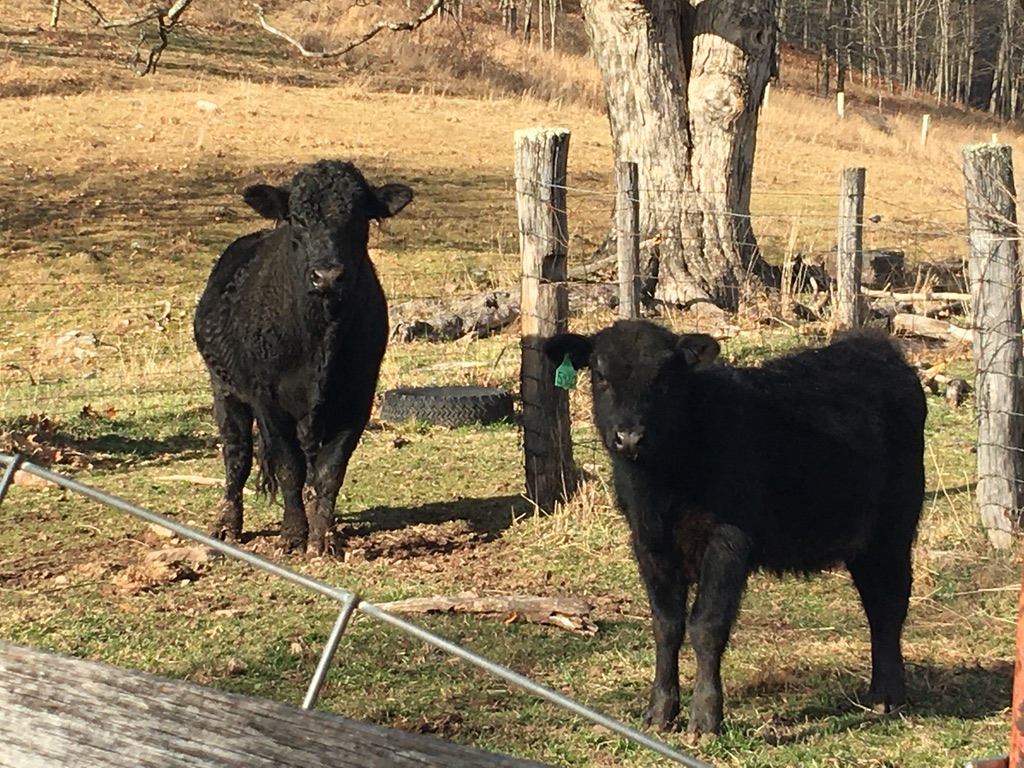
Today when I came back from getting groceries, I met two dawdling calves on the cliff road. They were moving along in a desultory fashion, jostling each other now and again, at ease and companionable. They turned their heads to look at me but didn’t change their pace. So be it. I didn’t want to force them down the steep slope to the left and there was little room on the right, so I advanced slowly but steadily. The smaller one (I believe a bull calf) finally took a dive off to the left—while the larger one stayed his ground and moved to the right. I was able to take his portrait from the car at just a foot or so away. His gaze was direct and calm. What a lovely face! I have often seen groups of calves playing and know they value playmates just like human kids.

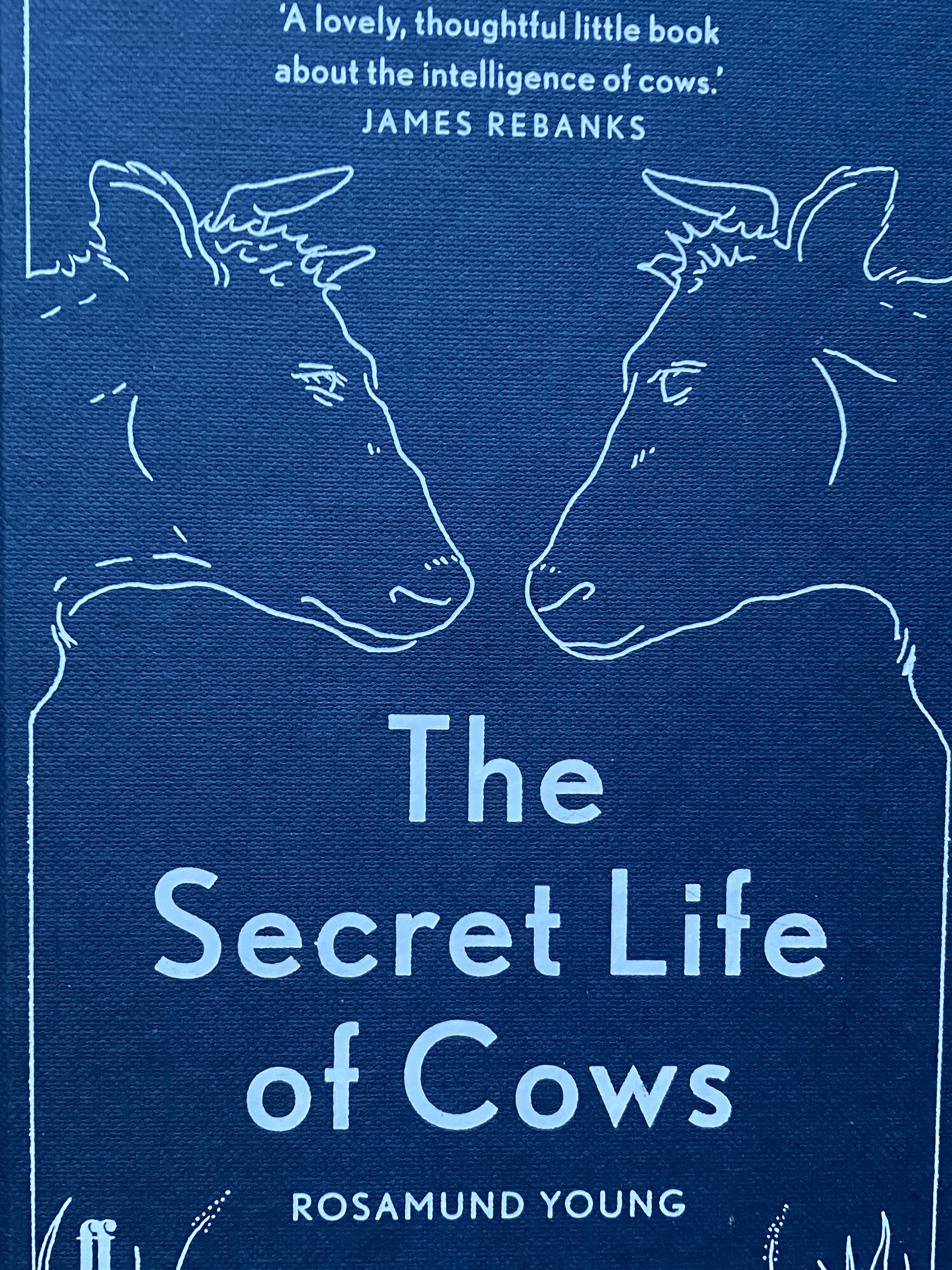
Studying his portrait and thinking about my cow mother friends led me to find a book I had long wanted to read–The Secret Life of Cows by Rosamund Young. First published in 2003 and reprinted in 2017, it is considered a classic in the field of animal observation. Rosamund and her brother Richard and partner Gareth have tended a herd of Ayrshire milk cows on Kite’s Nest Farm near the Cotswold Escarpment for many years. Rosamund tells stories about their cows and other farm animals, persuading readers that cows are just like people, something that Mike has often told me, as I mentioned, based on his experiences tending to his beef cattle in Vinegar Hollow. Rosamund both tells and shows readers that the animals she knows are individuals. She writes, “Just because we are not clever enough to notice the differences between individual spiders or butterflies, yellowhammers or cows is not a reason for presuming that there are none” (p. 3). Her statements throughout are eloquently sensible.

In turn she is able to write about individuals because all members of the herd have names, which sometimes change as events occur in their lives. For example, Highnoon IX became Mrs. Bumble when she produced a “red-and-white bull calf who bumbled about instead of walking, in a cross between a stroll and a lumber” (p. 14). Mrs. Bumble then produced a heifer calf, Miss Bumble, who produced twin heifer calves who were named the Misses Bumble. At this point Miss Bumble became Granny. When Granny produced a tiny calf named Dot she was able to adopt a 2-week old bull calf named Pritchard whose mother, Mrs. Pritchard, had died suddenly. Before Granny was producing milk, Rosamund had been feeding Pritchard by bottle: “Often it would be almost midnight when I trundled up the hill with his last feed, champagne bottles of warm milk clanking at my sides” (p. 43). She describes how her job was made harder as Pritchard hung out in a group of look-alike-in-the-dark calves. There is always plenty of hard work involved in being responsible for the welfare of dependent animals.

A group of calves hanging out together in the fall with a cow on either side.

In a section titled “Bovine friendships are seldom casual,” she writes “it is extremely common–the norm in fact–for calves to establish lifelong friendships when only a few days old” (p. 59). Thus comes the story of the White Boys, whose profiles appear on the cover of the book. Nell and Juliet produced pure white calves a day apart:”We had never had such white calves: grey, cream, buff, off-white, silvery, golden, but not pure white. The first calf walked over to greet the new arrival and stared at him as if looking in a mirror. They became devoted and inseparable friends from that minute” (p. 59). She writes, “The White Boys lived in a world of their own, in the midst of a large herd but oblivious to it. They walked shoulder to shoulder, often bumping against each other, and they slept each night with their heads residing on each other. They were magnificent: tall, gentle, independent, kindly, though not over-friendly, noble. One had a pink nose, one a grey” (p. 60).

Now when I look at the cows and their calves I will ruminate about their lives. They don’t have long together as most beef calves will go to market (the slaughterhouse) at 9 months or so of age.

Reading The Secret Lives of Cows was comforting and inspiring–because the author showed me that when humans interact in meaningful ways with other species they create peaceful kingdoms within themselves and for others.

A cow visiting last summer on the other side of the garden fence.

I love visiting with the cows and their calves over the garden fence. They are my main companions as the day goes into night at the end of hollow.

On the longevity of pear trees

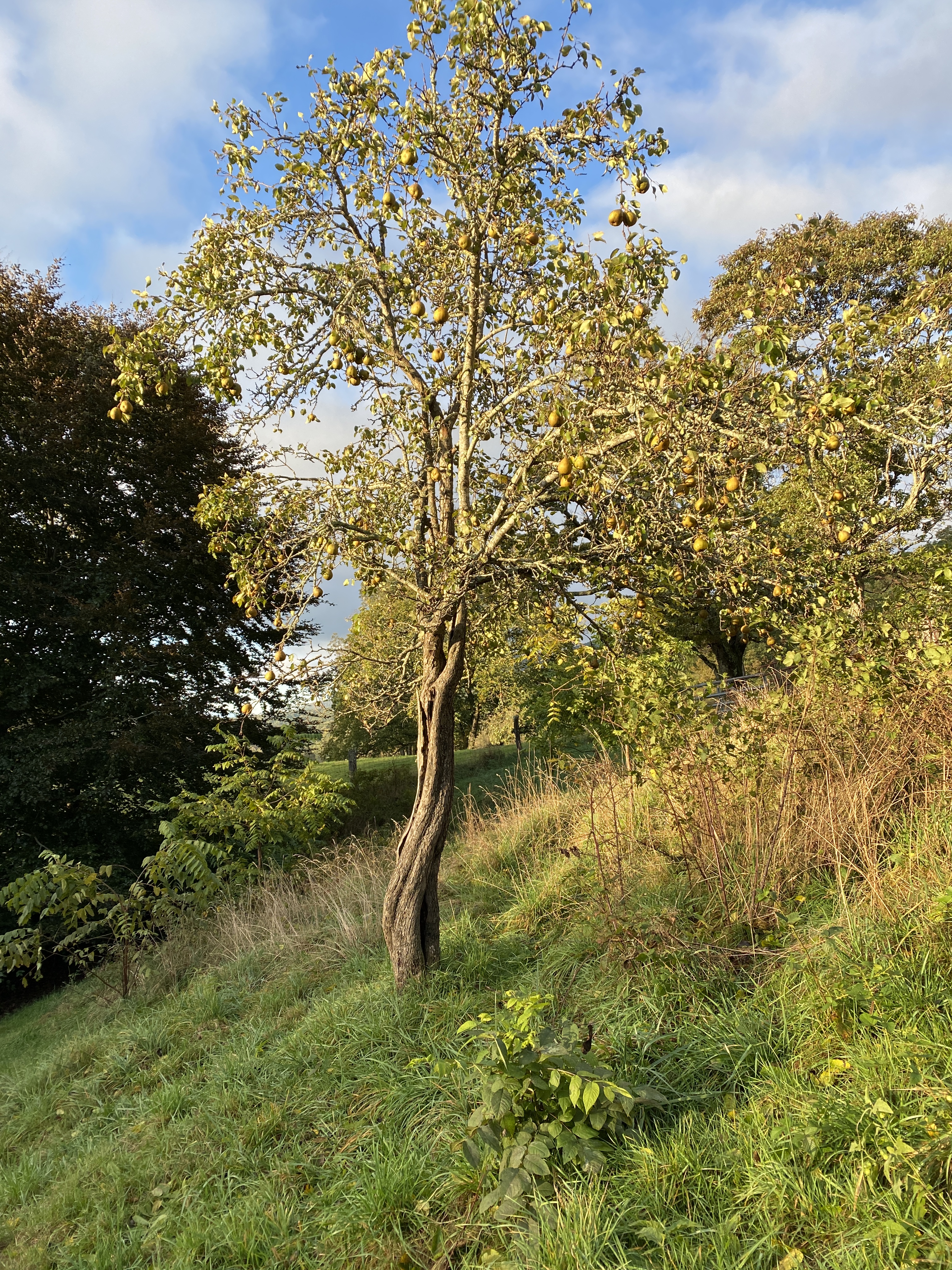
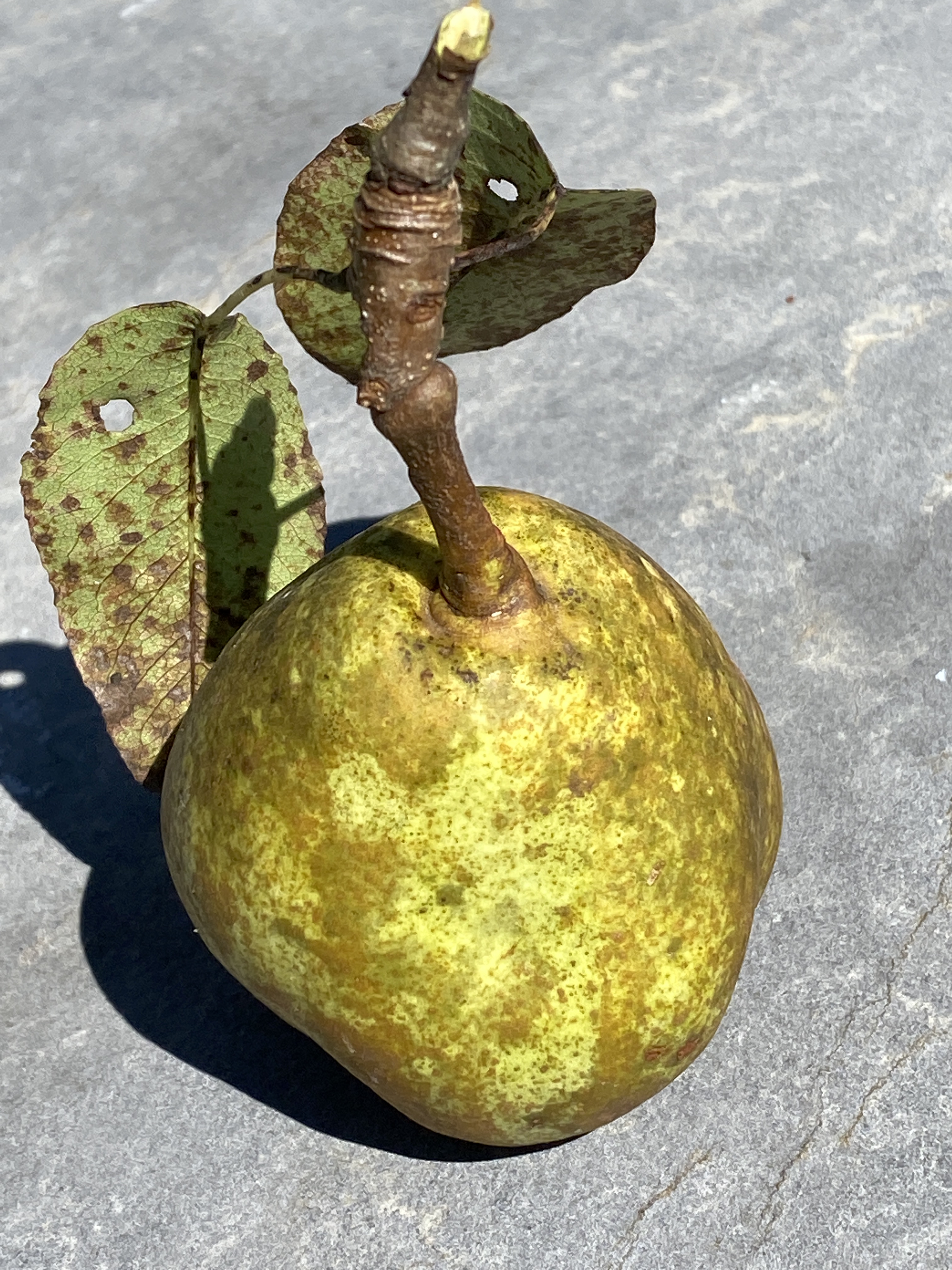
On a recent trip to Vinegar Hollow I made a point of reacquainting myself with an old friend. It is out of my usual view, perched on a steep little hillside up above the root cellar. The pasture around it is deeply rutted by cow trails and tough tussocks of tall grasses. It takes some effort to come face to face with this friend, as one is either looking up at it or looking down upon it. Since I was very young, it has looked very old, but now I am catching up in age, and it seems to be reversing course, looking younger. I have never seen a more bountiful crop of pears even though August and September were droughty. The pears are large, green gold, gleaming in the sun, holding on tightly. They cannot be pulled off easily. They seem to prefer to fall on their own terms.

The leaves, branches, and pears play with the sunlight.

Each pear is a work of art with a myriad of spots and speckles and blemishes, documenting the history of growth day by day. I pick a few from the ground and photograph them. Each one is perfect in a slightly different way.

Green and gold.
Most of a pear’s nutrients are in or just below the skin, so all these blemishes are nutritious.

There is no one alive now to tell me how this lone pear tree came to be here. Since I am almost three-quarters of a century, I would say it must be at least 100 years old. Its trunk has always had been braided, existing on twining remnants of a once vigorous tree hollowed out by age. Wild pears apparently are round, so this tree with pear-shaped pears came from cultivated stock. There is a Peach Tree Hill on the farm, named for a small orchard of peach trees set on its steep hillside. Grooves of the orchard rows on the hillside were visible for years after the trees had died. The early farmers had to work very hard to grow any crops on this rocky limestone land, which is best suited for livestock grazing. There is no lore about a Pear Tree Hill in this hollow, but perhaps I can start a story and name this little slope the Pear Tree Hill. 

I am amazed that this fragmented trunk can still pull enough nutrients from the ground to nourish so many pears.

Curious about the longevity of pear trees, I went to the internet. It seems that wild pears (Pyrus communis subsp. pyraster) can live several hundred years. I came across an “obituary” for UK’s Cubbington Pear, said to be at least 250 years old. It was felled to make way for a high-speed railway line (HS2) despite a 10-year protest by environmentalists and local activists.  Billions of pounds have been allocated to the HS2 project, but even so costs spiral and the line to Leeds has already been scrapped. I also came across a recent story with an environmentalist angle: “Environmentalists advocate for ancient pear garden in Lanzhou, China.” The orchard is part of a park that is over 600 years old. One of the pear trees is said to be 400 years old. Numbers have dwindled from 13,000 to 9,000 due to use of the trees as building materials and lack of replanting. 

A visitor to Lanzhou’s pear garden who had visited the garden as a child recalls this impression in 2021:

The same pear orchard, I came to watch it again after twenty years, but I never thought that it moved my heartstrings so much. Is it the so-called three stages that must be experienced in life: seeing the mountain is a mountain, seeing the mountain is not a mountain, seeing the mountain is still a mountain. The realm of life is constantly sublimated with the precipitation of the years, thick and beautiful.

There is some awkwardness in the phrasing for an English-speaker, probably because the text has been translated from the Chinese, but I love the description of the “precipitation” of years as “thick and beautiful.” Also, I was interested in what he said about ways of seeing a mountain in different stages of life. I puzzled but felt I was missing something, so I asked Google to enlighten me with this search term: “seeing a mountain three stages of life.’ I found the Three Mountain Problem was posed in the 9th century by Qingyuan Weixin, which D. T. Suzuki translated in 1926 as “Before a man studies Zen, to him mountains are mountains and waters are waters; after he gets an insight into the truth of Zen through the instruction of a good master, mountains to him are not mountains and waters are not waters; but after this when he really attains to the abode of rest, mountains are once more mountains and waters are waters.”

Vincent Van Gogh painted several pear trees. The angular trunk of this pear tree is similar to the one in Vinegar Hollow.

So, are we to understands that in our youth we see with wonder and clarity, while in our middle years our view is limited because we live in our heads beset by the fears and anxieties associated with earning a living and caring for family, and then in the final stage of life we can, in the best of all possible worlds, become fully attentive again (enlightened)–a mountain is a mountain rather than something vastly symbolic or useful for other purposes than being a mountain? Maybe we can even think like a mountain (see Aldo Leopold’s Thinking Like A Mountain” . A few days ago I heard a news item about the lack of restoration, which had been promised, for the mountain top removal that occurred in West Virginia during coal mining. From an environmental point of view, one might like to see the thought that part of being attentive is to accept the mountain as a mountain and let it be. 

When I returned to Ithaca, I brought one of the pears to my neighbor and friend, little Fran, who is 99 years old. She is a musician, poet, and writer. I always give her pears, real ones and once a pear Christmas ornament. I always tell her she is like a pear, not an apple for sure, but definitely a pear. At 99, she is just like the pear of Pear Tree Hill. She is finding it hard to believe that she is still worthwhile and beautiful, but I tell her that she is like the pear tree. I will go back in November and climb the steep little hill. Maybe the bear has visited the tree and eaten the drops. Earlier this fall Mike told me not to worry if I saw a young bear sitting under the walnut tree where I park my car, which is not too far from the pear tree. He says that the bear eats walnuts whole, hull and all. He says that you can hear the clicking, crunching sound from pretty far away. And, yes, this little bear will come for the pears. Bears have such sweet tooths! This reminds me to add a note about the two fairy tale apple trees in the orchard that I wrote about in my last blog. I suggested it would take a hook and ladder truck to get at the apples. Mike says the bear spends half the day aloft in those trees eating the apples! Walnuts, pears, and apples—perfect provisions for winter!

In any event, I have certainly been inattentive to this pear tree. Luckily, there is some time left I hope for our relationship to continue. I remember how years ago when I was young, my father and I happened to come back from a walk and pass by the little tree. I asked how it could still be alive because of the hollowed-out trunk. He said he didn’t know but smiled knowingly. It was clear to me that he loved the tree. What can I learn from the pear tree? That longevity can be beautiful, that I am fortunate to know that a tree that has been a friend of my youth now will be a friend of my old age. I wish very much that it will outlive me and be a friend in my hereafter. It looks likely that my tree will do so. In September 2022, fruit was picked from a pear tree in northeastern Turkey said to be 1100 years old. Anatolia is thought to be the home of the pear. Conditions in Vinegar Hollow may be similarly conducive to longevity. I am also heartened by this quote from Virginia Woolf’s To the Lighthouse (it was in the magazine Taproot that came to my mailbox this weekend):

And all the lives we ever lived and all the lives to be are full of trees and changing leaves.

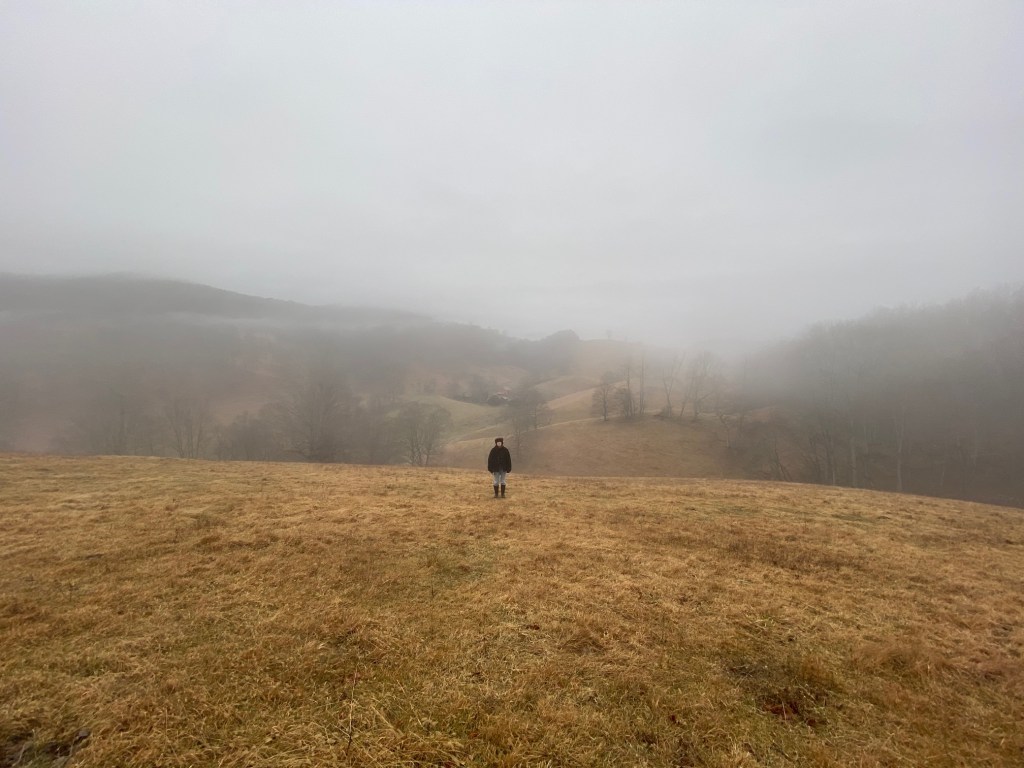
Vinegar Hollow: 2019 (mist) ends and 2020 (sun) begins!

I am looking to the north, but the view is to the south end of Vinegar Hollow I favor photos without people, because there are so many of us, but my husband said that we need scale and human interest. Photo credit courtesy of David Fernandez.

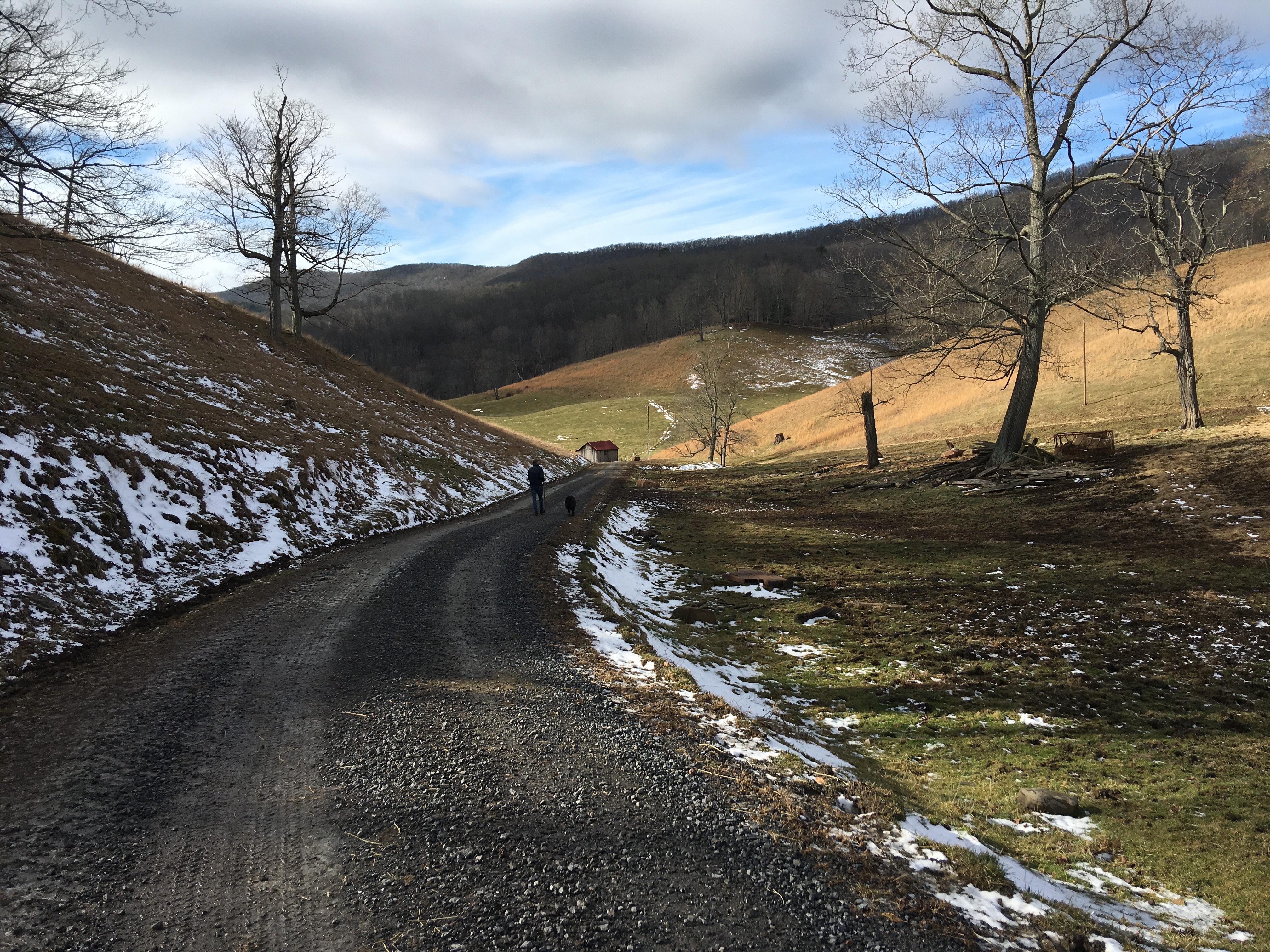
Once again I am here for my year’s end reset. The trip from Ithaca is long, and we arrived in the dark. The gutters gurgled gently in the night, so it was not unexpected to see an overcast sky in the morning, but there was an ocean of mist filling the entire hollow.

Another view from Stark’s Ridge to the south end of the hollow.

The mist looked gentle and soft, like a soothing gauze bandage over the landscape and its inhabitants. It was peaceful. I wondered whether I would want to see the sun again. Luckily the sun pays no attention to silly thoughts. As we walked, I marveled how the hollow always offers me surprises after all these many years. Sometimes I go looking for stories, sometimes they just find me, and sometimes they are the latest chapter in a long history.

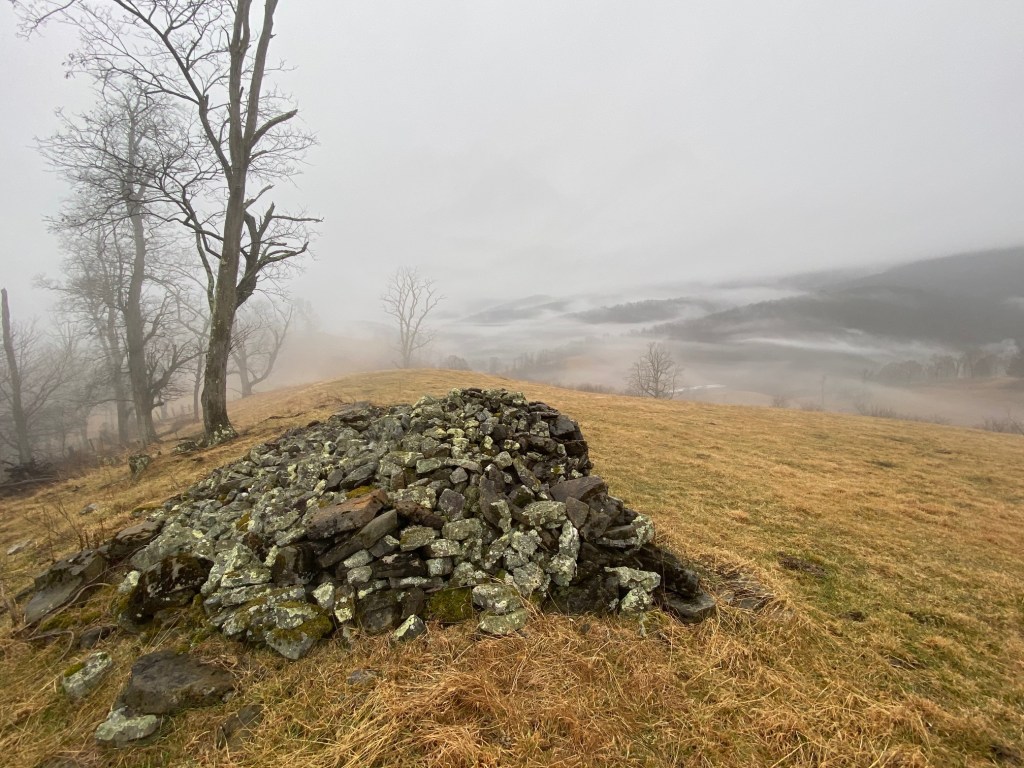
Rock cairn, a haven for mosses and lichens, on the top of Stark’s Ridge looking south. Photo courtesy of David Fernandez.

A misty, warm morning is the perfect time to focus on mosses and lichens. They appreciate moisture, so having absorbed the overnight rain and morning mist and expanded in the warmer than usual temperatures, they were in glorious condition on the morning of December 29. My husband says that my current interest in mosses and lichens makes it even harder to walk with me. I tend to creep, slowly. The stories of plants are harder to dramatize but just their appearance offers food for thought.

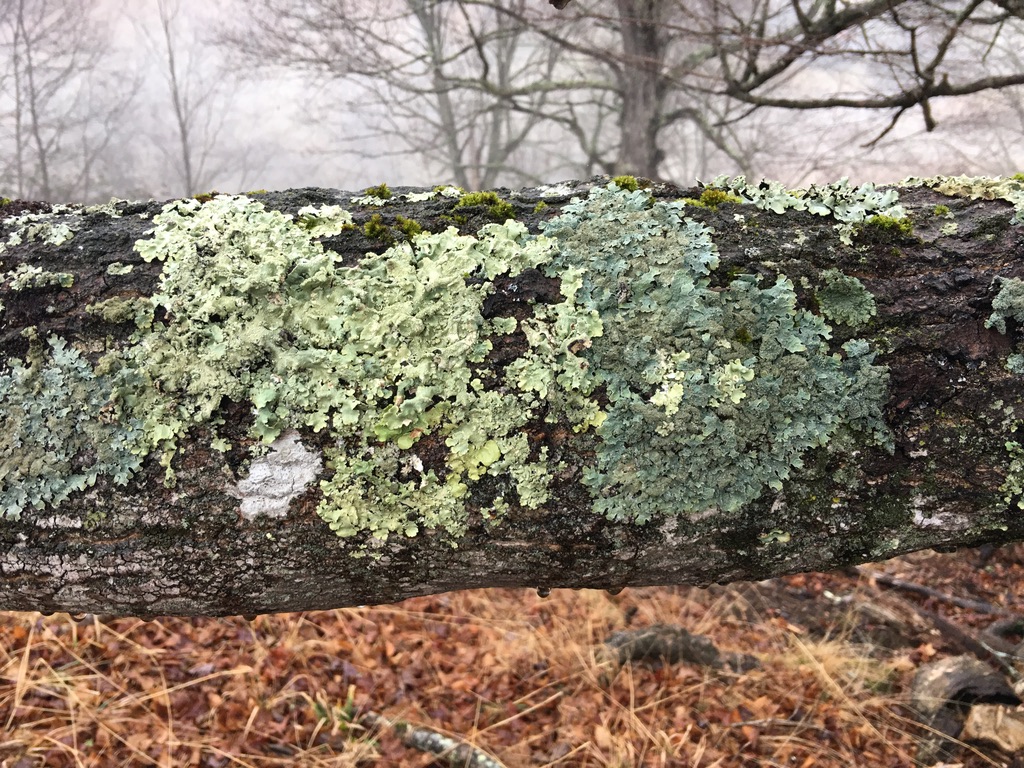
Fallen log covered in lichens.
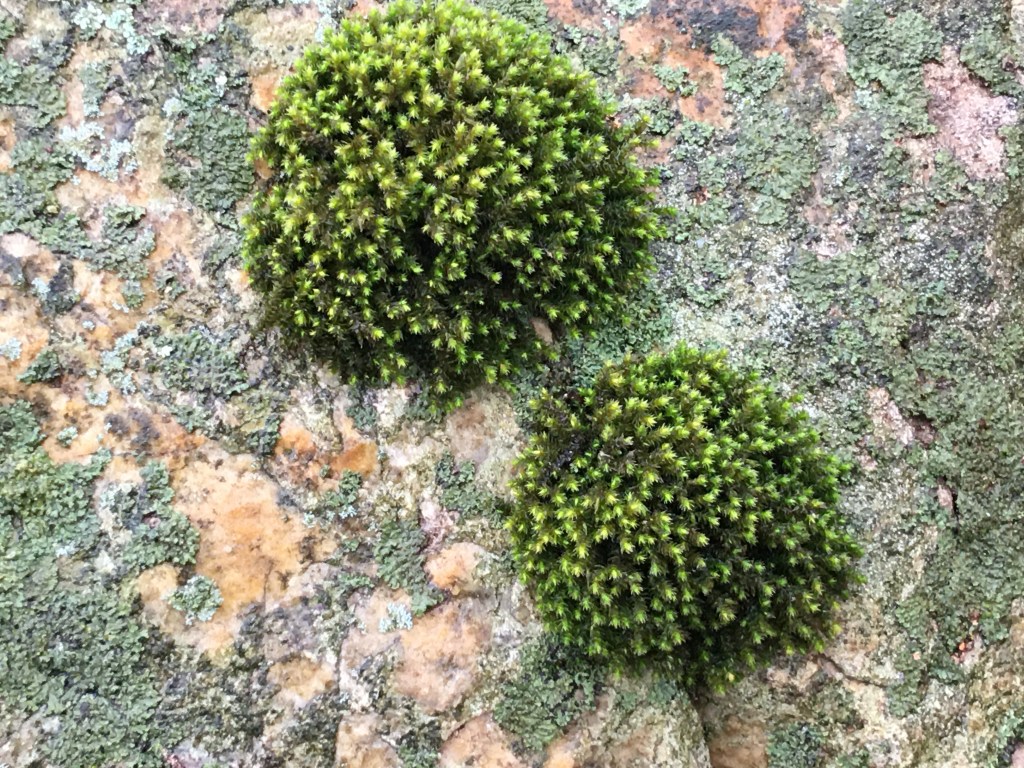
Cushion moss flourishing in crevice of lichen-encrusted rock.
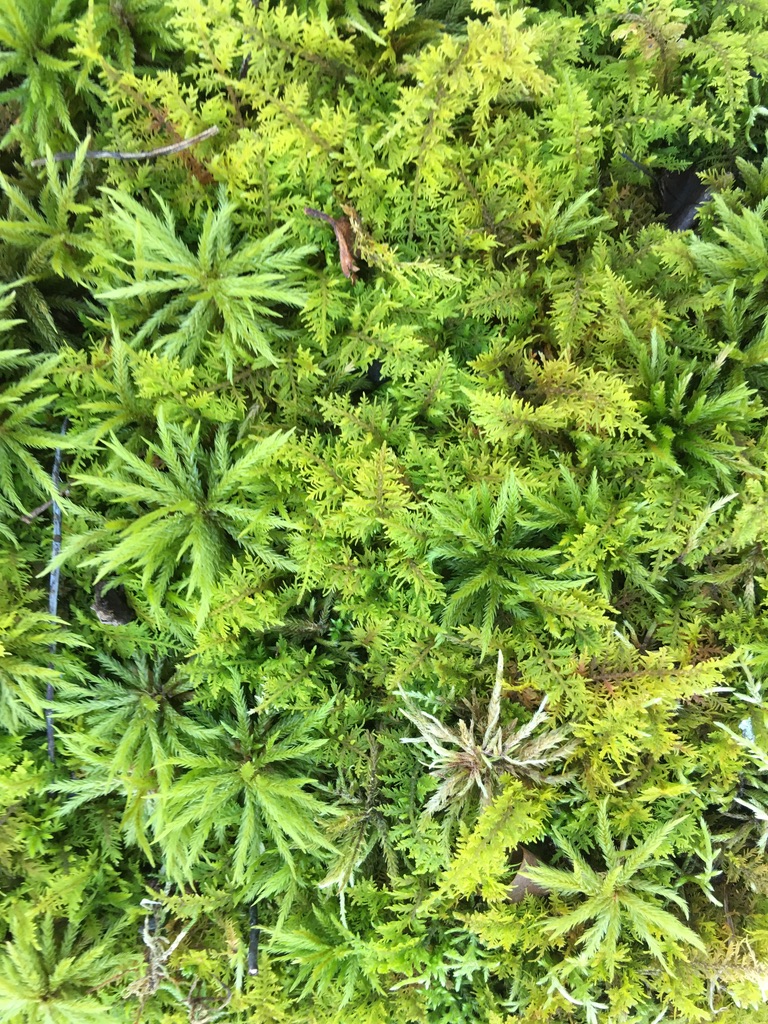
A community of mosses: American tree moss (Climacium americanum) and fern moss (Thuidium delicatulum).

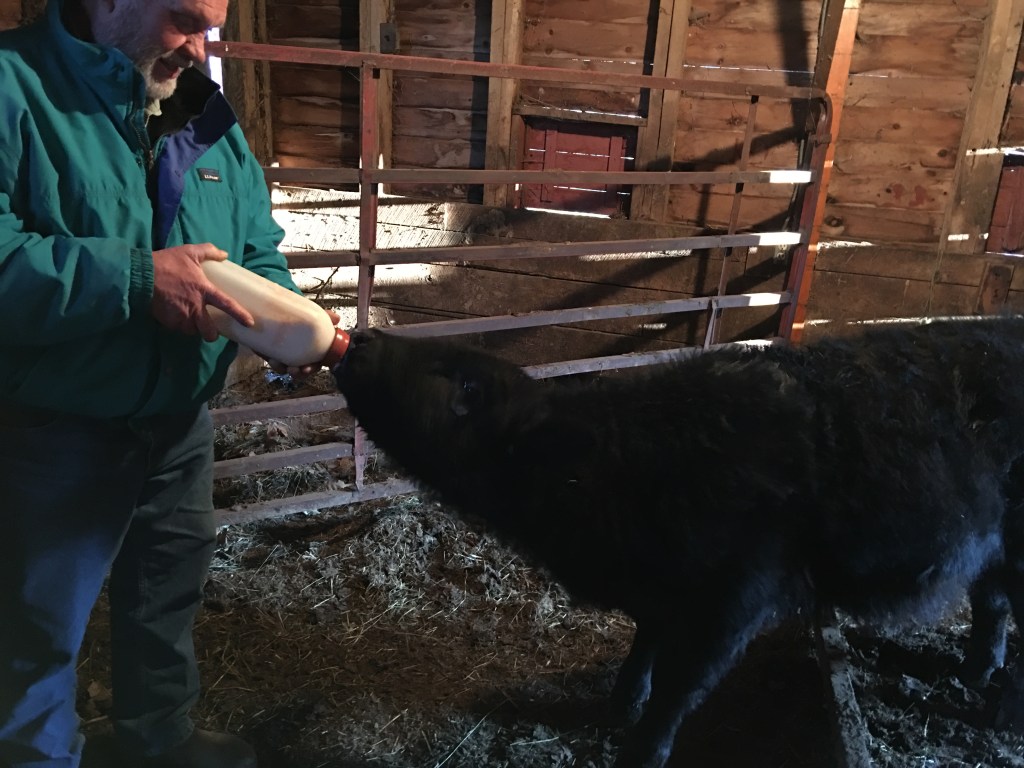
The next day was gloriously sunny. I checked in on Isabella, whom we met on our last visit. She was born in September and orphaned in early November when her mother, an apparently healthy 1500 pound plus cow, suddenly dropped dead. Mike thinks that either it was an aneurysm or a case of choking on an apple. (To check whether the cause of death is an aneurysm I learned that one sticks a knife in the body above the diaphragm and watches for a copious volume of blood.) Ever since, he has been bottle-feeding Isabella. She has to be separated from the herd because he can’t go chasing all over the farm with a bottle twice a day. She was lonely until Mike got a new young bull, whom I am calling temporarily Young Bull With No Name. He is a little small and shy. Apparently Young Bull’s previous owner did not socialize him with other cows or people. Mike says that when a stranger approaches, he lifts his head in a kind of fear-and-flight response, which makes Mike uneasy. One of Mike’s grandsons names Mike’s bulls, but he has said that he needs more time to think about a good name. Sally, Mike’s wife, named Isabella.

Isabella slurps milk from the bottle in just a few seconds. Then she gets grain.

Isabella and Young Bull With No Name have become inseparable. They make a stunning pair. Isabella is Angus and Young Bull is a Simmental. Their hides are thick and furry at this time of year. They graze side by side–and play together!

‘Ferdinand’ on the left and Isabella on the right.

When I was walking down from Stark’s Ridge later in the day, I saw two black shapes flying the length of the barn meadow. I realized it was them, hooves and tails aloft, side by side, flinging themselves into a race back and forth. When I reported this to Mike, he laughed but shook his head and said seriously, “He has to grow up. He thinks he’s still a calf.” Maybe Young Bull With No Name should be called Ferdinand I thought, drawing a comparison with the hero of Munro Leaf’s The Story of Ferdinand, a now-famous children’s story published in 1936, about a young bull who won’t fight, preferring to smell flowers and lounge about. My husband reminded me that Ferdinand and Isabella were the monarchs of Spain who financed Christopher Columbus’ voyage to the New World.

And then there is the story of Roy and Big Red, man and cat, great friends now separated. Roy, 95, the oldest inhabitant of the hollow, collapsed in December and finally agreed to go live with his daughter in Roanoke. He has been living alone for years in a trailer on his tidy little farm next to ours in the hollow. After a lifetime of constant physical work, he had to rest, his body too worn out to do labor of any kind. Roy says that he could not have lived so long alone without the TV (his was so old and tiny its screen was practically invisible by modern standards, but at least there were voices and words coming out of it) and his cat.

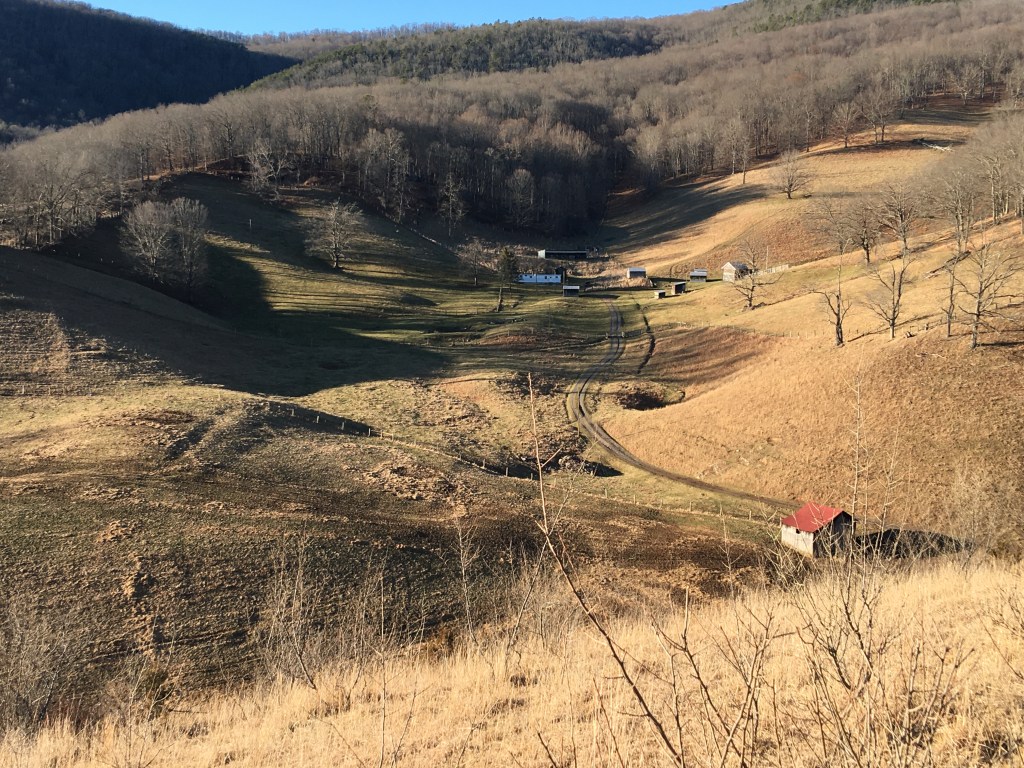
View of the Big Meadow and its sinkholes with Roy’s farm tucked away top left.

Big Red is a handsome, slightly portly butterscotch cat, who turned up in the hollow as a stray kitten eleven or so years ago. He roams freely, clever enough to escape coyotes and other predators, but also spent hours on Roy’s lap each day and slept nestled against his back every night. Roy positively beamed with admiration and love for Big Red whenever he looked at him. His greatest fear was leaving Big Red without a home.

A closer view of Roy’s trailer and tidy farm seen from Stark’s Ridge.

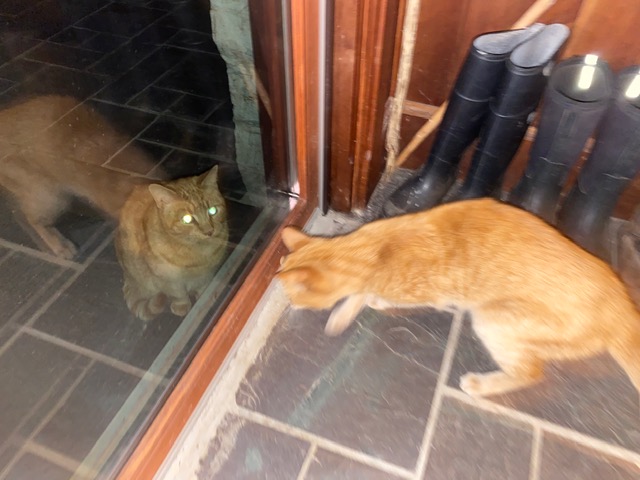
Roanoake was not an option, so Big Red is back up here at our farm where he started out, and Mike is feeding him morning and night. Big Red won’t eat with the other barn cats, so Mike has to feed him separately. Big Red had a huge fight with the current tom cat in the barn and beat him up badly, without ruffling a hair of his own perfect coat it seems. Big Red sleeps in the barn now. Last night was cold and so blustery even the cows were skittering away from the noisy gusts of wind. Big Red came to the sliding glass door of the cottage where we stay and stared at me intently. I did go out and converse with him and stroke his fur–he knows me as he has sat in my lap for hours at Roy’s–but I couldn’t let him in because of our cat, Rex Fernandez, who looks exactly like Big Red, but is only 6 pounds, 4 ounces. Despite his small size and health issues Rex is fiercely territorial. Big Red and Rex stared at each other through the glass for several hours. Unhappy with the situation I went to bed early even though it was New Year’s Eve. When I woke up, Big Red was still there staring through the sliding glass door. I made a cup of coffee and took a blanket out to visit with him. He purred and purred, sniffing my coffee intently. Roy relished his three cups a day. I just called Roy and he said that he was happy living with his daughter. We didn’t mention Big Red.

Big Red to the left and Rex Fernandez to the right. Rex F. may look big here but he is tiny.

It is hard for me to see Roy and Big Red separated. They both arrived as “strays.” Roy was brought here as a foundling soon after birth. He did farm chores for his adoptive parents, all the while working as a boy at a tanning factory stoking huge vats of boiling tannin. It was nightmarish he said–the fires were never let to go out. He walked eight miles each way over hill and through forest to get to the tannery. On one trip in the dark at night he was blinded in one eye by a bramble. Hard times, a wife, two children, a divorce, more hard times, then not so hard times–he lived on and became one of the most genial, gracious, and sweet-tempered of men. He told me he remembered the day I was born. He said, “Jack came home and said you were here.” So, we have been friends a long time.

I don’t know how the story will end for Big Red. He is a people cat. Mike comes up to the barn morning and evening, and even more times as farm chores demand. We’ve decided that Big Red can stay on very cold nights in the old house, which is heated now. But there is no permanent human in residence. Big Red may go off looking for a new owner or the memory of Roy may keep him anchored in the hollow. Though lives and relationships seem to dissolve like the mist, there are durable remains of our passage. Ferdinand and Isabella’s hooves pounding the barn meadow, and Roy and Big Red’s tracks criss-crossing the hollow have marked the landscape forever. There’s a huge slab of sedimentary rock with dinosaur footprints on Stark’s Ridge, but that’s another story.

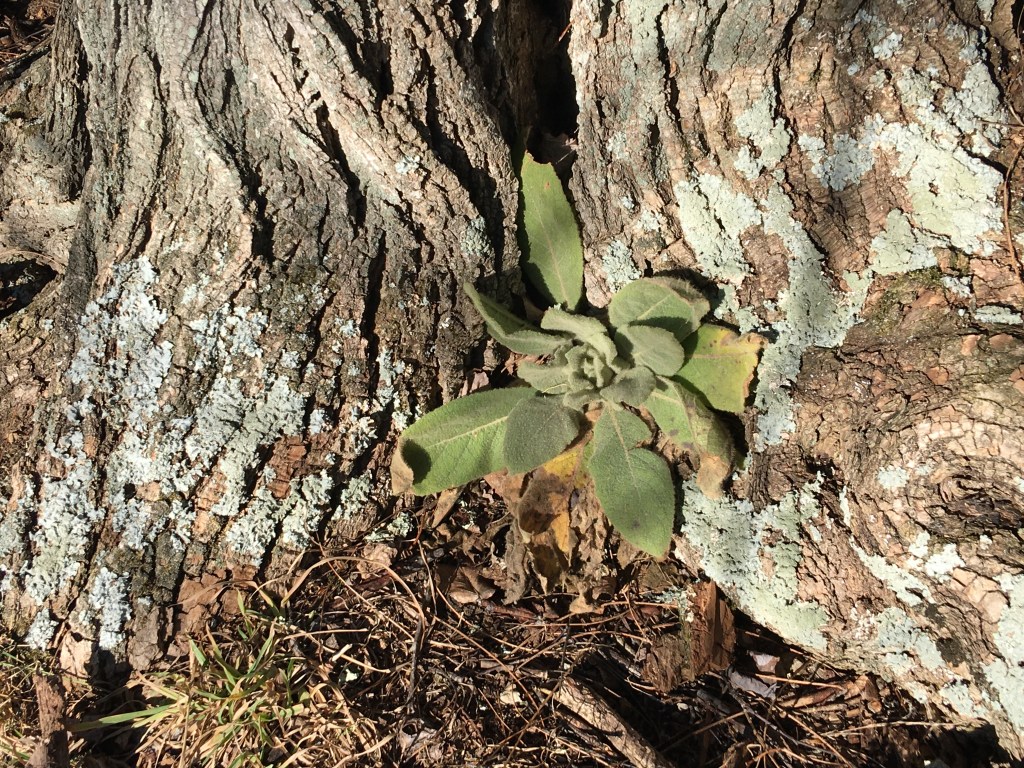
Lichens and mullein nestled at the base of a locust tree on the Hill With No Name (which is between the Pine Tree Hill and Stark’s Ridge).

In the Hollow: little Slick the Contrarian

UNADJUSTEDNONRAW_thumb_f83d

Straw barn in the center of the photo. Red oaks stand out in the fringe of forest in the distance.


As I have said before, when I return to Vinegar Hollow, there is always a new story. The story has usually begun a long while before my arrival, maybe even generations, but my presence  allows me to enter that story. In the cluster of farm buildings that surrounds the house, I especially love seeing the straw barn glow in the late afternoon sun,  but I also love it on a misty morning.

UNADJUSTEDNONRAW_thumb_f868

Slick (center).

This particular misty morning I heard Mike hollering from the barn, ‘Slick, come on. Come on, Slick.’ There would be a pause, then a further entreaty.  ‘Dat gum, Slick, you come every afternoon, what’s wrong now? Come on, Slick! I am not wading through this mud.’ Mike has a few large, pregnant, cows in the barn meadow and they have churned up the rainy-soft earth. Mike’s one-sided dialogue with Slick went on quite a while. I didn’t approach because I figured Mike was having trouble with one of his herd and my presence might cause the recalcitrant beast to baulk entirely.  When Mike left the barn meadow I asked him for the story.

 Slick is a twin. His mother is down at Mike’s house with the sibling. Mike says that Slick wouldn’t follow his mother, and his mother wouldn’t go after him to make him feed. She was satisfied with the one. After three days of this stand off he was skinny, a case of  “failure to thrive,” so Mike brought him up to our barn,  bottle feeds him twice a day, and puts him in a stall to feast on grain at night. I guess you could say that Mike is his mother now, but it’s not easy with the little contrarian. Slick butts him, hard, as hard as if Mike were a two-thousand pound cow.  Mike says that he doesn’t worry so much about a calf outside at night curled up next to a warm mama–a warm drink in the belly will get you through– but Slick has no mama now, except for Mike.

The next morning I decided to pay Slick an early morning visit, climbing numerous gates to find him. It never ceases to amaze me how many gates are needed on a farm. I could have opened some of them, but not easily. Gates take a lot of abuse. They were stuck in half-frozen mud, sagging on old hinges, or bent from run-ins with mad cows.  I went in through the back of the barn because approaching from the front meant wading through a sea of mud. Really deep. I assessed the possibility but decided it was a complete no-go. Even I who like mud was daunted, but I eventually found Slick, the lonely king of an empty barn. It’s a big, sturdy barn, with huge chestnut beams,  built in the Depression, by an itinerant barn builder, who earned his keep building five barns like ours in the county.

Slick, king of the barn.

Slick alternated between coming up for a head pat and backing up shyly. When asked about the name, Mike answered that he doesn’t know how he decided to name him Slick. “It just happened,” he said. “Perhaps it’s because he is so silky looking,” I suggested, and Mike agreed that he was that way from birth. I watched as Slick gulped his two quarts of milk in less than 30 seconds.

Mike and Slick.

In my last view of Slick, he was heading slowly toward the small group of pregnant mamas, lifting each hoof slowly and deliberately. It doesn’t do to go down in the mud. Usually March is mud season, but it rained so much in September and October that it’s mud a long way down right now. 

Slick heads off to firmer ground in the meadow.

I am back in Ithaca now, away from the mud, and the gates, and rounded curves of these old Allegheny mountains, but still thinking about Slick for some reason.

A view of the Pine Tree Hill where two red oaks flourish that my mother transplanted from the forest at just two foot high. After the first winter, my father said “they have died,” and my mother said, “no.” She scratched their bark with a finger nail. There was green under the brown. 

The New Year, 2018, Begins in Vinegar Hollow

It looks like my New Year’s post from Vinegar Hollow is going to be an annual event. What new is there to say one might ask? I am different, the land is different, the weather is different–more wear and tear in general–not that these are necessarily bad things. Some wear-and-tear is simply polishing. In the hollow I never tire of looking at the trees

IMG_0589

View from apple orchard to old barn (center) at the Big Meadow.


and the hills and the play of light, and I always see new designs and colors in the landscape. The snow illuminates the hoof-marked cow trails, while Mike’s tractor, which delivers hay morning and afternoon to the

This, the old locust grove, is where the cows prefer their hay. The little barn is more visible.


cows, uncovers grass still green. Yesterday Mike and I had a talk about the cows’ preference for the locust grove  this time of year. He is surprised they are not out in full sun on these cold days and observes that this is their favorite spot. They are reluctant to move around when he delivers hay elsewhere, which is fine with him  because when he leaves hay near the barn, they stomp around and unplug the automatic timer to his tractor. Which is not good, because then on these cold mornings, some below zero, he can’t get the tractor started.  (The timer activates the heating of the engine oil so it is not too sludgy on a bitter cold morning.) He thinks the cows prefer the locust grove because it is their shady home place of summer.

Tractor ready to distribute hay bales for the next feeding.

Cows have memories he says. When it is time for a twice-bred cow to go into the barn to calve, he just opens the door and she heads straight into the stall she had the year before. If there is a cow in there already, there is sure to be a terrible fight. On the other hand, getting first-time mothers into the barn presents a problem. Mike has tender feelings for his cows in the winter when he is out feeding no matter the weather and his bad knee. Cows can withstand the cold if all their several stomachs are full. The gut bacteria create a literal fire in the belly. It’s freezing rain that causes Mike to tighten his lips and shake his head about the suffering of domesticated animals.

On a clear day when the sun reflects off a layer of snow, it’s hard to notice anything but a beautiful dazzle.

IMG_0566

Looking south to Stark’s Ridge.

Farms have a lot of fences and gates that create intersecting shadows. Because of some construction going on at the old house, there is provisional wire fencing adding to the complexity of the design above.

The fence in the center divides the orchard (very few trees left) from the orchard meadow. A few small sinkholes are visible in the ground that rises to the hillside.

On a day when the sun is wan, the colors of a winter landscape become subtle. I notice the soft brown of frozen mud, the pale russet of dried sage grass, and snow poked through with a thousand blades of grass. Tree branches are witchy, twitchy, sometimes ungainly, and always beautiful against the sky.

The side of Stark’s Ridge with tree branches against a wan sky.

I walk around the farm looking at everything, trying to understand placement of objects, natural and unnatural, how a landscape becomes what it is.

Layers of limestone that have heaved and broken apart provide dens for foxes.


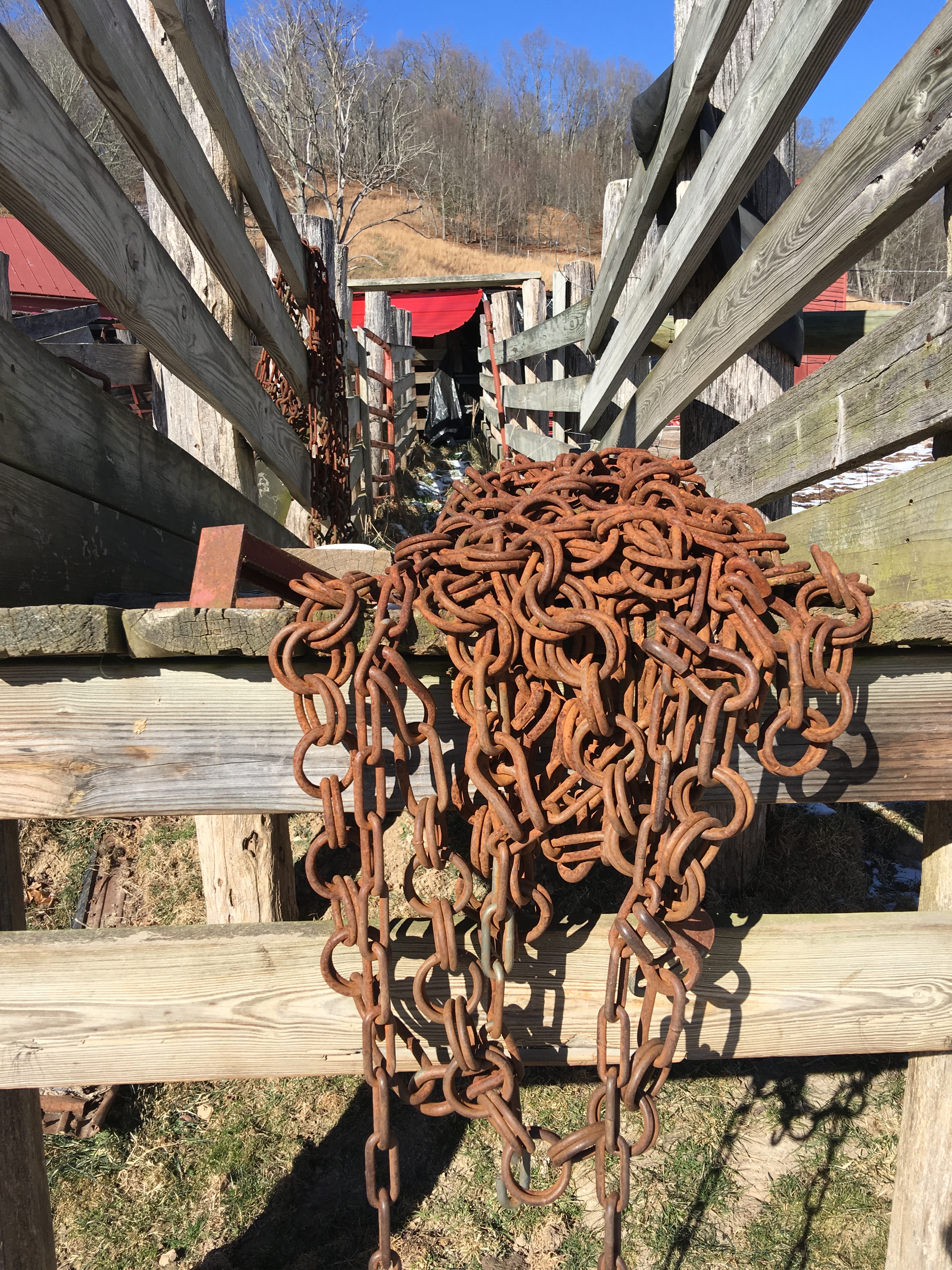
A cattle chute with rusty chains.

Maybe I have a memory like the cow going into the stall where she has been before. Since brought home to the farm at birth, I always return, amazed at how much more there is to see and think about. When I visit Roy, my neighbor, who will be 94 on January 24 of this new year, we deconstruct  the history of the hollow, no moment or detail too small for discussion.  He lives alone with his cat Big Red, who for the first time deigned to sit in my lap before jumping, somewhat gracefully for a big cat, from the kitchen counter to a perch on top of the refrigerator. Mike checks on Roy every morning and the driver of the woman who cleans his trailer brings two apples each week for his old, long-legged donkey.

IMG_0643

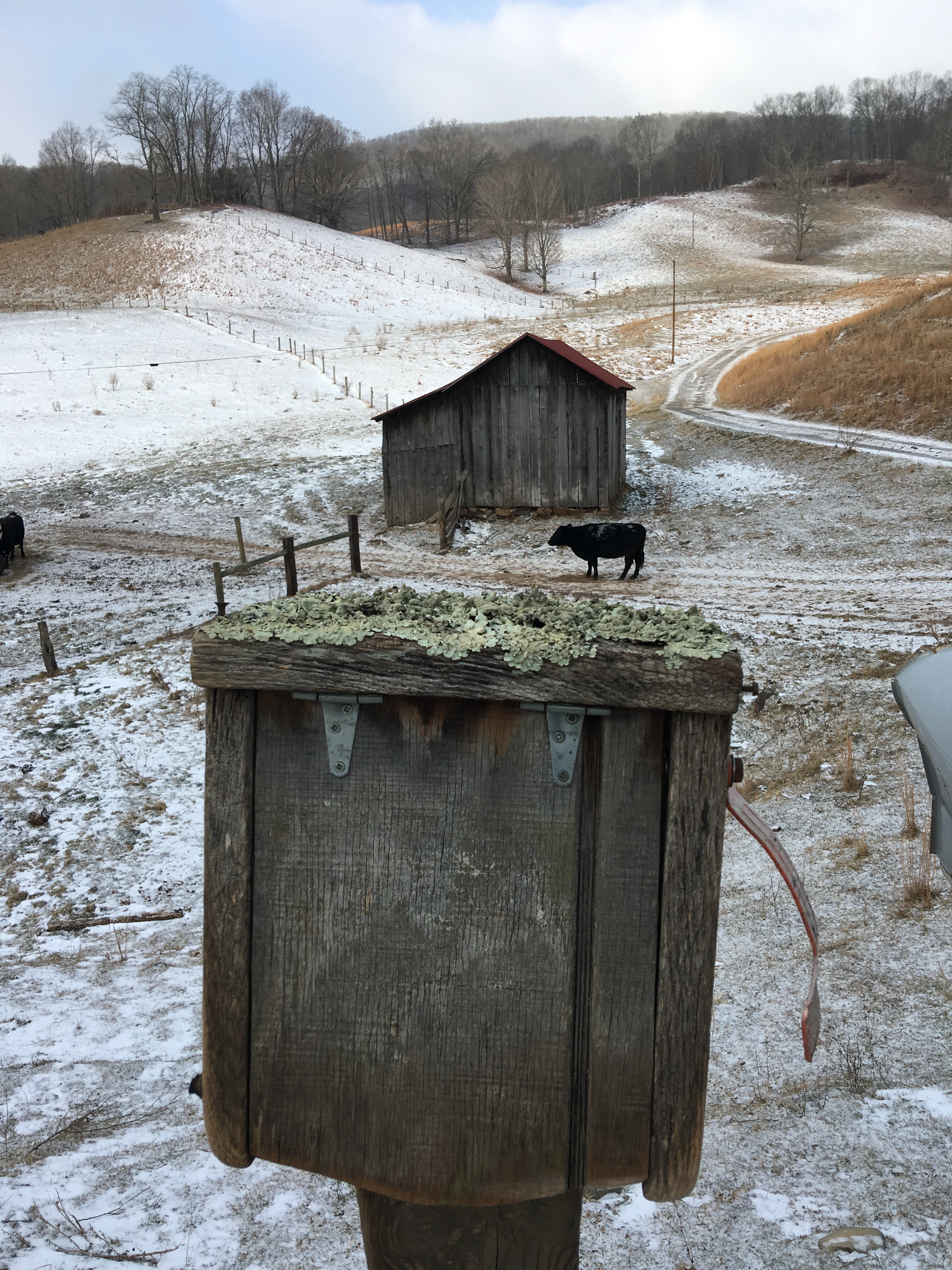
Roy’s mailbox. The road at the upper right winds around to his home. Cow in front of the old barn seen from a distance in the first photo.

Roy only needs one meal a day now he says–two fried eggs, two pieces of toast, a rasher of sausage, and a cup of coffee. He fixes it himself even though his hands are almost curled shut with arthritis. I took him two bite-size mincemeat pies made by my English friend who makes wonderful pie crust. That’ll be dinner he said as I set them by his easy chair. The thing I puzzle about is that Roy even in midwinter, when he can’t sit outside on the top step to his trailer, seems to know what is going on in the hollow. It’s as if he is now not bounded by walls and poor vision (he lost sight in one eye as a child) because he is so attuned to the hollow. “You should see Mike’s dog running after the tractor. Down the road and back up the road these cold mornings. You should see that,” he tells me. I have seen that but I wonder when he has.

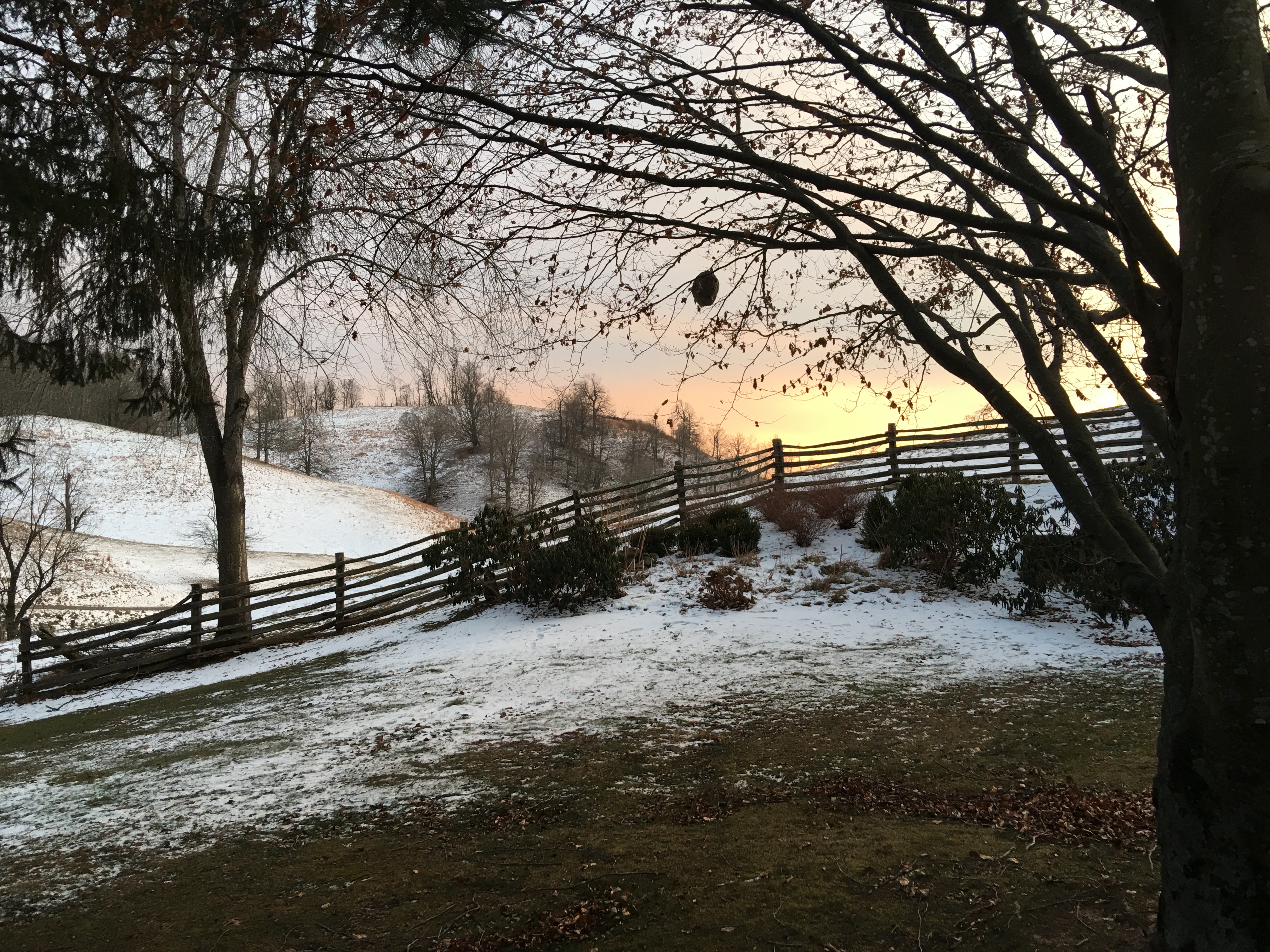
A paper wasp nest dangles from the copper beech branches in the foreground; Stark’s Ridge in the background.

On the long drive from Ithaca to Mustoe, we listened to the audio version of La Belle Sauvage by Philip Pullman. As a frontispiece he  quotes a few lines from Irish poet Louis Macneice’s  “Snow” , a poem about how much lays before our view– how “the world is suddener than we fancy it.” The hollow has always looked “sudden” to me. Now it’s time to say good-bye again; I have had my reset for the New Year!

A New Year Begins in Vinegar Hollow

img_5406

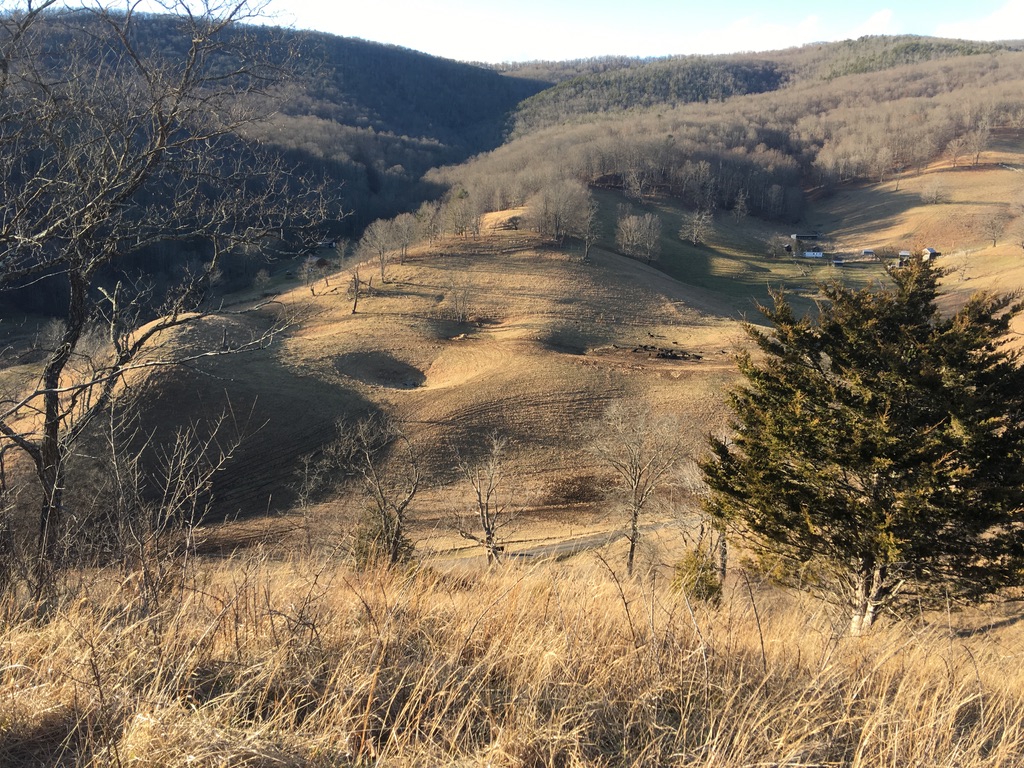
Looking to the north end of Vinegar Hollow.

The long drive from Ithaca to Mustoe completed, we arrived just after dark on New Year’s Eve to a howling wind, snow-covered hills, and an icy terrace. By morning the melt was on, the ice turned to puddles and the snow just feathery patches. But there had been prolonged cold so, while the primrose that flowered last January 1st looked bright green, its buds remained tight. The melt brought mist and drizzle and for a few days we were in a fog bank.

Despite a few injuries, the old collapsed ankle, the new broken wrist, and the sudden onset of a stupefying upper respiratory virus, I took walks with my husband and Belle the dog.

img_5317

Looking to the south end of Vinegar Hollow.

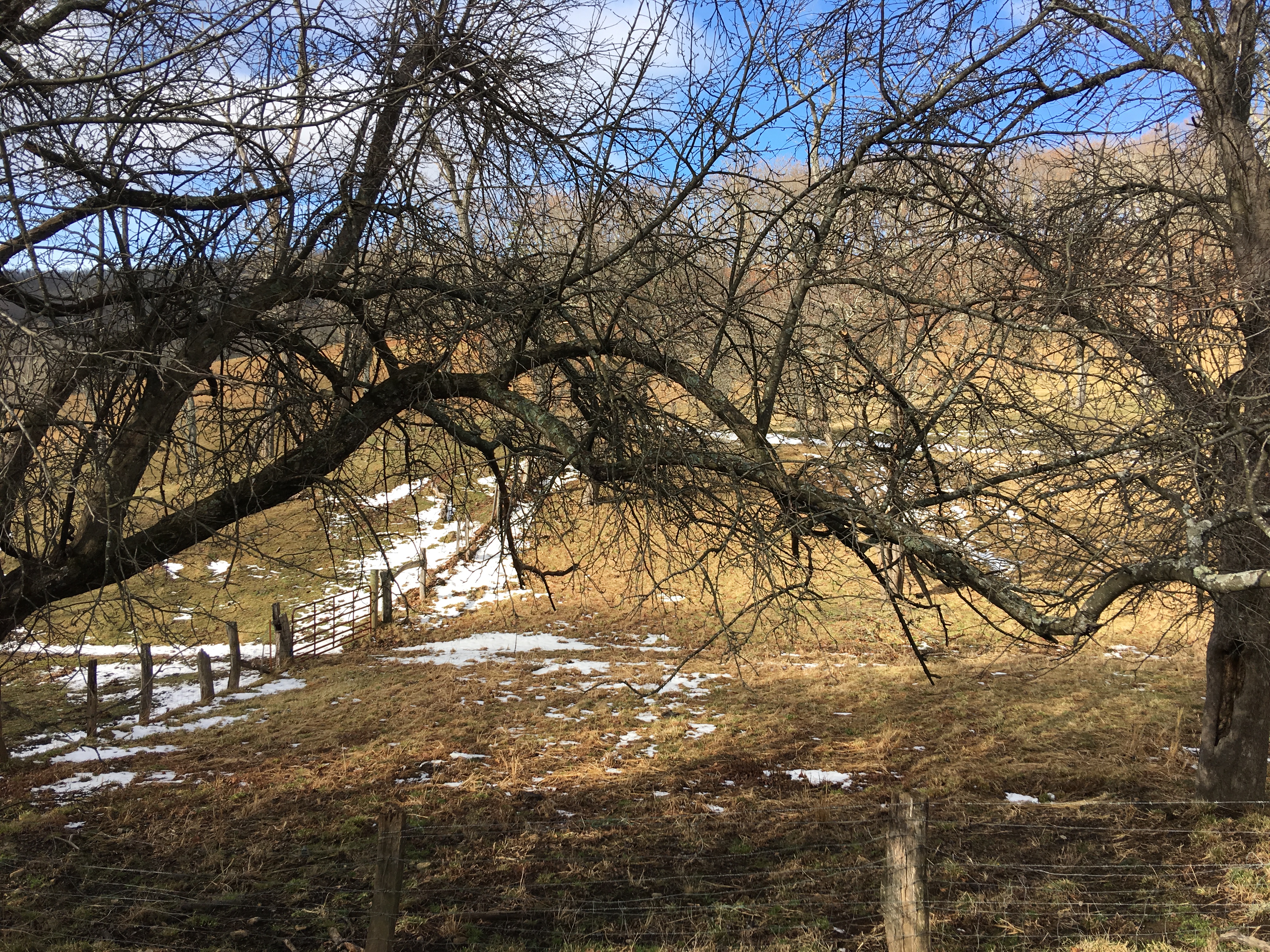
Trees in winter tell such different stories than those of their summer selves. The old apple trees in the orchard that haven’t been pruned for decades reveal the thicket of watersprouts jutting vertically from almost every horizantal branch. Shoots that spring from the base of a tree are called suckers. They are an important source of regeneration. Arising from latent buds and the result of “weather and other damage” (old age?), watersprouts, on the other hand, make a mess of the interior life of a tree, blocking light and air flow, which in turn decrease the quality of fruit. I remember my mother telling me that the apple tree in the orchard was an old variety called the Northern Spy. I loved the name. Trees do make perfect spies. No one notices them. There are only six left now, each uniquely misshapen.

img_5314

Two old apple trees join branches, heavy with waterspouts.

Another walk takes us up Back Creek Mountain on one of the old logging roads. It’s misty. These woods were logged about 10 years ago. The giants are gone, and the slender trees that remain reach for the sky from the steep hillsides, a maze of toothpicks tilted slightly off vertical. Pale grey green lichens cover their trunks, a contrast to the deep green leaves of the mountain laurel thickets forming the understory. These are Appalachian colors, muted.

img_1453

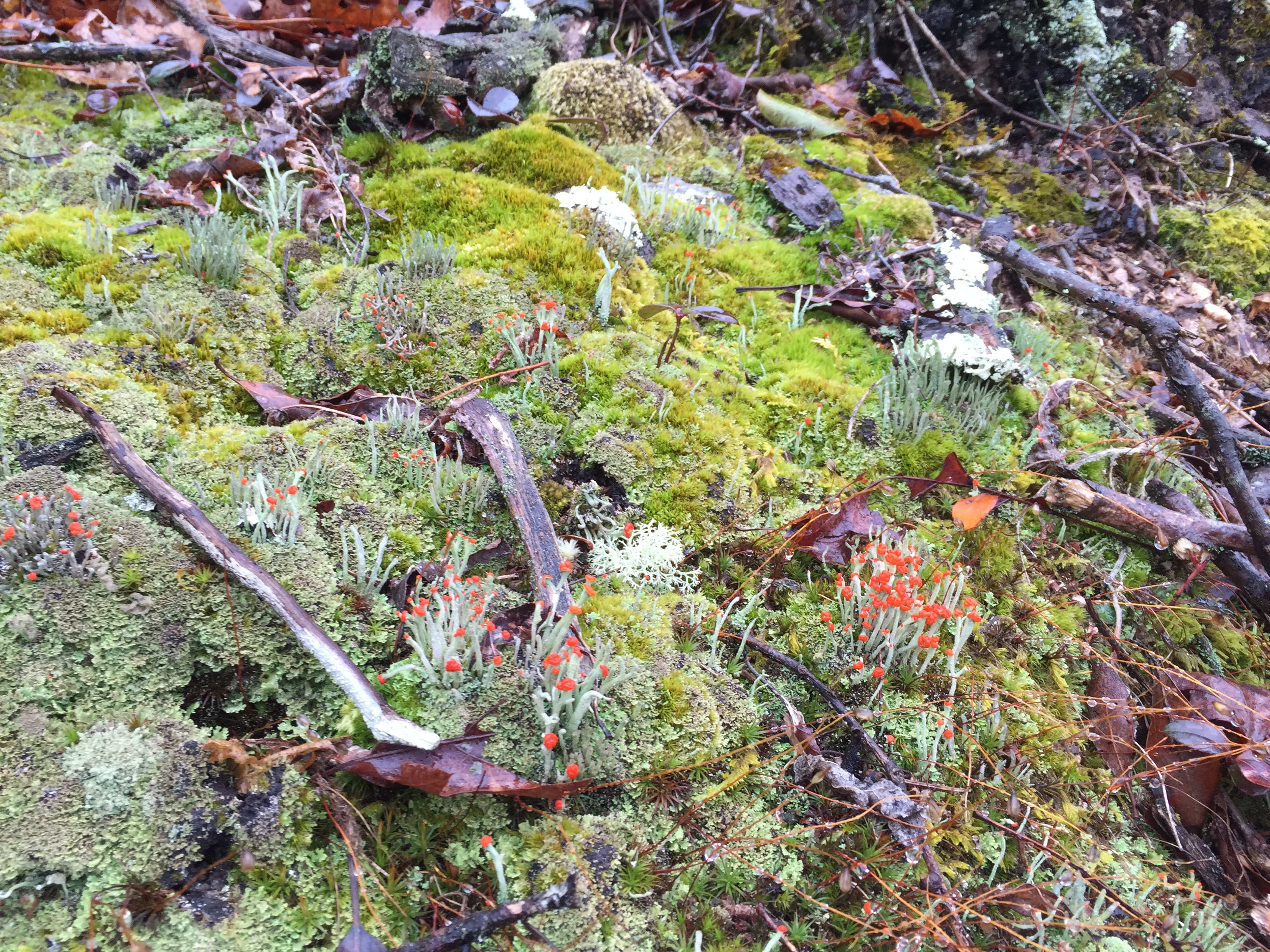
Lichen-and-moss garden along logging road. British soldier lichens are red topped.

There have been other travelers on this road. We notice coyote scat, blunt at one end and pointed at the other, a pale grey brown that blends with the fallen leaves. The British soldiers do not blend in. They are bright and bold, in lime green uniforms and orange red helmets. This seems to be their season as they look fresh and new. Large patches, like miniature gardens, occur frequently along the sides of the trail. The mosses look prosperous also at this time of the year, their green rich and glowing.

We walk up to a large bend and then turn around, retracing our steps. I am thinking about how I love these woods, and that, though they do not have the diversity and flamboyance of a tropical rain forest, there are surprises, like the British soldiers, and undoubtedly there are very beautiful mosses, lichens, and liverworts that have never been named, when I hear a loud “Wow!” I race to catch up with my husband. He is staring at the ground. Even when almost upon him I do not see anything under his gaze. On bended knee, however, I come face to face with a strange life form. As we walk down the trail, we find more and more of them in various stages of development, all of which we had missed on the way up.

img_1458

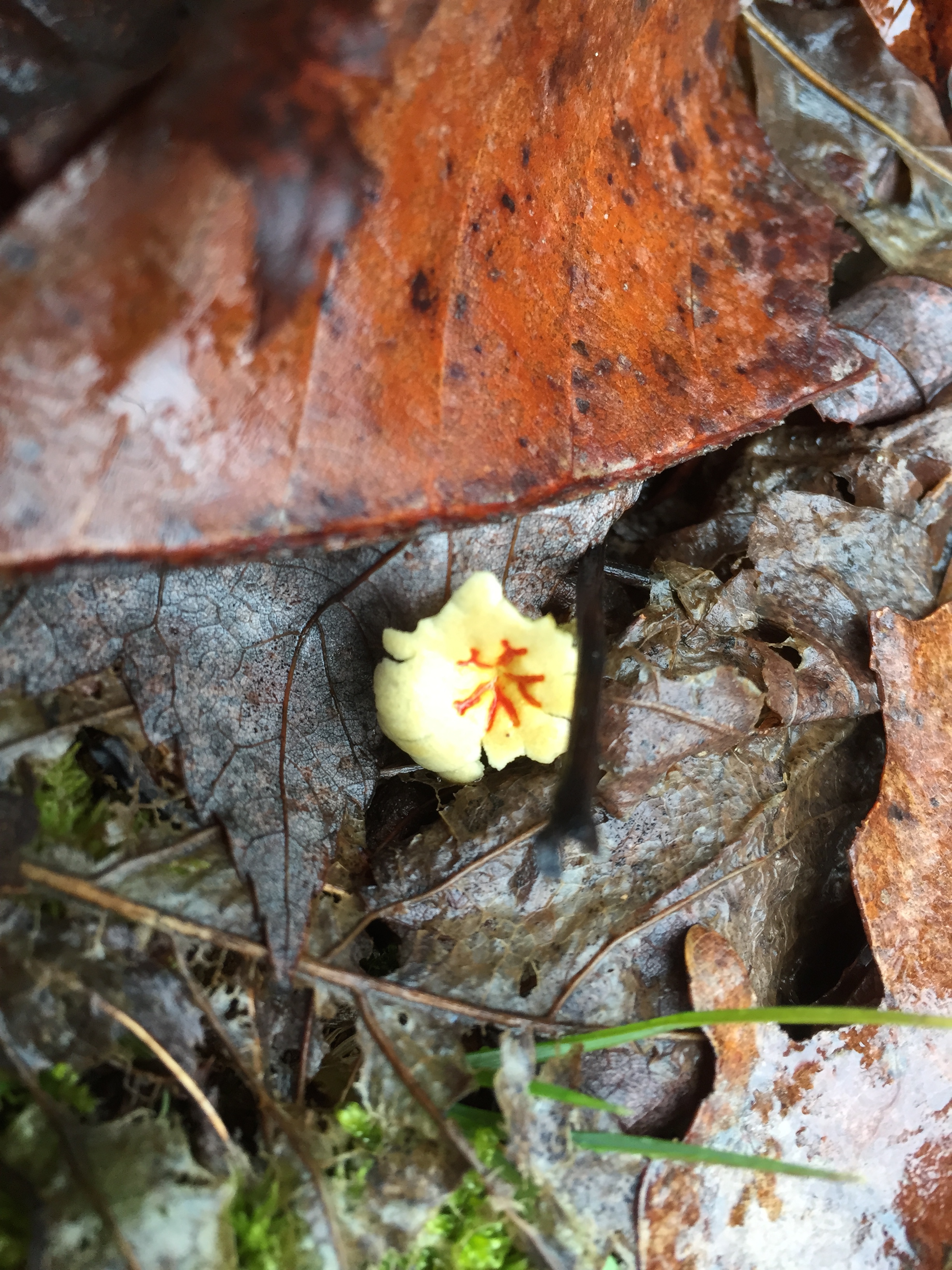
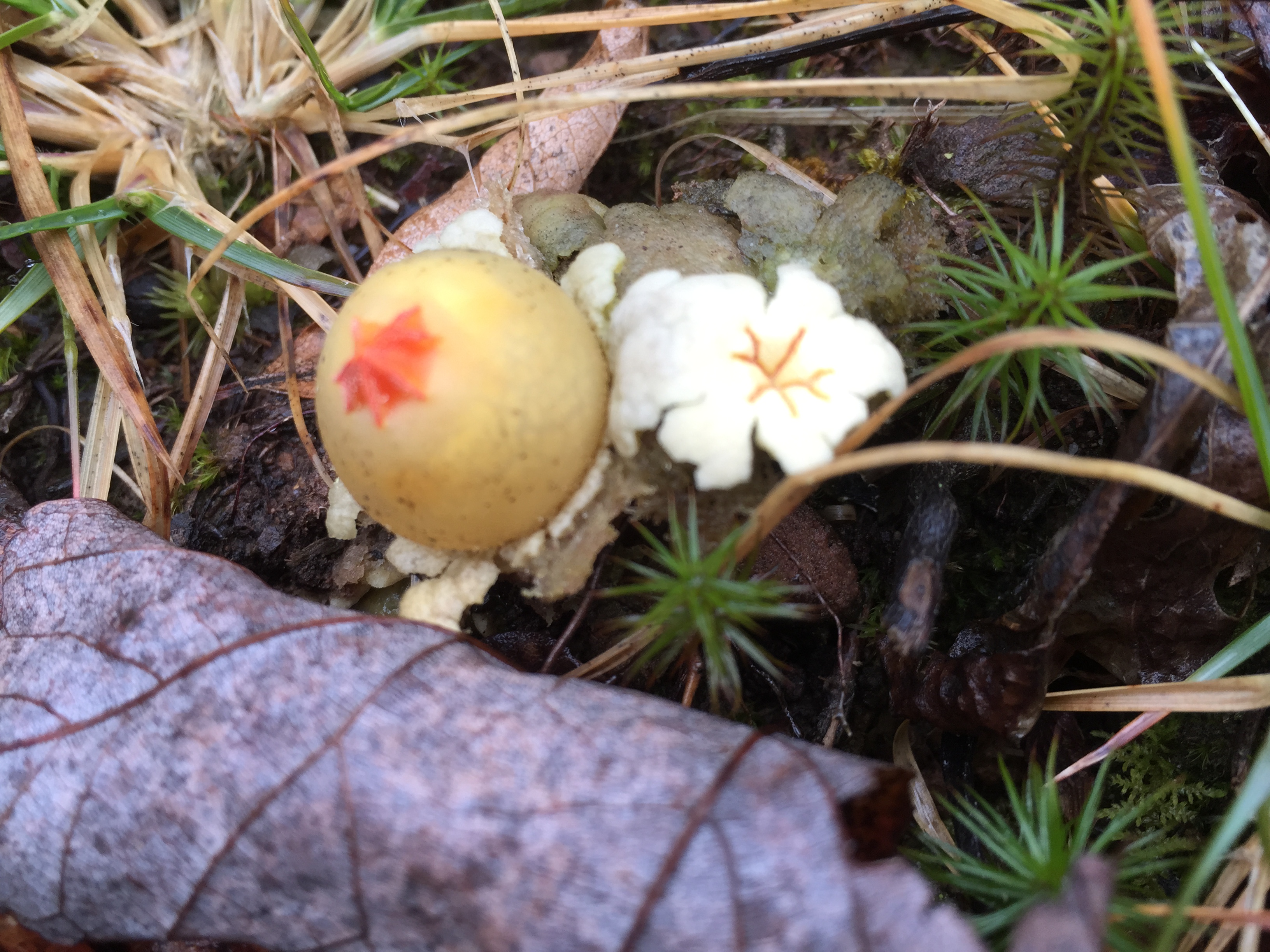
Stage 1 of the yellow-stalked puffball.

The first stage looked like a very small yellow star-like flower flattened on the ground. Next a balloon-like orb appeared underneath the “flower” whose “petals” became a reddish collar around a “mouth” atop the balloon. Tapping the balloon produced a cloud of white dust.

img_1456-2

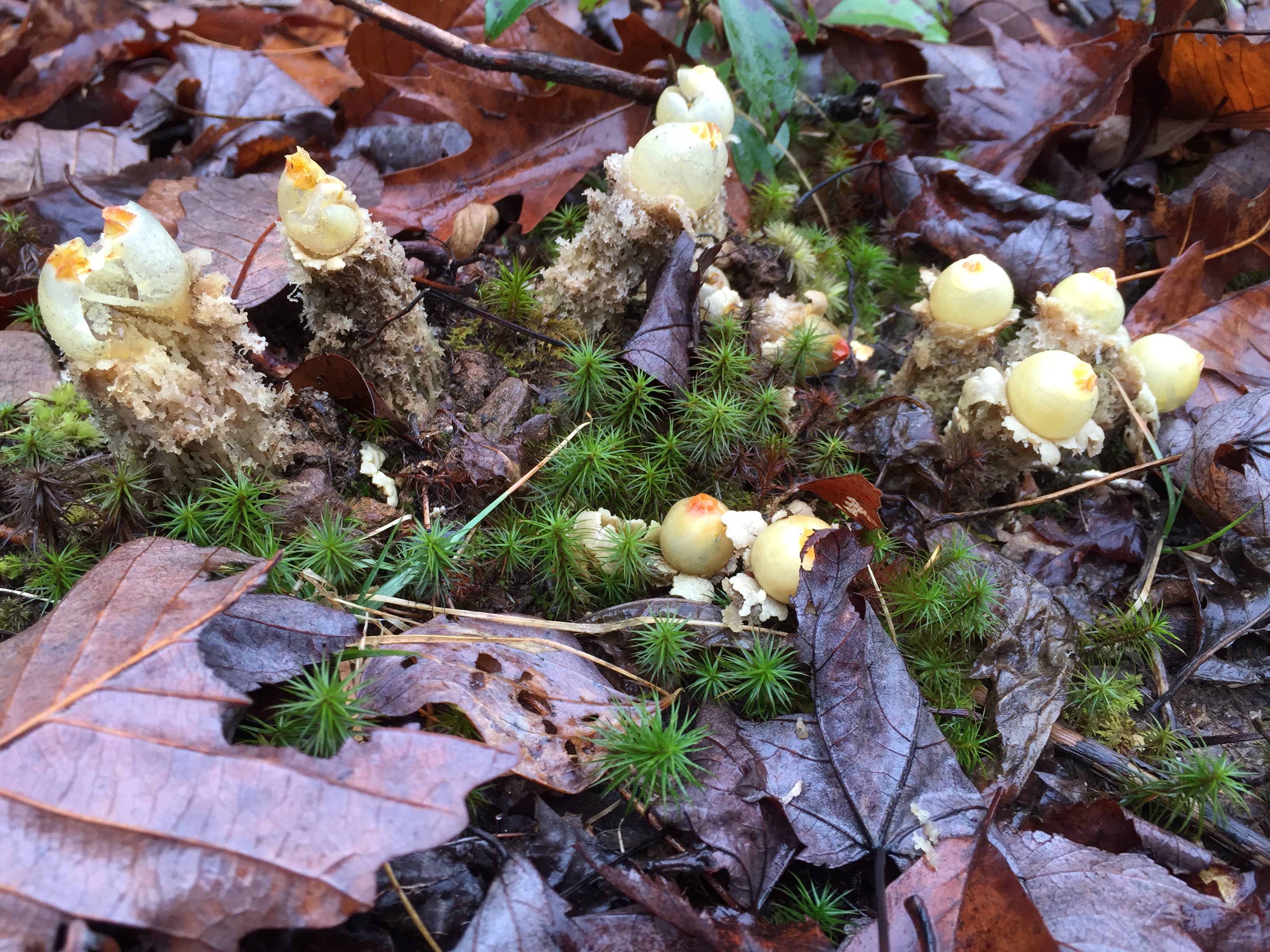
Stage 2 of yellow-stalked puffball: balloon (spore case) has “mushroomed.”

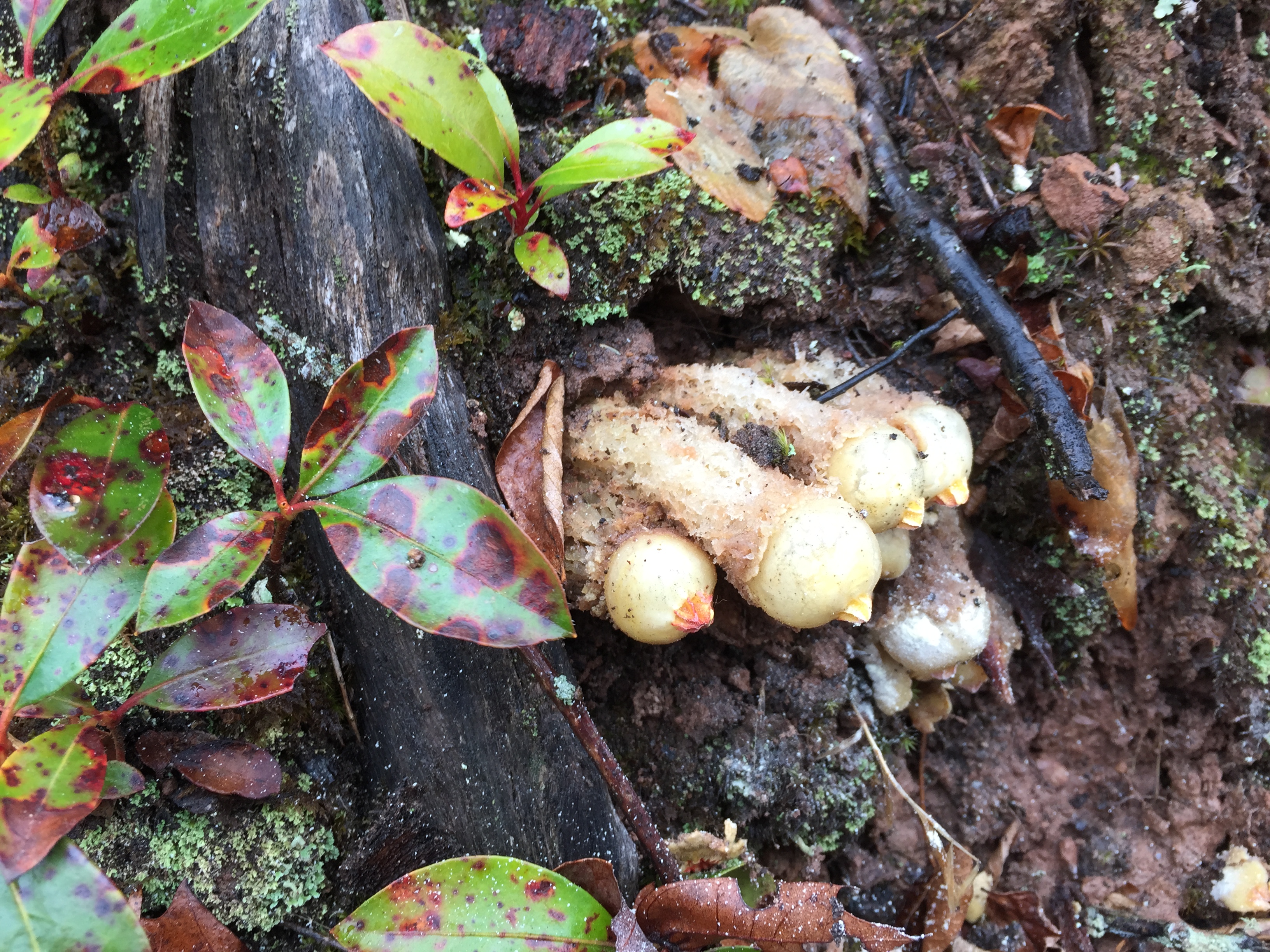
It was so bizarre that I couldn’t see it belonging to any of the five kingdoms of living organisms. But it had to be a mushroom, perhaps related to an earthstar. An Alice-in-Wonderland Google search through the world of bizarre mushrooms led to dead ends until I stumbled on the phrase “stalked puffball,” and then I found it—the yellow-stalked puffball, Calostoma lutescens. It is also called the lattice puffball, apparently for the mesh-like consistency of the stalk.

img_1457

img_1464

Stage 3 of yellow-stalked puffball: net-like, fibrous stalk elevates “balloon” for spore dispersal.

Michael Kuo of MushroomExpert.com writes that

This distinctive, funky fungus is fairly common in the southern Appalachians, but has been reported from Arkansas to Massachusetts. It looks like a little yellow globe with puckered red lips, sporting a tattered collar, held aloft by an odd pedestal of half-digested pasta. It’s hard to imagine mistaking Calostoma lutescens for anything else.

My Internet search reminded me of Project Noah. It is a site where ordinary people, or citizen scientists, can upload photos for sharing and identification. Someone posted a photo of the yellow-stalked puffball found in North Carolina about a year ago.

For some reason I have always felt the role of reporter or recorder of the hollow’s news, whether about a puffball or water-sprouted old apple trees, as my calling. Why? Why do some people have certain inclinations that seem necessary, like a cosmic job, despite how difficult to honor along with all one’s other responsibilities?

These first few days of January, while thinking determinedly about the yellow-stalked puffball, I read obituaries of John Berger (b. November 5, 1926; d. January 2, 2017), the English writer who spent 43 years living in a small village in the Haute Savoie of the French Alps, in part to chronicle the peasant way of life (he preferred the word peasant to describe the rural worker). In an essay for The Guardian in 2014, he wrote:

What has prompted me to write over the years is the hunch that something needs to be told, and that if I don’t try to tell it, it risks not being told. I picture myself as a stop-gap man rather than a consequential, professional writer.

I take heart from that. One can be a stop-gap writer of or for almost anything. Most would say that Berger was a pretty high-level, stop-gap writer. I think he would affirm that it is ok to be a low-level, stop-gap writer like me. He also said, even when nearing 90, that writing never got any easier for him, though drawing did.

Berger had been an influential art critic, author of Ways of Seeing, but from Quincy in the Haute Savoie, he wrote about the people and their down-to-earth work, making hay, shepherding, and the like. In his essay about the yearly cleaning of his outhouse, “Muck and its Entanglements: Cleaning the Outhouse,” he describes a local schoolroom story of a conversation between a cowpat and a fallen apple. The fallen apple is too pristine to speak to the friendly cowpat. This is his point of departure for seeking meaning in “shit” and the nature of cows:

Perhaps the insouciance with which cows shit is part of their peacefulness, part of the patience that allows them to be thought of in certain cultures as sacred.

Berger also made the observation that cows walk as if on high heels. Their hooves do seem extremely dainty for their ponderous bodies, and I have often wondered that they don’t just topple over on the steep hillsides of Vinegar Hollow. I blame the breeders for their ungainly, top heavy bodies.

img_5334

They are waiting.

Every time I am here I do some cow watching. Mike, owner of the cows, comes up twice a day with giant hay bales skewered onto the front and back of his John Deere tractor, which he spreads in different parts of the farm, leaving swirling, Celtic patterns, figure-eights of uneaten hay all over the farm.

img_5331

The cows may seem to vaguely follow his whereabouts, but their attention is not vague. They came up the road more or less single file and stop on the part of the road between the barn and the granary. They stop moving and stand still as statues, no flick of a tail or turning of a head, noses to the north, tails to the south, single file (they are chewing however, as I can make out a rhythmic movement of their jaws), not moving for up to an hour or until they hear a vehicle and then they bound towards the sound, practically scampering. It’s comical, though, if they are in error (if it’s not Mike with their hay bales) because they return to their positions on the road, single file, and wait, chewing, as if they have not been caught dancing about on their high heels to watch the approach of the bales.

It is good for me to start the new year by fitting into the rhythms of Vinegar Hollow. Too soon it will be time to go. I have ordered Pig Earth, the first  book in John Berger’s trilogy (Into their Labours) about working with the fiercely independent people who farm the French Alps, in order to understand the rhythms in places where people have worked the land for centuries.

img_5349

Looking south, through the branches of a young black cherry, on the day of departure.

P.S. Pictures of the puffball were taken by my husband David Fernandez.

The uncertainty of winter: the primrose and the hellebore

The view to Stark's Ridge.

The view to Stark’s Ridge, where Lawson’s Knob overlooks Vinegar Hollow, Highland County, Virginia.


January 1, 2016

Apparently it is a fact that Monet thought the Christmas rose (hellebore, also known as Lenten rose; Helleborus sp.) and the primrose, Primula sp., belong together. See New York Botanic Garden’s “Monet’s Garden: Creation, Facts & Secrets.”  Monet was right, of course, because  he is reported to have said “I cannot live without flowers.” So, he surrounded himself with flowers– in order to survive.

I agree, though I have never been able to have a grand garden like Monet’s, but even a few flowers here and there are enough. Groundhogs in Virginia eat my snakeroot; beloved dogs in Ithaca sit on my primroses, though that has failed to kill them. So be it. My policy is share. No violence.  Right now I am looking at one hellebore and one primrose, and I am glad that I’ve gotten the pairing right according to Monet.


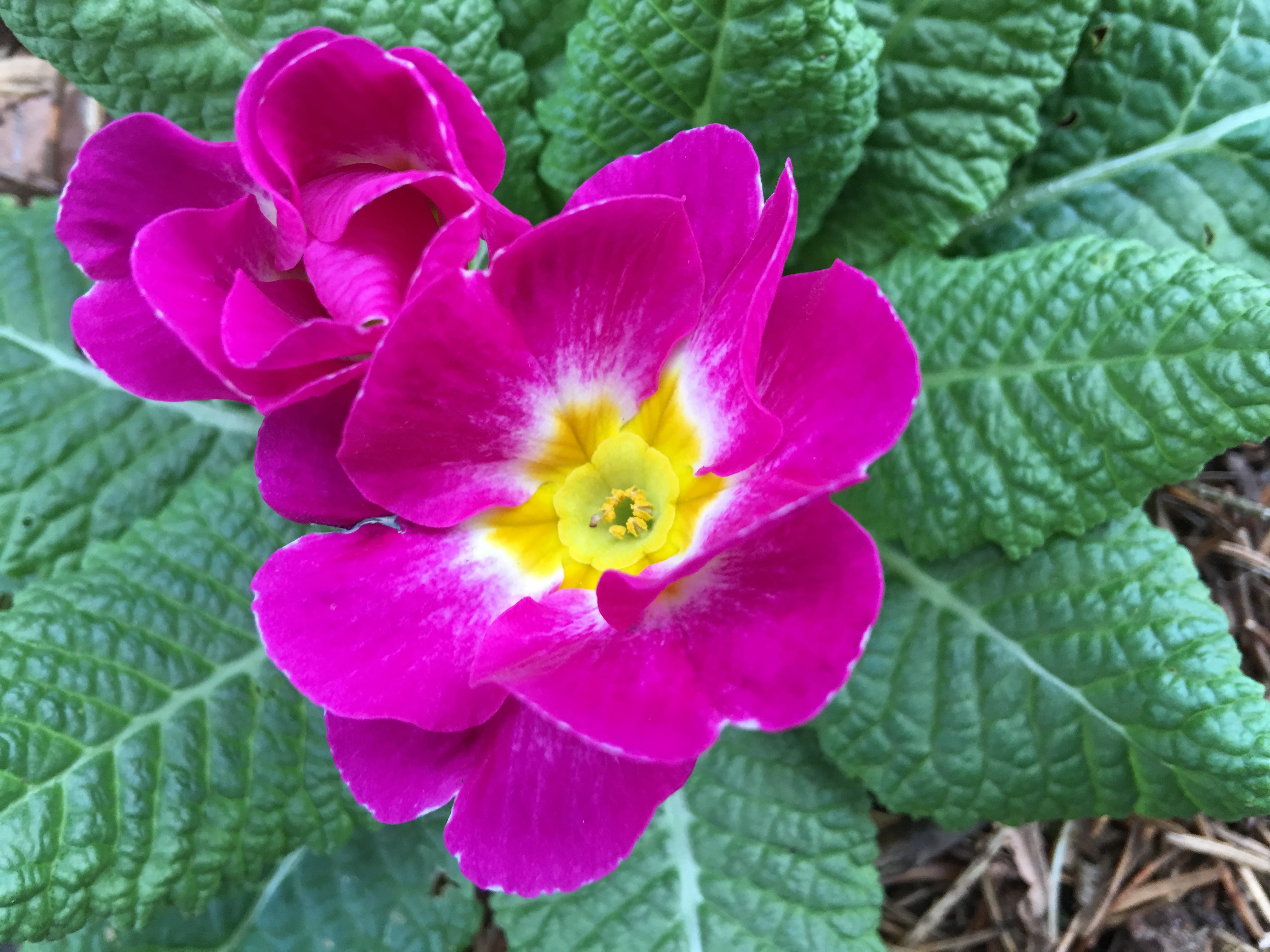
The primrose and the hellebore.

The primrose and the hellebore.


I am here again in Vinegar Hollow where Angus cattle, their black bodies and white faces are silhouetted against the copen-blue sky behind the Peach Tree Hill, three bluejays are splashing in the gutter, flocks of juncoes swirl over the sinkhole, and I see the unexpected shades of pink and rose in the garden. Unexpected for the first of January.

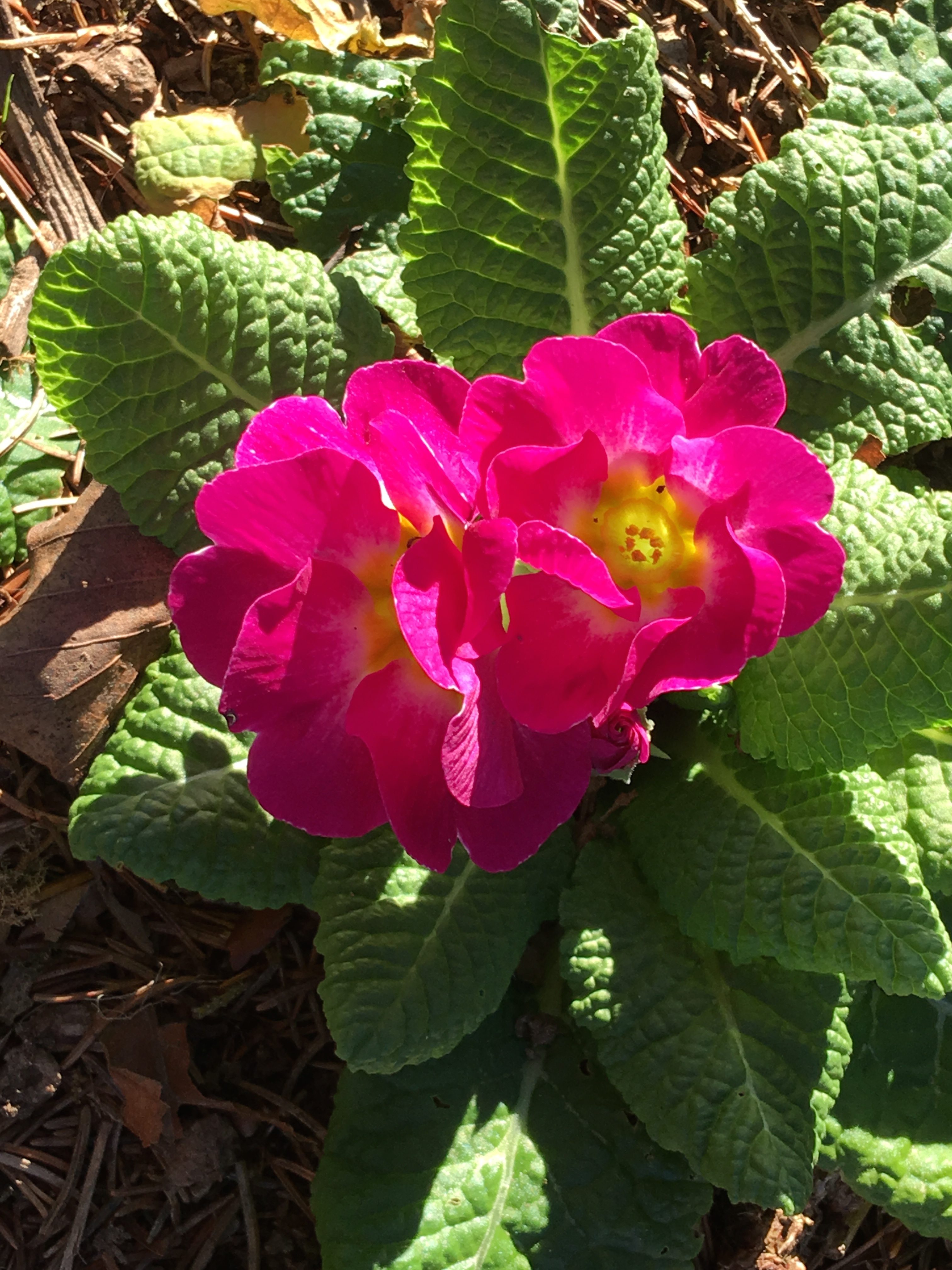
The primrose in the noon sun.

The primrose in the noon sun on January 1, 2016. This is a polyanthus, a hybrid primrose. Notice the circle of anthers resting in a golden yellow cup slightly raised above the petals at the center of the flower. This is called the rose-crown or the rose-eye. When this occurs in a thrum-eyed flower (anthers visible, stigma invisible), one has “the last word in Polyanthus elegance” according to Florence Bellis, renowned primrose breeder (APS, 1943, p. 35).


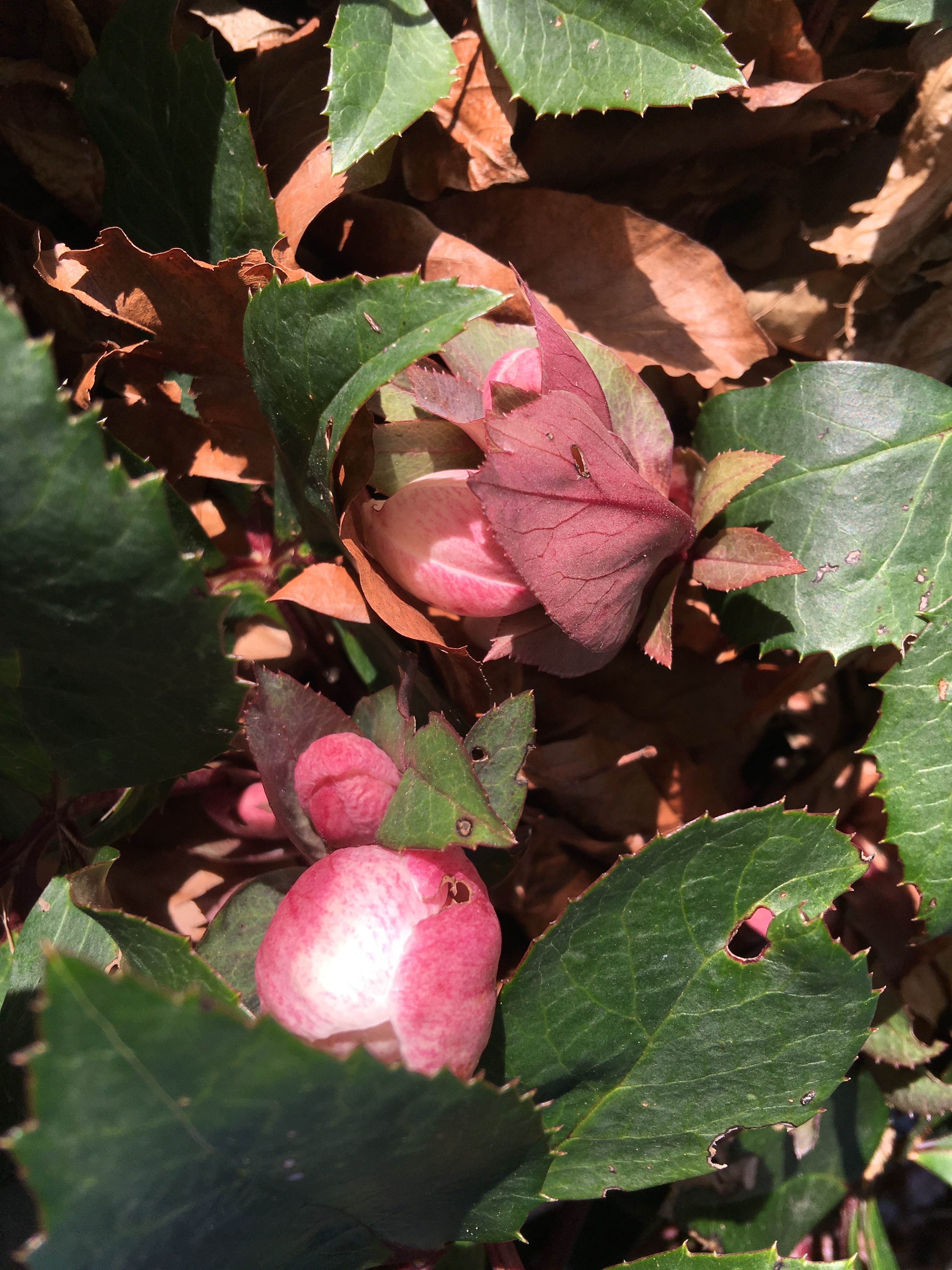
It has been unusually warm here in western Virginia as in most of northeastern North America. Last year when here in the hollow I reported about reading Antarctic explorers and braving a blizzard to experience the chill. It is has been spring-like here for a month. I am not surprised the hellebore is budding and even opening flowers. Every year it pops up in snow in the coldest of temperatures here in the hollow. The plant now has between 50 and 100 buds. If winter comes now, when all these buds, so delicately striated pink and white, are ready to open, what will happen? It will survive. Hellebores are tough.


Buds and foliage of the hellebore.

Buds and foliage of the hellebore.


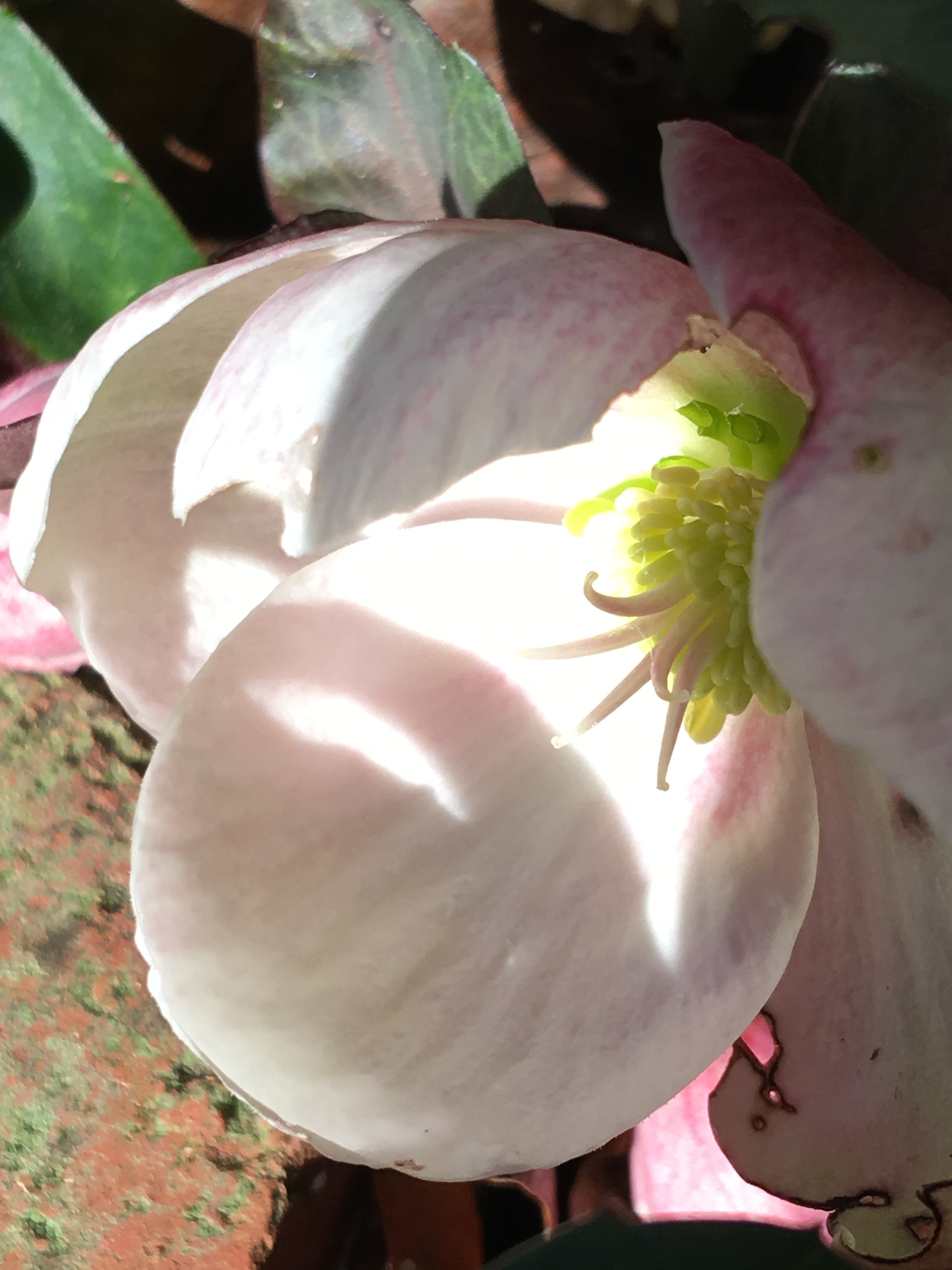
The flower of the hellebore.

The one flower of the hellebore open in Mustoe today.


The primula will survive also, though its more delicate greenery will get glassy, frozen looking if very low temperatures come. But it will survive. Primroses are tough.

I think again (see previous blog called “Snow as Metaphor:  Revealing and Concealing”) of the very old 15th century Christmas carol “Es ist ein ros entsprungen.” Its centerpiece is a rose that blooms in winter. At that time “ros” or “rosa” was a generic term for flower. Although of metaphorical import here, it is important to remember that a literal flower is at the root of the metaphor. Some think that the song’s rose is a hellebore. But it could have been a primrose. “Roses” of all sorts do bloom in winter. A version that I like is sung by the Ensemble Amarcord. Or this one using the words of Praetorius. There are various translations of the original German. Here is one:

Lo, how a Rose e’er blooming from tender stem hath sprung!
Of Jesse’s lineage coming, as men of old have sung.
It came, a floweret bright, amid the cold of winter,
When half spent was the night.

Isaiah ’twas foretold it, the Rose I have in mind;
With Mary we behold it, the virgin mother kind.
To show God’s love aright, she bore to men a Savior,
When half spent was the night.

The shepherds heard the story proclaimed by angels bright,
How Christ, the Lord of glory was born on earth this night.
To Bethlehem they sped and in the manger found Him,
As angel heralds said.

This Flower, whose fragrance tender with sweetness fills the air,
Dispels with glorious splendor the darkness everywhere;
True Man, yet very God, from sin and death He saves us,
And lightens every load.

O Savior, Child of Mary, who felt our human woe,
O Savior, King of glory, who dost our weakness know;
Bring us at length we pray, to the bright courts of Heaven,
And to the endless day!

The primrose on January 3, 2016.

The primrose on January 3, 2016.

In an interview the poet James Wright quoted from memory a passage from a letter that Tolstoy wrote to a pacifist group, where he talks about spring (in relation to religion). He writes:

I can only go back to myself. I look around myself and I see every year that, no matter what people do to themselves and to one another, the spring constantly renews itself. This is a physical fact, not a metaphysical theory. I look at every spring and I respond to it very strongly. But I also notice that every year the spring is the same new spring and every year I am one year older. I have to ask the question: what is the relation between my brief and tragic life and this force in the universe that perpetually renews itself? I further believe that every human being asks this question.

We can’t have spring without winter.


January 4, 2016


IMG_0136

Winter arrives in Vinegar Hollow with a dusting of snow.

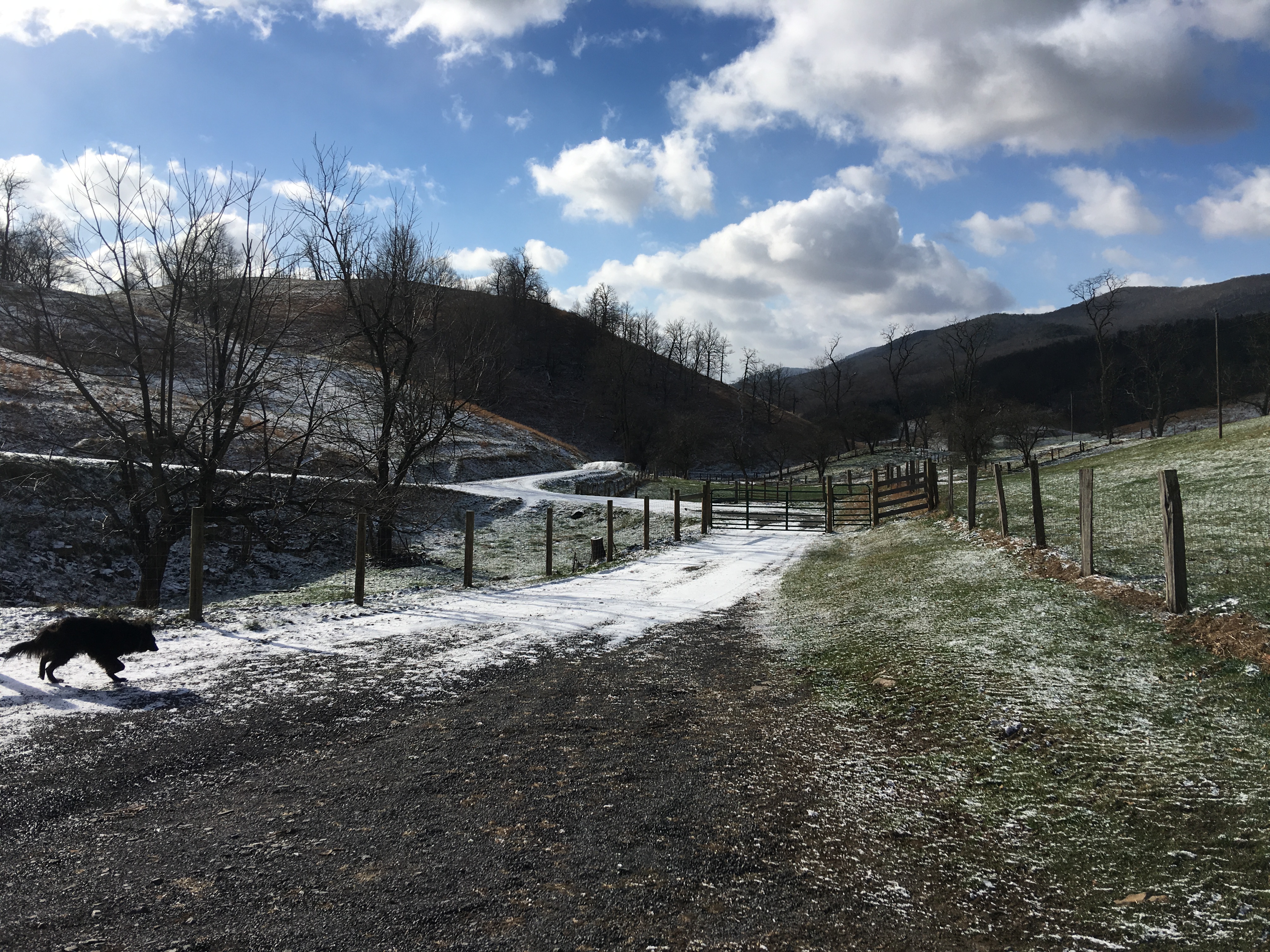
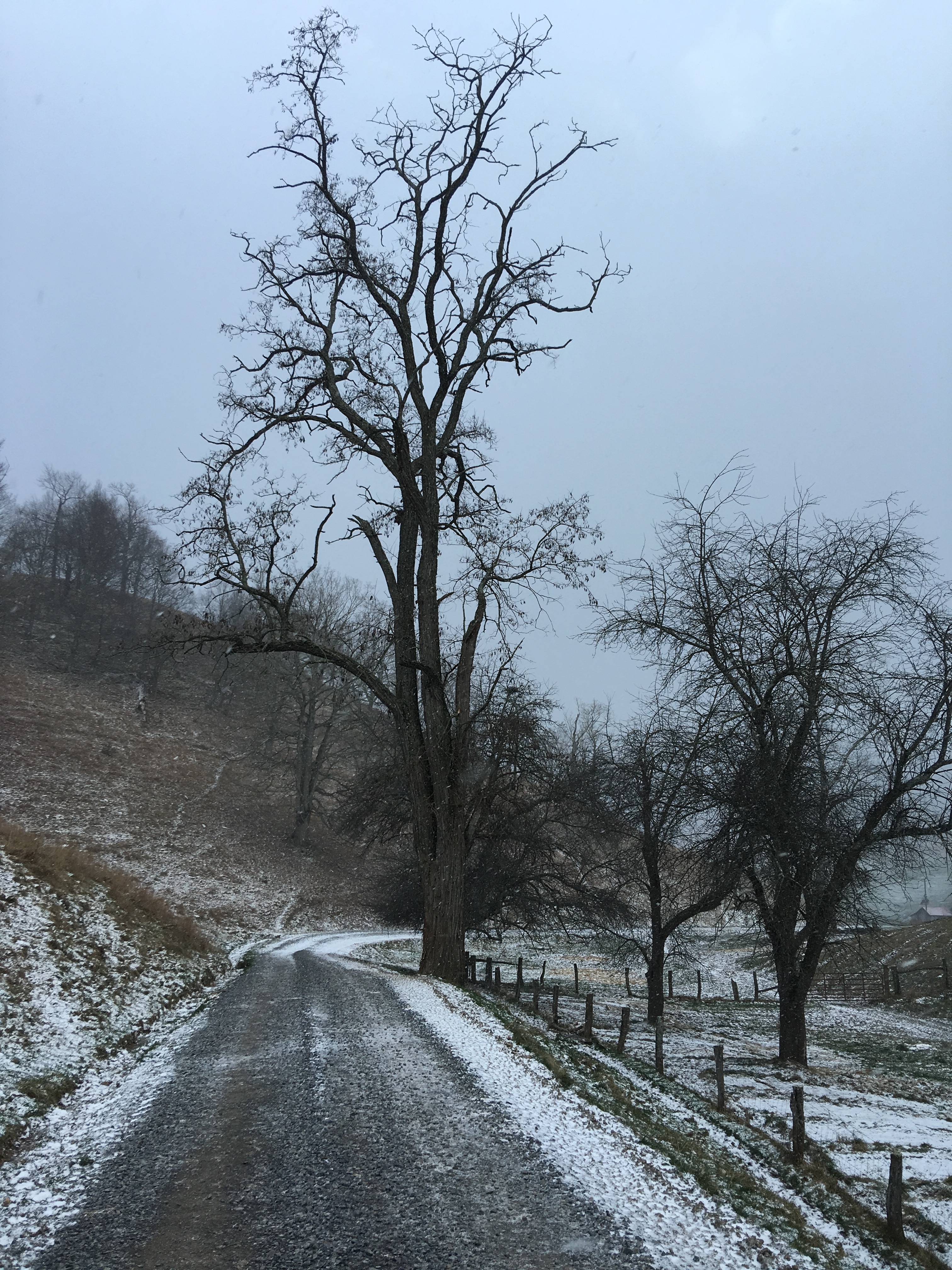
Winter arrived with a dusting of snow, and tonight it will go to 13 degrees F. This feels right. I will cover the primrose tonight just to ease it into this sudden drop from 40-50 ish degree F weather to the teens.

IMG_0147

Snow continues its dusting throughout the day. Black locust in the center and old apple trees to the right are still.


January 5, 2016

Second morning at 4 degrees F. Three blue jays are back with a flock of juncoes. They have  spread themselves all over the lawn in the morning sun and eagerly peck the ground, perhaps finding seeds of the red spruce and the beech? There was a howling wind the night before that might have dislodged seeds. But this is just a guess. I have no idea what they are so excited about. They are tapping at the ground. The three blue jays retreat to the gutter occasionally to splash. It is hard to describe the beauty of the translucent white fan that the ends of their feathers make as they alight and depart. There is more white to the blue jay than one realizes. The primrose has shrunken within itself, the vigorous green departed, the vivid rosy pink now a troubled purple. There were no pollinators for it, but a primrose lover has seen a “ros” in winter.

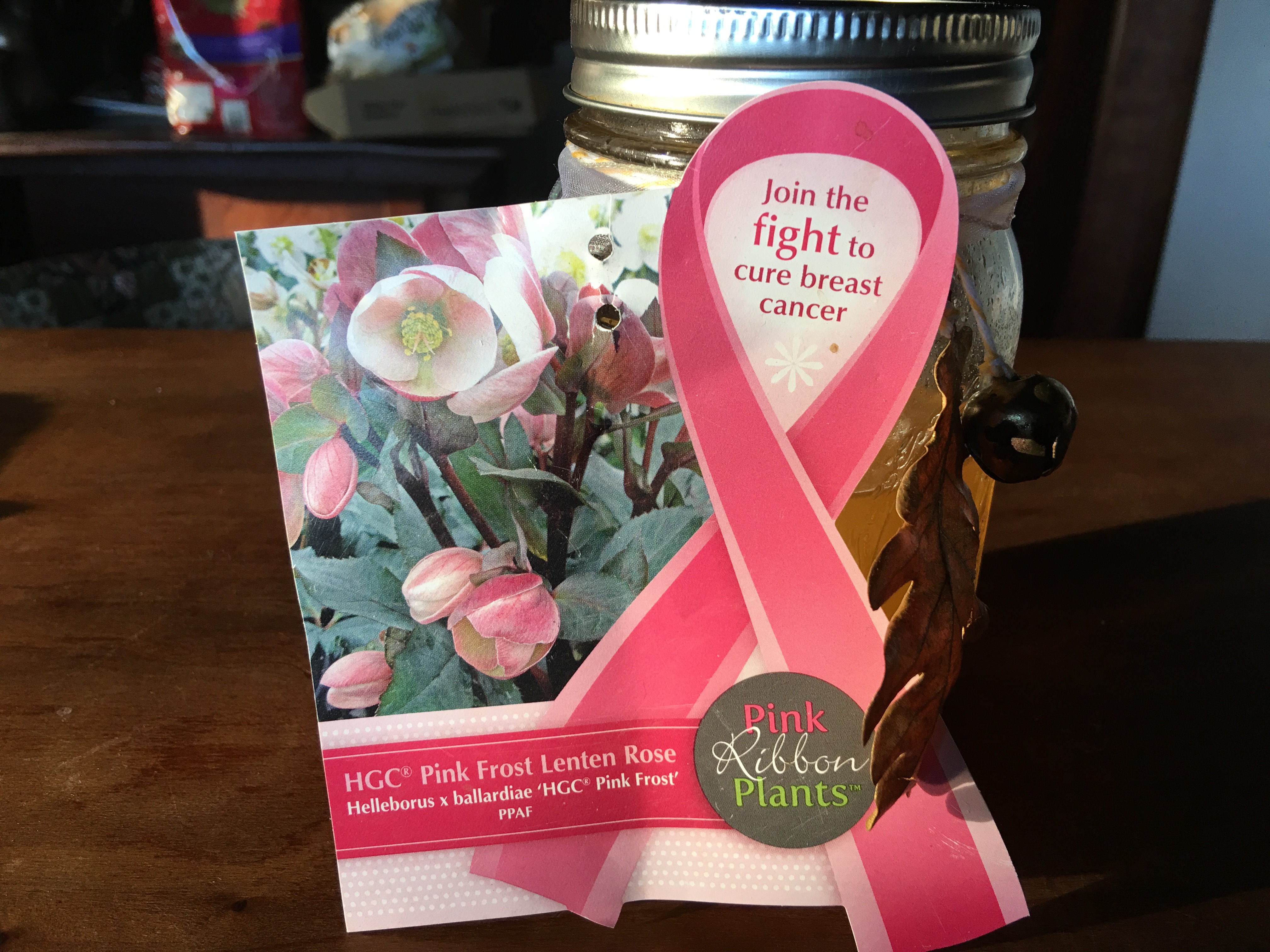
p.s. The hellebore is a really extraordinary variety called Helleborus x ballardiae ‘HGC’ ‘Pink Frost.’ I lose my plant labels, or maybe I can blame it on the dogs, but this label I saved in my writing desk. It certainly can handle the ultra cold.


IMG_0124


The rural life: Vinegar Hollow in June

Cows eating their way to Starks Ridge.

Cows eating their way to Starks Ridge in the cool of early morning.

I arrive back in Vinegar Hollow to experience  a week of June in Highland County, Virginia, at the farm that my parents bought in 1948. Things seem tranquil on the first morning as the cows move slowly across the hills chomping at the new grass, but soon enough a news story develops.
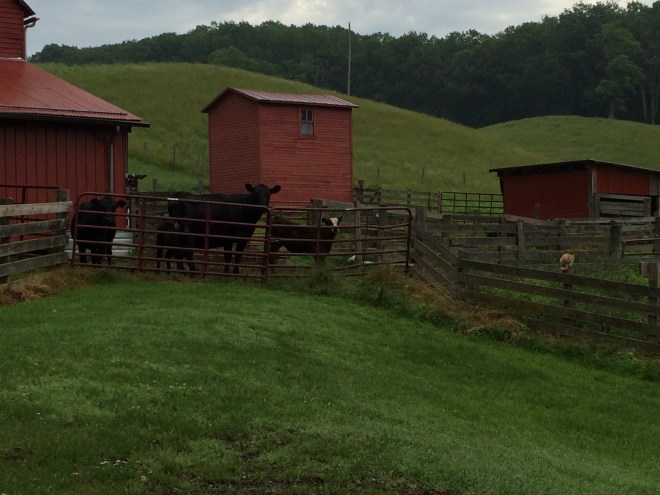
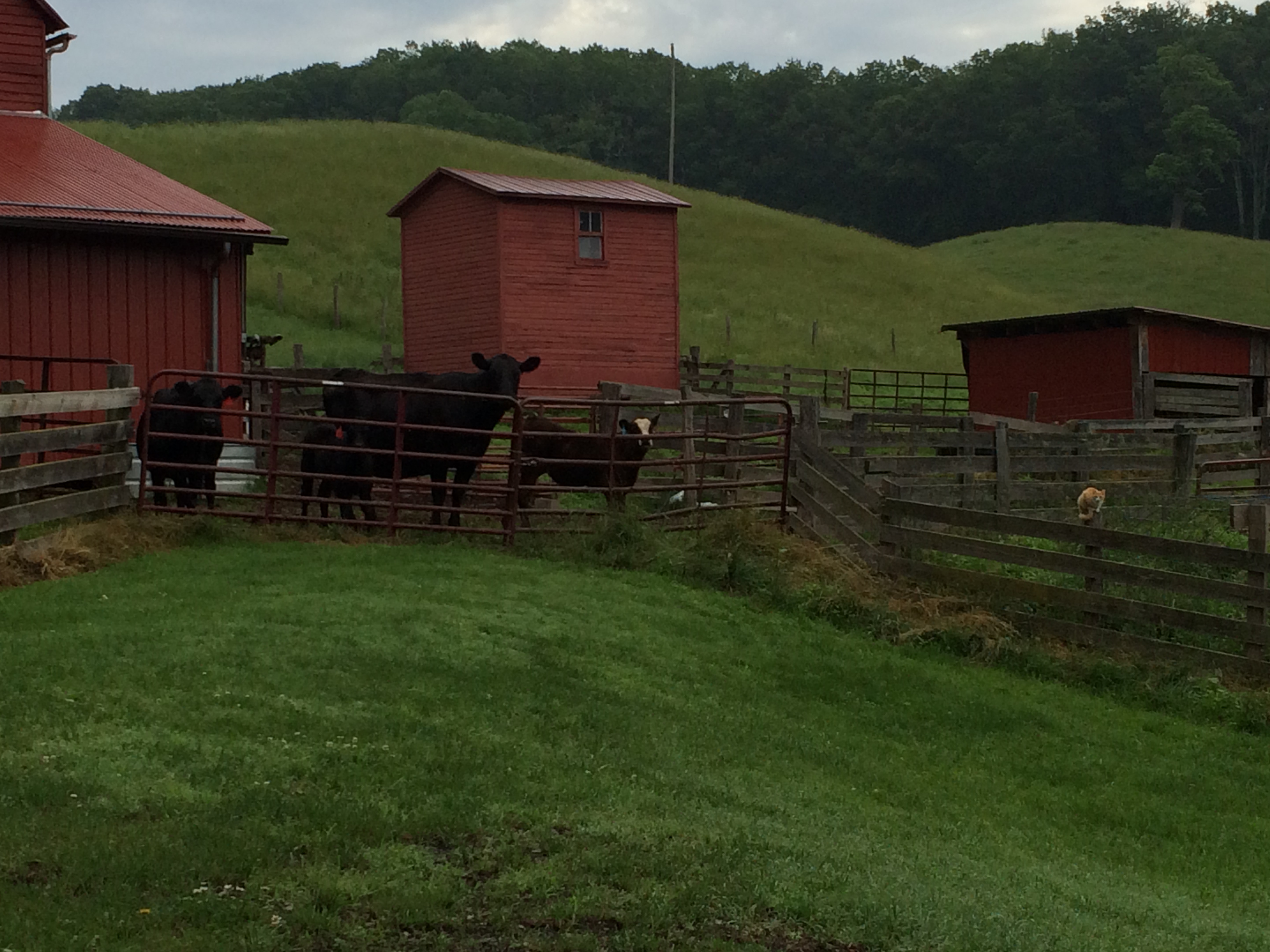
Four incarcerated cows and a cat on a fence post.

Early morning: four incarcerated cows and a cat on a fence post.

When Mike came to feed the barn cats the next morning, he noticed ear tags that didn’t match those of his herd. Two cows and two calves, not necessarily belonging to each other, which is problematic for all concerned, had strayed through an open gate from a neighboring property the day before, setting off quite a kerfuffle in the home herd. There was a tremendous bellowing by the trough all day as the cattle tried to figure out who belonged where. In the evening the owners rounded up the strays  but couldn’t get them back over the Peach Tree Hill before dark so they spent the night cooped up, like chickens you might say, which did not agree with them. They had plenty of water in the trough, but the grasses on the other side of the fence smelled so sweet. Their longing for freedom intensified over night and they stared at me intently as I strolled with my morning coffee, hoping I was the one who would free them. I told them Corey and Miranda would come soon.

I remembered the time my sister and I slept overnight outside in our sandbox, which had been converted into a tent. We woke up in the early morning when the large head of a large deer poked through the blanket over the sandbox, sniffing, nuzzling, and terrifying us. It turned out be to a pet deer that had escaped its owner. This is what I mean by news stories on a farm.

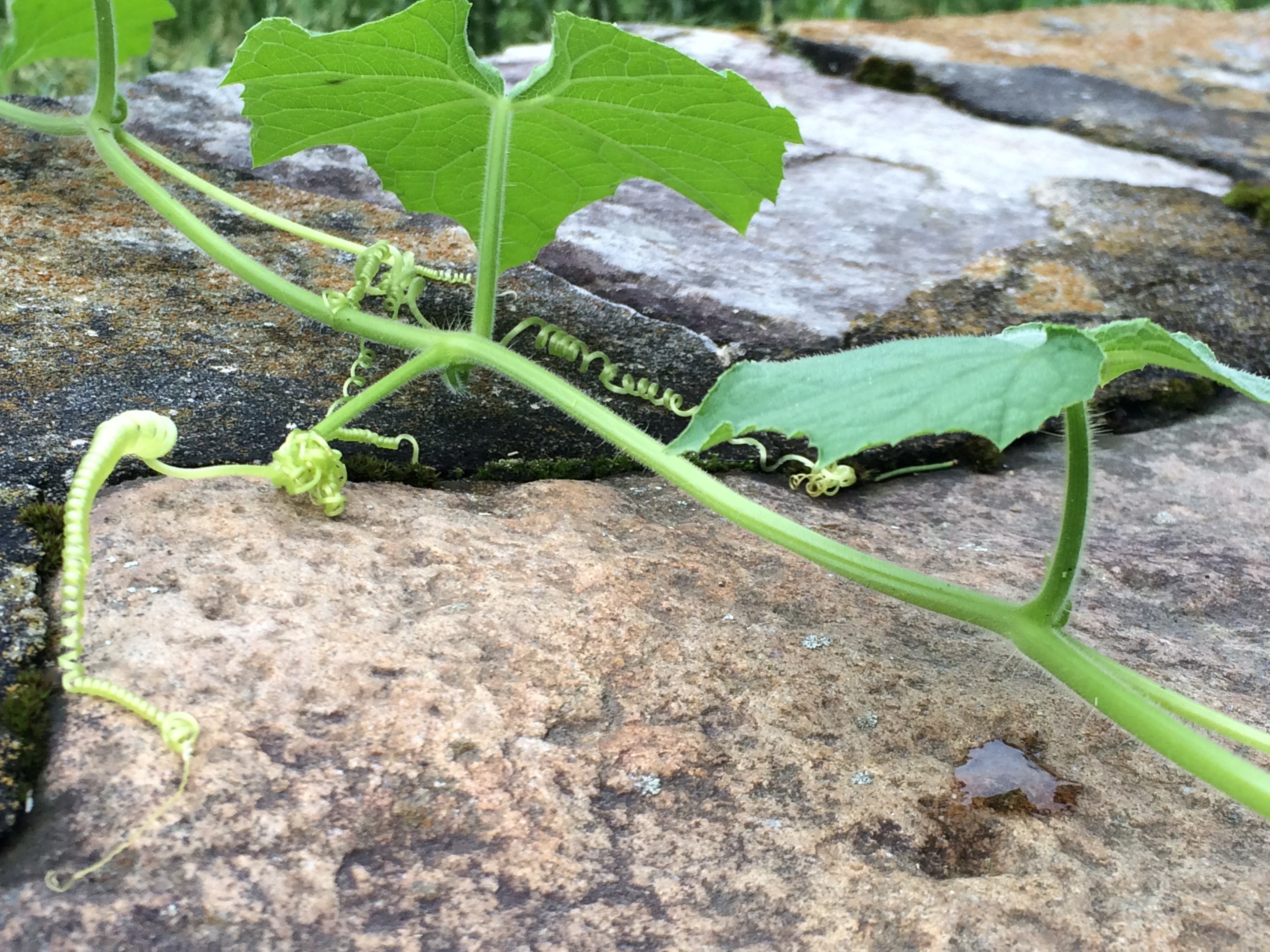
Nearby I watch the daily progress of the wild cucumber creeping out of the gone-wild calf nursery. This enclosure, my mother’s old vegetable garden, has metal hoops that are covered in winter with canvas to protect newborn calves that have been booted out of the barn to make way for new arrivals–in the too-cold of their birthing season.
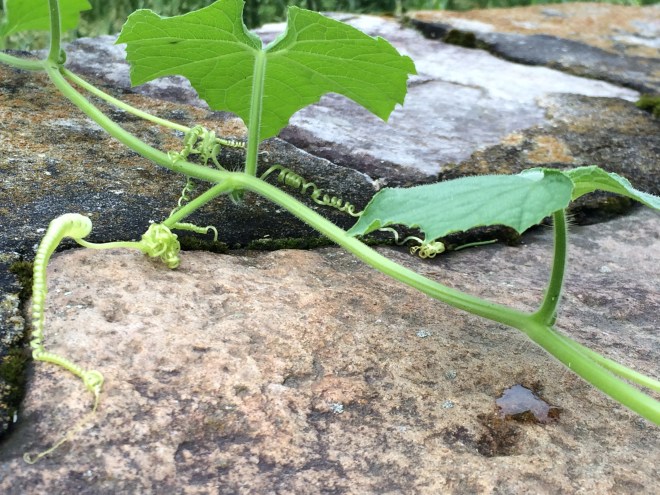
Wild cucumber vine creeping over the wall, tendril by tendril.
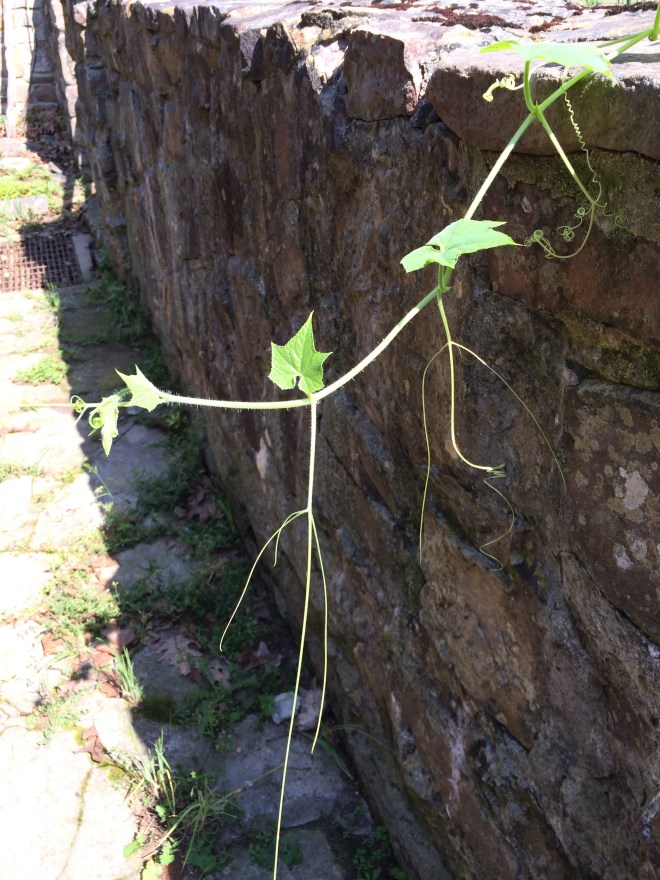
Wild cucumber vine creeping over the wall, tendril by tendril.

It's over the wall!

It’s over the wall!

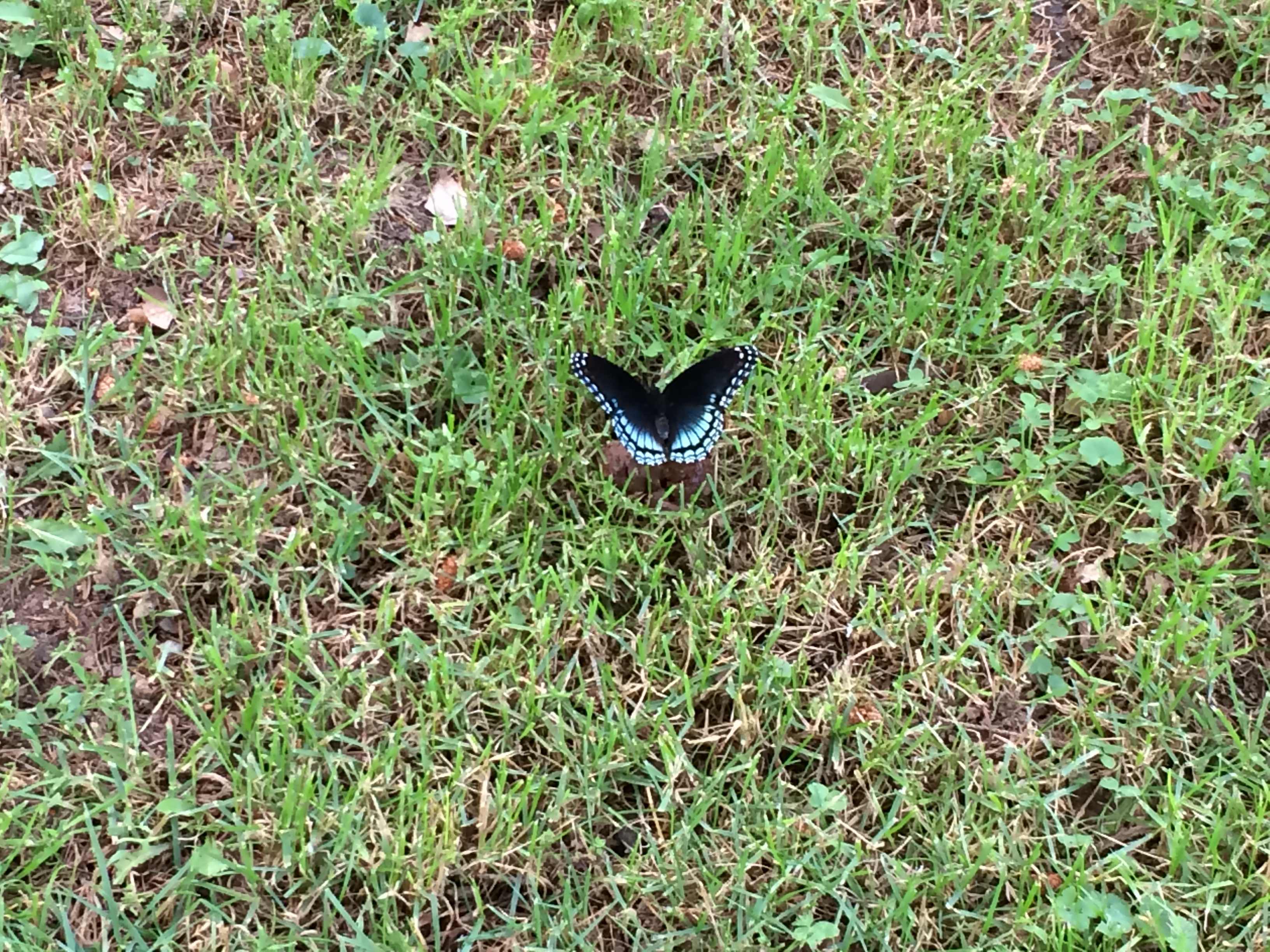
Still drinking my coffee, I watch the blue-black butterfly that comes jogging around the house every morning and afternoon visiting the same patch of scat, which has been rained on so often that it must seem fresh.  This is probably the black swallowtail mimic that has no tails, the Red-spotted Purple (Limenitis arthemis astyanax).
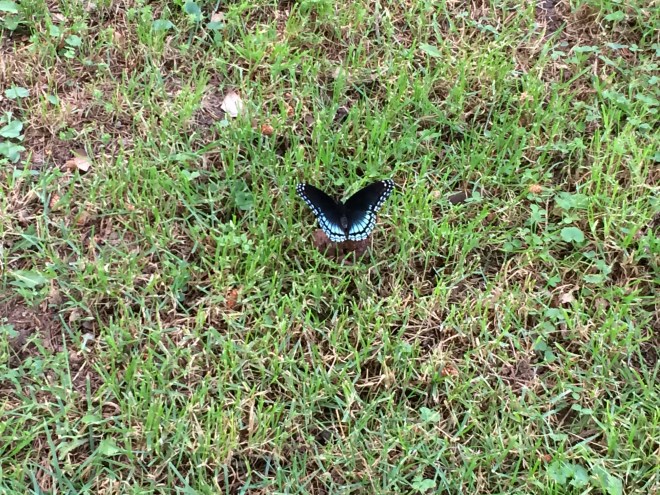
Red-spotted Purple on scat in garden lawn.

Red-spotted Purple on scat in garden lawn.

This individual has come to seem like my personal friend. I have chased around after it and found that its behavior fits that described for this species–it enjoys scat, gravel roads, and roadsides.
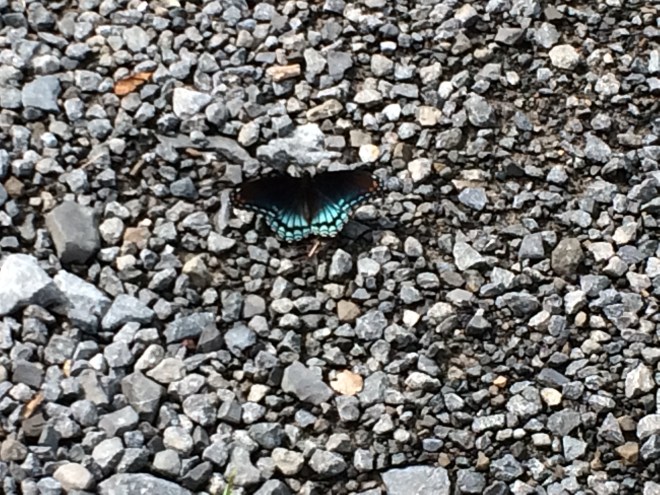
IMG_9289

The butterfly has made its way to our gravel driveway. Photographing butterflies is frustrating for the amateur. This is not sharp, but finally I see the “red” spots at the extremities of the upper wings. I didn’t notice them at all while observing the constantly moving “flutterby.”
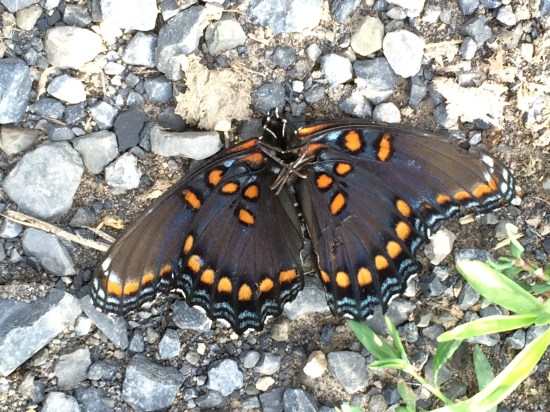
Underside of the Red-Spotted Purple found by the side of the road by the apple orchard in Vinegar Hollow.

Underside of the Red-Spotted Purple found by the side of the road near the apple orchard in Vinegar Hollow. It was killed, mostly likely, by my car or Mike’s as very few others travel this road. Soon I started noticing dead Red-spotted Purples on Route 220 north and south to Monterey. Their penchant for frequenting gravel and roads is not healthy.

The Red-spotted Purple has found fame in the hands of writer May Swenson, author of the poem “Unconscious Came a Beauty” written  in the shape of the butterfly that alighted on her wrist while she was writing one day. It is a delicate poem full of stillness until the last line, “And then I moved.” She was fortunate to have this experience, and we are fortunate to have her poem. The hollow seems to be full of Red-spotted Purples this year, and there is much to learn about them. There are good observers out there, like Todd Stout, who offers a youtube video on identifying the hibernacula of this species. A hibernaculum is the overwintering curled-leaf-like home of the caterpillar, beautifully camouflaged to avoid notice. It is hard for me to imagine that I can ever learn to spot a hibernaculum, but I do know black cherry trees, a preferred host, so that’s a start.
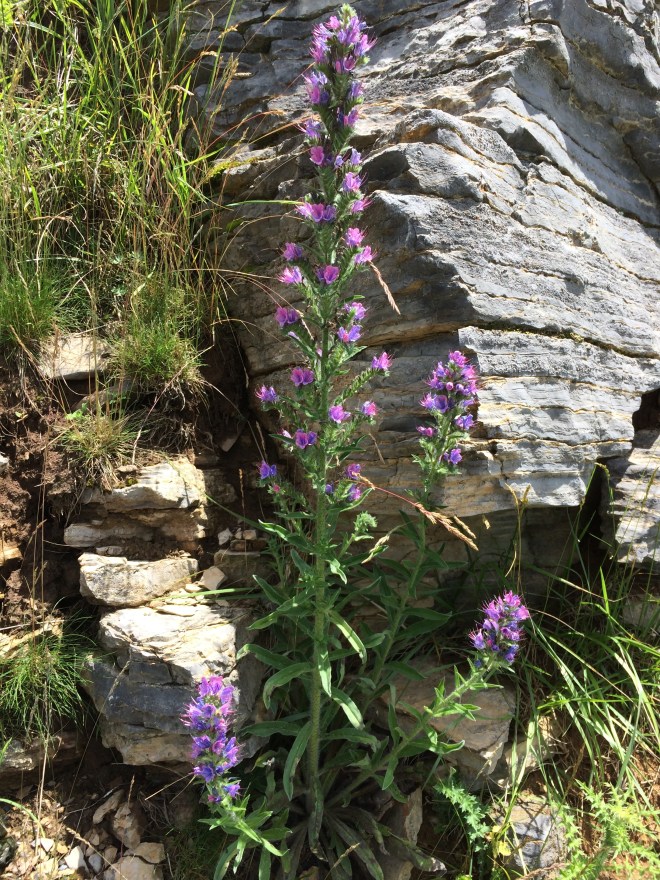
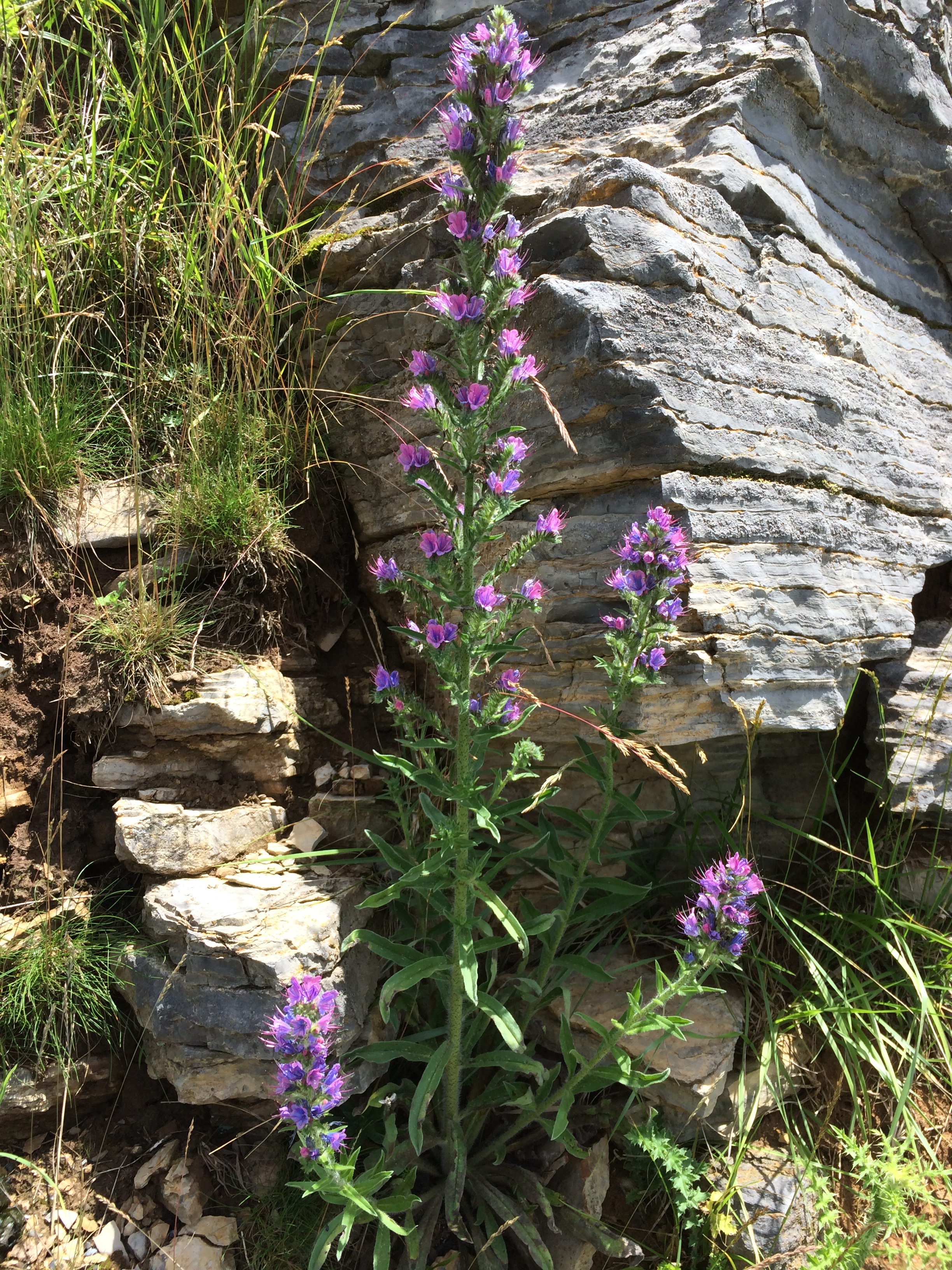
The viper's bugloss (Echium vulgare), a member of the forget-me-not family.

The viper’s bugloss (Echium vulgare), a member of the forget-me-not family.

I am happy to find viper’s bugloss, my mother’s favorite wildflower, abundant along the cliff road, nestled against the limestone outcroppings, as impressionistic a combination of pink and blue as one can imagine. The pollen is blue, while the stamens are red. Margaret McKenny and Roger Tory Peterson in A Field Guide to Wildflowers: Northeastern and North-central North America describe it as “bristly.” Yes, it’s the right word. The flowers may look a little fluffy, due to their exserted stamens, but the plant rebuffs touching. It is definitely a porcupine in flowery dress.  “Bugloss” derives from two Greek words meaning head of a cow and tongue, the import of that being that the leaves are as coarse as a cow’s tongue.
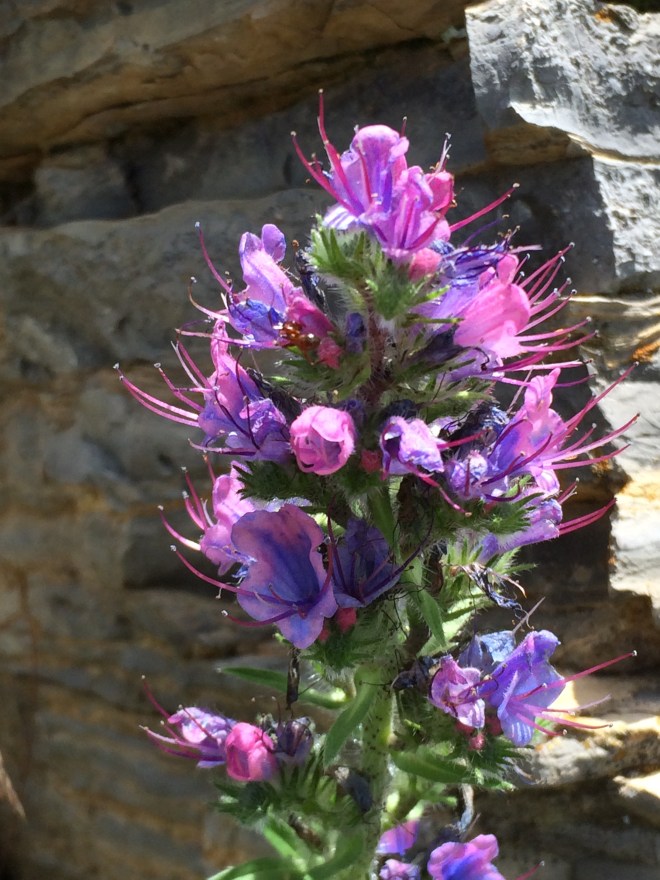
Close-up of viper's bugloss, also known as blueweed, showing exserted stamens.

Close-up of viper’s bugloss, also known as blueweed, showing exserted pink stamens with slate-blue pollen .
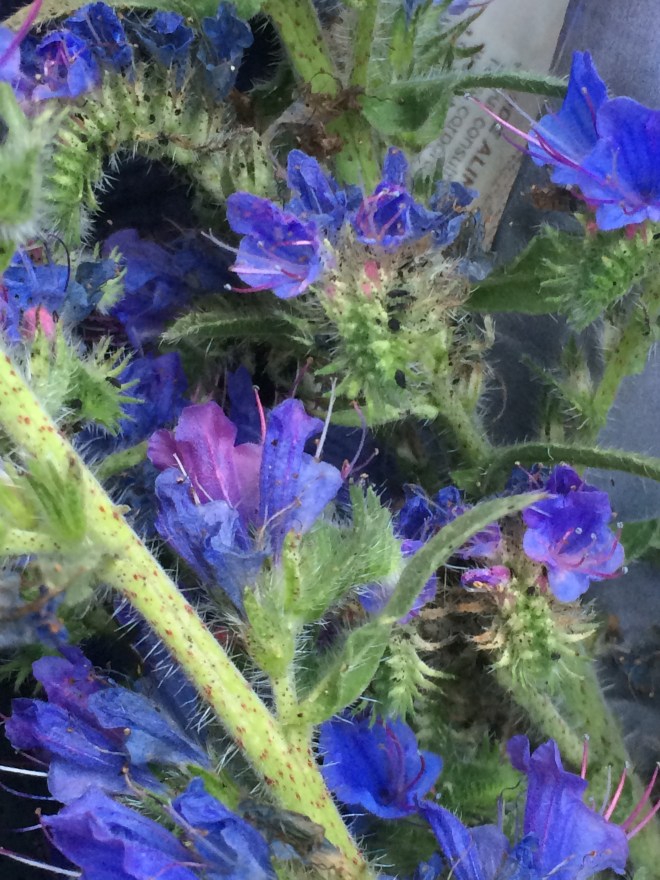
Close-up

Close-up showing bristly nature of the plant.

My mother had a passionate attachment to viper’s bugloss, tucking little sprays of it into vases in her kitchen whenever she could. Maybe it was the blueness that attracted her, because she loved the indigo bunting and the bluebird as well, but I suspect she also sympathized with its bristlyness.

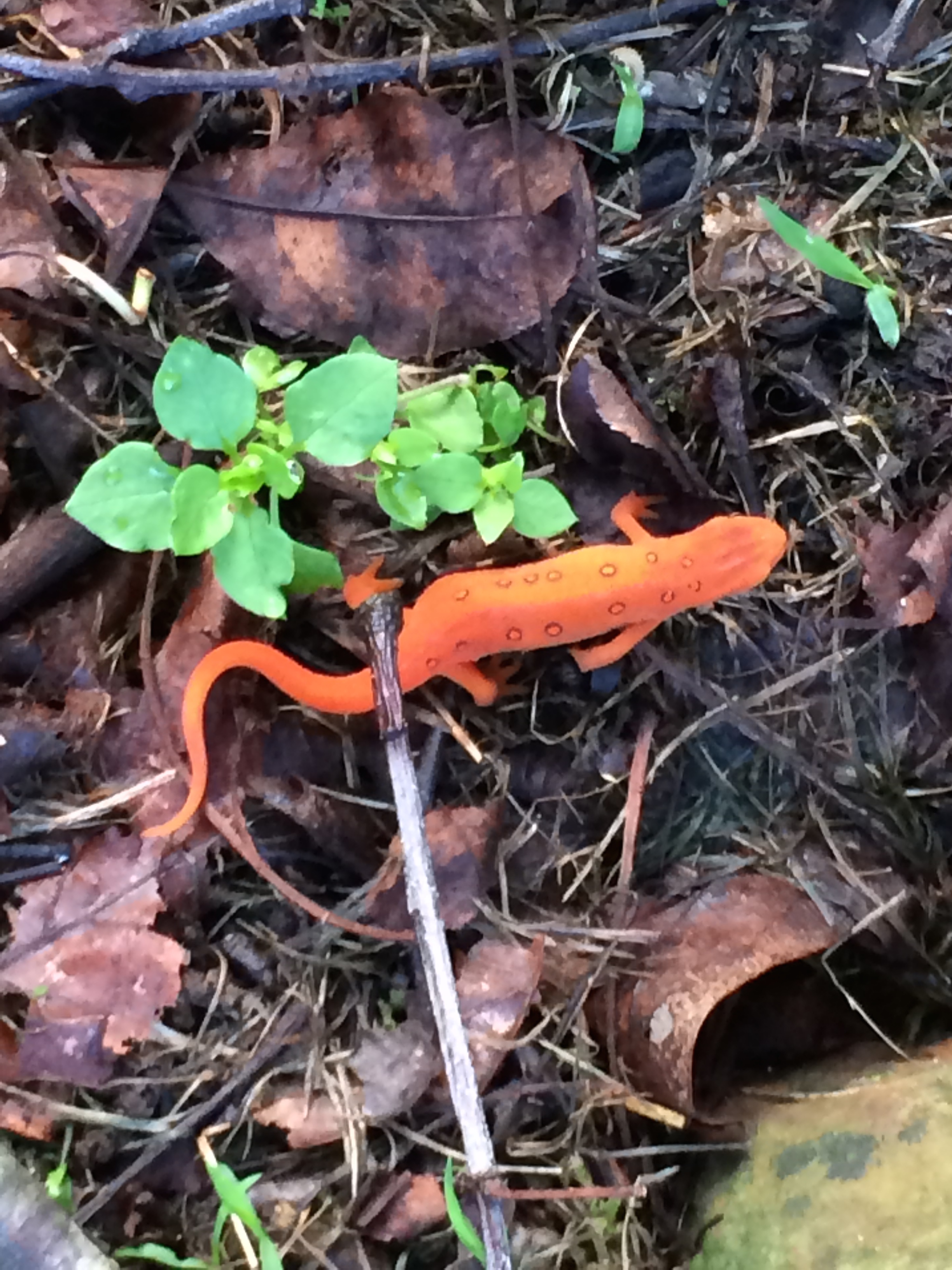
It rains every day, which brings the red eft out of hiding. Once years ago as a child I found one that had been stepped on by me or one of my family members near the garden gate as we arrived for the summer, one of its feet flattened, looking so childlike that I felt like crying. I watched this one undulate noiselessly to safety.
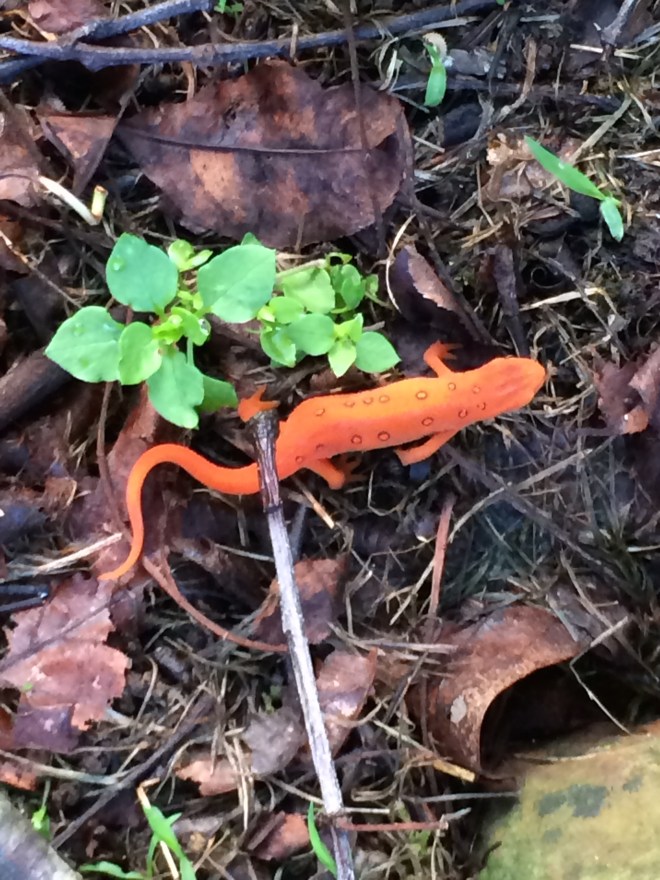
The red eft stage of the eastern newt.

The red eft stage of the eastern newt (Notophthalmus viridescens).

June is hay-making season, and the air in Vinegar Hollow is sweet with the scent of flowering grasses, native and nonnative.  I remember helping to make hay stacks in the Big Meadow in the old days when a pitchfork was the preferred tool. Then rectangular bales came along, which were easy to lift, though prickly, but with the advent of  the huge round bales of today the farmer needs sophisticated machinery to make and maneuver them into storage. Now I just walk among the grasses on the hills, admiring the delicacy of the myriad grass “florets,” trying to remember what I learned in Agrostology, the study of grasses, as a graduate student in botany at the University of Texas at Austin. I loved the course, but we worked almost entirely with herbarium specimens which took some of the romance out of the enterprise. A floret is a little floral package, which includes a very small flower lacking petals and sepals, but surrounded by two protective scales, the lemma and the palea. Much in the study of agrostology depends on the lemma and the palea. And the awn. The specialized vocabulary needed to described the intricacy of grasses is remarkable.

While each floret may seem too modest to admire, many florets grouped together make stunning inflorescences. Grasses in flower argue for a special kind of beauty. Their feathery stigmas and dangling anthers float and shiver in the breezes, and entire hillsides seem to shift when wind moves through the knee-high grasses.

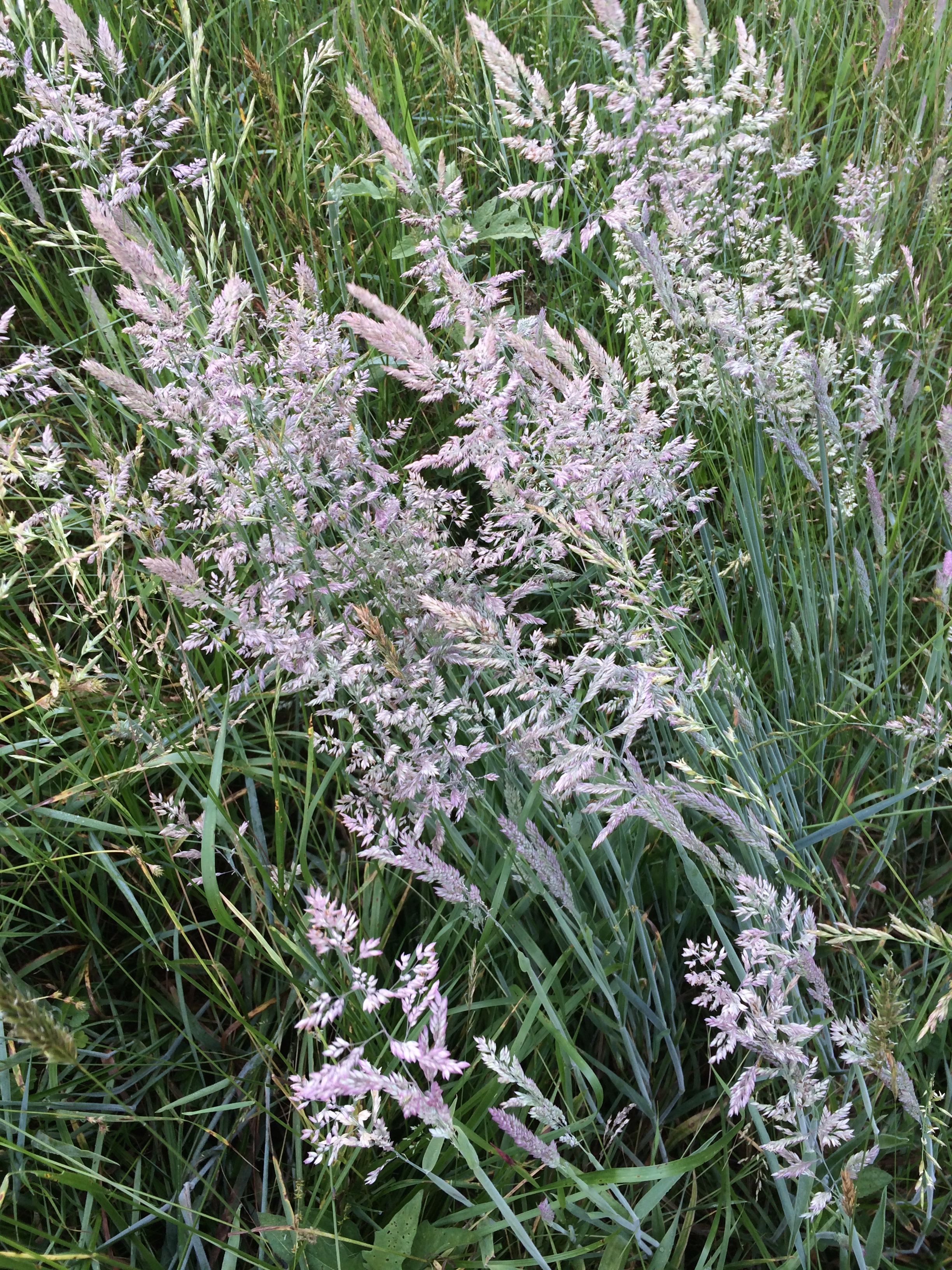
This week I fell in love, again, with a grass I know by sight but whose name I had never learned.  It’s downy, pinkish-purplish above and bluish-greenish lower down. Let’s call it the Mystery Grass.
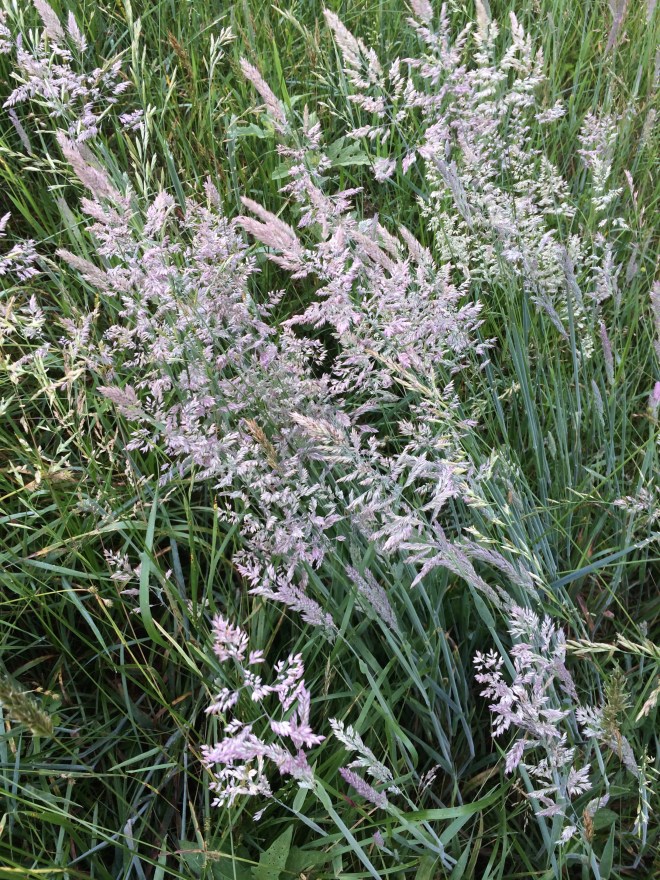
My mystery grass, which turned out to be Nuttall's reed grass (Calamagrostis ....).

Mystery Grass. Mike said that he’s always called it feather grass and that it’s one our native grasses.

Helen Macdonald, author of H is for Hawk, in her recent “On Nature” column for the New York Times, titled “Identification, Please,” writes that

There’s an immense intellectual pleasure involved in making identifications, and every time you learn to recognize a new species of animal or plant, the natural world becomes a more complicated and remarkable place, pulling intricate variety out of a background blur of nameless gray and green.

She’s right.
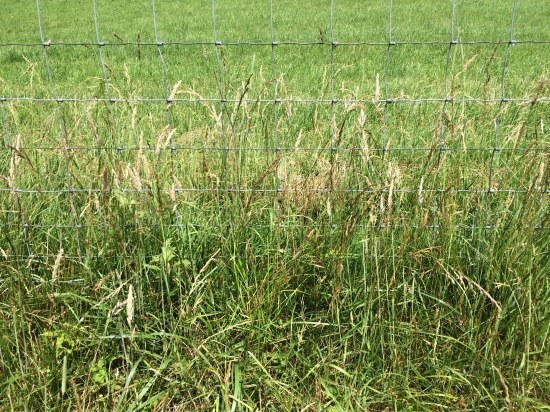
A

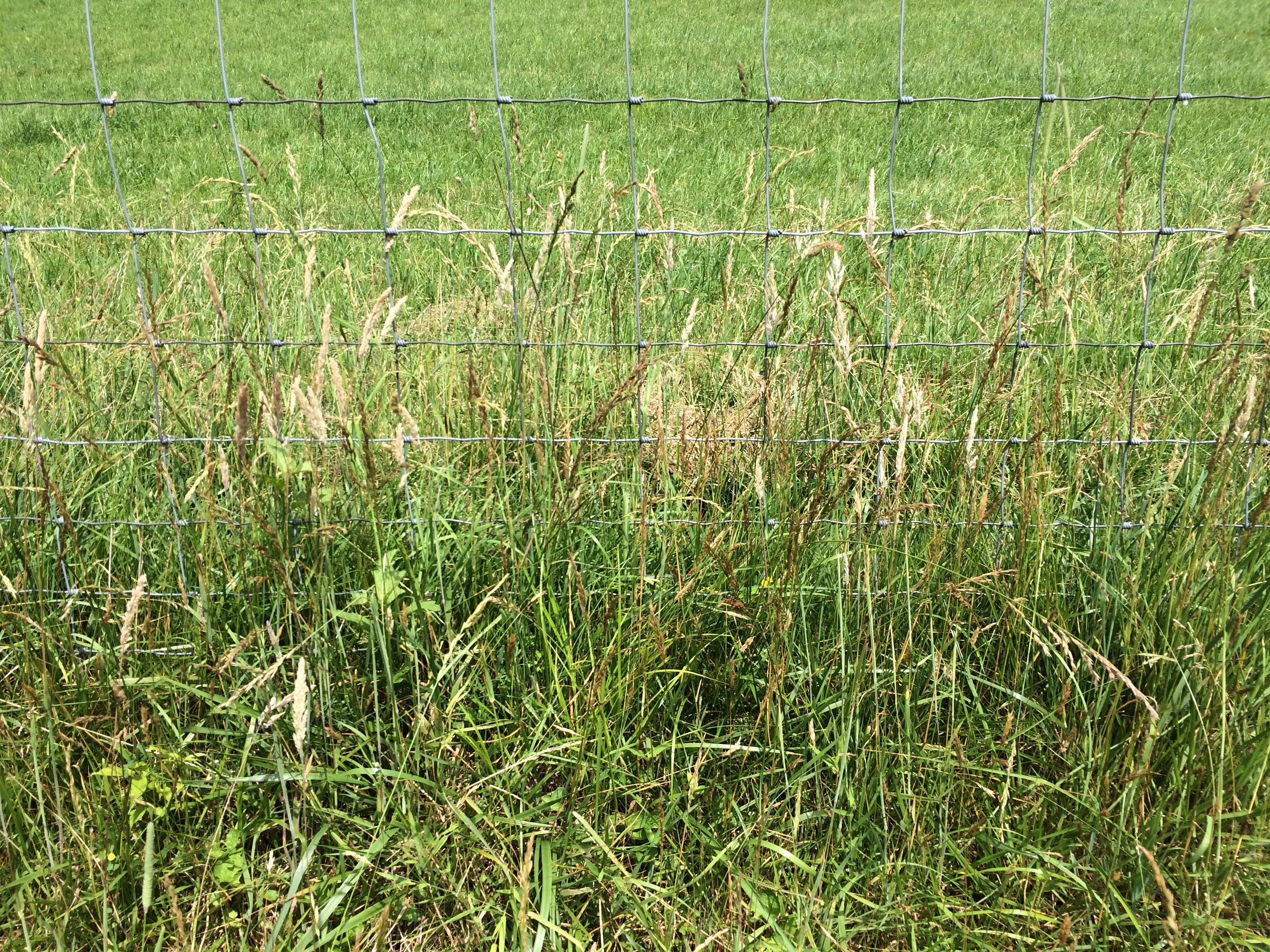
A “blur of nameless” grasses flowering in June in Vinegar Hollow.

I decided to try to name  the sweet-smelling, soft feather grass. I have spent almost a lifetime identifying plants in Vinegar Hollow using Virginia McKenny and Roger Tory Peterson’s field guide, but they don’t include grasses in their book, though grasses are wildflowers. My father taught me the easy forage grasses, like timothy and orchard grass, so distinctive that they can’t be mistaken for anything else, but I don’t remember him naming the mystery grass.
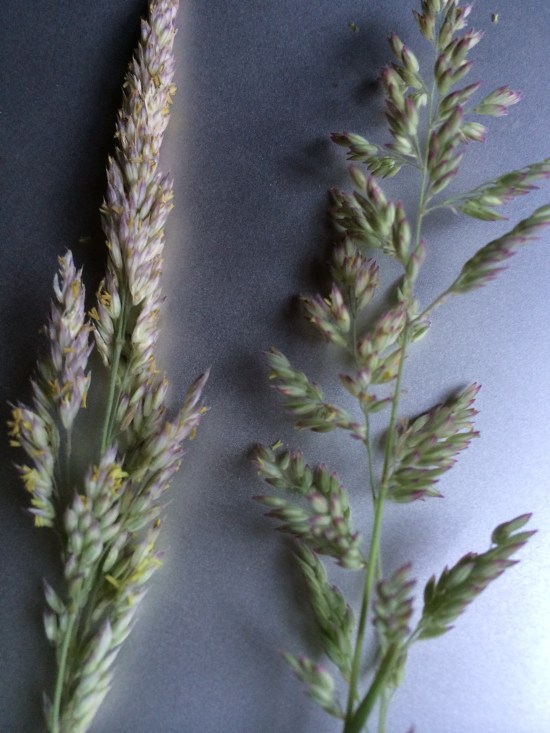
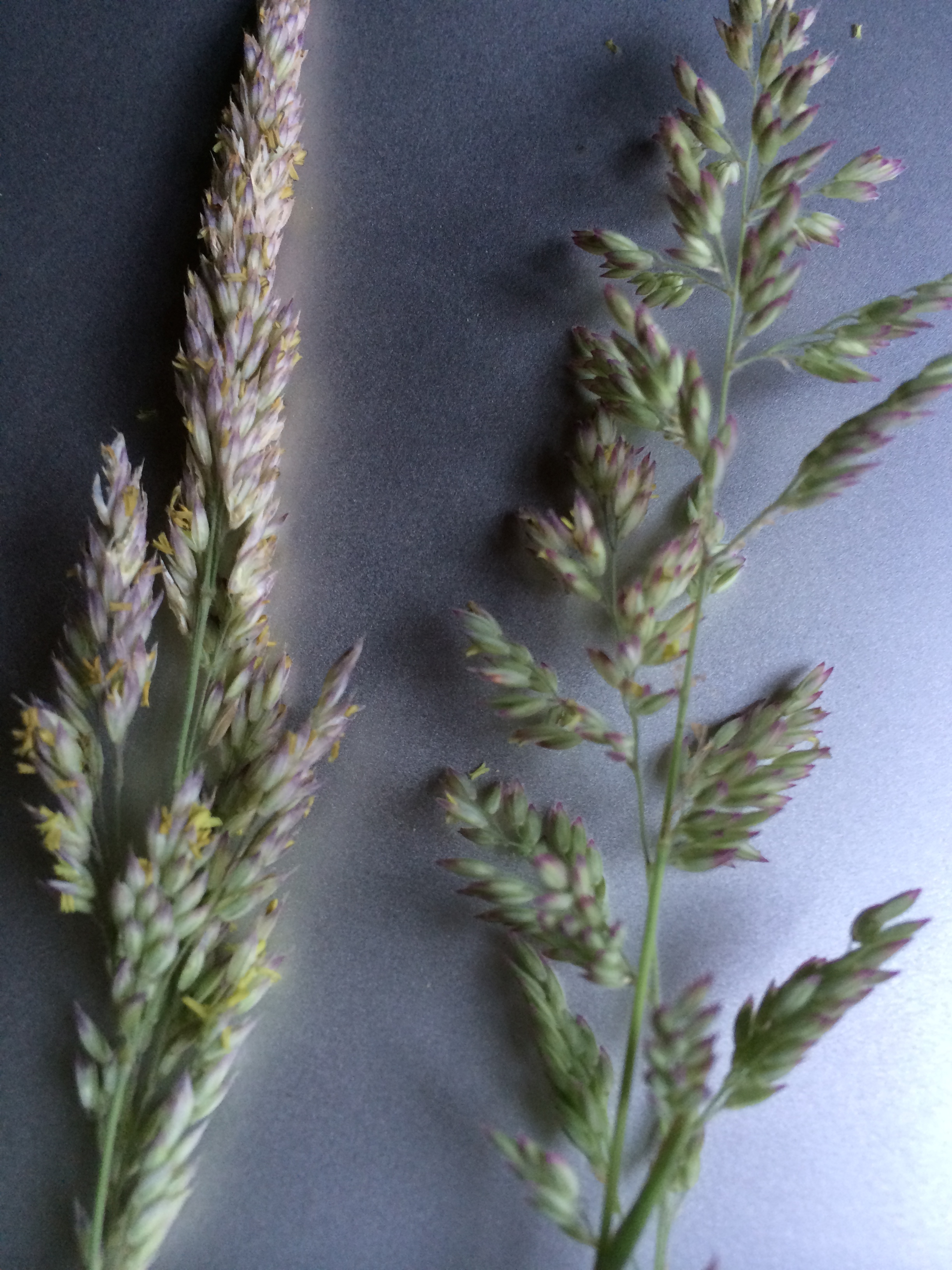
Mystery Grass. Inflorescences open as they mature, spreading out their pollen to the wind.

Mystery Grass. Inflorescences open as they mature, allowing anthers to dangle, offering pollen to the wind.
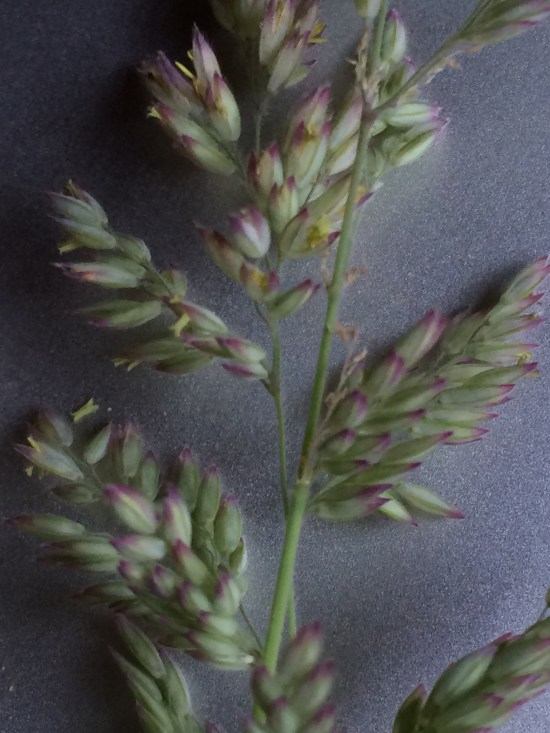
Mystery Grass, showing the purple tips of the inflorescence.

Mystery Grass, showing the purple tips of the inflorescences and a few anthers just peaking out of florets.

Lacking a field guide, I set off into the vast world of the Internet, which after three or hours yielded an answer through a combination of sources: Nuttall’s Reedgrass or Calamagrostis coarctata (synonym Calamagrostis cinnoides). Reader: if my identification is incorrect, please let me know. If I’m right, I’d like to know that also. I never found the perfect source with a clear photograph.

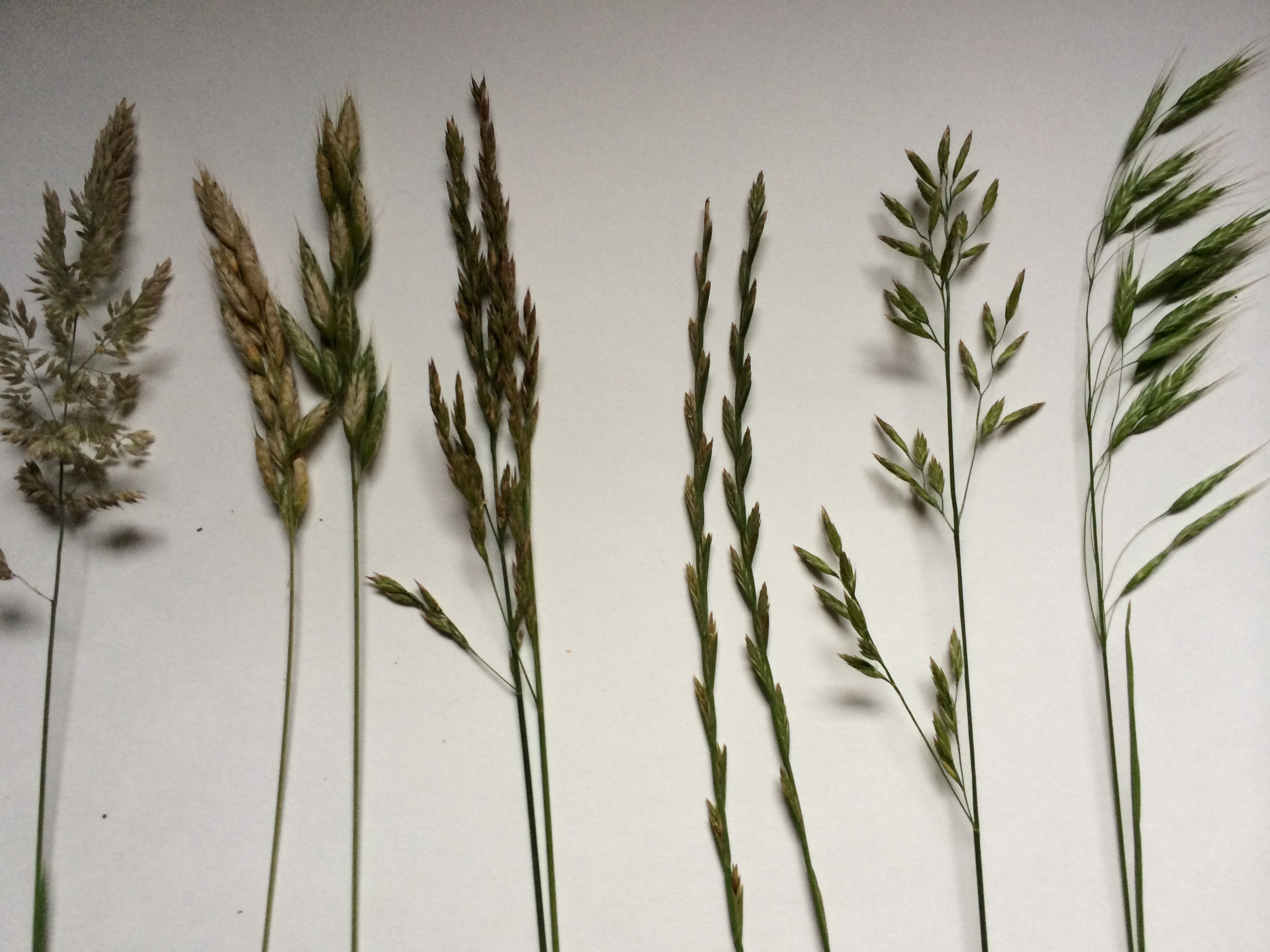
Grasses are hard to get to know, especially as they change through the growing season, similar to birds whose juvenile feathers have different colors and patterns than the adult ones. My “feather grass” will look different at the  end of the season, when the seed has ripened. The soft purple will have turned to a whispery tan, and the shape of the inflorescence will change as well. During my search, as I tried to differentiate the “feather grass” from the other grasses common in Virginia, I collected other grasses for comparison. Falling back upon my training in agrostology, I made a multi-species herbarium sheet to reveal the unique morphologies of the inflorescences that in the field “blur” together so beautifully.
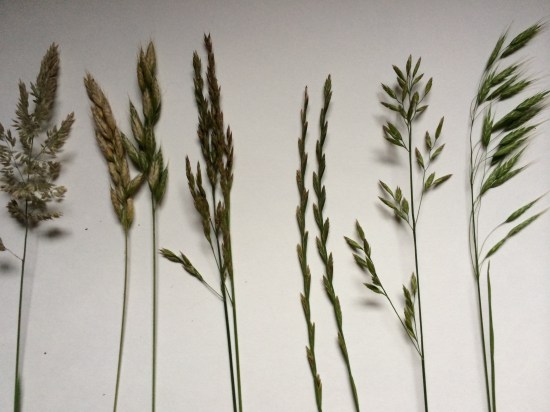
Grasses found in Vinegar Hollow, June, 2015.

Grasses found in Vinegar Hollow, June, 2015.

I have  other story lines here in the hollow to move forward as well. Two eminent trees, a sugar maple and a black oak, have dominated the farmyard at the end of the hollow for three generations or more. The black oak is all but dead. My father hired someone to put a lightning rod on the oak years ago, but age has overtaken it and limbs are falling steadily. Only a few slender branches have any leaves, and they are small. The granary nearby, full of valuable farm machinery, is at risk. Roy, who has lived in the hollow 91 years, says that it was in its prime when he was young. It is the kind of tree that people stand under and say, if only this tree could talk, the stories it could tell. In high school I wrote a poem for our literary magazine about the trees, which I always thought of as parental, the sugar maple like my mother and the black oak like my father. I had hoped to predecease them, but it has fallen upon me to take action. I met with the tree service this week to make the appointment for removing the oak. As I confronted my depressing role as executioner, I thought of W. S. Merwin’s remarkable piece of writing called “Unchopping a Tree.” No one should take down a tree with a light conscience.

There is good news, however. My husband and I have been protecting two seedlings of this oak in the yard under the electric pole. They must be transplanted this fall before they are too big to move and before the electric company decides to eliminate them. We are going to transplant both and hope that one at least lives for the next 300 years.
IMG_9235

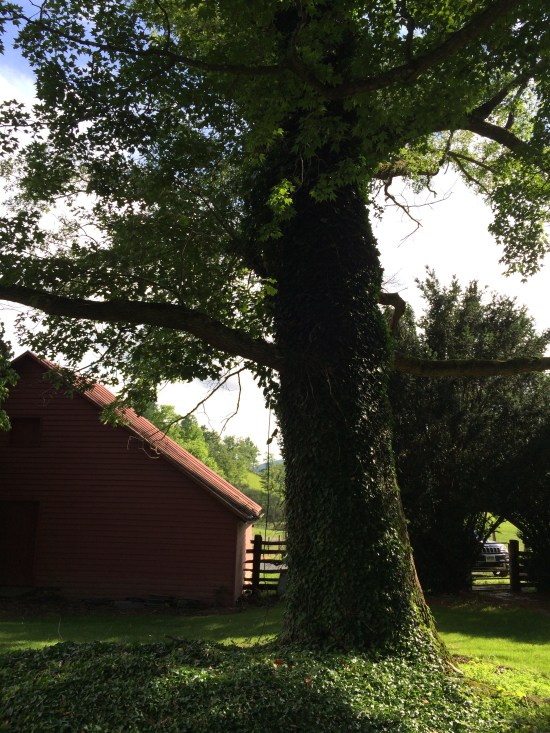
Granary and black oak.

Black oak seedling.

Black oak seedling.

The last news story is that the light on the pole lamp went out. Set on top of a tall telephone-type pole, it casts a broad illumination. My mother put it up years ago. She lived at the farm alone for many years and it must have given her a welcome sense of company, and, it would have lighted her chores at night. I never liked it because in the evening it attracted luna moths that would then cling to the pole, quiescent, during the day even as birds pecked them to shreds, and it casts too much light for sleepers who like a darkened room. I wasn’t prepared for the utter darkness that night when the pole light didn’t go on. I had come to the hollow with the dog and the cat, but without the husband, children, or grandchildren.  The stars and the moon can be very bright at the end of the hollow, but there are no lights from any other sources. My nearest neighbor, Roy, is over several folds of the creased hills that make up Vinegar Hollow. On this still, overcast night, there was complete darkness without and within, when I had turned off the house lights. Paul Bogard, in his book The End of Night:  Searching for Darkness in an Age of Artificial Light, talks about how light pollution affects our relationship with the natural world. Lying in bed, surrounded by complete and utter darkness, I felt a little uneasy, but settled into it, perhaps like a Red-spotted Purple caterpillar in a hibernaculum. I let the darkness take on a natural presence around me.

Then I started thinking about the new stories of this week in June. The cows and calves, the red eft, Nuttall’s Reedgrass, the viper’s bugloss, the black oak, the tendrils exploring  the hereafter, and so on. I also remembered one of my favorite reflections about the rural life, made by Verlyn Klinkenborg in his Farewell column for the New York Times’ editorial page:

I am more human for all the animals I’ve lived with since I moved to this farm. Here, I’ve learned almost everything I know about the kinship of all life. The only crops on this farm have been thoughts and feelings and perceptions, which I know you’re raising on your farm, too. Some are annual, some perennial and some are invasive — no question about it.

But perhaps the most important thing I learned here, on these rocky, tree-bound acres, was to look up from my work in the sure knowledge that there was always something worth noticing and that there were nearly always words to suit it.

Klinkenborg kept faith with his column on rural life for 16 years. “Nearly always,” he says, there are words that suit. I pause over the “nearly always.”  The work of finding suitable words keeps pulling me forward.
“It Was Blowing a Blizzard.”

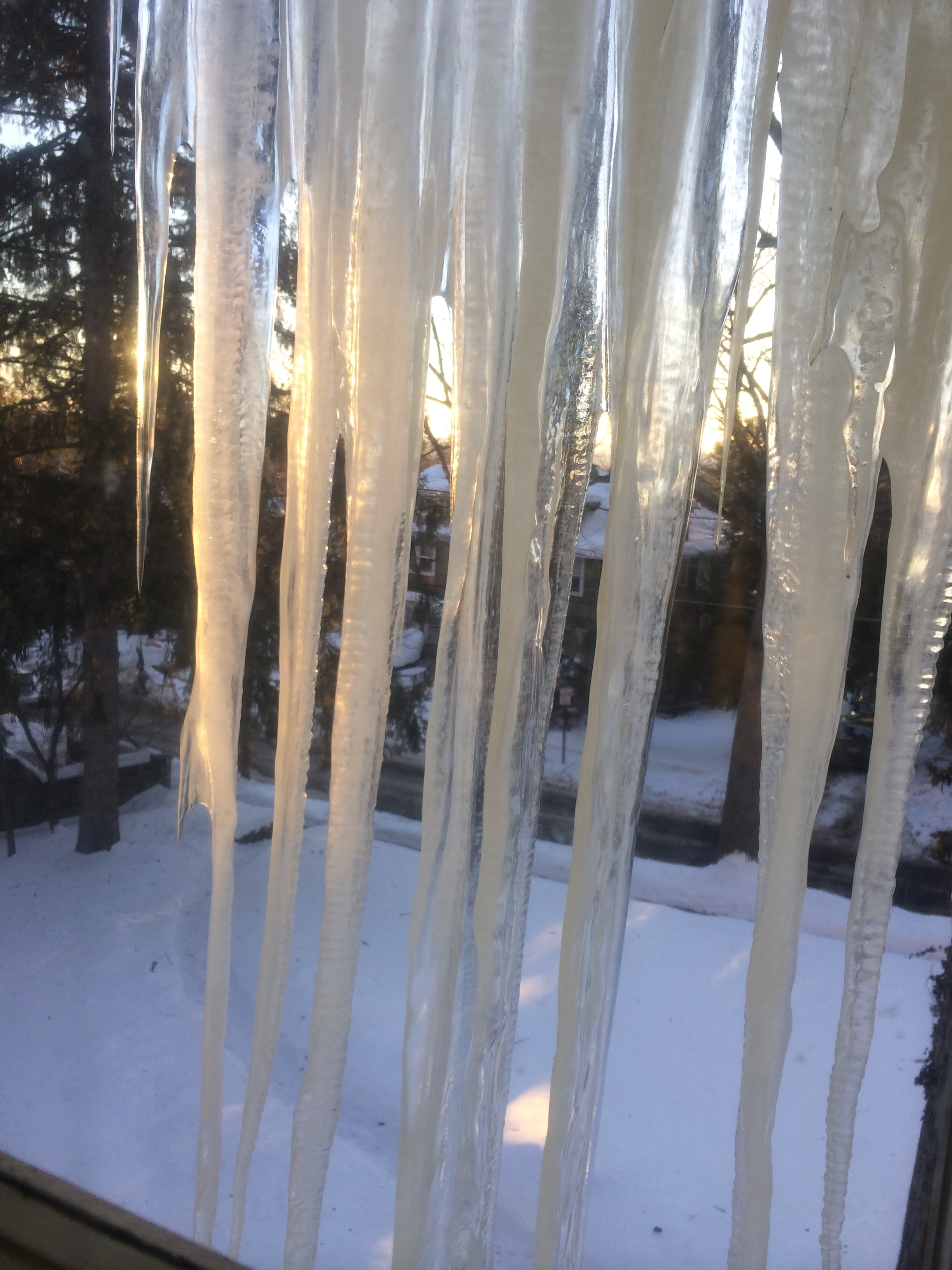
Setting sun gilds the icicles hanging outside the bathroom window.

Setting sun gilds the icicles hanging outside the bathroom window. These are relatively small.


The mantra of the naturalist is “Pursue direct experience outside every day.” I have been struggling to keep faith with the mantra, in the coldest February on record in Ithaca, New York. The temperature at 7 am a few days ago was -20 degrees F without a wind chill factored in. Houses all over town look like jails as enormous, life-threatening icicles hang from gutters. It’s a little grim, from the inside looking out.

However, throughout the prolonged deep cold a tufted titmouse has been singing at dawn every morning in the apple tree outside my bedroom window. This particular individual’s whistle-like call is an insistent reminder: Go out, go out, go out. Breathe the bracing air, rejoice, and shiver to acclimate and become one with the outside.


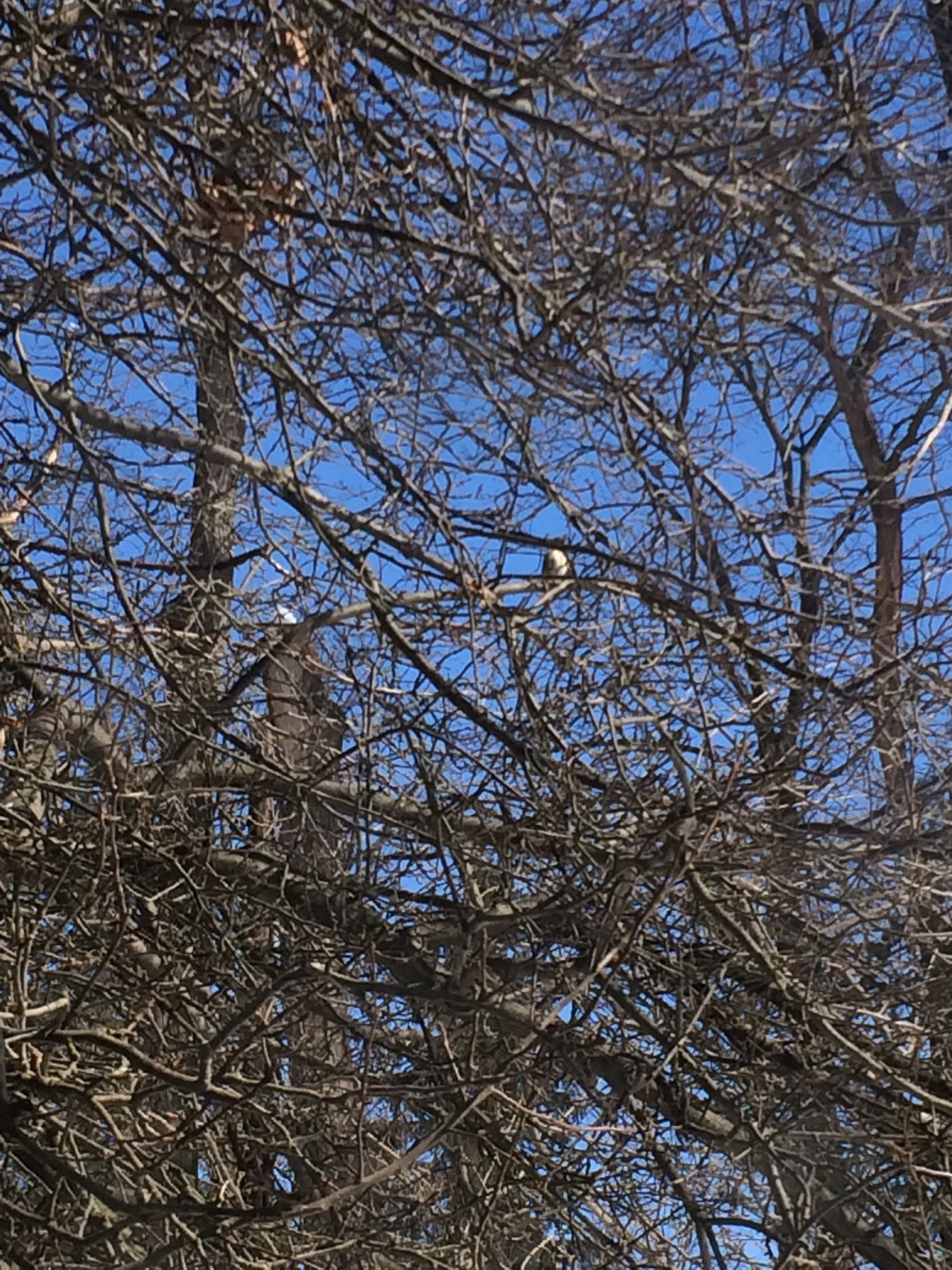
Tufted titmouse, slighting to the right and up from center, in the branches of the apple tree. Only the buff belly is visible.

Tufted titmouse, slighting to the right and up from center, in the branches of the apple tree. Only the buff belly is visible.


However, sometimes it is easier to be pulled out than to go out. My husband and I took leave of the bitter cold here in Ithaca and made a dash south to Vinegar Hollow in Mustoe, Virginia, to be with family at our homeplace. We were not expecting it to be much warmer because the Allegheny Mountains of western Virginia usually report very similar temperatures to those of upstate New York.

The end of Vinegar Hollow.

The end of Vinegar Hollow, cold but calm.

It was bitter. A brief warming trend lightened our spirits, melting much of the snow, but then a blizzard roared up from the south, filling the hollow with whirling, horizantal streams of snow. One by one the locusts, maples, and cucumber trees on top of Stark’s Ridge became ghostly, as did the hills and meadows and fence posts. In the yard the big yew and the big boxwood fluffed out like giant white owls. The cottage seemed to spin inside the whirl winding snowflakes.


The colors of winter: white on gray.

The colors of winter: white on gray.


My husband loves inclement weather. He was out there somewhere in the forest chopping wood. When poor visibility made chain sawing a hazard, I presume, he came to the sliding glass door. “Come out for a walk!” he said. “You don’t want to miss this!” I looked at the fire. I looked outside. “A walk?” The double sliding glass doors gave a full view of the white out conditions. I was no naturalist if I chose sitting by the glowing fire instead of going outside to be inside a small blizzard.
 

Author poses for husband in blizzard.
Author poses in blizzard for husband.
 

It was glorious. I could not see very far in front of my feet, but we walked on known land, around the Pine Tree Hill where the family cemetery awaits me. Yes, the sounds of the blizzard in the forest and the whizzing motions of the thousands of snowflakes stinging my face, ping, ping, ping, hypnotized my thoughts, commanding my attention to just one thing. Being there outside.
Trees silvered by snowflakes.

Trees polished to pewter by wind and snowflakes.


The next day I found an old paperback in my parents’ library room over the root cellar. There it was, an appropriate choice for the season–Scott’s Last Expedition: The Personal Journals of Captain R. E. Scott, CVO, RN. Found next to his frozen body, the diary is compelling reading even though we know the tragic outcome. One can read it over and over, trying to comprehend the predicament of this small group of men. Scott and his team are very near the South Pole traveling under extreme conditions when they find a black flag and sledge and dog tracks indicating that the Norwegians had made it there first. They had lost “priority.” Scott writes, “Many thoughts and much discussion have we had. To-morrow we must march on to the Pole and then hasten home with all the speed we can compass. All the day dreams must go….”

"All the day dreams must go...."

Published by Tandem Books, in the Great Ventures Series.

“All the day dreams must go….” The poignancy of this comment haunts me. But they must walk on, though emaciated and frostbitten. They do leave their mark at the North Pole proper, but then turn around in the worst blizzard they have yet encountered to head to the closest storage depot. They die just 11 miles away. But in what manner should they compose themselves for the end?

Scott makes a number of entries about his subordinate Titus Oates:

Should this be found I want these facts recorded. Oates’ last thoughts were of his Mother, but immediately before he took pride in thinking that his regiment would be pleased with the bold way in which he met his death. We can testify to his bravery. He has borne intense suffering for weeks without complaint, and to the very last was able and willing to talk about outside subjects. He did not—would not—give up hope till the very end. He was a brave soul. This was the end. He slept through the night before last, hoping not to wake; but he woke in the morning—yesterday. It was blowing a blizzard. He said, ‘I am just going outside and may be some time.’ He went out into the blizzard and we have not seen him since.

Scott himself at the time of writing has one foot so badly frostbitten that he knows it will have to be amputated should he live. The temperatures are -40 degrees F day after day. On March 22/23 he writes:

Blizzard as bad as ever–Wilson and Bowers unable to start–to-morrow last chance–no fuel and only one or two of food left–must be near the end. Have decided it shall be natural–we shall march for the depot with or without our effects and die in our tracks.

The reader hopes this is the end of the text and a merciful ending to their lives. But there is one more entry on March 29th. The last line of the diary is “It seems a pity, but I do not think I can write more.”  Roland Huntford in his book The Last Place on Earth gives an account of the interval between March 22/23 and March 29. Scott and his two remaining subordinates, too debilitated to move,  stayed in the tent in their sleeping bags writing letters to loved ones, documents that have become the subject of scrutiny by historians. Scott’s reputation as heroic explorer has been the subject of controversy.


Modern Library Edition of Roland Huntford's account of "Scott and Amundsen's Race to the South Pole."

Modern Library Edition of Roland Huntford’s account of the race to the South Pole: Britain’s Robert Scott vs. Norway’s Roald Amundsen. His critique has been challenged by subsequent historians. The photo of Castle Rock on the book cover was taken on 17 September 1911.


Huntford critiques Scott as inept, but recent evidence indicates that Scott faced harsher than usual weather and one of his orders that could have saved him was never carried out. Despite getting to the South Pole first, Amundsen lost the battle for renown, in part, Huntford says, because Scott was the better writer.

My blizzard was small. I was not at the North or South Pole, suffering the Homeric conditions that plagued the famous Arctic and Antarctic explorers, who fought their way to the poles for nation and glory. I knew exactly where I was, and it was not far from a fire, so I was no heroine. My reward was exhilaration, not renown, as I went outside to feel the weather, rather than look at it from the inside. The naturalist has a different temperament than the polar explorer, happily from my point of view, but the polar explorers have left us with diaries that exemplify heroic aspects of human beings, inept or not, under duress in the great outdoors.

I am back in Ithaca, the tufted titmouse still singing in the apple tree  at 1º F.

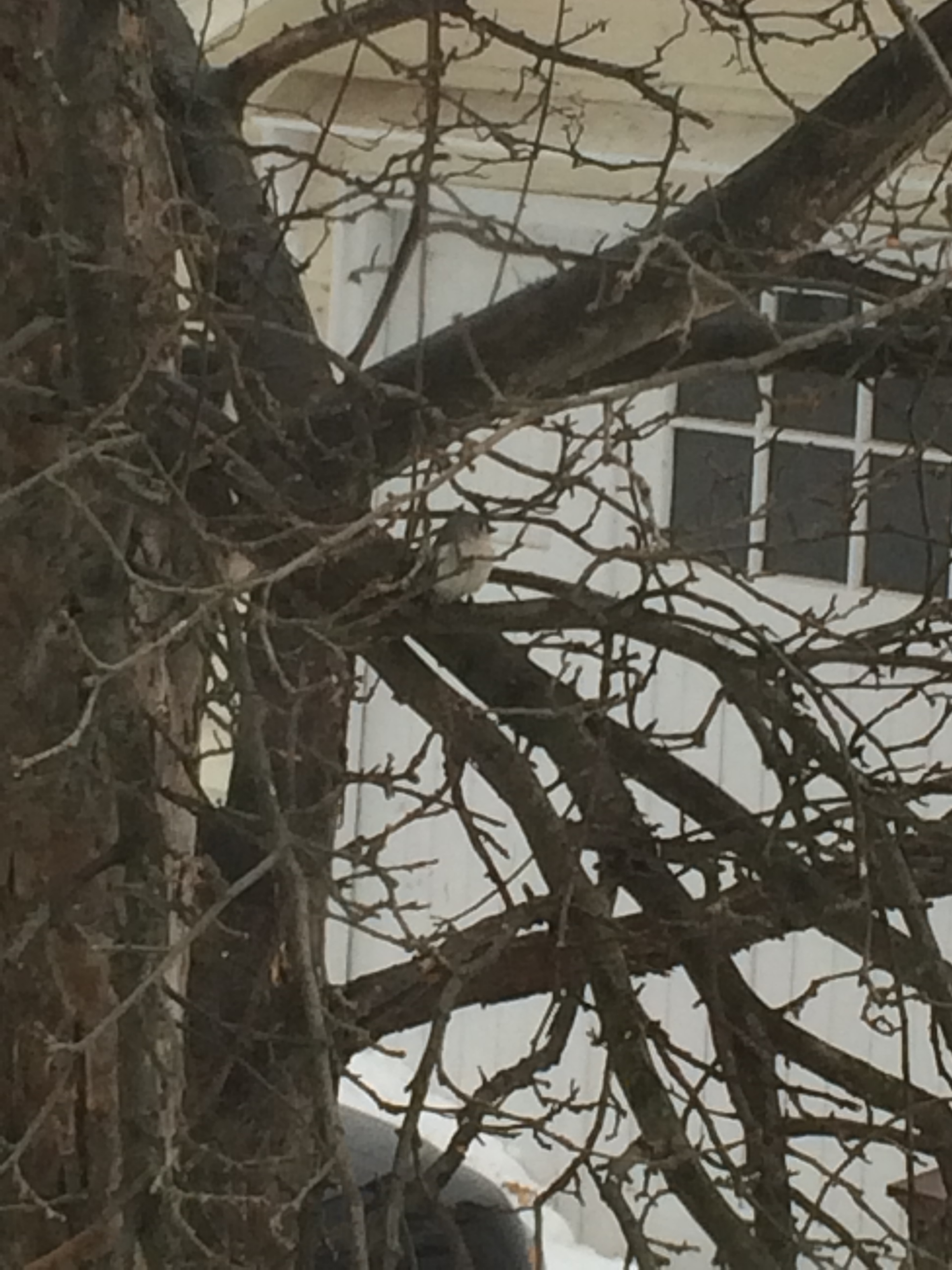
Tufted titmouse slightly up from center in the apple tree.

Tufted titmouse slightly up from center in the apple tree. Profile view.


Today I decided to stand at the window observing. I stood and the tufted titmouse sat, silent for once. This went on for quite a while. Sometimes the branches of the apple tree distracted me. That’s when I noticed the second tufted titmouse. There she/he was, higher up in the tree. So, silence because mission accomplished? The mate has acquiesced? I don’t know, but I will be looking into the habits and psychology of this hardy little bird.

The second tufted titmouse.

The second tufted titmouse almost dead center in the photo.


So, have I rambled? What do the tufted titmouse and the blizzard have in common? As John Muir said “When we try to pick out anything by itself, we find it hitched to everything else in the Universe.”


Falconress: A Facebook Avatar

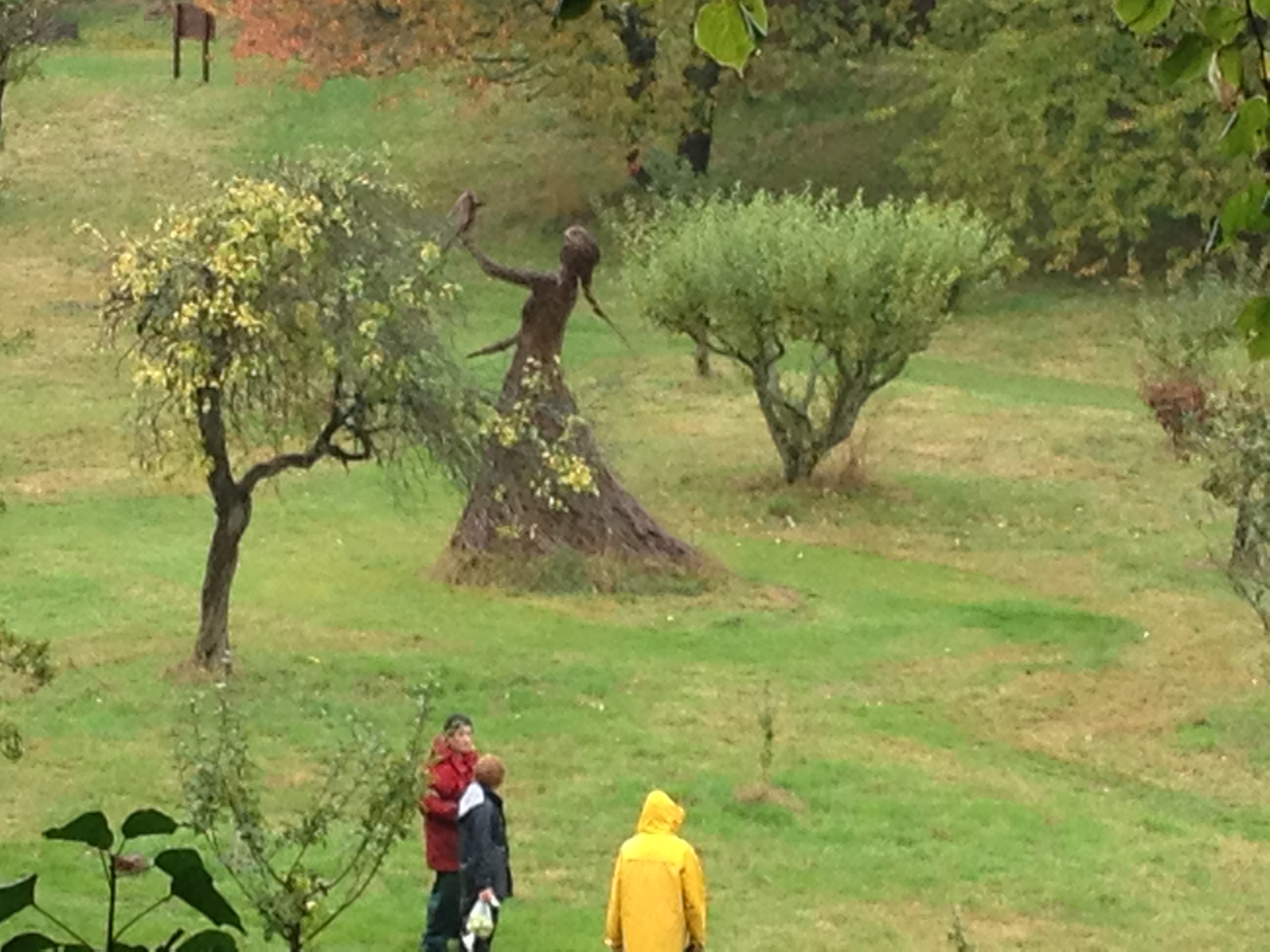
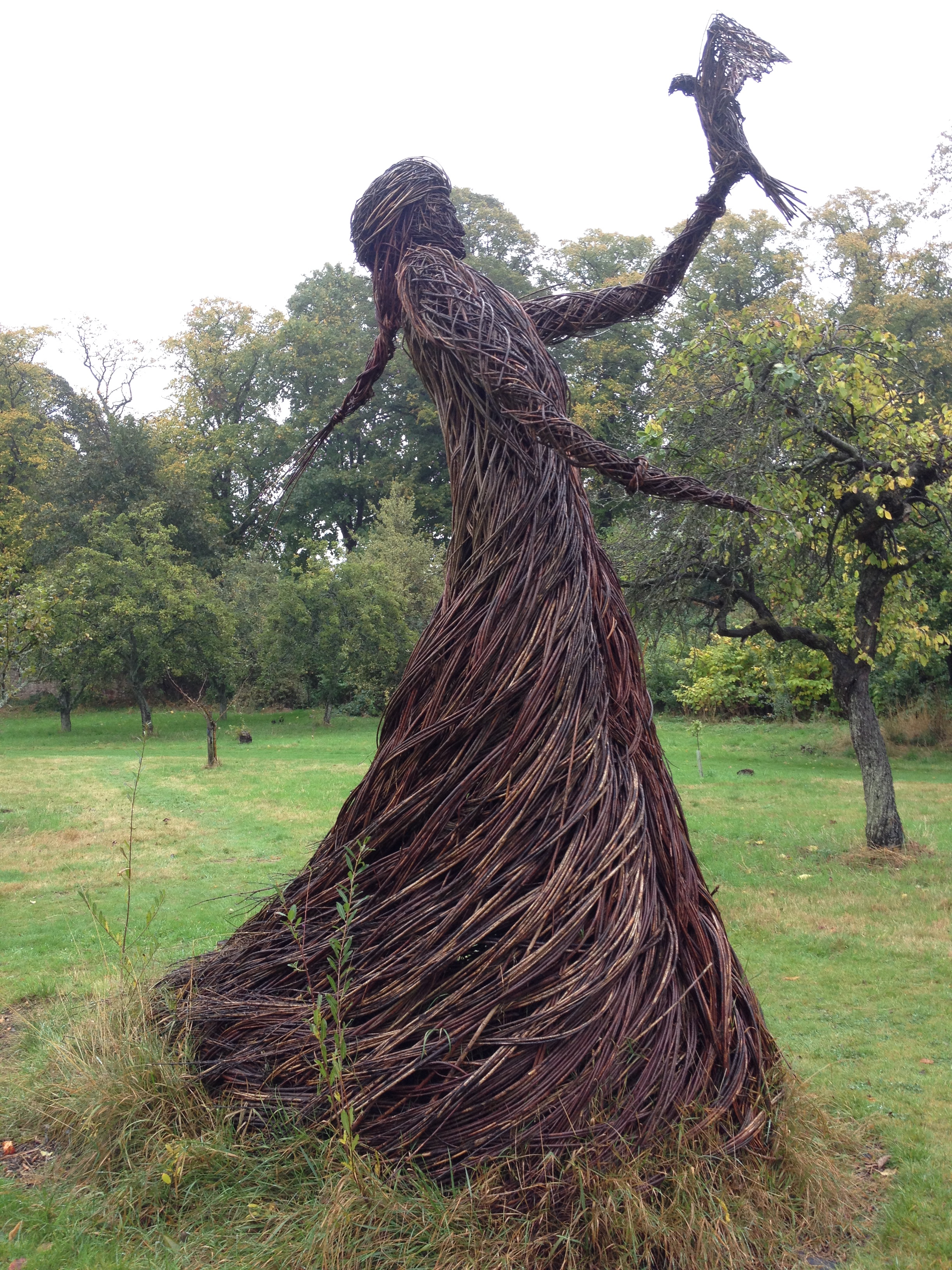
Trevor Leat's sculpture of a falconress (perhaps meant to be Mary Queen of Scots) at Falkland Palace, Kingdom of Fife, Scotland.

Trevor Leat’s sculpture of a falconress (perhaps meant to be Mary Queen of Scots) at Falkland Palace, Kingdom of Fife, Scotland.


My friend and professional mentor Jill Swenson had reminded me once again—“no egg heads on Facebook.” I figured it was time to take action. I have been slow to join Facebook because I struggle with reticence, but having found Twitter a treasure trove of interesting associations and even new windows into the natural world, I decided to dive into Facebook and solve the egg head problem.

But, what image should signify my presence in the world of Facebook? Myself? A photograph of me taken 30 years ago recently turned up. I could photograph that with my iphone and use it, but it seemed so vain to use my youthful unblemished self. On the other hand, my newer, older, self is less pleasing—the neck wrinkles, the liver splotches, the creases around the eyes. I love old faces, but mine is in transition, a work in progress, not fully perfected. When I have, hopefully, reached the fullness of true old age, I intend to love my wrinkles.


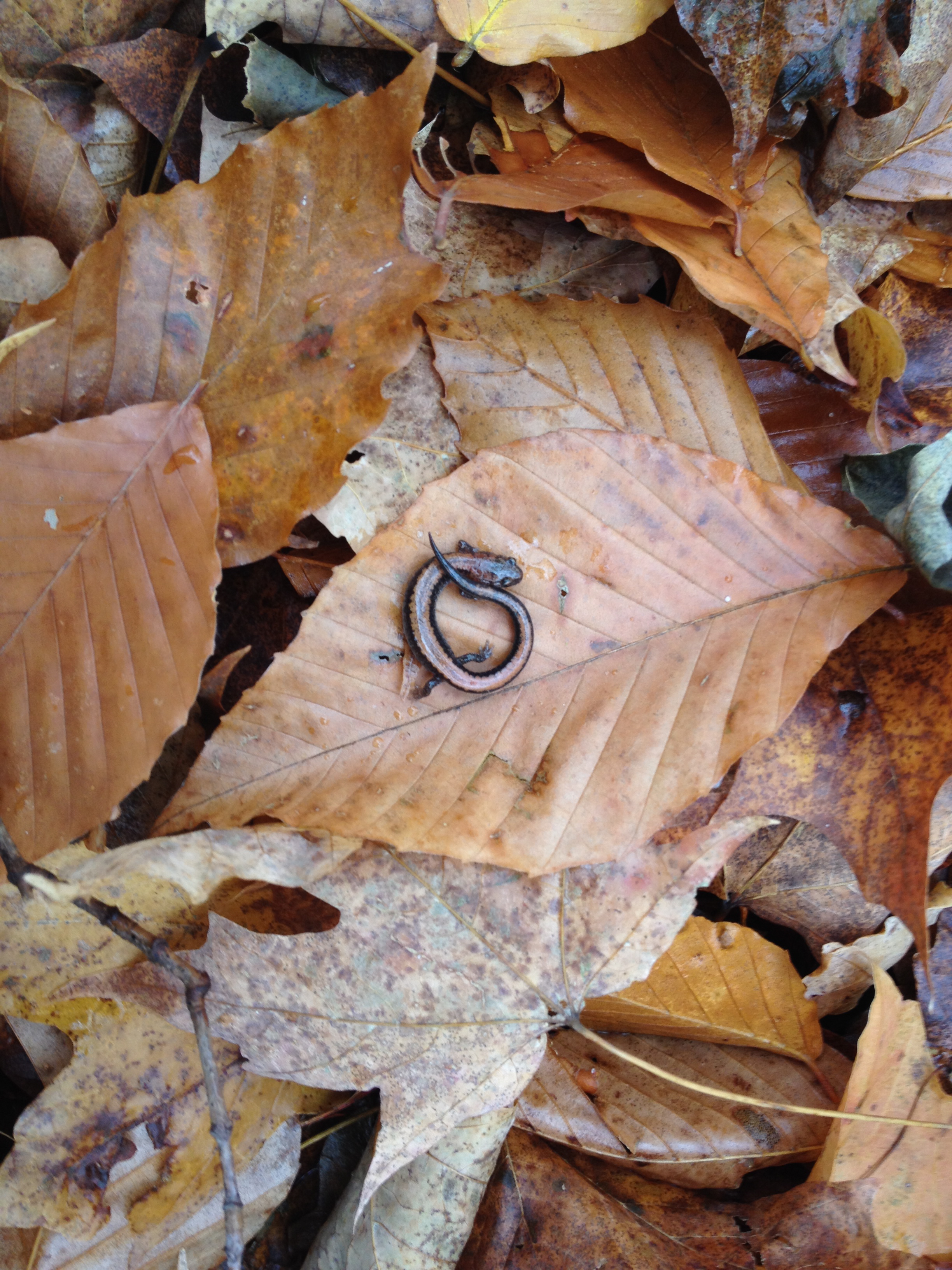
Salamander on fall leaves.

Salamander on fall leaves.


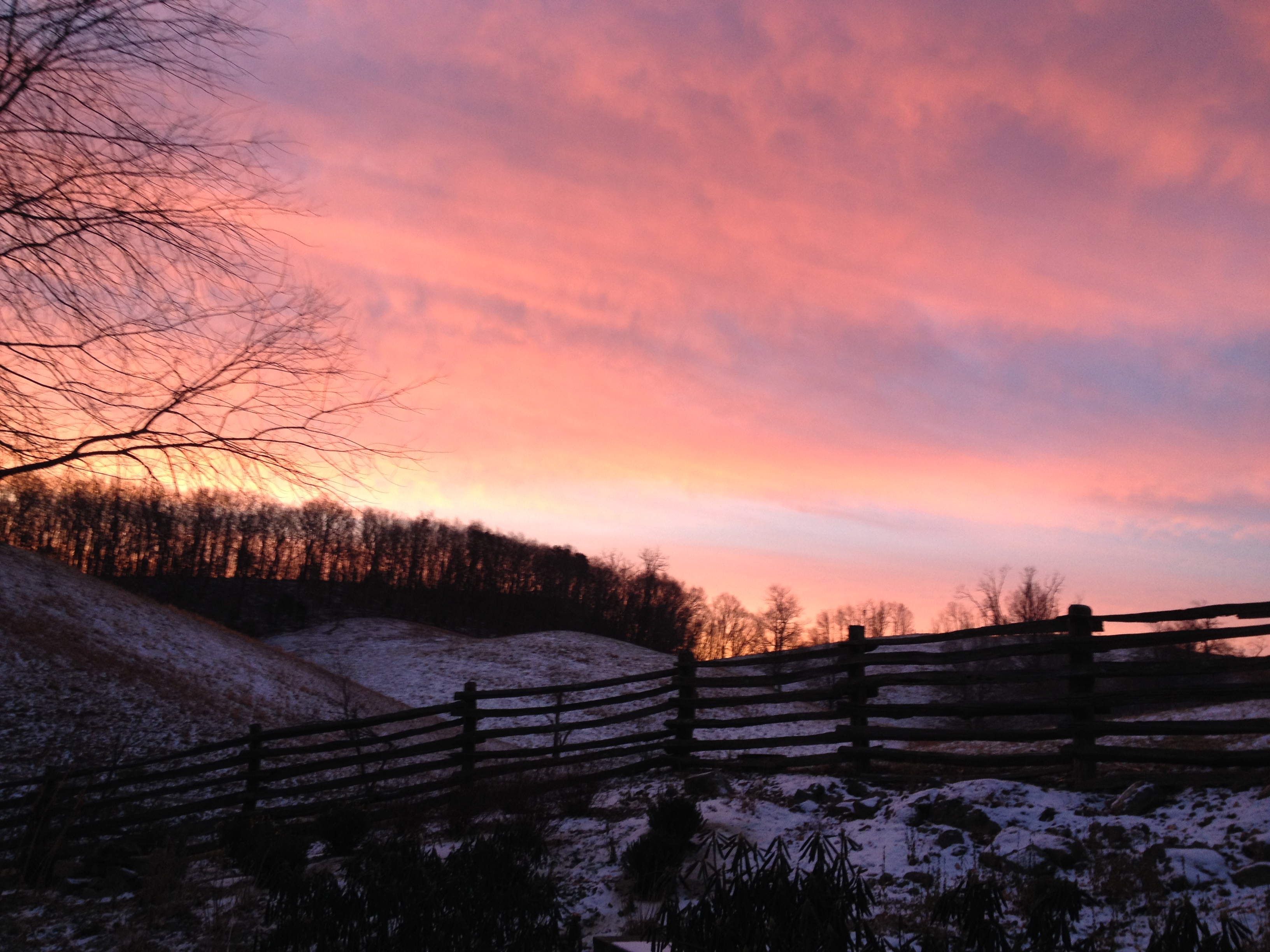
I started looking through my digital photos, quickly, because the whole idea of choosing an image, the opposite of an egg head,  made me nervous. A lovely salamander appeared, coiled like a rune or a Buddhist symbol on overlapping, damp leaves. So lovely, but perhaps indecipherable when reduced in size. I stopped at a beautiful purpley red sunset. A cliché?

Sunset in Vinegar Hollow, Highland County, Virginia.

Sunset in Vinegar Hollow, Highland County, Virginia.

A sunset should never be taken for cliché, but, out of context, brought into Facebook as avatar, no, I would not want to reduce the beauty of any sunset to the level of cliche–the danger of representation at the hands of an inept human. Then the pond at Seven Fields appeared. Countless times I have tried to catch reflections in this pond:  the crooked tree, the branches, the necks of the geese. I love this tree and this pond, but reduced, perhaps not the tribute I would most wish.

Pond, trees, and ducks.

Pond, trees, and geese at spring-fed pond, Seven Fields, Enfield, Ithaca, New York.


Then I moved into photos taken on a recent trip to Scotland to see younger son, the golfer, who was studying at St. Andrews, Scotland for a semester.

The historic golfing landscape of the Old Course at St. Andrew. (Photo credit: David Fernandez)

The Old Course at St. Andrews, Scotland. (Photo credit: David Fernandez)

While the golfer was studying, writing gobbets, my husband and I roamed the Kingdom of Fife, happening upon Falkland Palace, and there she was, the one I am calling the Falconress, the work of Scottish sculptor Trevor Leat, who creates large, expressive sculptures made from many varieties of willow that he grows organically. Some of his large pieces are burned at festivals, like Edinburgh’s Hogmanay celebration.

Trevor Leat's willow falconress.

Trevor Leat’s willow falconress.


Mary Queen of Scots spent a few happy years at the palace as a young woman. We saw her tennis court (she was an avid player) and her ornately carved bed. However, after seeing her death mask, it was a relief to go outside, though it was a rainy, misty day in mid-October. Tall dark-brown stalks of giant delphiniums tilted against a long stonewall. Giant cedars towered luminously, blue-green in the mist. A small greenhouse glowed with climbing geraniums in all shades of red. Two large garden beds were entirely planted with pale lavender-grey phacelia, a species good for soil improvement the sign said. Falkland has received awards for being one of the most floriferous villages in Scotland. The perennial beds of Falkland Palace must be one its glories in summer.


Close up of the woven willow.

The many hues of  the sculpture’s weathered willow branches.


The gallery of sculptures, posted on Leat’s website and available elsewhere, shows that he is drawn to archetypal forms, like the stag and the human female. Leat’s female figures have flowing lines and generous proportions, and their earthen colors, golden browns, beiges, and greens, glow in an outdoor landscape.  Although his women are tall and robust, their arms taper to delicate wisps. Apparently some of the sculptures bud out in spring, I suppose because some of the willow branches are still green enough or root into the ground a bit. Willow sculptures in the outdoors transform gradually, broken down by sun and rain, often just lasting five years.


The falconress trails a verdant gown.

The falconress leaves a verdant train in her wake.


A history of Falkland Palace states that the Stewart monarchs used the palace to practice falconry, so it is fitting that Leat’s sculpture of the Queen shows her in the attitude of falconress. A brief perusal of the life of Mary Queen of Scots is enough to put one off a royal life for an eternity. The intrigue, the double dealings, the difficult men, it was all dastardly and over the top. She handled the beheading, apparently, with equanimity and grace, thankful perhaps that her life was finally over. During her imprisonment she was allowed to fly a merlin in and out her window. This must have been a pleasure, being so close to a wild creature, a vicarious experience of freedom. One can imagine her listening to the swoosh of feathers through the air at take off and her watching the bird disappear into the sky.

I have never been attracted to falconry, though I am a great fan of T. H. White’s The Once and Future King, where the art of falconry figures,  and The Goshawk, an account of White’s tempestuous relationship with a young hawk he tried to “tame,” his first, and last, attempt at being a falconer.  For a current account of falconry practiced in North America, see Rachel Dickinson’s book Falconer on the Edge:  A Man, His Birds, and the Vanishing Landscape of the American West. White’s Merlyn is a great fictional character. He advised (my paraphrase):  when you are sad, learn something. This is good advice.

Some historians speculate that falconry began between 4000 and 6000 BC.  A Japanese historical narrative of 355 AD, Nihon-shoki, states the first falconer in Japan was a woman, whose daughter followed in her footsteps. Women in 19th century England were said to outshine men in proficiency. The word “falconress” is not in the OED, however. The only use of the word I have come across is in a poem by Robert Duncan called “My Mother Would Be a Falconress.” The poet compares the relationship between mother and child to that of the falconress and her falcon. It’s a dark, moody poem reflecting some of the strangeness of the relationship at the heart of falconry–and at the heart of parenting. Nevertheless, Leat’s sculpture appeals to me. Both bird and woman appear poised for flight. She is both sinew and grace. How lovely to be made of willow!

A final view of Trevor Leat's falconers.

A final view of Trevor Leat’s falconress.