The jade vine blooms!

Orchids on display at New York Botanical Garden's orchid show.

Cattleya orchids on display at New York Botanical Garden’s annual orchid show (March 9, 2014).

“So, what’s your vote? What’s the most amazing flower here?” a father asked his two young children. He sat on the knee-high edge of a long reflecting pool that ran the length of a stately glasshouse. There was no answer as his children were too busy trailing their hands among the water lilies. It was the second weekend of The Orchid Show: Key West Contemporary being held at the New York Botanical Garden (March 1- April 21, 2014). I was there with my son and grandson, just two.

Son and grandson in a conservatory of the New York Botanical Garden:  son pointing finger one way and grandson pointing  finger the other way.

My son and grandson pointing to different routes in the conservatory of the New York Botanical Garden. The two year old led the way.

“I vote for the jade vine,” the father said, looking up.

Raceme of jade vine flowers dangling over the reflecting pool at NYBG.

Raceme of jade vine flowers dangling over the reflecting pool at NYBG.

I answered the man. “Yes, I agree. The jade vine wins.” After college, I worked for a year at the Royal Botanic Gardens in Kew, UK, as a work-study student. There I met my first jade vine, and came home with a botanical drawing by Margaret Stones that I have carried with me ever since.
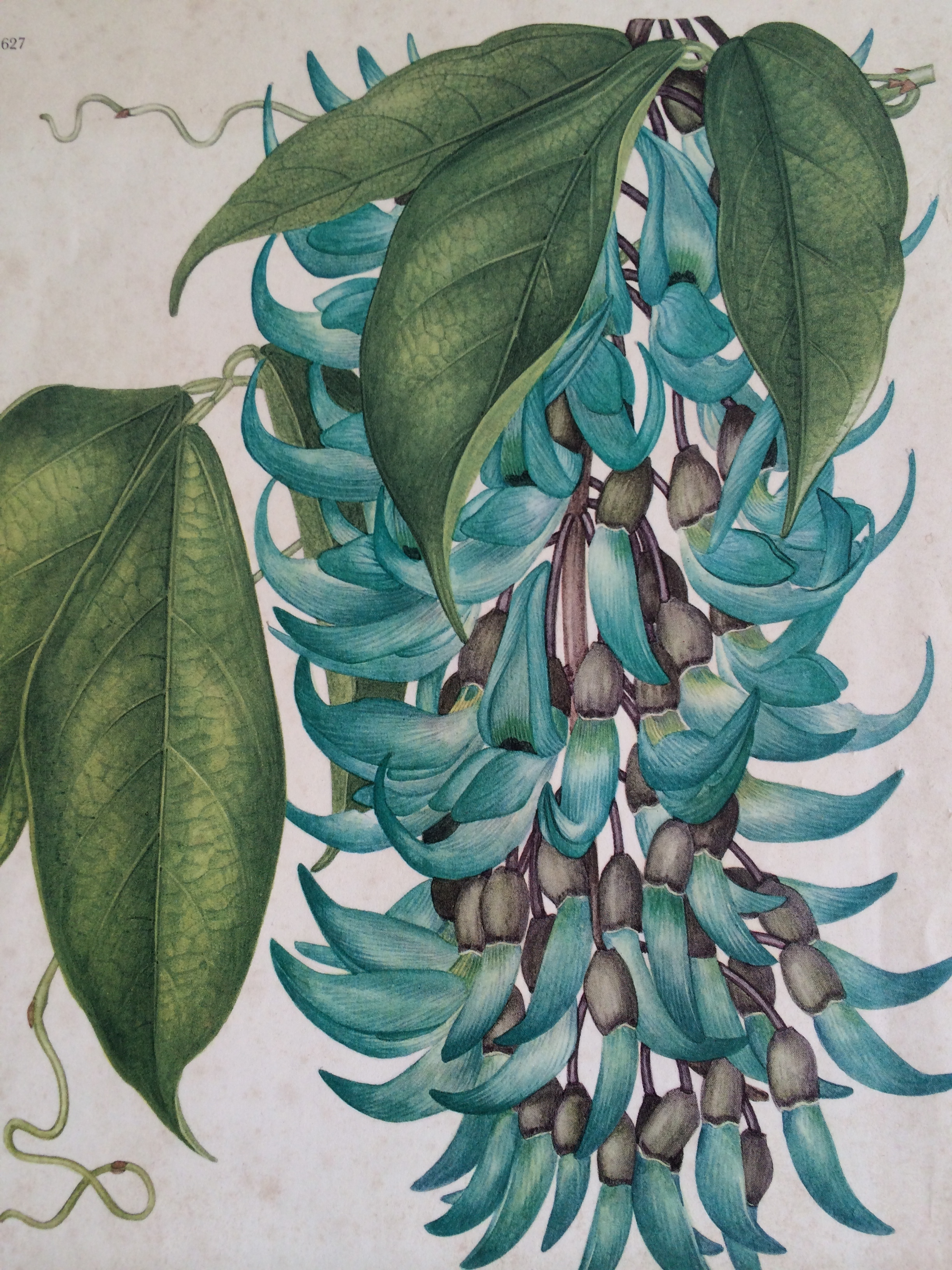
Botanical artist Margaret Stone's rendering of the jade vine.

Botanical artist Margaret Stone’s rendering of the jade vine.

To a budding botanist, Kew Gardens was heaven, but my entry into heaven was rough—and the ordeal was orchid related. I arrived in September for my first day of work with a terrible head cold contracted in the dry air of the British Airways flight over. I still remember the skimpy navy blue blanket I huddled under and how cold I was the entire trip. Mr. Pemberton, the director of students, had said he would put me “under glass” in the orchid house for the first three months because (it was clear during my interview that he didn’t like Americans) he assumed that I was a pampered sort I suppose. (I proved him wrong.) We have heard about orchid thieves and orchid addicts, but has anyone heard the story of a naive, young preparer of orchid potting medium? The supervisor of the orchid house set me to work making orchid “soil.” In my botanizing in Highland County, Virginia as a child I had met a number of orchids, beautiful species like the slender ladies’ tresses, which were terrestrial and hid sweetly among the meadow grasses. I was shocked when I saw how tropical orchids were arranged in the propagating house, attached to little gravestone-like boards, hanging row on row, on the side walls of the greenhouse. The “public” never entered this greenhouse. In the jungle these tropical orchids live as epiphytes high up on tree branches on leaf litter, absorbing nutrients through their peculiar spongy roots that protrude like branches into the air. They don’t live on the ground in soil. However, there were a number of tropical orchids that resided in clay pots on waist-high benches in the central part of the greenhouse. They didn’t need “normal” potting soil, but rather a special nutrient-poor potting medium.

Photograph of drawings of ladies' tresses orchids (Spiranthes) from Peterson & McKenny's A Field Guide to Wildflowers.

Photograph of drawings of ladies’ tresses orchids (Spiranthes) from Peterson & McKenny’s A Field Guide to Wildflowers (p. 18). The slender ladies’ tress grows in Vinegar Hollow, Highland, County, Virginia.

Making orchid compost with a bad head cold proved to be a nightmare. First, I snipped clumps of dried sphagnum moss into smaller pieces with scissors. Sphagnum moss is a wonderful vehicle for water retention when it is moist, but dry, it’s like fiberglass insulation. Luckily I didn’t know about sporotrichosis, the rose-gardener’s disease, but maybe that’s why I suffered so. Bits and pieces flew around and went up my nose where they tickled and prickled, causing profound irritation. Then I had to separate clumps of charcoal into smaller pieces using sieves the size of dinner plates. Clouds of charcoal dust surrounded me, invading my nostrils and sinuses.  The final step was to mix the chopped sphagnum and charcoal chunks with shredded bark. Hooray for shredded bark, a relatively “quiet” substance. After mixing, voila, a suitable substrate to anchor the orchid in its pot where it never wanted to be! I made orchid potting medium for a month and got sicker and sicker. I could hardly breathe and I couldn’t sleep at night for the coughing and snuffling and expectorating of greeny black effluent. Each day when I got on the tube to go to my flat, I looked like a chimney sweep, blackened snot dripping from my nose, my hair gray, my eyes red.

Another treasured moment from my year at Kew Gardens, a print of the squirting cucumber (Ecballium elaterium).

Another treasured momento from my year at Kew Gardens, a print of the wild squirting cucumber (Momordica [Ecballium]  elaterium), a copy of an 1842 Burnett botanical print). I met the squirting cucumber in the order beds, where species were arranged by family, and  watched fruits explode.
  Fortunately things just got better (no, I forgot about the horrible, horrible episode of potting up practically an entire greenhouse of Primula obconica, one of the woolly primroses, from which I got a gargantuan [not quite the right word here, but I am trying to make the overall point clear] case of hives that drove me insane). For my last “tour of duty” at Kew, I spent three months in the great Palm House, doing this and that (other stories…).  It was full of palms, obviously,  historic cycads, tall gingers, and many other wonderful tropical plants that dazzled me. There were vines too, dripping from the rafters of the greenhouse. I was lucky. For the first time in many years the jade vine flowered when I was there. Just one raceme in late winter that dangled to the top of my head in the North end of the glasshouse, as I yelled “Closing Time” in my best British accent. Just as stuffy as Mr. Pemberton in my own way, I didn’t think it proper that an American should be doing the honors at such an important moment. When the jade vine puts on a show in the conservatory of a botanic garden, it usually makes headlines in the local newspapers. On April 7, 2003, The Oxford Times ran a piece with the headline “Our vine isn’t jaded” and quoted curator Louise Allen who said “It’s incredibly difficult to grow and you can never guarantee it is going to flower.” They were proud to have 60 flowers “spikes” according to the newspaper. The more proper term is raceme to describe the huge pendant clusters of wisteria-like flowers. The headline in The Hindu Times on July 2, 2005 included the words “as precious as jade.”

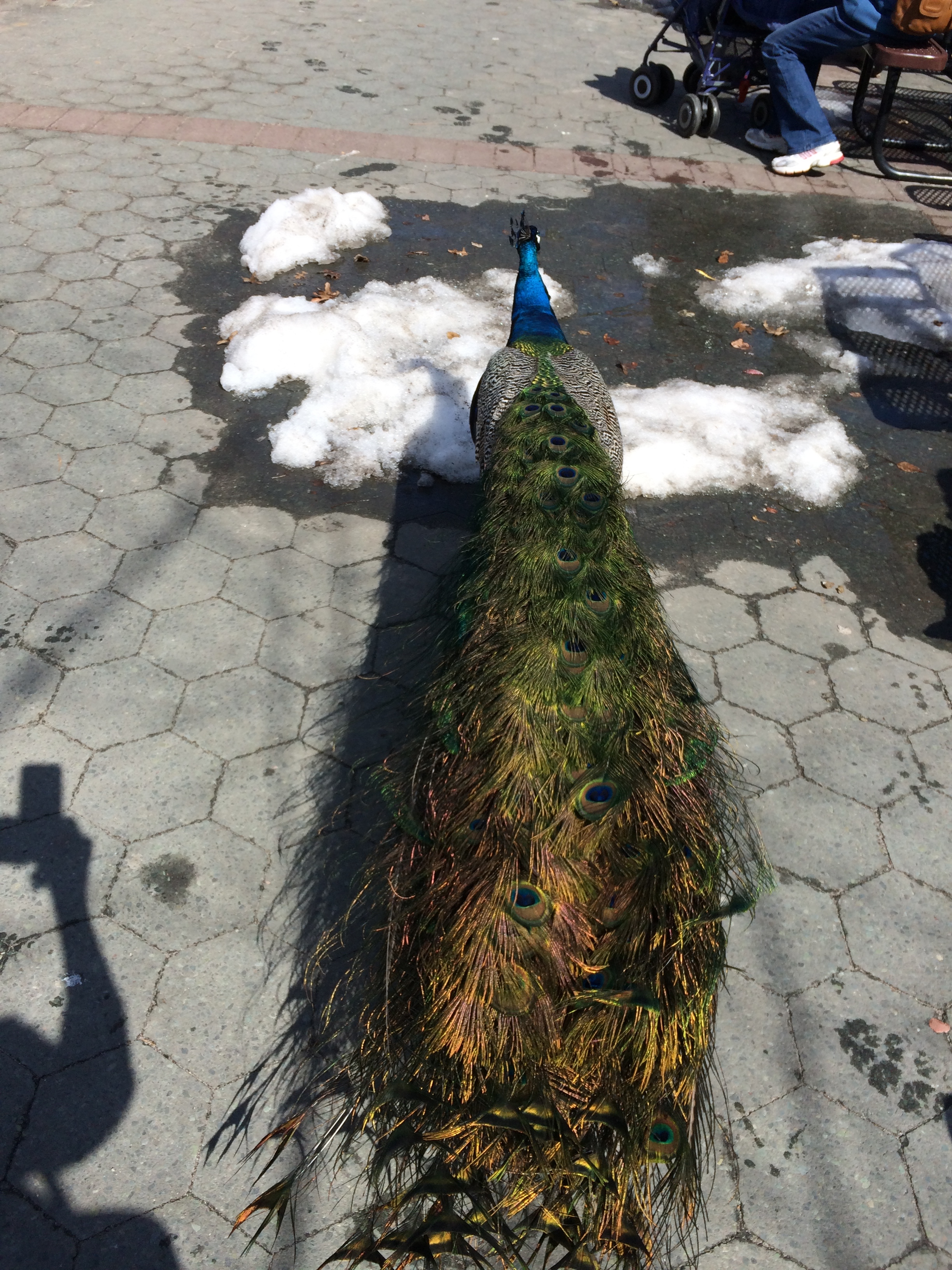
Peacocks roam the outdoor eating area at NYBG scarfing up french fries and the like.

Peacocks roam the outdoor eating area at NYBG scarfing up french fries and the like.

I would say the specimen at NYBG is growing like topsy, as “rampant” and “rank” and “aggressive” (all words applied to the growth habit of the jade vine) as it can get in the still relatively confined space of a conservatory. In the wild of its native Philippines, it can grow to 80 feet and each raceme can carry 100 flowers. But it’s the color that makes you stop dead in your tracks.  I think it safe to say that there is no other flower in the plant kingdom so strangely, alluringly, and bizarrely colored. It is like jade, but the hue in plant tissue takes on a startling iridescent sheen. I picked up a blossom that had fallen to the floor and put it in a small plastic address box I carry. By evening the blossom was shot through with the colors of the northern lights– pinkish, pale bluish, lavenderish, pale jadish.

Close-up of Margaret Stones' botanical drawing of the jade vine.

Close-up of Margaret Stones’ botanical drawing of the jade vine.

Its shade has been scrupulously characterized in a lovely book published in 1976, Flowering Tropical Climbers by Geoffrey Herklots.  The author, botanist and ornithologist, developed a hobby of cataloguing sightings of the great tropical vines of the world and drawing them, beautifully, both in color and in line drawings. For the jade vine, he names three colors with numbers, probably in reference to an artist’s color chart that apply—Jade Green HCC 54/1 and 54/2, Viridian Green HCC 55/1, and Chrysocolla Green HCC 56/1. Interestingly, jade, viridian, and chrysocolla are all mineral stones. There is something mysteriously unplantlike about the color of the jade vine, as if it’s the result of being crossed with a lizard or a chameleon or rare gemstone.

Rampant, "agressive" growth of jade vine.

Display of jade vine’s vigorous growth.

The shape of the each blossom adds to the intrigue. A member of the Fabaceae (Leguminosae) or Pea Family, the blossoms have the characteristic architecture of pea flowers, but on a grand scale. The jade vine’s awkward-sounding Latin name derives from the Greek “strongylodon” meaning spherical and “botrys” meaning raceme or cluster.  Grouped en masse, the blossoms’ “claws” or “keels” zigzag swingingly down the stalks, sultry scimitars just looking for a fight. The flowers are the opposite of flimsy, often described as “fleshy” or “waxy.”
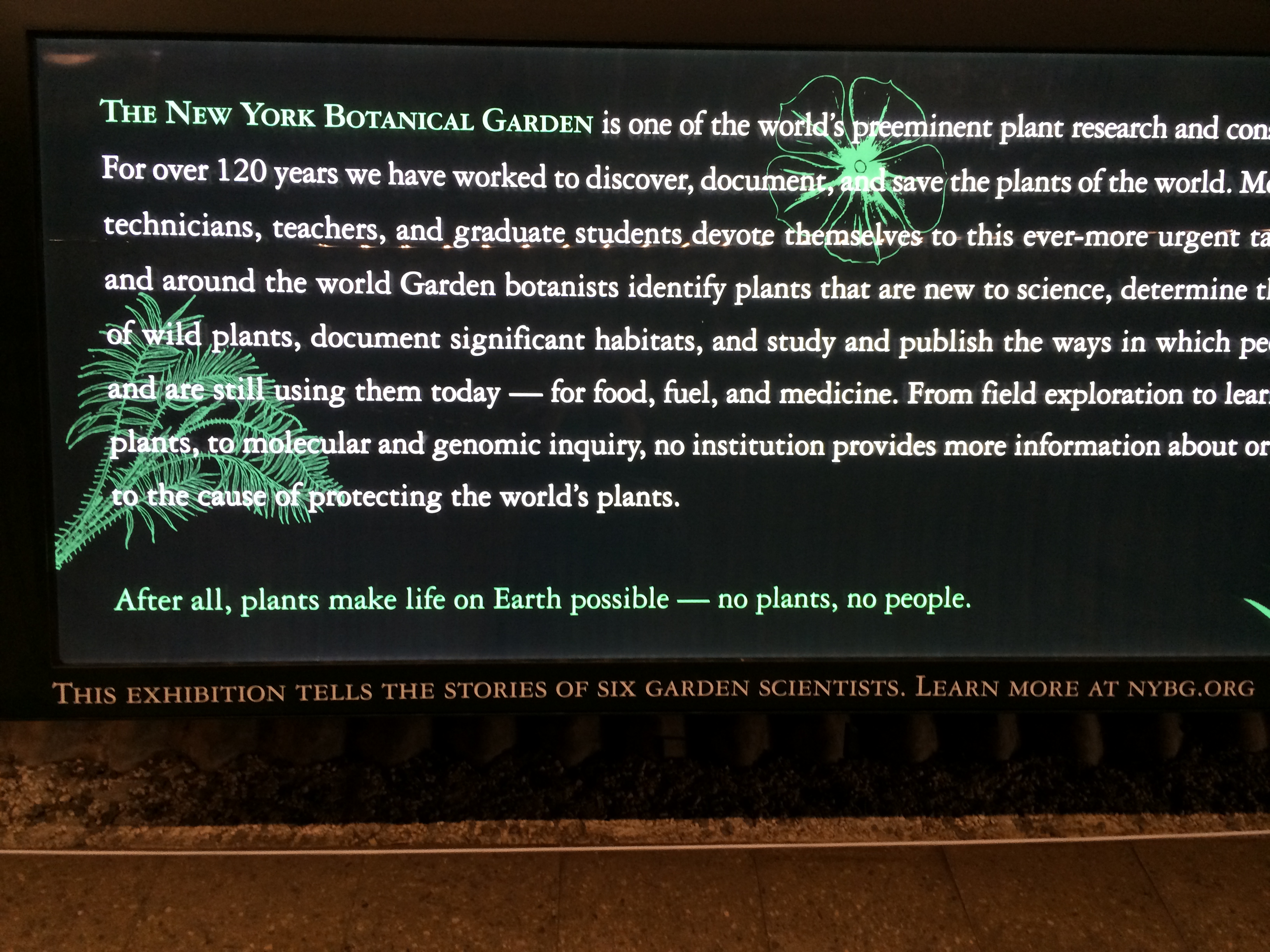
Informative display in the greenhouse, reminding us "no plants, no people!"

Informative display in the greenhouse, reminding us “no plants, no people!”

The jade vine is losing its place in the wild, although a recent expedition of botanists to Palanan Point in the Philippines has found locations where it still climbs freely. Known to be bat pollinated, specimens have not been happy setting seed in the conservatory setting, but researchers at Kew Gardens have recently enabled a plant to set fruit. A few years ago their website showed a heavy pod attached to the vine with a little help from a supporting macramé like mesh. In Puerto Rico, bees are vigorous pollinators, tearing apart the flowers for nectar in the process. So what is the world’s most beautiful flower? The question is unanswerable. Is it one of the orchids– the voluptuous cattleya?  the delicate slender ladies’ tresses? or is it the sea-foam green jade vine flower? (Or is it the peacock’s tail?)
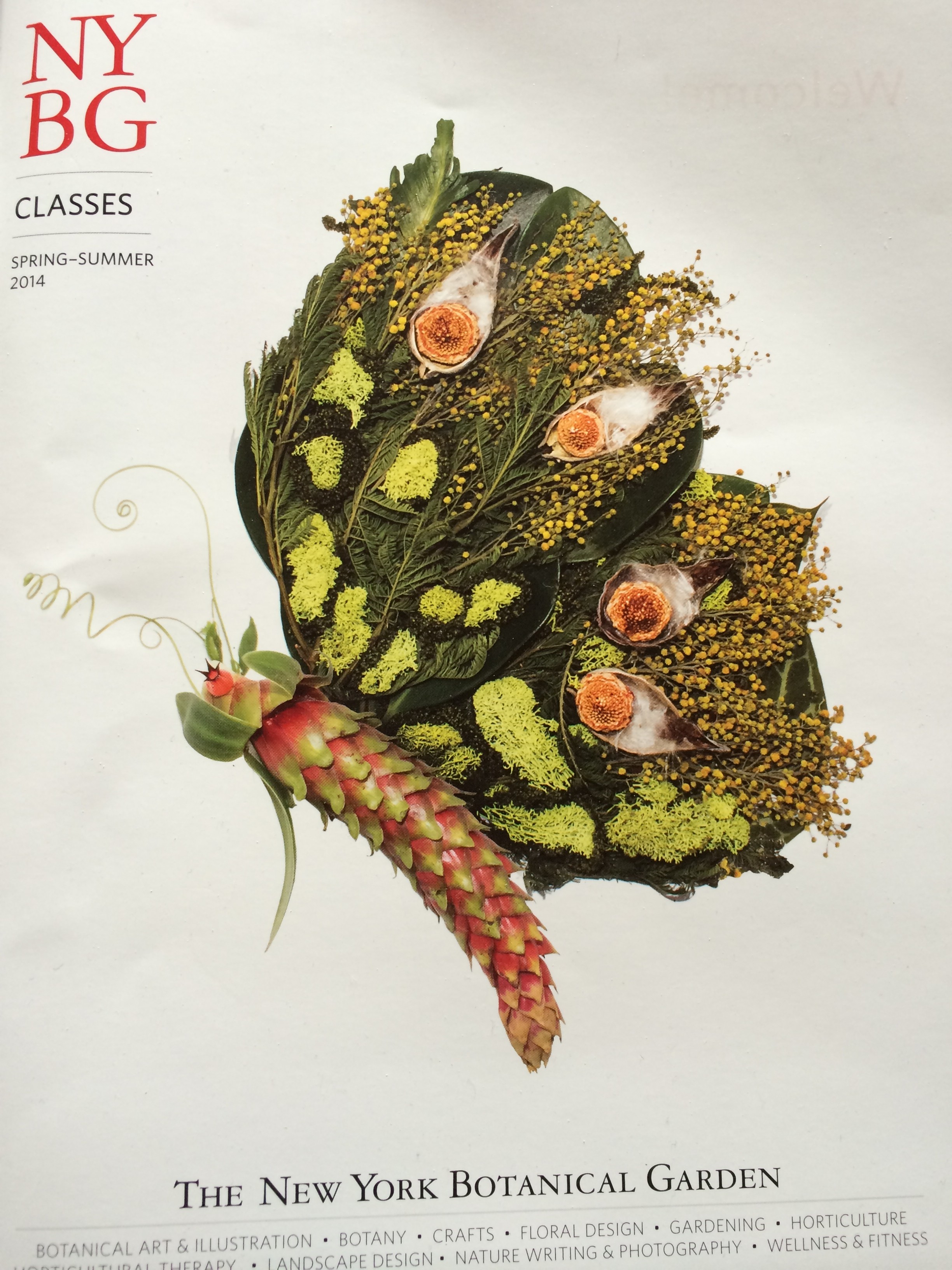
Cover of NYBG's Spring/Summer Catalogue, listing classes and events.

Cover of NYBG’s Spring/Summer Catalogue, listing classes and events.

Who is the fairest of us all? That is not a good question, and the young father did not ask that question. He asked, “What is the most amazing flower here?” Yes, the jade vine. It was then in early March, and still now, the most amazing flower at the orchid show at NYBG and the most amazing flower I saw during my year at Kew Gardens. The fairest?  Each organism is the fairest of us all. We need every speck of diversity, as E. O. Wilson, the great naturalist has said over and over. Working with plants, in horticulture–sowing seeds, digging, planting, weeding, mulching–has always made me feel grounded, literally and spiritually. Plants have been for me, from a young age, a lifeline to sanity (except for those few experiences mentioned above). I look at each individual plant and feel rooted in partnership as his or her neighbor on the Earth. Support your local botanic garden. Take classes. Draw plants. Write about plants. Grow plants. Weed, yes, but place the weeded gently in the compost. Remember the words on NYBG’s display sign: “After all, plants make life on Earth possible–no plants, no people.” If we are what we need, then people are plants, and, why not consider the reverse,  plants are people.
Tending foxes: real and imaginary

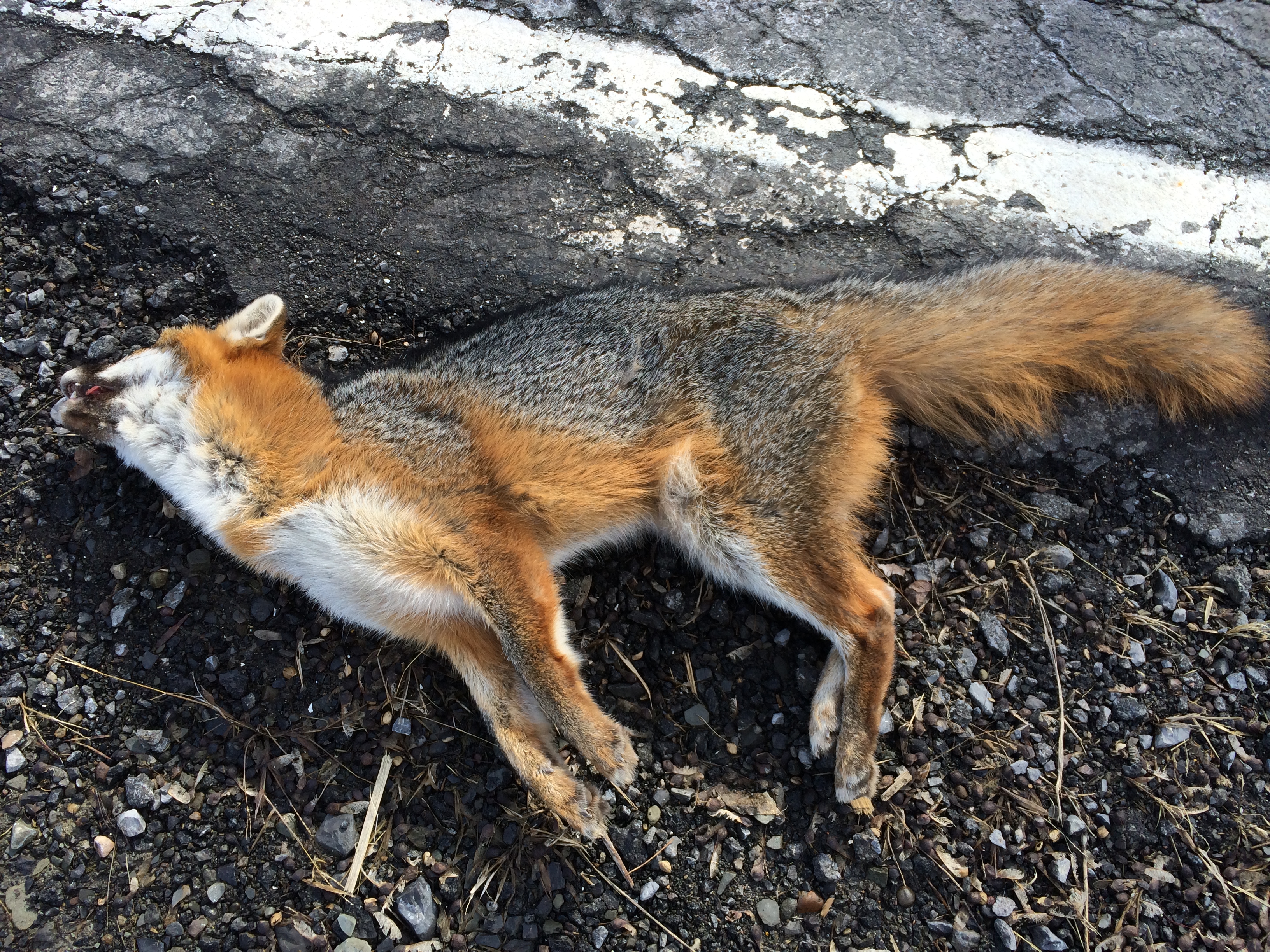
A few days ago I drove past a dead fox on a road I travel frequently. I stopped and backed up carefully. I feared it was my fox.

IMG_0343

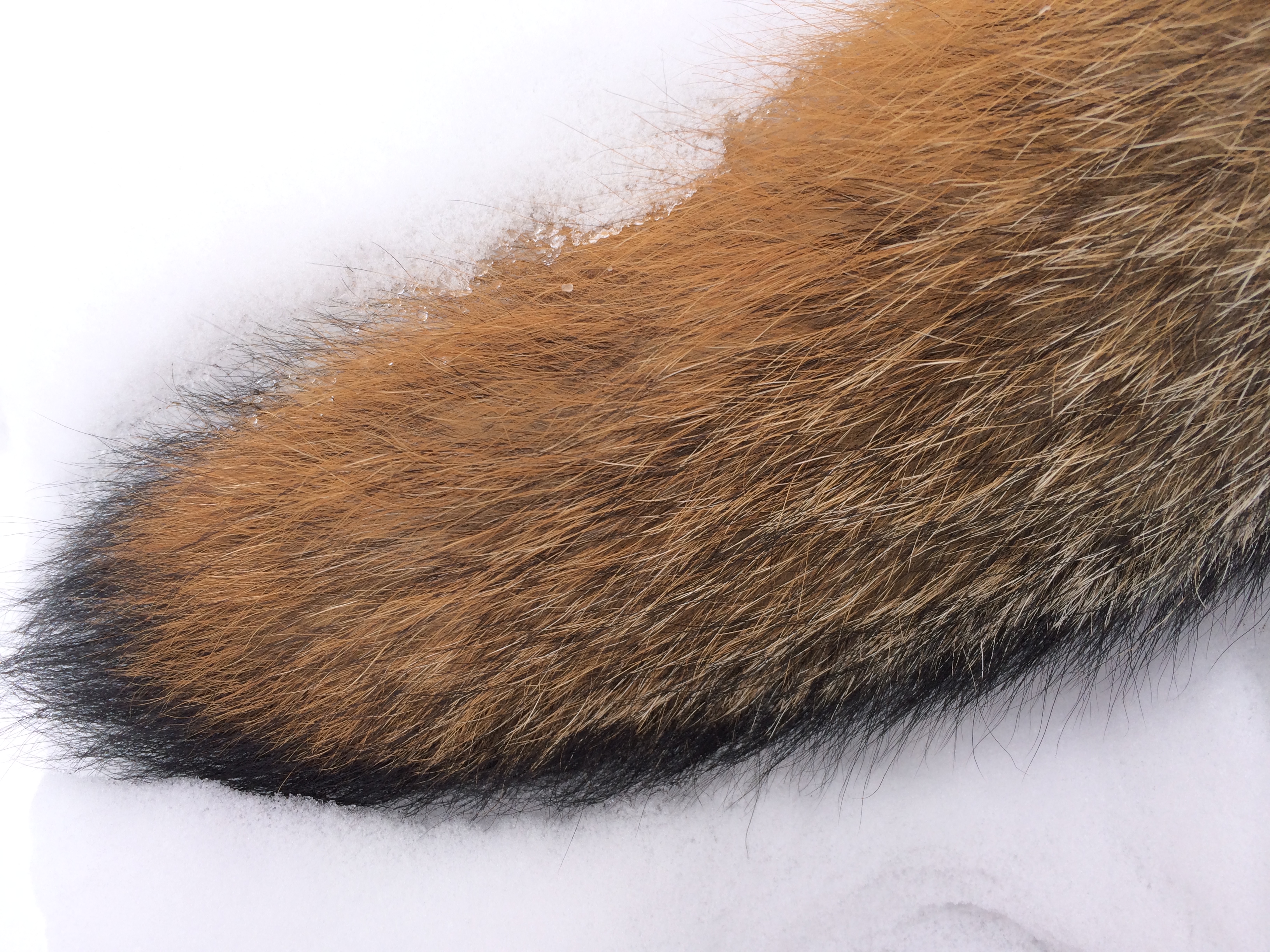
The tail of my fox.

The fox lay a short distance from the entrance to a small parcel of land, 9/10ths of an acre that my husband and I recently purchased from a Ms. Fox (a real person) as a writing/gardening retreat (this writer needs to be close to the land in order to write). Ms. Fox told me that a fox was living under the garden shed and that she would block the entrance because of the musty smell. I could see the scooped out place at the entrance to the shed and imagined a fluffy red tail disappearing into a safe hiding place under my writing desk. I said that I didn’t mind the smell (because in fact I couldn’t smell anything unusual) and I would like to share the shed with the fox, and I came to think of Ms. Fox’s fox as my fox. Ms. Fox told me that the garden “wants to be wild” but she had wrested, with her pruning shears, weed wacker, and true grit, sinuous beds for hardy, tough perennials. My husband and I planted three different kinds of foxgloves (Digitalis)  (the woolly foxglove, the salmon-pink Foxglove ‘Glory of Roundway,’ and the golden-apricot Foxglove ‘Goldcrest’) to attract pollinators and glove the fox.

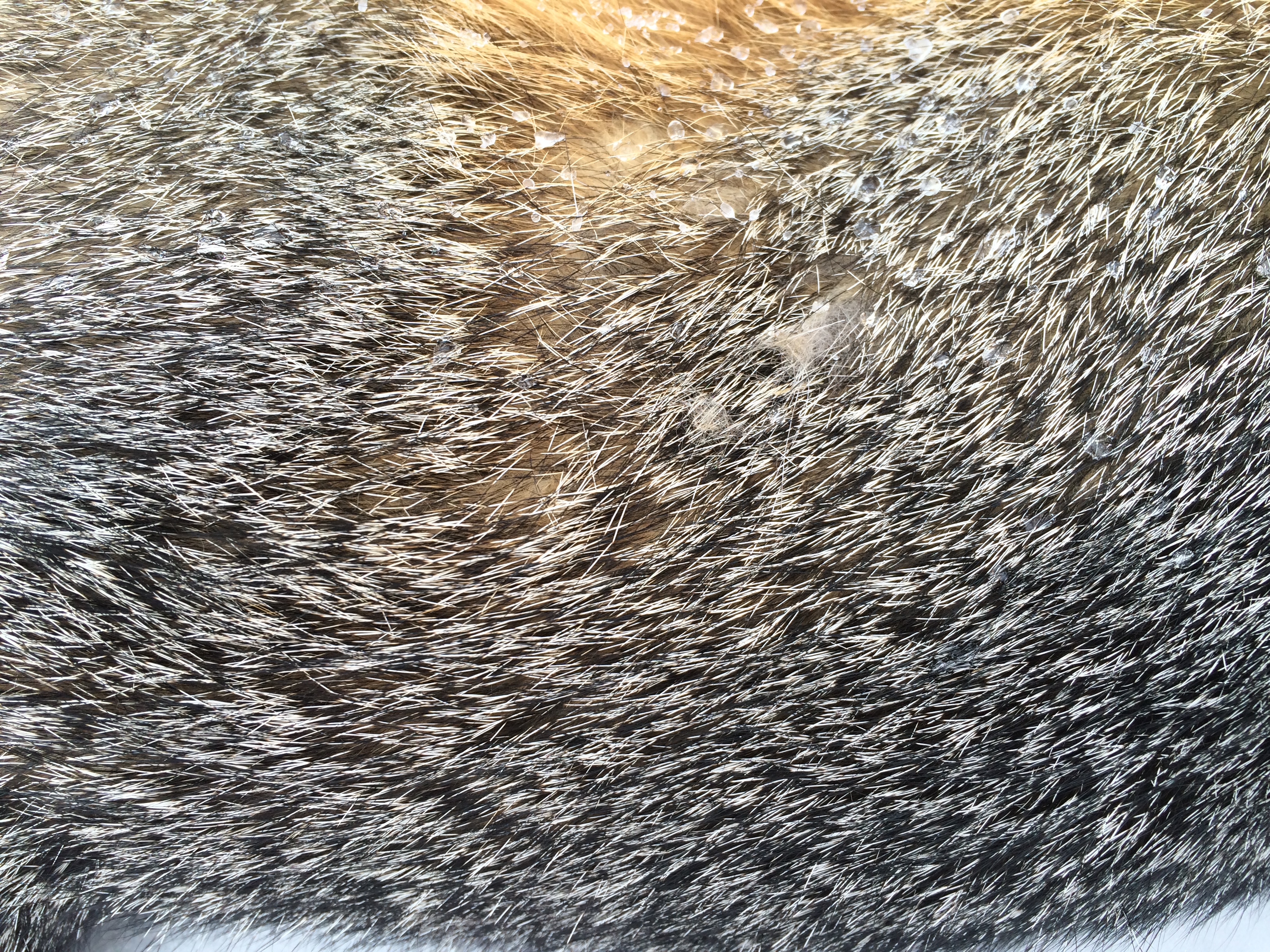
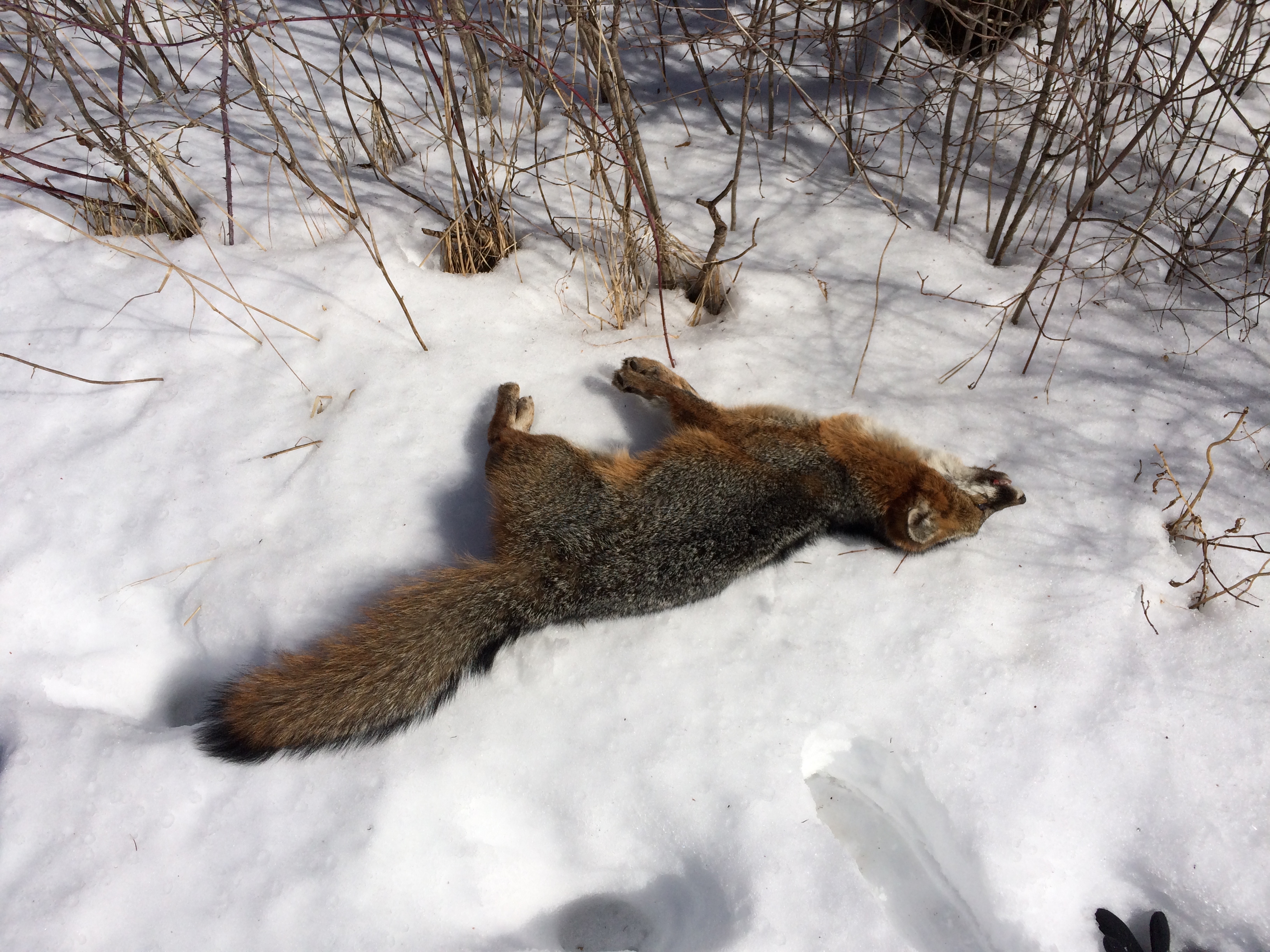
So when I saw the dead fox near the entrance to the secret garden, I felt a sense of loss and a need to take responsibility for the body. I got out of the car, put on my gloves, and went to the fox. She (he?) was in perfect condition. There was no blood nor any visible external blemish. I picked her up, she had stiffened in rigor mortis, and brought her inside the entrance, set her on a patch of clean snow behind the gate, and admired her beauty. The tail was magnificent, bushy, long, and full. The ears were lovely, delicate, pointed, furry. The tip of a pink tongue peaked out from her mouth. Dainty feet! What whiskers! Gray or red fox? I thought gray because  each tawny hair was white tipped. From a distance it looked like a dusting of snow covered the body. A perfect way to be gray.

IMG_0342

The fur of my fox.

Ithaca was in the grips of another polar vortex, so the body remained frozen, and the ground as well, so that we could not bury her. My husband and I decided that nature’s way was best, that letting vultures or coyotes nourish themselves upon her body was beneficial to the ecosystem. That was the decision—but nothing happened. I kept visiting my fox. After 48 hours she lay there as pristine as ever, though I had seen signs of  winter creatures eating other winter creatures everywhere.

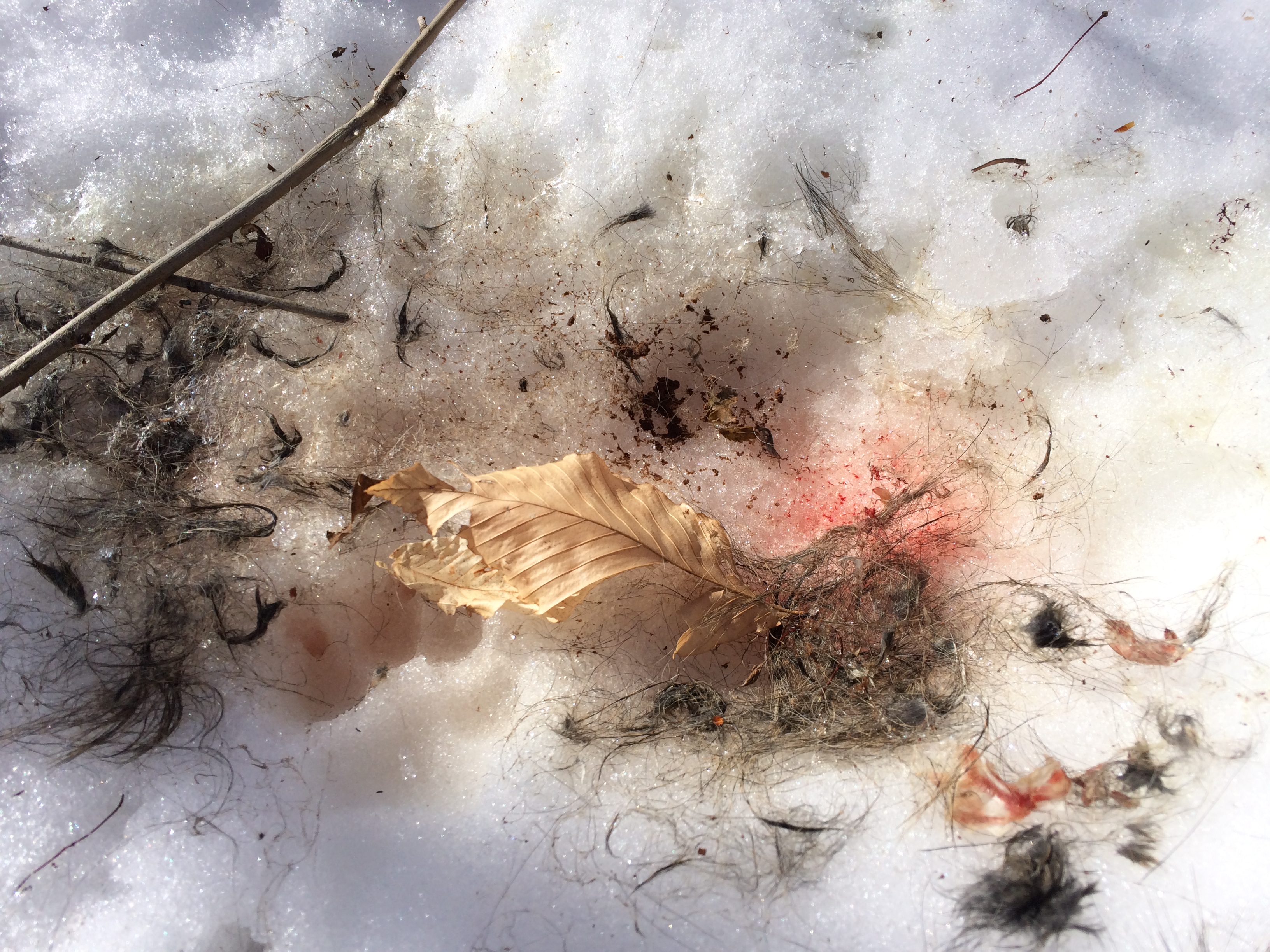
Blood, fur, and pawprint:  a meal has been eaten in the forest.

Still life of blood, fur, and pawprint: a meal has been eaten in the forest.

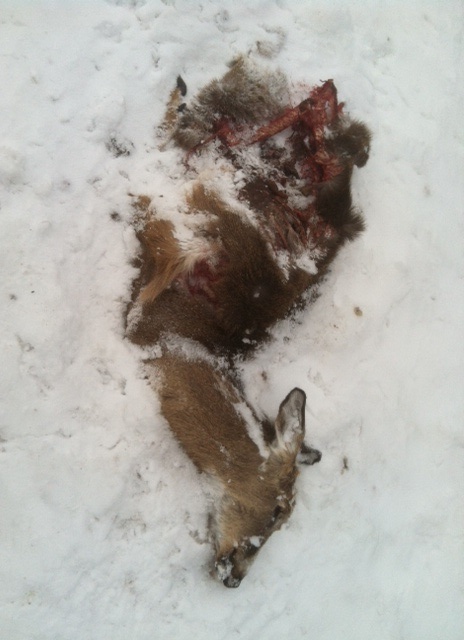
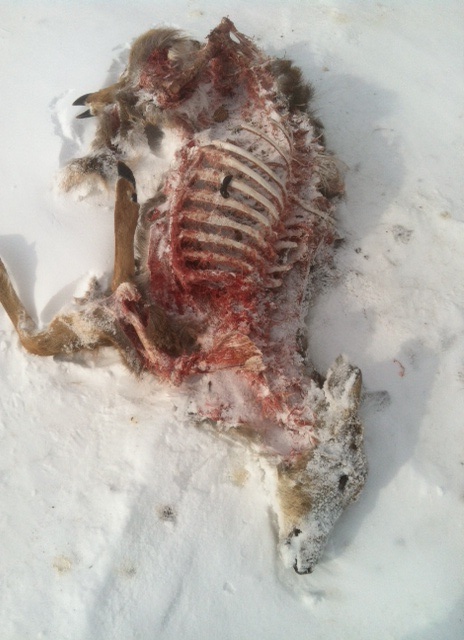
At Seven Fields my husband and I observed a frozen deer carcass be eaten to the bone over several days. I worried about my dog becoming interested  in my fox if a thaw set in and decomposers had not found the body.

Deer carcass at Seven Fields, Enfield, Ithaca, NY.

Deer carcass at Seven Fields, Enfield, Ithaca, NY.

Deer carcass at Seven Fields cleaned by scavengers (scat of scavenger visible on ribs).

Deer carcass at Seven Fields cleaned by scavengers (scat of scavenger visible on ribs).

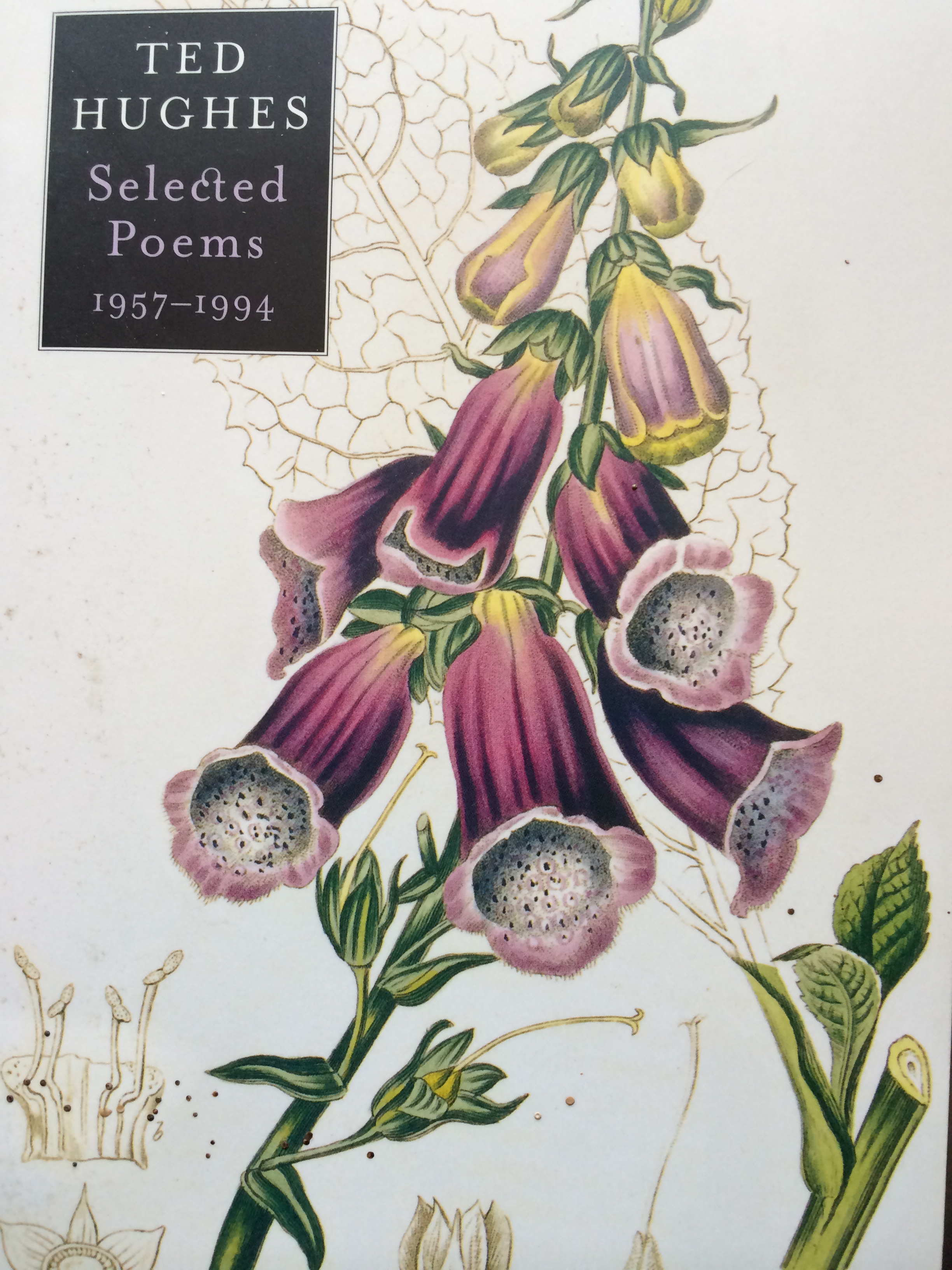
Meanwhile, at the same time, on a completely different tangent, hunting for a poem to memorize, I opened Ted Hughes: Selected Poems 1957-1994.

IMG_0474

Botanical illustration of foxgloves on cover  of Ted Hughes: Selected Poems 1957-1994 (Farrar, Straus and Giroux 2002).

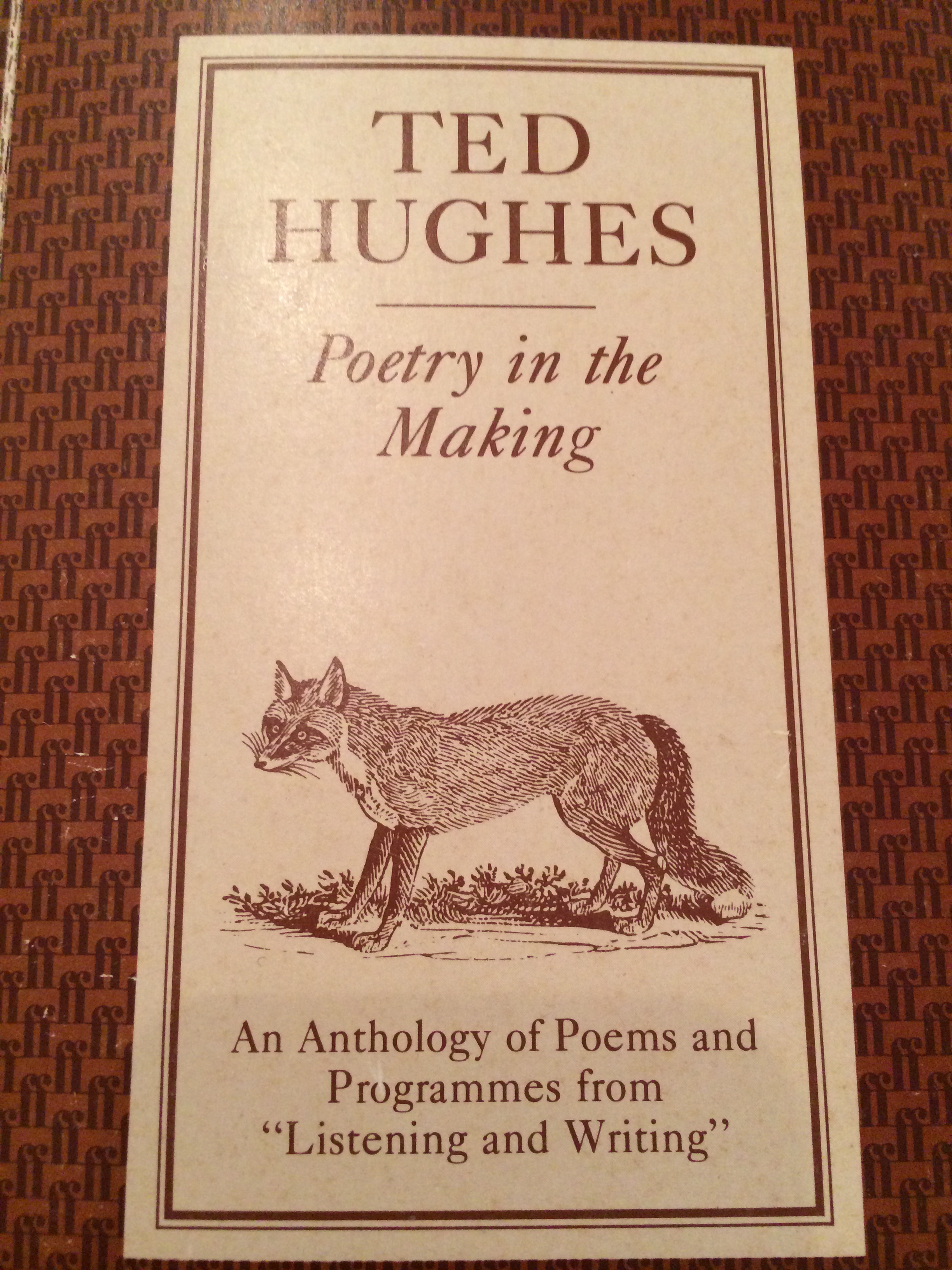
The first poem in the volume  is “The Thought-Fox,” which I read many times with my writing-as-a-naturalist students in a different book, Hughes’ superb Poetry in the Making: An Anthology. It is a collection of informal talks he gave for the BBC designed for interesting children in poetry.  In the essay called “Capturing Animals,” he describes his youthful interest in animals, how sometimes as a boy he stuffed 30-40 live mice in his pocket that he had plucked from sheaves at threshing time, and the genesis of his poem  “The Thought-Fox.”

TED HUGHES Poetry in the Making: An Anthology ( Faber and Faber, 1967)

TED HUGHES Poetry in the Making: An Anthology ( Faber and Faber, 1967)

Hughes writes: “An animal I never succeeded in keeping alive is the fox. I was always frustrated: twice by a farmer, who killed cubs I had caught before I could get to them, and once by a poultry keeper who freed my cub while his dog waited. Years after these events I was sitting up late one snowy night in dreary lodgings in London. I had written nothing for a year or so but that night I got the idea I might write something and I wrote in a few minutes the following poem: the first ‘animal’ poem I ever wrote. ”

So as I was visiting my fox I was thinking of Ted Hughes’ “thought-fox.” I completely agree with Hughes that immortalizing an animal in a poem has many advantages, but I had a body to think about.

My fox as I found her.

My fox as I found her.

I agonized, checked the yellow pages, made a phone call, and then made a decision on the third day. I drove back out to the secret garden a few hours after my morning visit, wrapped my fox in a blanket, put her in the back of my car, and took her to a taxidermist.

My fox behind the gate in the secret garden.

My fox behind the gate in the secret garden.

I was apprehensive about my decision, but happily a positive adventure ensued. I handed my fox over to a lovely couple in their ‘70s who run a retirement business in taxidermy. He, tall, bright-blue-eyed, youthful baseball cap on his head, and she, beautiful, gracious, and friendly, gave me a complete explanation of the processes involved in taxidermy, which I will omit here for the sake of brevity. Their ranch house looked unremarkable from the outside, but soon my head whirled, as I found myself nose-to-nose with several elk, a turkey vulture, crow, huge mountain goat, and numerous deer. These taxidermists work terribly hard. After a career in construction he retired to taxidermy and championship archery, and she, after 39 years working for the local trust company retired to be his indispensable helpmate and companion in the taxidermy business. They know a lot about animals of all kinds, well, mostly the furred and feathered. He told me that the grey fox (Urocyron cinereoargenteus) is a creature of the brush and has the footprint of a cat. Coyotes tolerate this most  ancient member of the dog family (Canidae), which can climb trees to escape predators.  He said the red fox has the footprint of a small dog and favors wooded areas.

Taxidermy was a critical job skill that helped Charles Darwin gain his position as naturalist on the H.M.S. Beagle. In Edinburgh, when he was studying (unhappily) as a medical student at the university, Darwin had lodgings two doors away from those of a freed Guyanan slave named John Edmonstone, whom Darwin hired for a guinea a week to teach him the art of taxidermy. Darwin and Edmonstone formed a congenial friendship, based on mutual natural history interests, that Darwin remembered all his life (see his Autobiography). In the process of rewilding, a movement whose aim is to bring extinct animals back to life (see Nathaniel Rich’s “The Mammoth Commeth” in the New York Times, Feb. 27th, 2014),  taxidermied specimens may offer the DNA fragments that will allow geneticists to reconstruct the original genome of the extinct animal. Thus, Darwin’s specimen of the now-extinct Floreana mockingbird may sire descendents one day.

In his BBC talk, Hughes tells children,  “in some ways my fox is better than an ordinary fox. It will live for ever, it will never suffer from hunger or hounds. I have it with me wherever I go. And I made it.”  Hughes wanted children to understand that poets are pacifists, but there is a paradox in his words. There would never have been a thought-fox without the real fox, which first appeared 3.6 million years ago.

Taxidermy has been called the art of death.  I cannot offer a rational explanation for why I took my fox to the taxidermists. However, in a few months, a fox, more than a thought but less than real, will keep me company in the shed as I think about the lovely taxidermists and the poet, thought-foxes and real foxes,  and mortality and extinction.

I want lots of foxes and foxgloves in my garden, all real. I want to see fluffy tails disappearing into tangles and thickets, and spires of speckled peach and rose colored foxglove flowers. Like Hughes, I want foxes of all kinds to live forever. One problem with extinction is how barren human imaginations will become if we destroy all the models for our flights of fancy.

Winter leaf lies quietly.

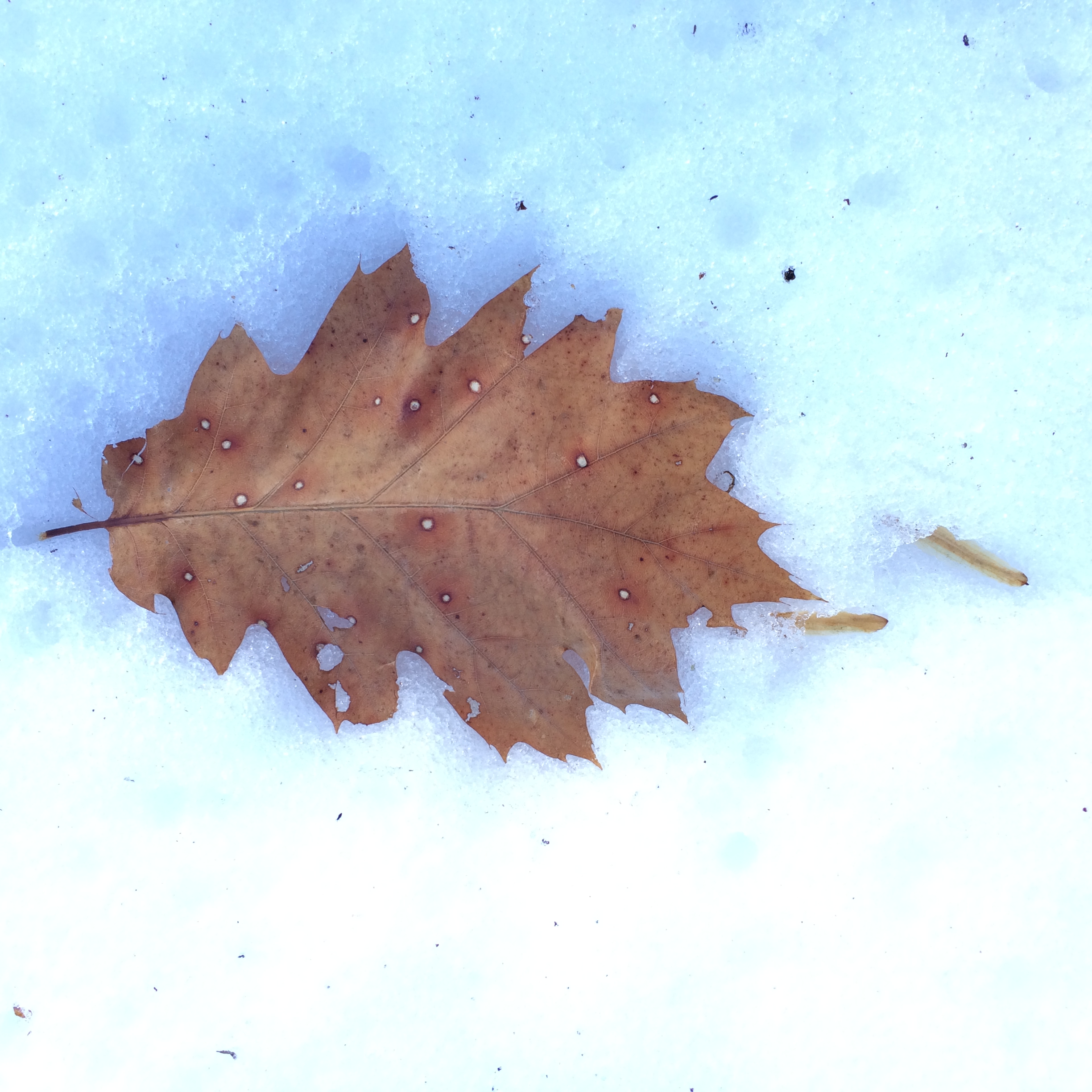
Oak leaf on snow, holding out against decomposition.

A Winter’s Day in Vinegar Hollow

The night before had been snowy.

The night before had been snowy.

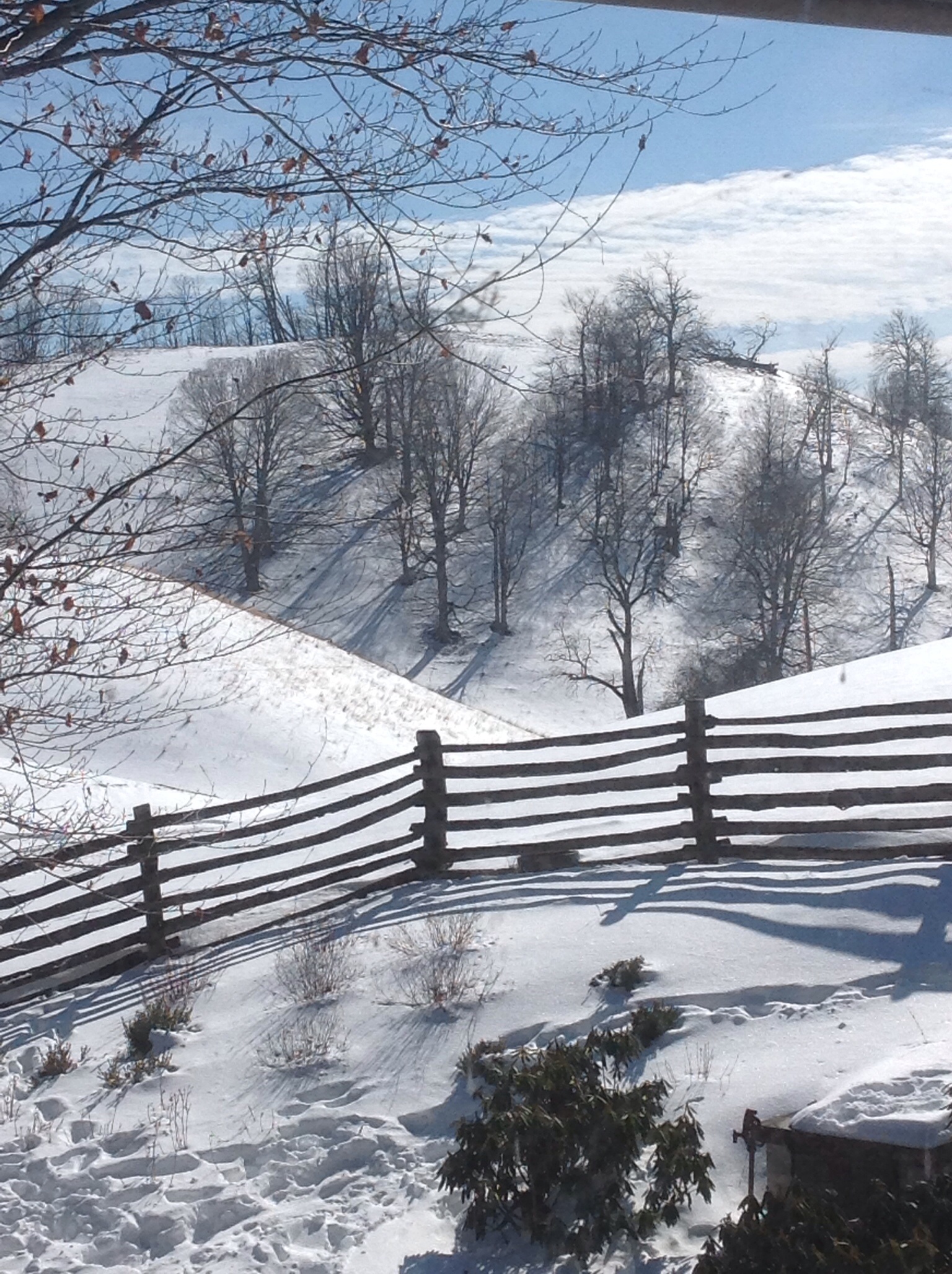
As the sky lightens in the east, toothpick trees standing like steadfast tin soldiers row upon row take shape, straight and thin. Rosy pink gives way to layers of pale gold and pale gray blue. The scene is still, perfect in its way, but a calf died in the barn in the early morning.

Light appears to the northeast.

Light appears in the east.

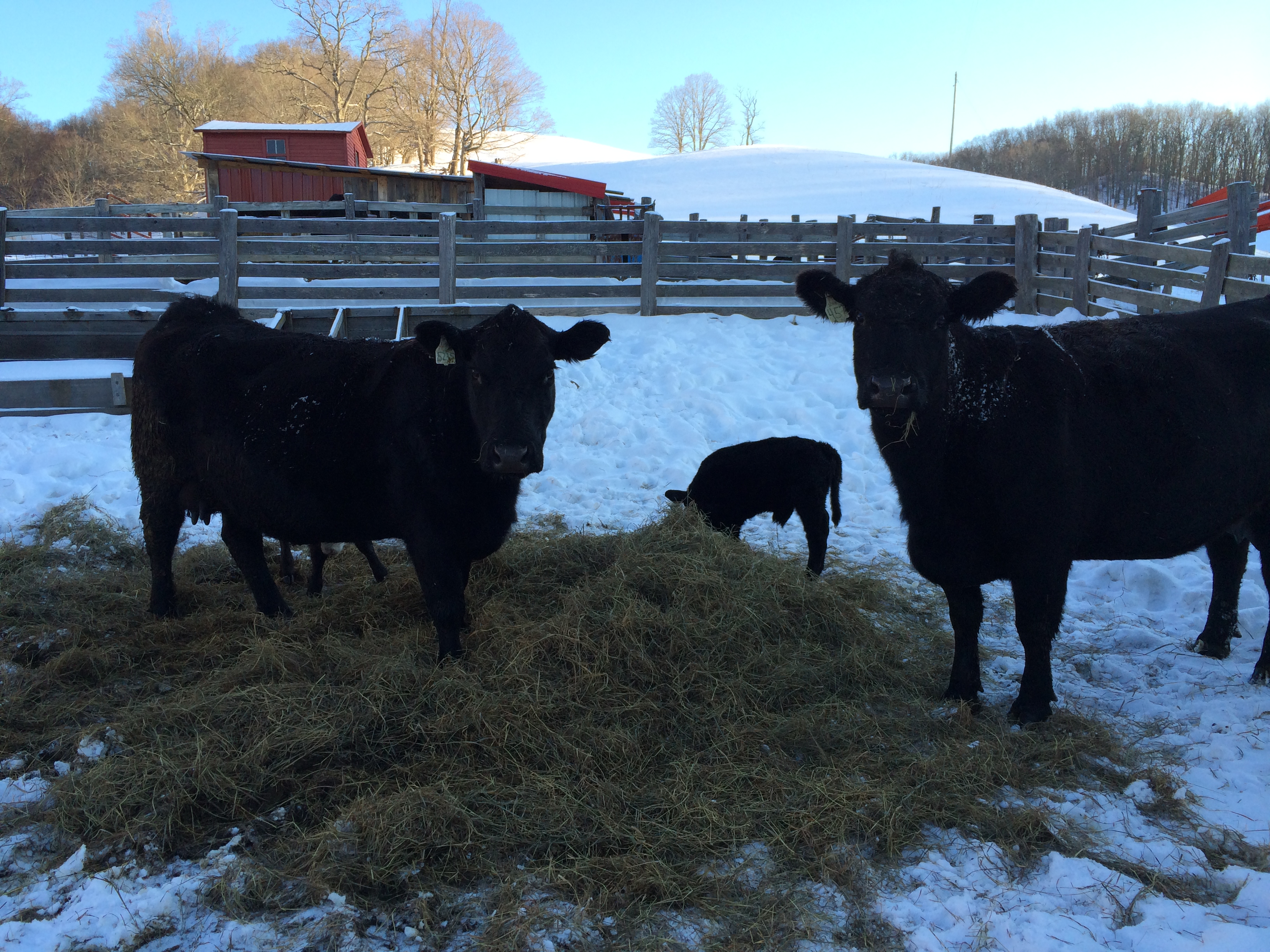
During calving season Mike checks the barn at regular intervals.  He had checked at 3 am, despite his flu, the cold, and the fresh snow that made the road slick into Vinegar Hollow from his house on Route 220. When he came back at 7 am, a calf lay dead on the hay in the stall with its mother.  The death of a calf is both an economic and an emotional loss.

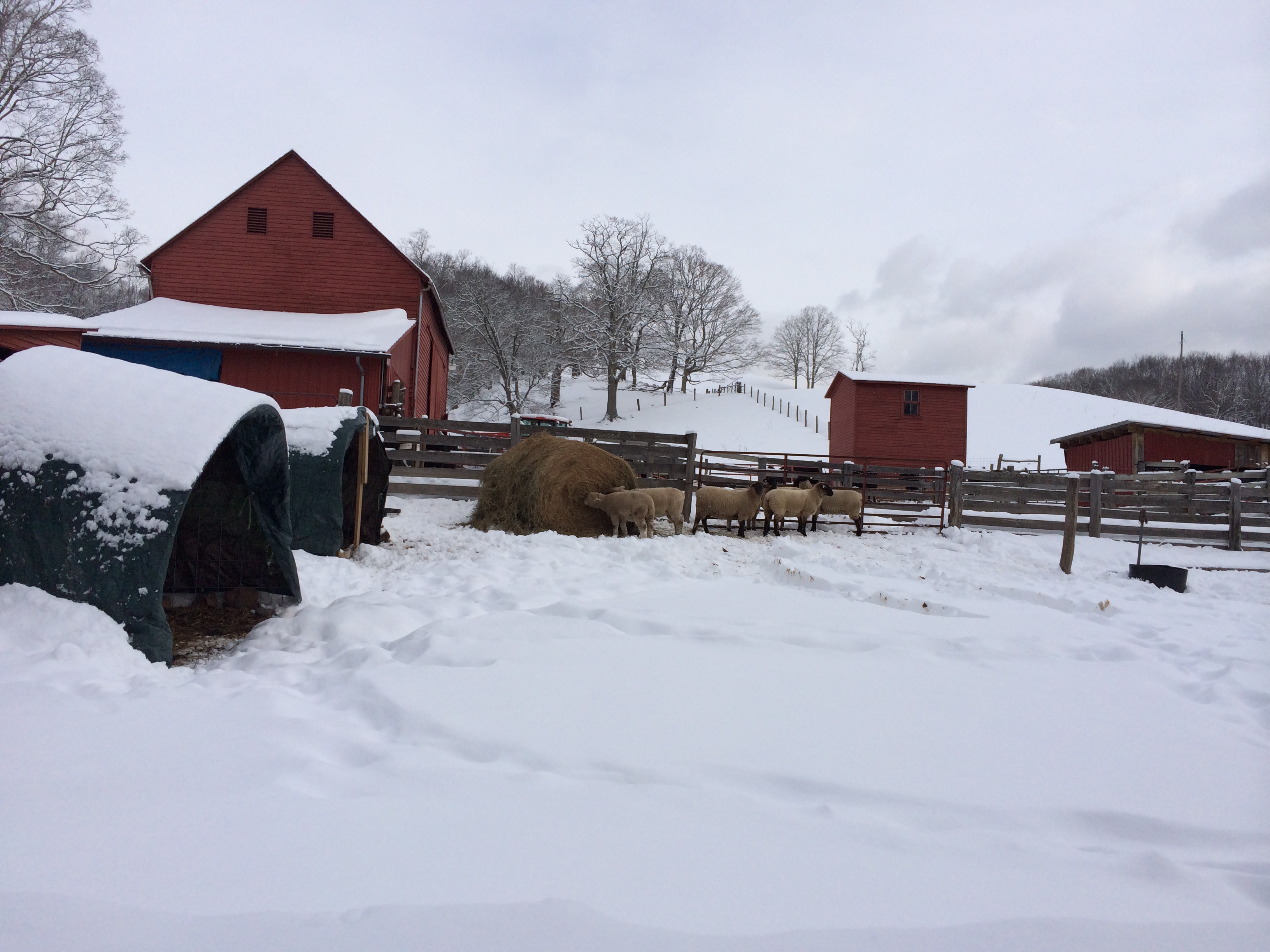
Cow-and-calf shelters to the left, yearling sheep near center

Cow-and-calf shelters to the left,  and yearling sheep near center with straw barn behind.

“I can’t sleep beside them all night,” Mike says, his voice roughened by flu and tiredness. The cow could have stepped on its calf by mistake, or failed to lick the sac off fast enough, or maybe it was born dead, or…. There is no way of knowing what happened in those few hours as the cow and calf enacted this farm tragedy. The cow will feel her loss for some time in the pain of swollen udders. Sometimes there is a solution. It may be able to take on one of a set of twins.

image

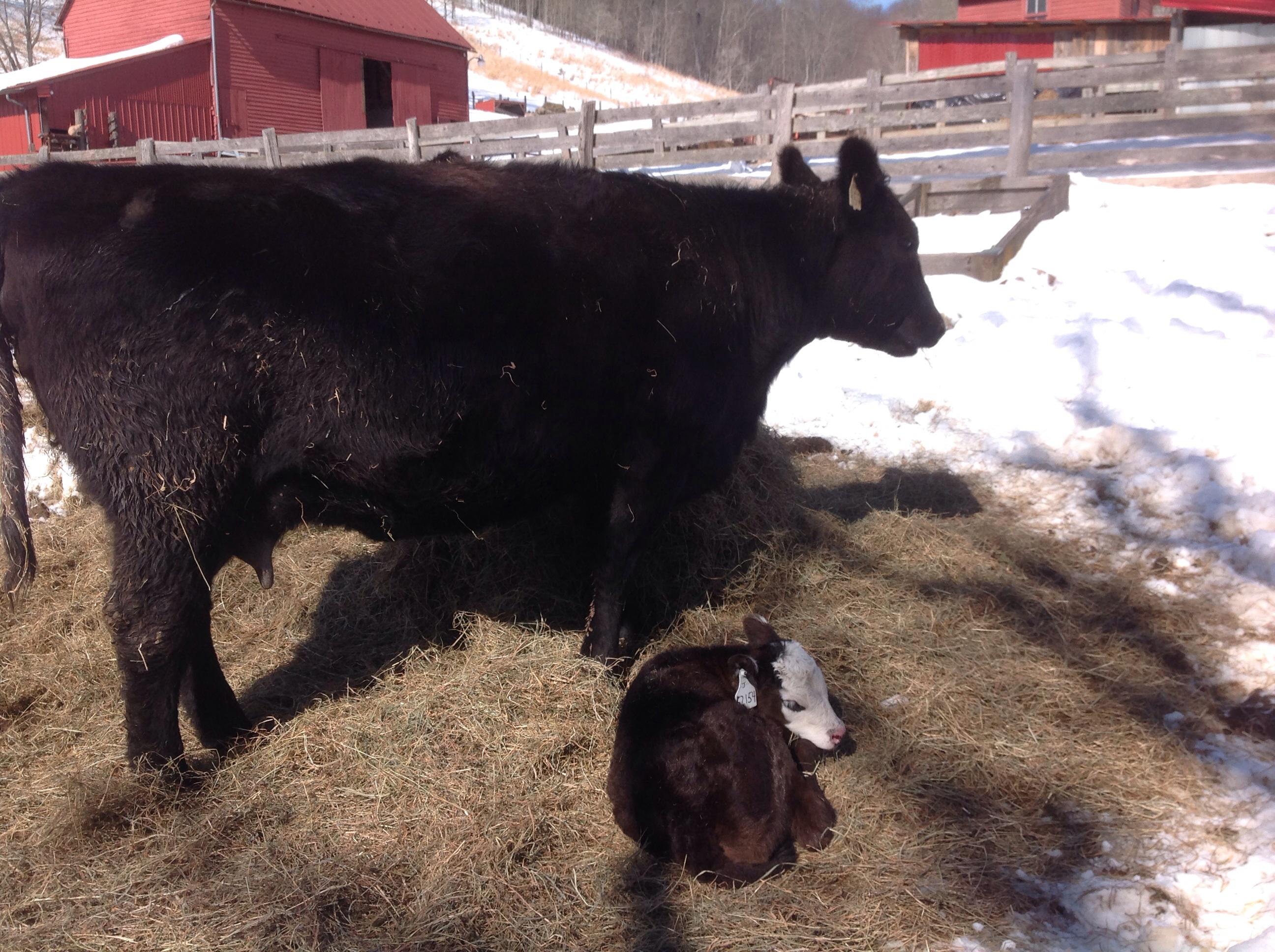
Cow and calf enjoying the noonday sun.

Young California Red (has some fat-tailed, red-faced Tunis in his background).

Alert young California Red (has some fat-tailed, red-faced Tunis in his heritage).

A few hours later, two crows appear in the blasted walnut tree in the sinkhole. One crow leaves. One remains. Lovely, simple math. Now there are two again. One flashes away, then the other. Back and forth they go. If they left contrails like planes, it would be quite a tangle in the sky. By midday the juncos are visiting the cows and yearling sheep in the pen by the old house picking up hayseed. They are very busy. The crows take an interest as well.  Two cows and their calves sit soaking up the sun. Occasionally one rises to spray steaming manure or lick the face of her calf, but mostly they sit, face to the sun, soaking up heat, to balance those minus 15-degree nights of the week before. Black crow on white snow. Black Angus on brown hay on white snow. Juncos gray and white. Butterscotch barn cat lolls along in the sled tracks, confident that the dogs are worn out, asleep.

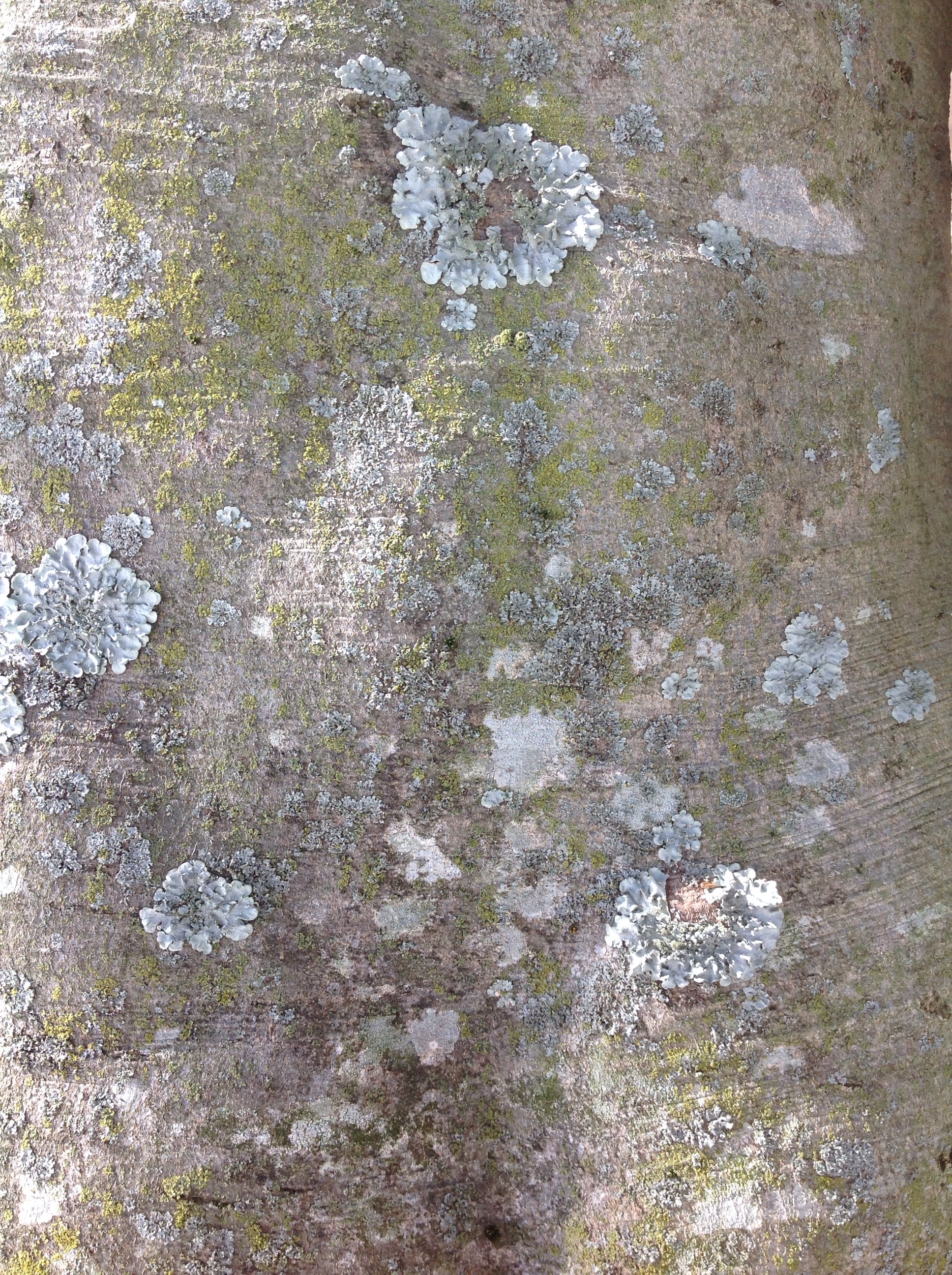
Lichened bark of the copper beech.

Lichened bark of the copper beech.

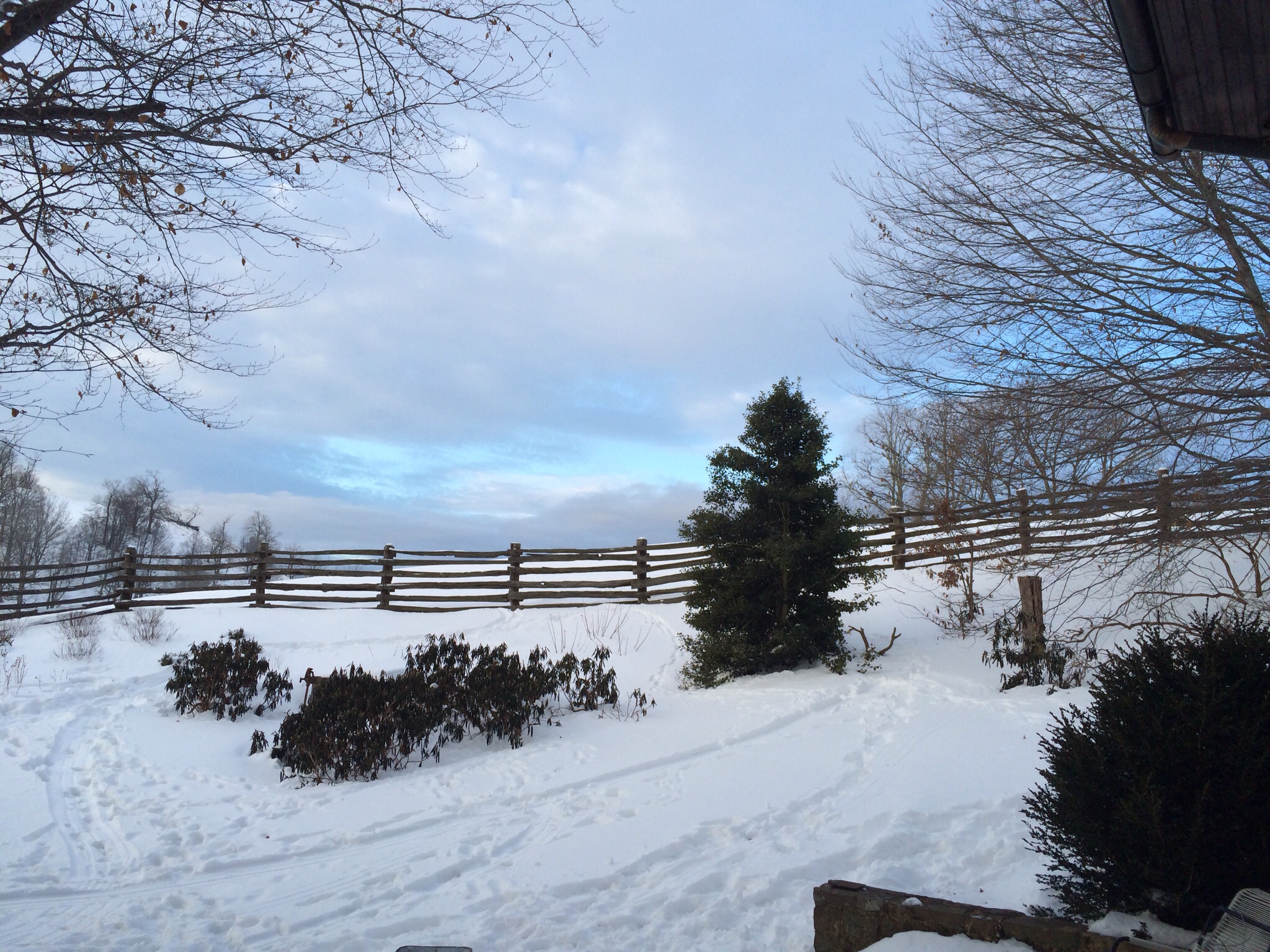
Tree trunks in the garden become art objects, their surfaces intricately sculpted.  No doubt much is going on beneath the lichened bark of the beech and the owl eyes of the red spruce as the juncos visit the bare ground at their base. Days like this in late February set in motion the whirring cogs of spring. Snow and ground are melting.  A large bluejay floats from branch to branch of the beech tree.

"Owl eye" of the red spruce.

“Owl eye” of the red spruce.

The hollow, like a reflecting pool, shimmers with each movement of the sun and clouds. Mid-afternoon is a time of shine and shadow.

Trees on flank of Stark's Ridge cast shadows. Top of hill is Lawson's Knob (named after John S. Lawson).

Trees on flank of Stark’s Ridge cast shadows. Top of hill is Lawson’s Knob (named after John S. Lawson).

Calves have only a day or two in the barn before they must face the elements to release space for the next cow near birth. The cows and their new calves may take to the shelters Mike has made for them or they will remain embedded in the hay close together.

Sky to the north becomes turquoise in later afternoon.

Sky to the north becomes turquoise in later afternoon.

The day begins to fold in for the night. Shadows grow darker and bigger. Juncos take shelter in the overgrown boxwood and yew.

View to the south in later afternoon.

View to the south in later afternoon..

Where the hollow tapers, to the south, the sky colors in hues of apricot, lavender, chocolate. I rush out to catch them but they have gone. It is all happening so fast. Night comes, and it will snow again.

Cows headed to the barn in the early morning.

Cows headed away from the barn meadow the next morning.

After a day here, hollowed, I feel as if I have been spinning around the entire world. There are no places I am not part of when I plant my feet in Vinegar Hollow. Oh, little calf that never even experienced a day!

An Encomium* to Trees in Winter!

Winter silhouette of a tree with vines nearing the top.

Winter silhouette of a tree with vines nearing the top.

I am snowshoeing slowly through the deep snow of a forested hilltop in Enfield outside Ithaca, New York, following a circuitous path behind my dog and my husband, pondering the nature of trees and my understanding of them. Puffs of snow drift down occasionally, a woodpecker drills, and beech leaves tremble in a breeze that I cannot feel.

My daughter  asked me a few weeks ago over lunch why trees don’t freeze in winter. She was thinking about cold hardiness. A special herb from the West Coast had arrived blackened, nearly dead, after transit through airports during the Polar Vortex. A grown woman now, Charlotte still asks questions with the same intensity she had as a child. Now, since becoming interested in mind-body therapies, herbalism, and shamanism, she has taken a great interest in all the life forms around her, educating me about some aspects of plant life of which I have been ignorant. I should have been able to answer her question in a snap.

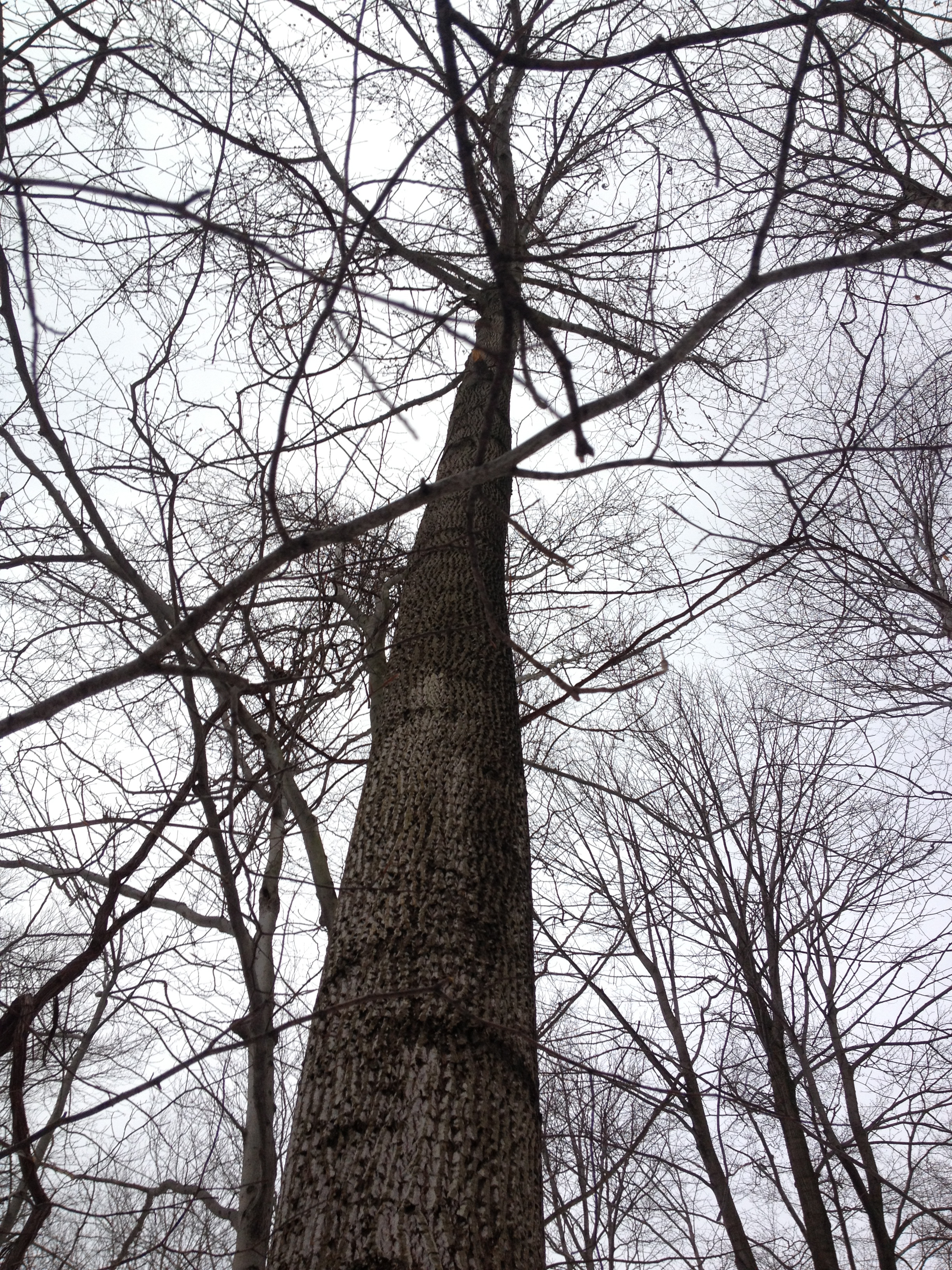
Looking up at a tree in Enfield.

Looking up at a yellow poplar (tulip tree, Liriodendron)  in Enfield.

Yes, back in 1979 I took Water Relations with Professor Roger Spanswick at Cornell as part of my PhD studies. I received an A in the course, which I was very proud about, because I had to shepherd two of us through the class. On January 9th I had delivered my first child and on January 20th or so I sat at 9 am MWF in a classroom in the basement of the Plant Science Building in the front row with Jack in a Snugli. Dr. Spanswick, always entirely gracious about Jack’s presence, often told me he would be happy if I took Jack out of the Snugli, implying that he was worried that Jack might be getting smothered. I dared not do so because Jack was a very active infant, except in the Snugli. I could feel his heart beating so I was not worried. (Jack and I successfully TAed Phycology, the study of algae, together that semester as well.) I want to make clear that Dr. Spanswick made Water Relations fascinating, his lectures were brilliant and comprehensive, and it is just the passage of time that has made retrieval of the pertinent information difficult.

The coils of wild grape vines that overgrow and pull down forest trees.

The coils of wild grape vines threatening young beech trees.

The cold hardiness of trees in winter. The question lurked in my mind. Although I found one of my water relations textbooks, it dwelled solely on Plant and Soil Water Relationships (the title of the text), and did not include cold hardiness. Not surprisingly, one of my favorite magazines, Northern Woodlands, gave me good information.  An article in the December 2013 issue, which I unaccountably missed, titled “ How Do Trees Survive Winter Cold” by Michael Snyder, forester and Commissioner of the Vermont Department of Forests, Parks, and Recreation, provides answers.

A light snow covers every branch of forest trees.

A light snow covers every branch of forest trees (doubleclick to see detail).

The basic facts are these. Trees are about 50% water so the danger of freezing in winter is great.  Although many cells in a tree are dead, forming important structural elements, like bark, and these do freeze, there are important “tissues” of living cells that must not be allowed to freeze. A threefold system for minimizing the formation of ice crystals is in place:  (1) the composition of the cellular membrane changes in order to force more water out of the cell; (2) the contents of the living cells become sweeter as starch is turned to sugar (“sweet antifreeze”); and (3) as a result of the first two changes, the remaining contents of the living cells go into a supercooled or “glass phase” (“suspended animation”) that disallows the formation of ice crystals in the interior of the cell, though ice crystals may form outside the cell.

Woodsman (alias husband or forest troll) warming up at campfire on top of Seven Fields.

Woodsman (alias husband or forest troll) warming up at campfire on top of Seven Fields.

Snyder says that not all the details of these processes are understood. Mystery and magic remain. The “magic” is that a tree survives winter as a community of living (nonfrozen) and dead (frozen) cells living side by side at the same temperature. Snyder cites research plant physiologist Paul Schaberg of the USDA Forest Service’s Aiken Forestry Sciences Laboratory in Burlington, Vermont, as a source of ongoing research.

Rosette pattern of beech bark blight (fungal disease).

Rosette pattern of beech bark blight (fungal disease) and ensuing wounds (right of center) that will kill an older beech tree.

I love trees in winter. I see their structure, the strength of the main trunks tapering to ever greater points of delicacy. I see their wounds. Almost every tree bears a sign of mutilation. The forest is a place of constant turmoil, losses and gains as trees must outgrow heavy grape vines, survive bark blights, deer antlers rubbing great gashes, and crashes caused by lightning.  It’s only in winter when I see them “naked” that I understand so much more about their lives.

Tree standing dead, but revisited multiple times by woodpeckers.

Beech tree showing the long, oval excavations characteristic of the pileated woodpecker.

Trees in winter have become friends that I miss in summer when leafiness distracts my eye from the “inner” lives I have come to know during the cold. Our woods, about 10 acres on a hilltop on a piece of land we call Seven Fields, is a sugar maple-beech climax forest that includes white ash, black cherry, and red oaks in the upperstory, and hophornbeam, spice bush, and carpinus in the lower story. As I snowshoe through the forest in the deep cold, I think about disturbance and suspended animation, how the forest is a lesson in the splendid survival of life forms that cannot run away. I am thinking also of the questions we ask and how and why we ask them, and the answers we find and how and when we find them.

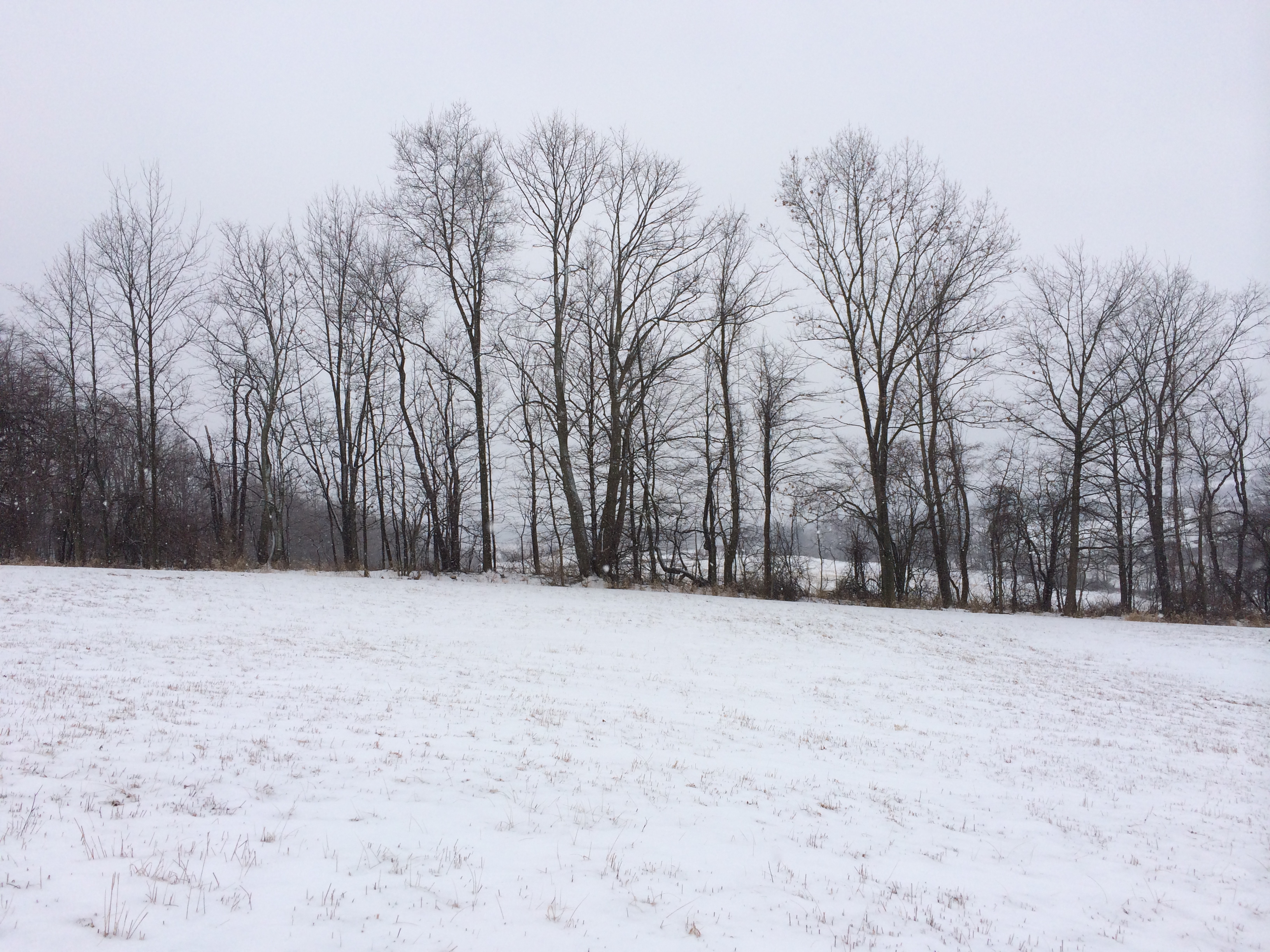
Hedgerow in winter.

Hedgerow at Seven Fields (Enfield, Ithaca, NY) in winter photographed in a light snow (triple click to see the snow flakes) .

*  I realize that encomium is a strange word in this context, but I wasn’t satisfied with “tribute” or “appreciation.” Encomium, a Latin word derived from a Greek one meaning “laudatory ode,” carries the sense of  a eulogy. A few years ago the New York Times carried a headline on the front page, something like “Forests Dying Around the World.” A forest remnant of 10 acres deserves a big word.

Sugar maple finding blue sky.

Sugar maple finding blue sky.

A miraculous bouquet!

I know it’s winter, and I love the colors of winter, the grays of tree trunks and the white of snow and the beige of beech leaves, but I am thinking about a bouquet of flowers.

Belle surveying Enfield on February 2, 2014.

Belle surveying Enfield on February 2, 2014.

I have a big, black wolf of a dog, a Belgian Shepherd named Belle, who needs to be reminded often that she is a dog and not leader of her human pack, so I take her to doggie day care once a week. There in a pack of 17 or so dogs she learns that a pecking order is the name of the game for most creatures on Earth. Pam, who runs the doggie day care, is in my pantheon of heroines. There is no question that she is leader of the pack of 17 who run and romp and bark and snarl in the fields by the barn. It helps that she is tall. But she has the voice as well. When she says “Knock it Off,” the most overexcited, tooth-ey cat killer (there are such dogs there, but Belle is not one of them) wilts, sitting back on his or her haunches, ears back, the picture of canine contriteness. Pam understands each dog, adapting her approach to his or her strengths and weaknesses. Assertiveness blended with acceptance and compassion is an art. Even though I can’t say “Knock it Off” the way she does, I have learned from her.
Pam is also good with flowers. They abound every which way on the property, in beds along the driveway past the trailer to the barn, around trees, hanging from vintage contraptions on the barn itself. Huge barrels of dahlias guard the fence of the first pen. Though I was in a rush to get to my 8 am class, I stopped to admire a 4-foot tall dahlia, its flowers absolutely off the charts in size and pinkness.
“Hang on a sec. Let me grab a blossom for you,” Pam said. She picked the biggest, pinkest blossom, her large, work-hardened hands turning the flower to face upward.

One of Pam's dahlias.

One of Pam’s dahlias.

“But, do you like this lavender one?”

“Sure.” She plucked it.

“What about this rose one?”

“Sure.” She plucked it.

“You need this one with the ruffley edges.” She plucked it.

Soon enough I had a bouquet of 8-10 blossoms, all in different hues, pink lavender, pink white, red red, all with varying petal shapes, from frilled to square cut.
“Go, girl!” she said. I did. I dashed over hill and dale to the Writing Department at Ithaca College, found a vase in the copy room, and situated the bouquet in my office. I considered carrying the vase to my classes to freshen the blah bureaucratic ambiance of the classrooms in which I was teaching, but decided I couldn’t handle it as I am also a bag lady (a literary one, though).
Upon return to my office I found the bouquet alive and well. In fact, there was a large green and white caterpillar munching on the largest dahlia, making great inroads into a lovely pleated petal while producing sizeable chunklets of poop (technical term here is frass) one after another as I watched. And a demure ladybug, skimming lightly over an adjacent petal.

Pam's Bouquet.

Pam’s Bouquet.

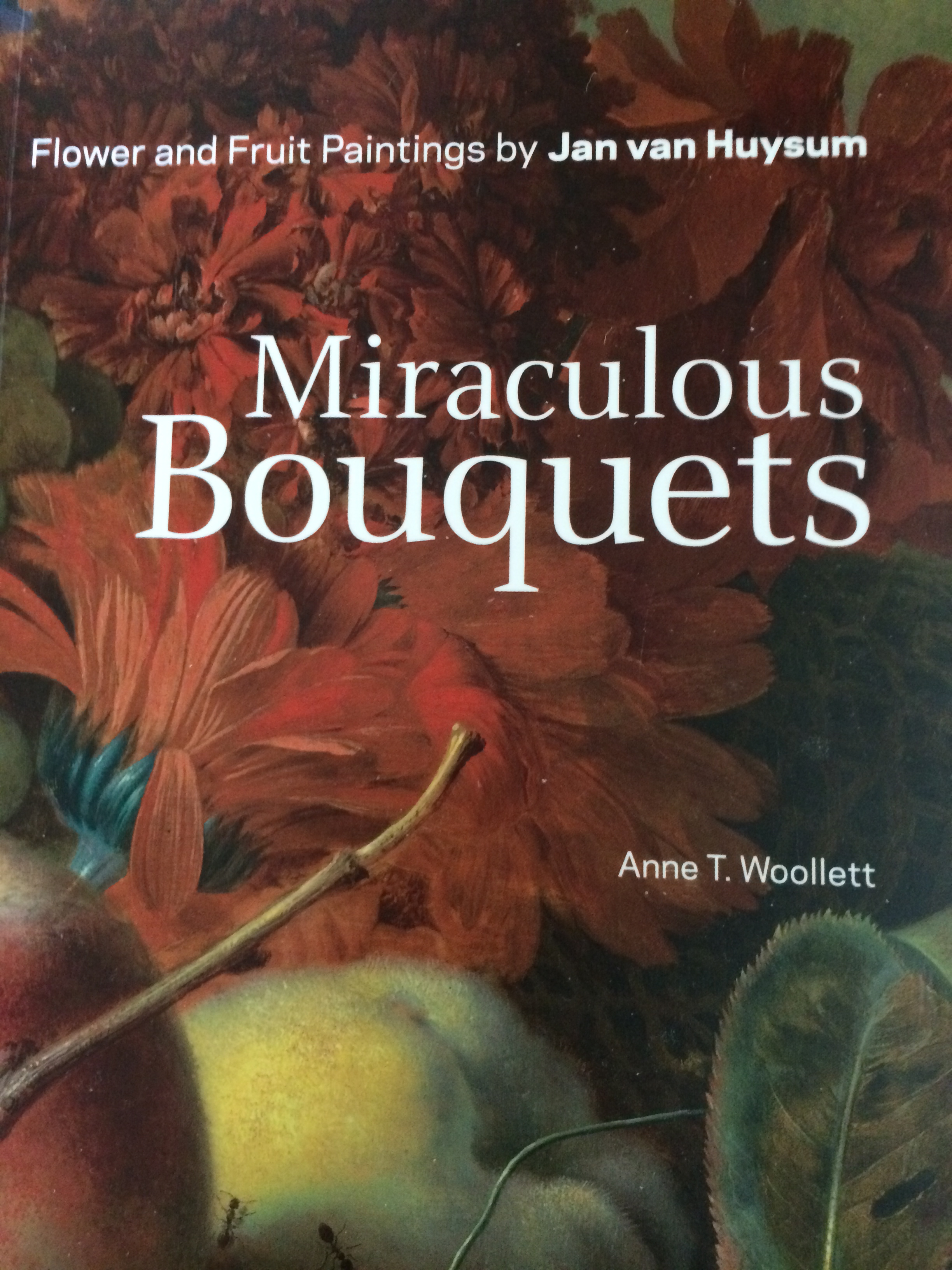
Pam’s bouquet made me think of the little book I couldn’t resist buying (book jacket below) as a potential gift for someone, but have not parted with yet. I have always been attracted to the contradiction inherent in still lifes—the serene perfection of the still representation vs. the attempt to capture life in motion—the water droplet about to roll off a leaf, a caterpillar poised for the next bite.The Dutch still life painters of the 17th century, like Jan Van Huysum (1682-1749), often painted the insects that lurked on the bouquets they tried to capture so realistically. Anne T. Woollett, author of Miraculous Bouquets:  Flower and Fruit Paintings by Jan Van Huysum (The J. Paul Getty Museum) writes, “Although the brevity of life was not their primary theme, the curling petals and bent stems of Jan’s lavish bouquets, as well as the exposed fruit seeds and gnawed flesh, convey the passage of time.”

Book jacket of J. Paul Getty Museum's publication about paintings of Jan Van Husum.

Book jacket of J. Paul Getty Museum’s publication about still lifes of Jan van Huysum.

Painters from many cultures have labored over these kinds of still lifes, pushing technique to achieve ever greater perfection of representaton. Huysum painted on oak and copper, had special minerals ground for his paints, and overlay the images with yellow glazes.  James J. White and Autumn M. Farole in their commentary for the exhibition catalogue shown below (given to me by a friend, which I can’t part with either) describe how Mahaveer Swami, a painter of natural-history miniatures in Jaipur (the Pink City of Rajasthan, India), uses a paintbrush that is just a single squirrel hair to achieve precise details. I love the work of these natural-history artists, while hoping that each brush stroke is a tribute to the life form, bug or flower, that posed as model.  In writing here I realize that I am engaged in representation, when the true gift of the bouquet was life in motion.

Book jacket of exhibition catalogue published by Hunt Institute for Botanical Documentation, Carnegie Mellon University, 1994. Cover, by Jaggu Prasad, is titled "Cluster of Apples with Insects."

Book jacket of exhibition catalogue published by Hunt Institute for Botanical Documentation, Carnegie Mellon University, 1994. Cover, by Jaggu Prasad, is titled “Cluster of Apples with Insects.”

I rushed home with the bouquet, placing it in my garden to liberate the caterpillar and the ladybug. I watched it age day by day. The water grew green with algae. The petals lost color, drooped, and fell. The bouquet did not look less beautiful to me. It represented a gathering of experience: dogs scampering along the fence line trying to figure out what the humans were doing, Pam’s large but gentle hands turning each blossom this way and that, and the surprise of the caterpillar and the ladybug.

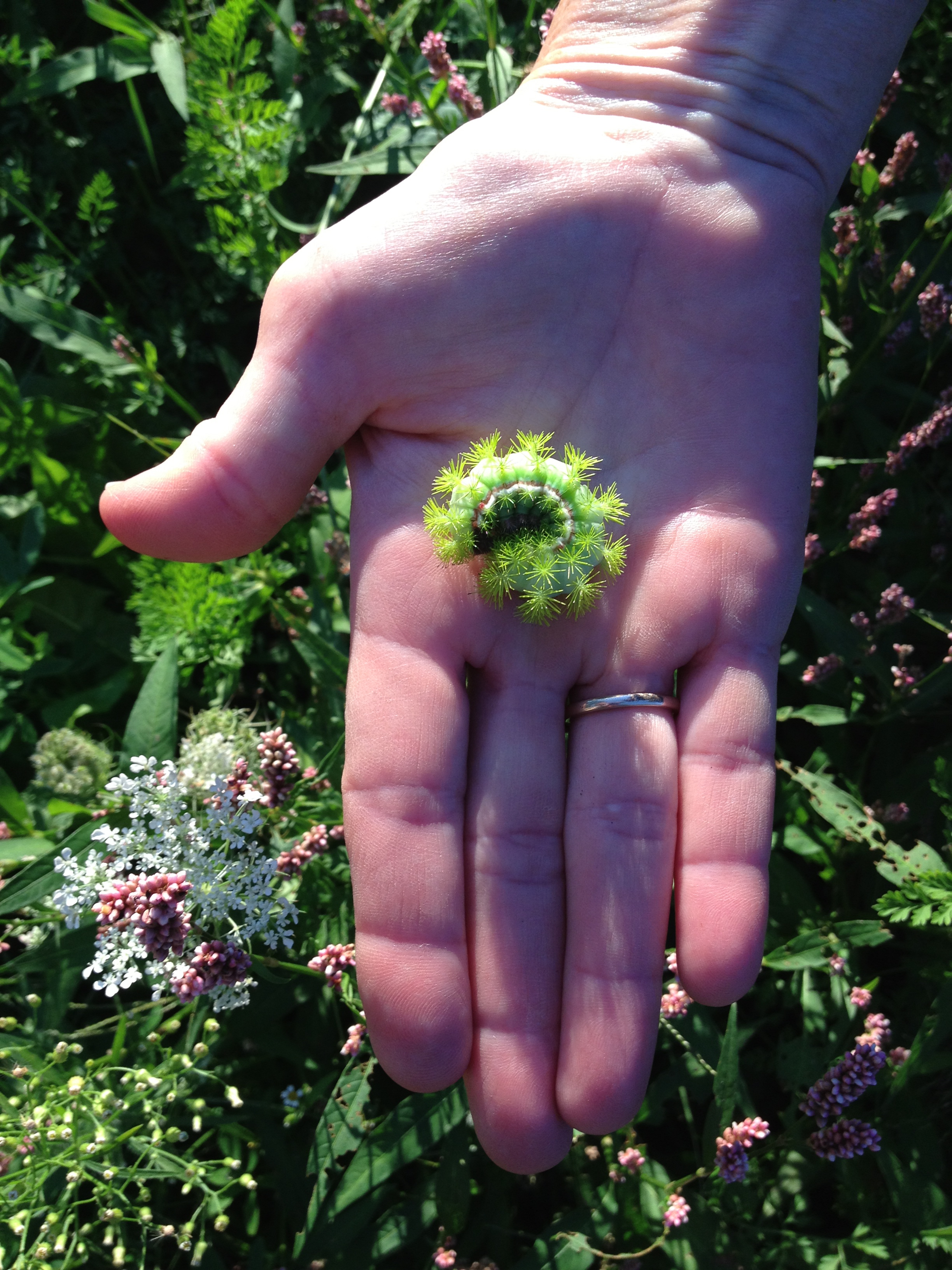
Caterpillar found on Seven Fields in Enfield, Ithaca, NY.

Caterpillar found on Seven Fields in Enfield, Ithaca, NY.

Fieldwork 101: Naturalist defers to Polar Vortex, but Pair of American Black Ducks Carries On

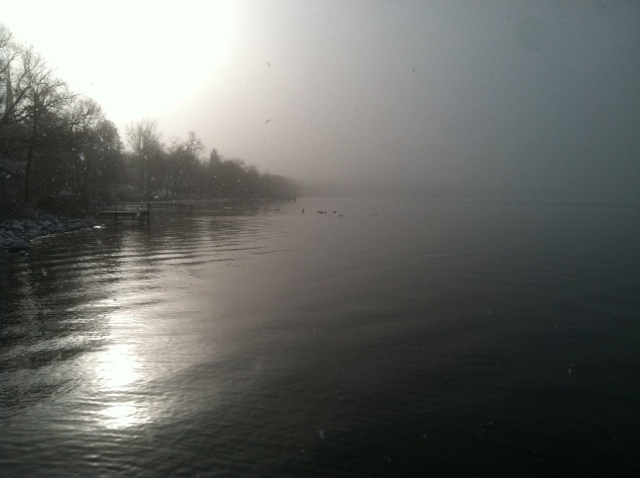
Cayuga Lake, one of upstate New York's Finger Lakes; Aurora, New York (photo by David Fernandez; Christmas, 2013)

View of Cayuga Lake, one of the Finger Lakes in upstate New York; Aurora, New York (photo by David Fernandez; Christmas, 2013)


A naturalist of the modern era—an experientially based, well-versed devotee of natural ecosystems—is ideally among the best informed of the American electorate when it comes to the potentially catastrophic environmental effects of political decisions. (Barry Lopez, “The Naturalist,” pp. 120-121 in Vintage Lopez, Random House, 2011)

One of my 2014 New Year’s resolutions is to devote a part of each day to living as a naturalist, observing all species and nonliving forms (like clouds), and reading and writing in response to those observations.  That means fieldwork first, wherever the field might be (even the corner of a bathroom if an interesting spider resides there), carrying on despite snow, rain, heat, gloom of night, and fear.

The contemporary naturalist, it has turned out—again, scientifically grounded, politically attuned, field experienced, library enriched—is no custodian of irrelevant knowledge, no mere adept differentiating among Empidonax flycathers on the wing, but a kind of citizen whose involvement in the political process, in the debates of public life, in the evolution of literature and the arts, has become crucial. (Barry Lopez, p. 121)

One can argue that we all, at every moment, have this opportunity, but we do not realize it. We are not in the naturalist’s “trance,” E. O. Wilson’s word for the observational state of mind of the naturalist.

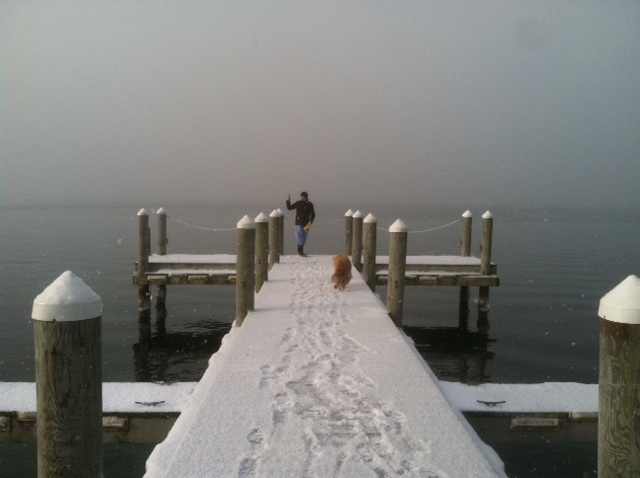
Jack and Daisy on Aurora Inn Dock (photo by David Fernandez; Christmas, 2013)

Jack and Daisy on Aurora Inn Dock (photo by David Fernandez; Christmas, 2013)


Shortly after New Year’s Day I found myself tending a house with no furnace. The house faces the western shore of Cayuga Lake in upstate New York. Like a gang of wailing banshees, the winds of the Polar Vortex  from the north swept into town, causing furnaces to fail, schools to close, and a wind chill of double digits below zero. Seven space heaters and a constant fire were keeping the house at plus/minus 52 degrees.

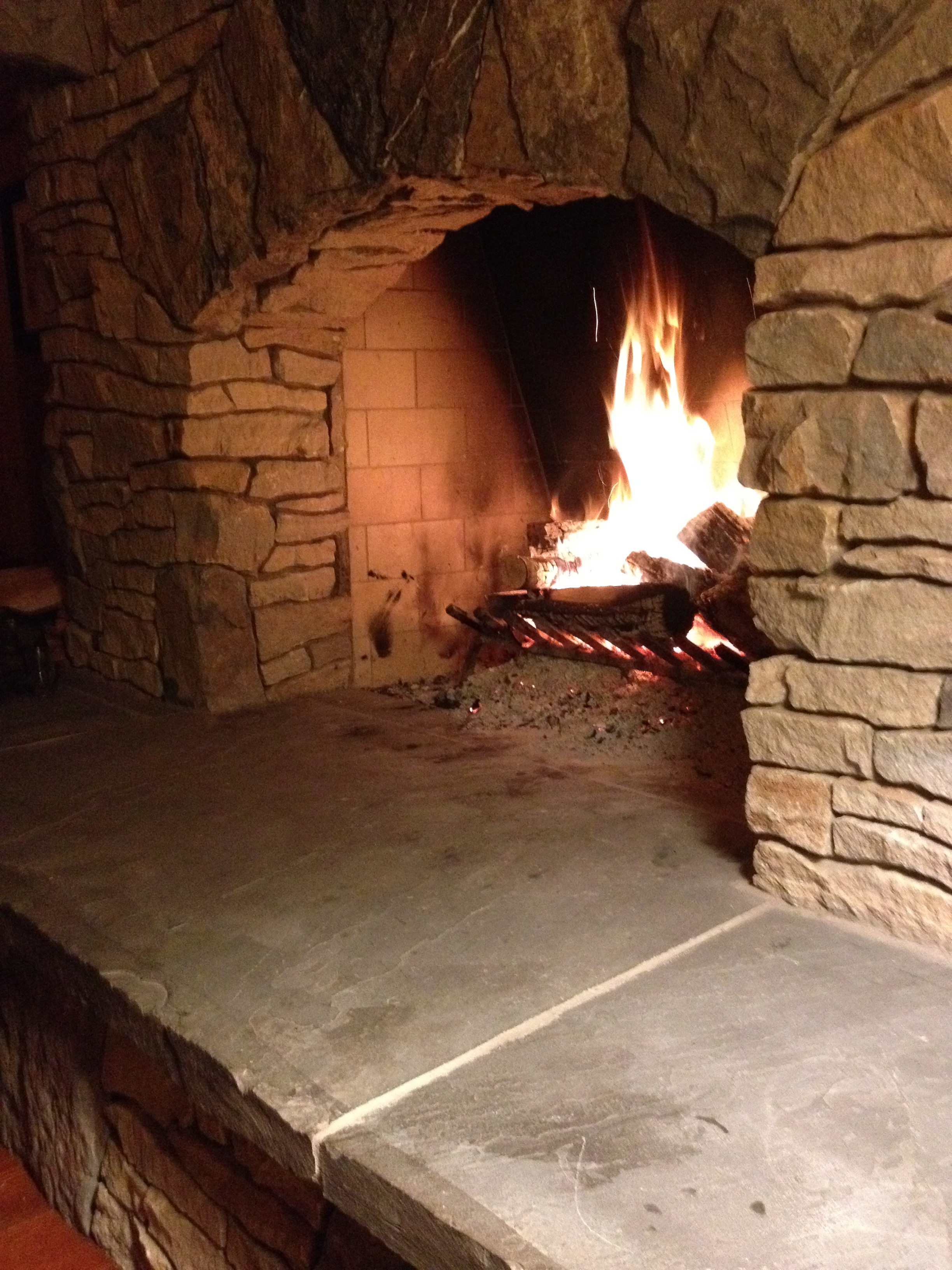
I set my chair up on the stone hearth to be as close to the fire as possible. When I felt toasted on the left side, I turned the chair the other way to warm my right side. Even with long underwear, a long woolen coat and hat, I needed to be about a foot from the fire. I had work to do, reading about bees in preparation for a submission to an upcoming anthology about pollinator decline.

Hearth with small fire

Hearth where “naturalist” hung out during Polar Vortex


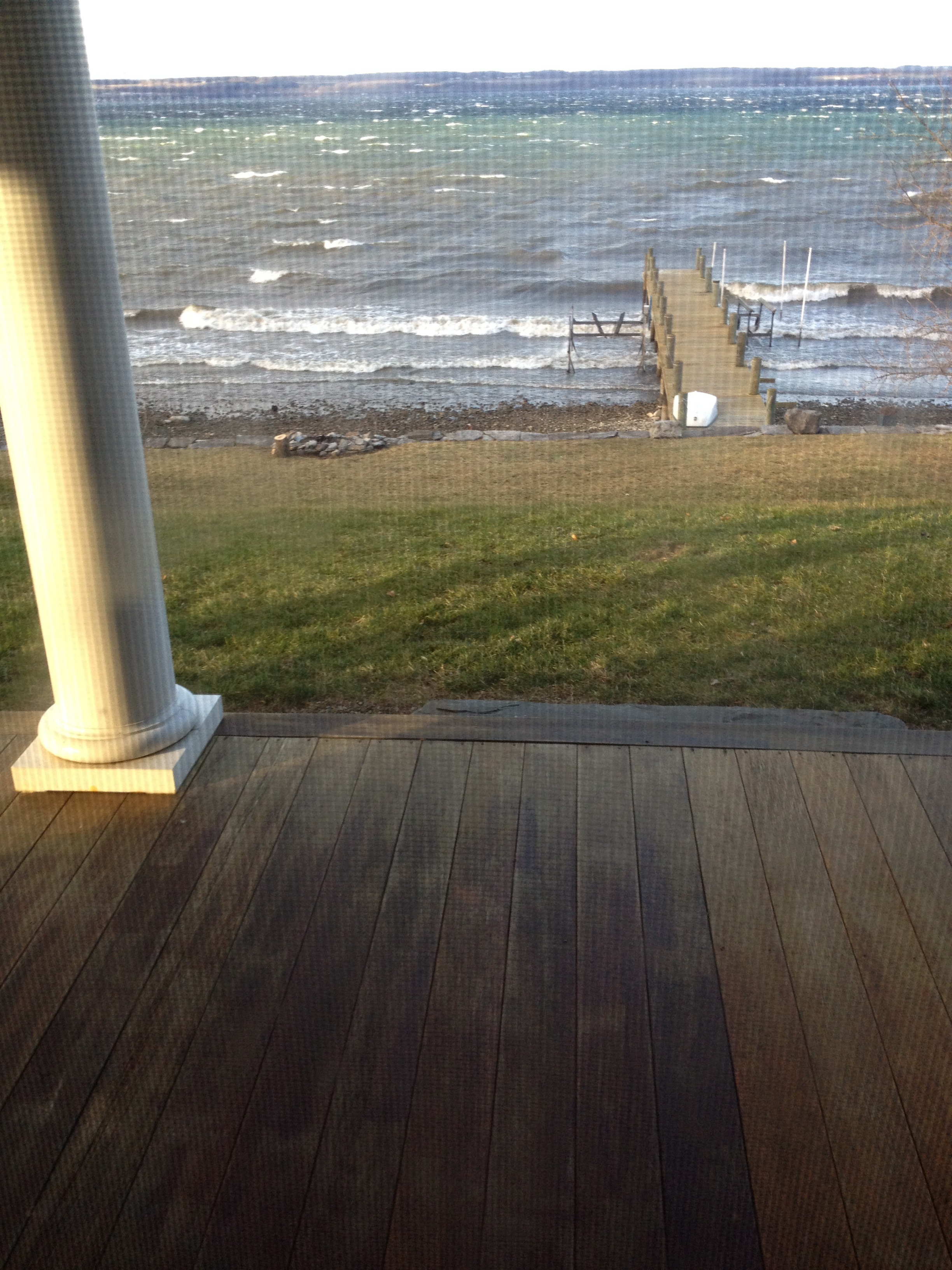
On Day 3, the furnace service technician still elsewhere (at a doctor’s office we were told), I continued my vigil, heaving wood into the fire assiduously. When toasting my left side up on the hearth, I had a good view of Cayuga Lake. Just a few weeks earlier, huge flocks of Snow Geese (called “rafts”) had settled on the lake in long, white ribbons, which parted into immense threads in the sky when they arose, alarmed by hunters’ gunshots. Now there were only two ducks, riding the tumultuous white caps side by side about two feet apart, near the dock. Although very Mallard like, their plumage was darker. I knew they were American Black Ducks (Latin species name: Anas rubripes, in French: Canard noir, in Spanish: Anade sombrio Americano). The plumage is actually dark brown, alleviated from somberness by an iridescent, violet patch (called a speculum) on the shoulder. As if sentinels or appointed companions to me, they rode the waves all afternoon within my view, side by side, until as the sun was setting they drifted under the dock, to parts unknown. The next morning the white caps had frozen into place. The ducks did not return.

Modest wintry white caps in January 2013.

Modest wintry white caps in January 2013.

The bugbear in all of this—and there is one—is the role of field experience, the degree to which the naturalist’s assessments are empirically grounded in firsthand knowledge. How much of what the contemporary naturalist claims to know about animals and the ecosystems they share with humans derives from what he has read, what he has heard, what he has seen televised? What part of what the naturalist has sworn his or her life to comes from firsthand experience, from what the body knows?  (Barry Lopez, “The Naturalist,” p. 121, Vintage Lopez)

I realize now that I failed, missing an opportunity to be a true naturalist in unusual, extreme conditions. I should have gone down to the dock, observed the American Black Ducks in the conditions that they were enduring, and photographed them. I wish I had, because I miss that particular pair.  I watched white caps pound them out of sight, but they bobbed up, again and again. American Black Ducks are “dabbling” ducks (as opposed to “diving” ducks), frequently tipping over headfirst to feed. I would distinguish their “bobbling” behavior during the winds of the Polar Vortex from what I have seen of “dabbling.” I would say it was more a matter of take-the-wave headfirst and reappear at all costs.

Cost is an important word. It “costs” in the form of energy to move any part of the body, to swim, to forage, to fly. I found a Master’s of Science thesis online entitled “Constructing a 24-hour Time-Energy Budget for American Black Ducks wintering in coastal New Jersey,”  by Orrin E. Jones III. Jones, a graduate student in Wildlife Ecology at the University of Delaware, logged in 11, 542 observations of black duck behavior to find out just how much energy it takes for an American Black Duck to get through a day and night (the DEE or daily energy expenditure). In other words, he tried to calculate their personal balance sheet for maintaining existence. Activities like flying cost a lot. A bird under stress flirts with death if stored body energy reserves cannot support the cost of flying, for example. Jones’ research was partly funded by the Black Duck Joint Venture: An International Program to Conserve the Black Duck.
I shivered just watching the ducks, moving closer to the fire each time one of the pair disappeared into a wave. Having now reassured myself about the duck’s beautiful adaptations for surviving cold weather (greasy feathers and a special countercurrent heat exchange system in their legs and feet , I know that the human being, naked in so many ways, is much more in need of sympathy in a polar vortex than a duck. However, would it be too anthropomorphic to consider that they might have been uncomfortable in duck terms? Surely, any living species can experience discomfort?

Apparently ducks are associated in many people’s minds with “silliness and humor.” Not for me. As I revisit the image in my mind of the pair of American Black Ducks bobbling in the white caps on Cayuga Lake, I think about how all species struggle with their personal balance sheet, the wonder of biological adaptation, and the pleasure of spending an afternoon en-“tranced” by a pair of ducks. I treasure Barry Lopez’s description of the naturalist. I can’t think of a better job description for every human being.

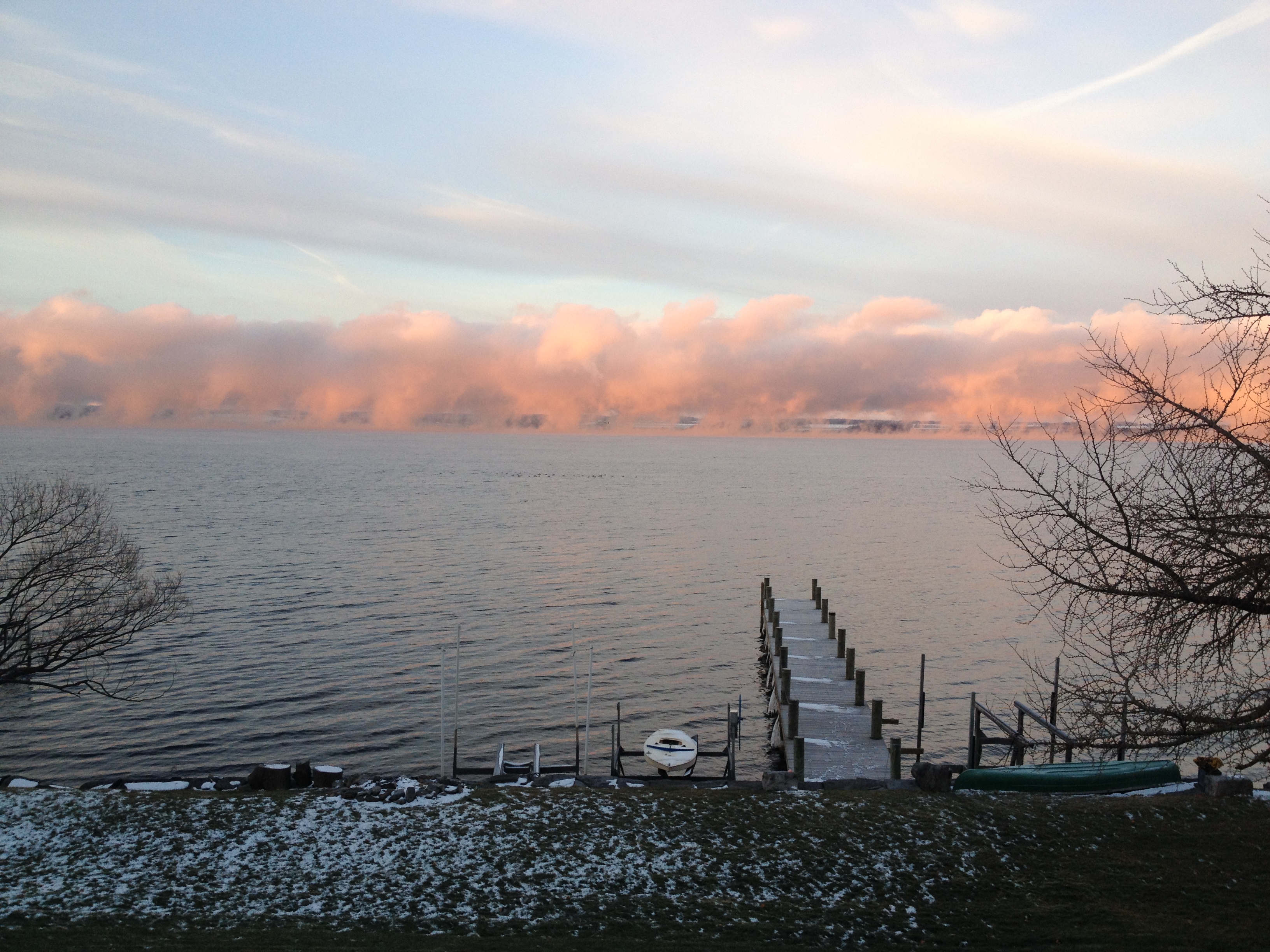
Western shore of Cayuga Lake in early morning (November 2013).

Western shore of Cayuga Lake in early morning (November 2013).


P. S. For photos of American Black Ducks “on ice,”  please visit the website of naturalist/interpreter Gerald Wykes and read his  “Naturespeak” blog post “Black Ducks on Thin Ice,” which gives information as well about their dwindling numbers. Having diverged from their “sibling” species, the Mallard, about a half million years ago, they are now converging, it seems, as a result of interbreeding. See also Gerald’s photoessay “Picture a Polar Vortex,” which shows the ferocity of the vortex and various creatures “hanging out” in it.

The Hugs

The Hugs

“It’s a pretty quiet crowd,” my husband said, surveying the many, many people waiting at JFK’s Welcome Center for their loved ones, straggling intermittently down the corridor from Baggage Claim and Customs, holding babies and wheeling suitcases, a day or so before Christmas.

“They are just tired,” I said, “as we are, aren’t we?” And we were, having driven from Ithaca in wintry rain under bleak skies through the Catskills over the George Washington Bridge into Queens, creeping for the last 40 miles.

We were late, but so was our son’s plane from Heathrow. So we wedged into position along the long rope barrier separating arriving passengers from those who waited. During the hour in which we were part of the quiet crowd, we stood behind a man with two young boys at his side. I could not identify their nationality—Israeli, Middle Eastern—I did not know. The man was slight, of medium height, his face thin, care worn, gray hair at his temples. The two young boys, seven or eight years old, fidgeted. At one point they decided to look for playthings in the pockets of his coat. He dissuaded them gently and absent mindedly, his utter distraction a deterrent to any further efforts at engaging his attention. They waited quietly. For whom was he waiting? Just when it seemed possible that loved ones would never materialize because our role was to wait endlessly, the man reached out. He grabbed the face of a man on the other side of the rope, kissed him on both cheeks, and then wrapped him arms around him in a hug, the rope still between them, their faces buried in each other’s shoulders. The hug went on forever. Forever. I looked away because it felt intrusive to continue looking at them, though only a bundle of jackets was visible, but I knew there were arms holding tightly and beating hearts nearly touching. The man who had arrived was taller; he looked better rested and nourished than the man who waited. He had a boy of about 13 with him who gazed happily at our man, who proceeded to grab this boy’s face for kisses and then embrace him in the same long hug. When the boy was released, there were tears welling out of his eyes. I could have cried. And then they left.  As we continued our wait, I wondered where the men and the boys went, in what part of the great metropolis or beyond they would eat and sleep, how they would continue going about their lives after the intensity of such hugs.

The hug is a gesture characteristic only of the human species for the most part. I carried the JFK hugs through my Christmas and into the New Year. We put up with separation, but we should not become inured to it, or at least we should fight to connect when we can. I believe I was in a position to be a proper witness because I had read this past fall Thich Nhat Hanh’s words on hugging meditation. He writes, “When we hug, our hearts connect and we know that we are not separate human beings.” This is the message of David Grossman’s new children’s book The Hug, published by Overlook Press, in which a mother hugs away her child’s feelings of estrangement. This is the message I received from standing near the hugs in JFK. Thich Nhat Hanh says that we should hug for at least three in-and-out breaths—to establish presence in the moment with the other person and connect with the Earth.

Dew drops on a tulip tree leaf.

Rain drops on a young tulip tree leaf (Ithaca, NY)

Wingstem Season in Highland County

image

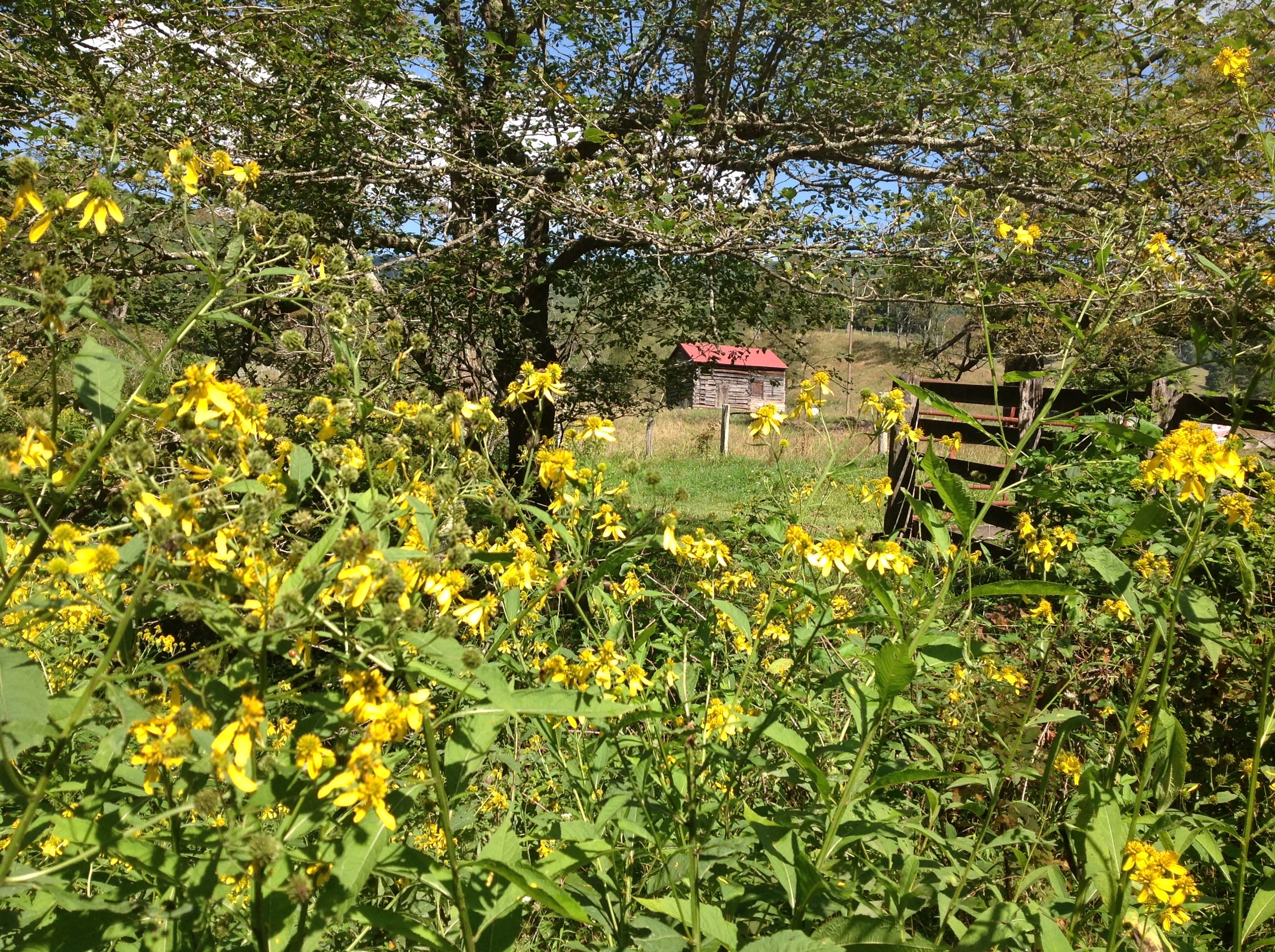
Wingstem framing view of hewn log barn in Vinegar Hollow

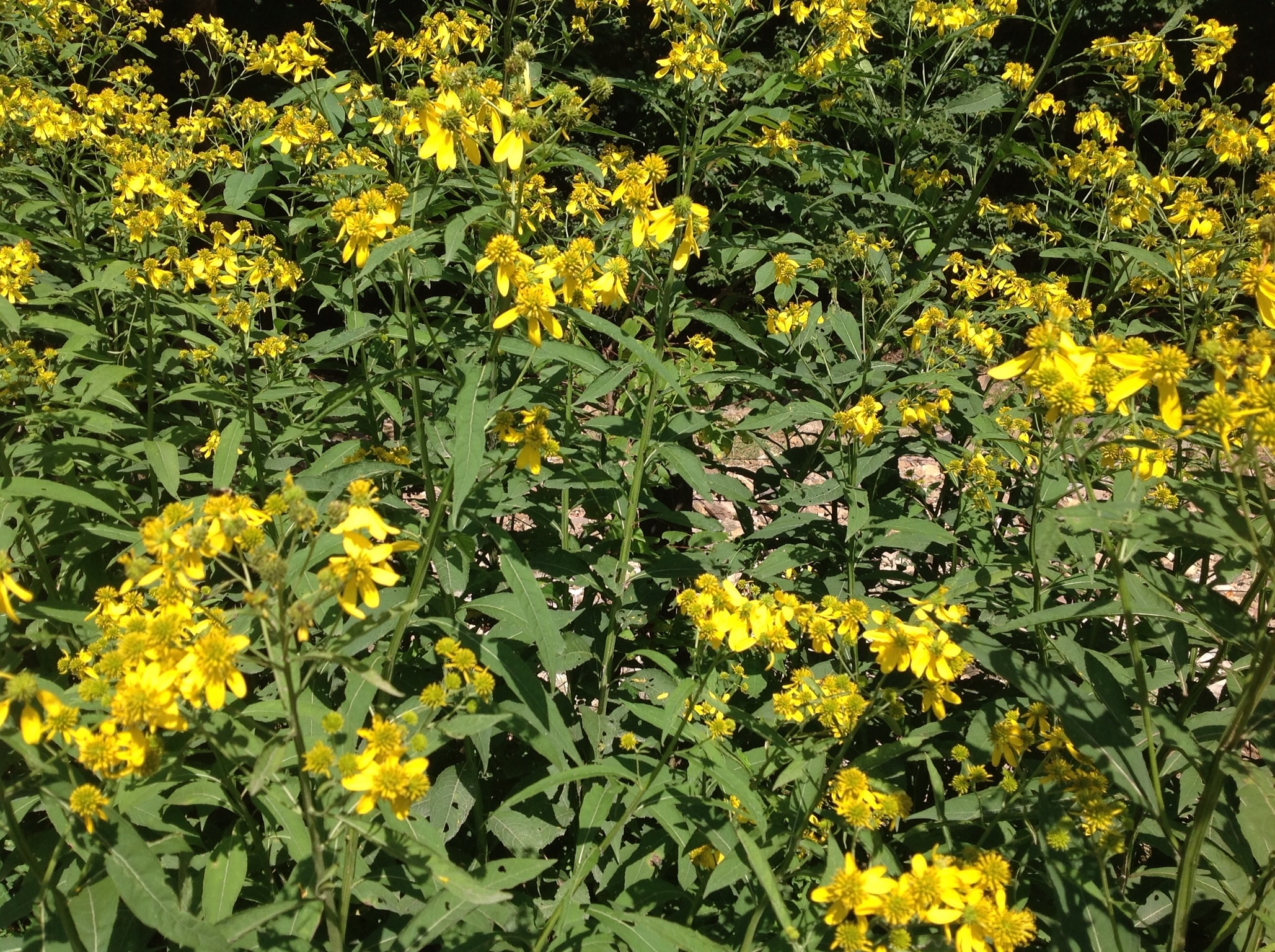
If you start following wingstem, with an intent to admire or photograph, at the end of August in Highland County, Virginia, it is hard to stop. There is always one more scenic road, one more view of hundreds of yellow petals waving haphazardly atop firm, straight stems in the sun or in a glowing shade. Tall, up to 13 feet, and unbranched, it forms dense stands in damp ditches, along waterways, and on moist hillsides. From a distance, the yellow ribbons of wingstem (Verbesina alternifolia) prominently mark changes in topography and moisture of Highland’s  five beautiful valleys.

Of course, one doesn’t necessarily follow something, unless one is fleeing another something. The last few days we have been cleaning out my parents’ old farmhouse in Vinegar Hollow, encountering mounds of dusty debris, a long-dead rodent under the icebox, many moldy, rusted things, once useful, and now difficult to salvage. It is hard to so tangibly acknowledge the termination of two passionate people’s (my parents) endeavors. So, one hits the open air and the open road to counterbalance this stressful housecleaning operation.

View of wingstem thicket

View of wingstem thicket

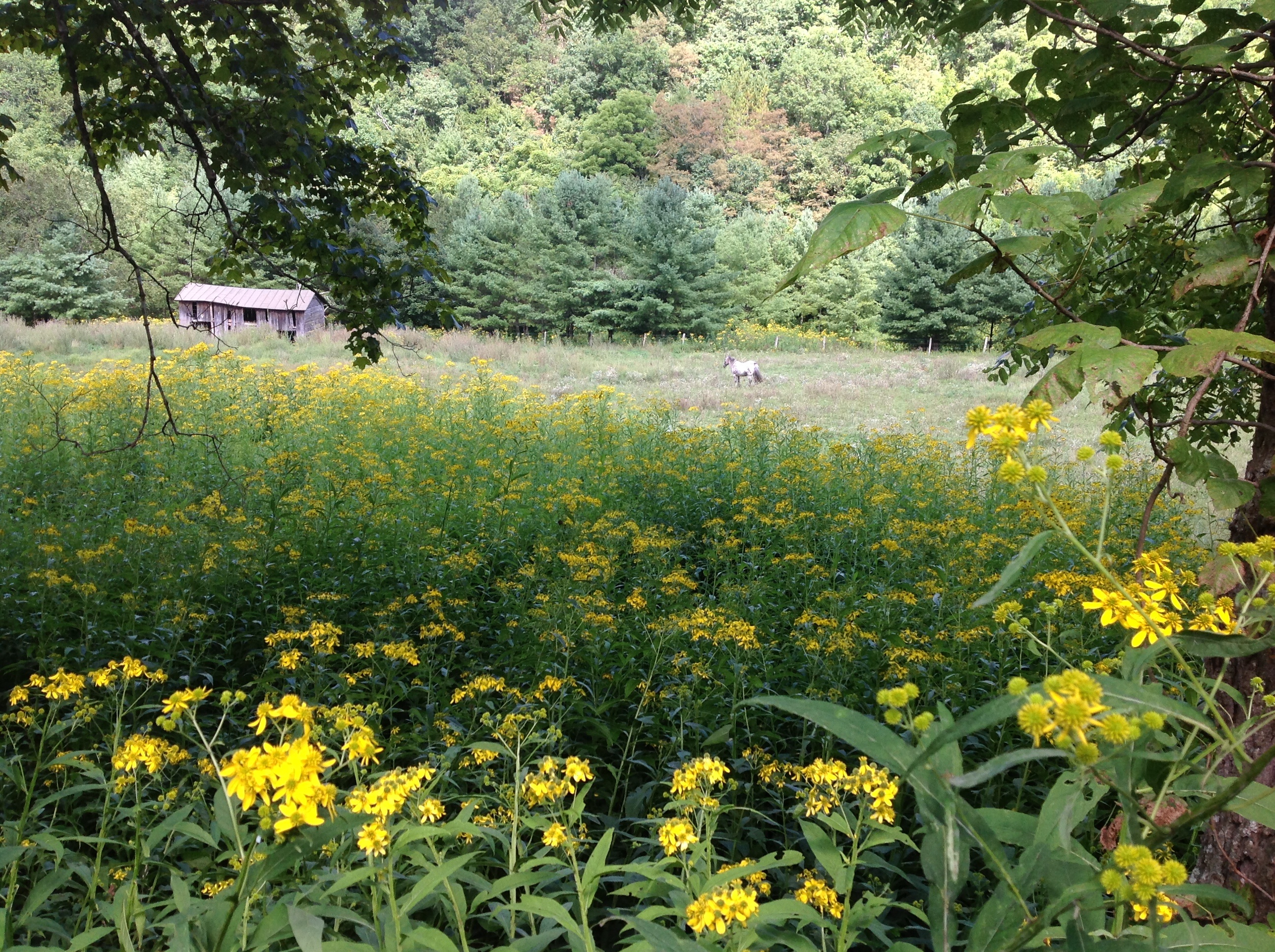
We leave the hollow, driving south on 220 toward Warm Springs. A left turn opposite Lamb’s Hollow leads us across the Jackson River, where we encounter roadsides, hillsides, and fields filled with wingstem. In one meadow along a section of the road known as Dry Branch, a dappled gray horse comes into view.

Dappled gray horse is just slightly right of center. Wingstem in the foreground.

Dappled gray horse is just slightly right of center. Wingstem in the foreground.

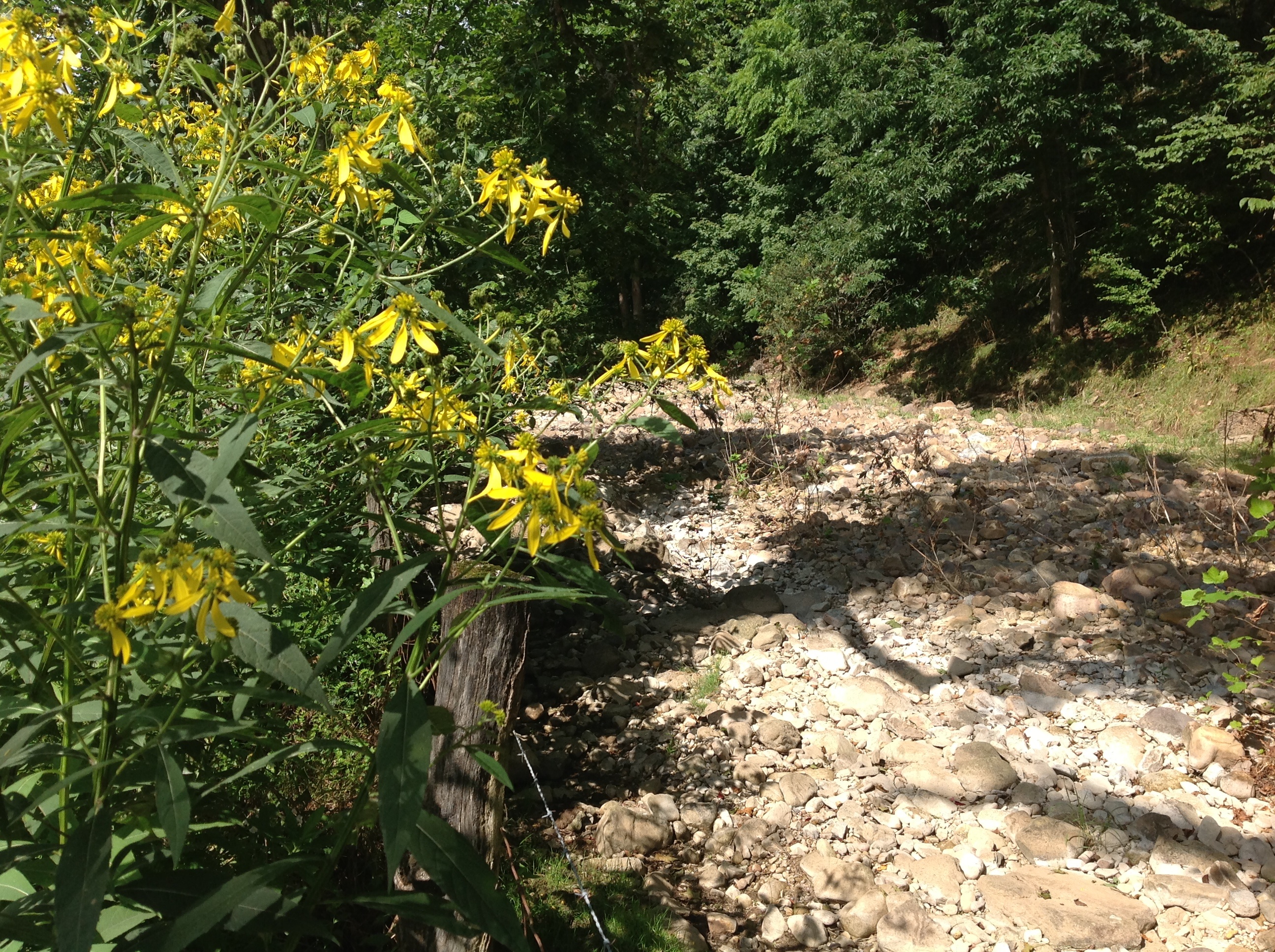
Sensing our presence, the solitary horse soon gallops away towards its barn. Dry Branch is aptly named because, although some of it has water, many parts are dry. This is limestone country, and water easily disappears into underground caves.

Wingstem alongside dry part of Dry Branch.

Wingstem alongside dry part of Dry Branch.

Wingstem, a member of the Compositae or Asteraceae (the daisy/sunflower family) is named for its wingedness. The petioles of the leaves lead into ridges, called wings, on the stems. This is not totally uncommon in plants. Burning bush, for example, bears prominent woody or corky wings on its stems. Wingstem has rough, sandpapery leaves that bear marks of numerous predators, but it outgrows all the chewers beautifully.

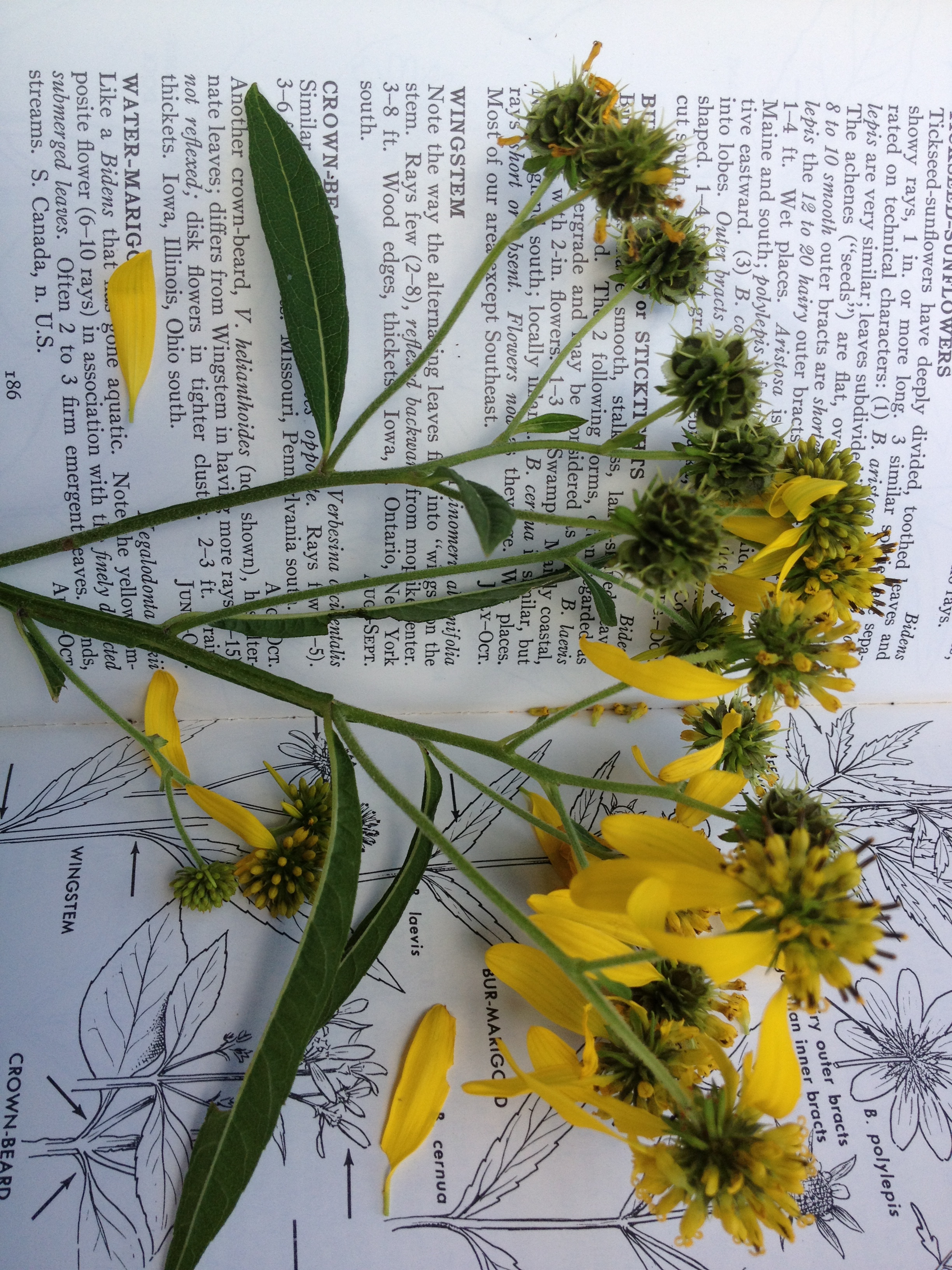
Wingstem flowers and immature fruits displayed against page from Peterson and McKenny's North American Wildflowers.

Wingstem flowers and immature fruits displayed against page from Margaret McKenny and Roger Tory Peterson’s A Field Guide to Wildflowers: Northeastern and North-central North America.

There can never be too much wingstem. Because it is so tough, so tall, and so yellow. And another admirable quality is that in the winter it vanishes, all of its abundant foliage replenishing the Earth. If only humans’ “stuff” could do so as well, vanish, without the artefacts of imperfect ownership littering the landscape.

Wet Books

Both my mothers-in-law have said, “Elizabeth, you have too many books.” Others have said it as well, but I particularly remember the comments  of my mothers-in-law. They are right, of course,….., in some sense, but I am unrepentant, …,  for the most part.

Because I have too many books, most of them are stored in the basement I share with my husband, although he does not think I am a good sharer of basement space. My husband likes a free-flowing, emptyish sort of basement, while I have thought that a basement is for storage. A bit ago I had some support from a nice electrician. He said, “What difference does it make? It’s just the basement. No one lives down here.” I will always remember his pleasent, unconcerned, unjudgemental face as he made this comment.

However, a torrential rain hit Ithaca at the end of the week of August 6, 2013. We have had basement floods in the past and thought we had all points of entry sealed, but it was not so. A river poured through the back basement (no books) into the middle basement (books) and soaked about four to five boxes that I thought were safe. (Most of my books are on shelves with feet.)

To Google I went, and typed in “how to dry out wet books” and got a nice article from the University of Maryland (I think) that said to put the books on their heads with absorbent paper underneath and blow a fan at them, something like that. Which I did, adding a powerful dehumidifier as well.

IMG_4228

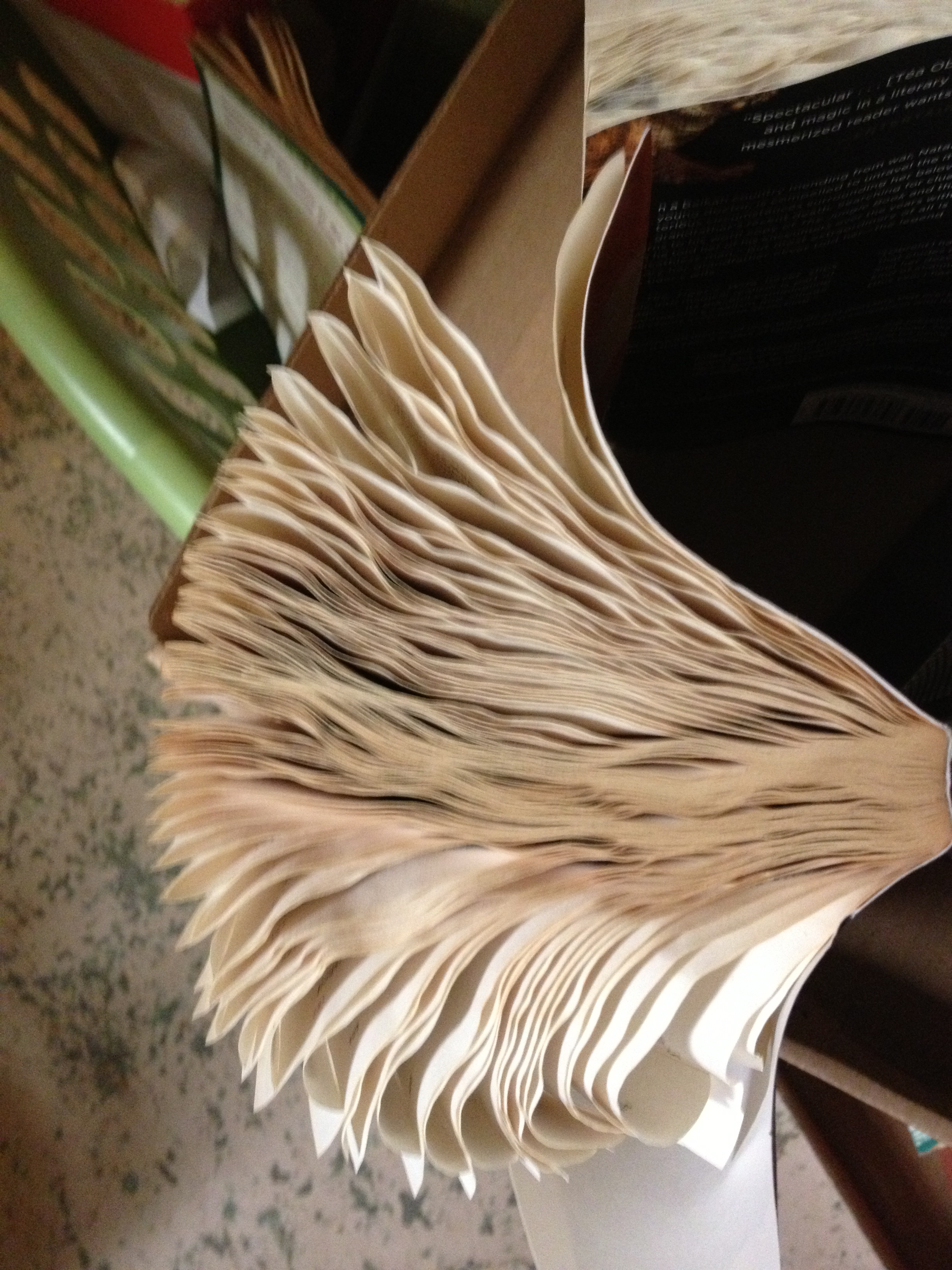
I emptied the dehumidifier repeatedly, turned the books on their other heads, and changed the scot towelling underneath. I made some progress. The pages gradually dried and fanned out, like the gills of a mushroom.

IMG_4229

My daughter came home from a long trip and suggested I try the sun. I pointed out that the weather in Ithaca had not been reliable, as storms would come up out of the blue letting loose further torrential rains, but I followed her advice.

Wet books in sun on terrace by door to basement

I realized as I carried the books up and down the stairs, thinking about digital books all the time, that I value my tangible books despite the energy I spend in their upkeep. I value their presence–the titles on the spines, the words and the stories and the images that they hold, and the space they take up in my basement and my life. Books have been the only friends I can lean on with total freedom in times of loneliness, stress, and happiness. I do have human friends, but they have their problems as well, and I am loathe to add my burdens to theirs. Why not seek a book, even if not to read it, but dry it out?

The flood particularly hit some of my cricket song books and John Daniel’s Winter Creek: One Writer’s Natural History, which I will be reading once again with my Writing as a Naturalist students soon. I am particularly happy to be reunited with my books about cricket songs, e.g., Cricket Radio by John Himmelman, because it is that time of year when crickets announce the end of summer with that hum, the zzz-zzz-zzz’s of which make me happy and sad at the same time. As I was thinking about my wet cricket song books, which are proving the hardest to dry out because of the glossy full-color photographs, I stumbled on a posting in the Music Blog of the Guardian (UK) titled “Andrew Bird’s Sonic Arboretum reminds me of the natural music we are losing: music of the fields and the woodlands, the lapwings and bunting, is giving way to the sounds of the city, the new housing estates, the motorways” by Laura Barton. Composer Andrew Bird uses natural sounds he has heard on his Illinois farm to inspire his compositions and musical installations.

Wet books in the sun.

Wet books in the sun.

Having left my still wet books in front of the dehumidifier in Ithaca and transported myself to Vinegar Hollow in Highland County, I am tuning in to my own cricket radio, thinking about the wonderful little musicians rubbing their wings together to make August’s gentle hum.

Pages from The Songs of Insects by Wil Hershberger and Lang Elliott

Pages from The Songs of Insects by Wil Hershberger and Lang Elliott

What a pleasure to dive into books about crickets–I hear better after reading. So, I plan to give all my dried out books center stage for a while. They are twice as big, the surfaces of the pages wavy, crinkley, and wrinkley, and I will read or reread as the case may be with greater insistence and diligence.
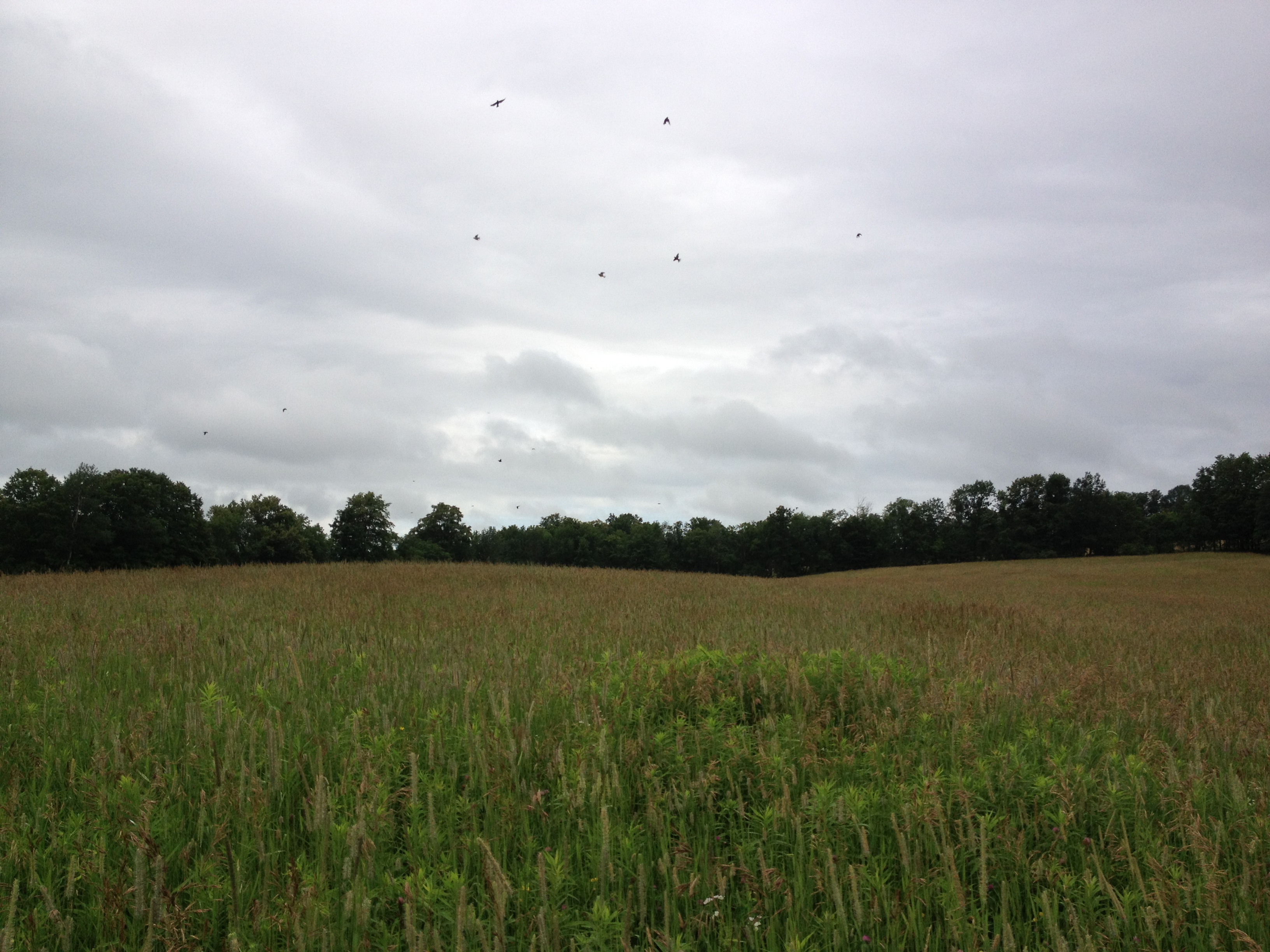
Bobolink Alley

Bobolinks. At first it was just a passing acquaintanceship. After all, they are birds, flying by quickly. But now, having spent time in Bobolink Alley and surrounding hayfields, I have become charmed by everything about them, the fact of their bobolinkishness, and, I, a forlorn lover, am mourning their imminent departure for Bolivia, Paraguay, or Argentina.IMG_3873
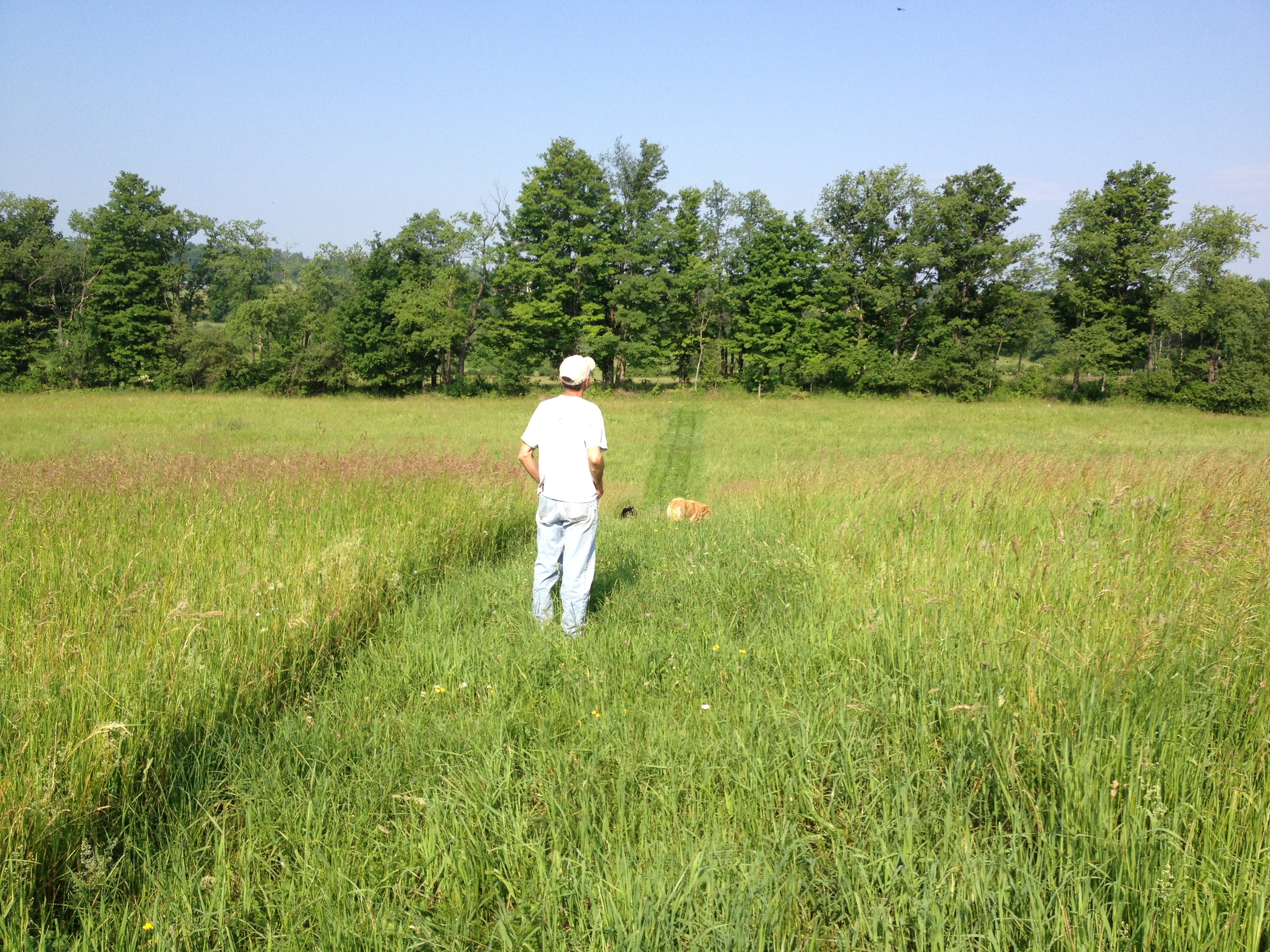
Like the bobolinks, I am migratory, returning to home territory in Highland County, Virginia. When I am gone, my husband David spends his evenings vegetable gardening, seeing friends, mowing, and bird-watching from a chair in a hedgerow in some hayfields we newly own, which we call Seven Fields. So, I first heard about bobolinks on the telephone. David would rave on about the numbers of bobolinks in the hayfields in Enfield, near Ithaca, and what he was learning about their endangered status. Since then we have discovered that our hayfields are natal territory to a significant number of bobolinks. Watching bobolinks from a distance, even with binoculars, is difficult. They are the usual songbird size, 7”-8” long, and whirl and swirl about with the typical fleetness of such birds, i.e., they don’t pause in prolonged introspection like a great blue heron. David decided to mow a walkway through the middle of the largest, most open of the hayfields in order to observe them more closely.  This walkway is Bobolink Alley.

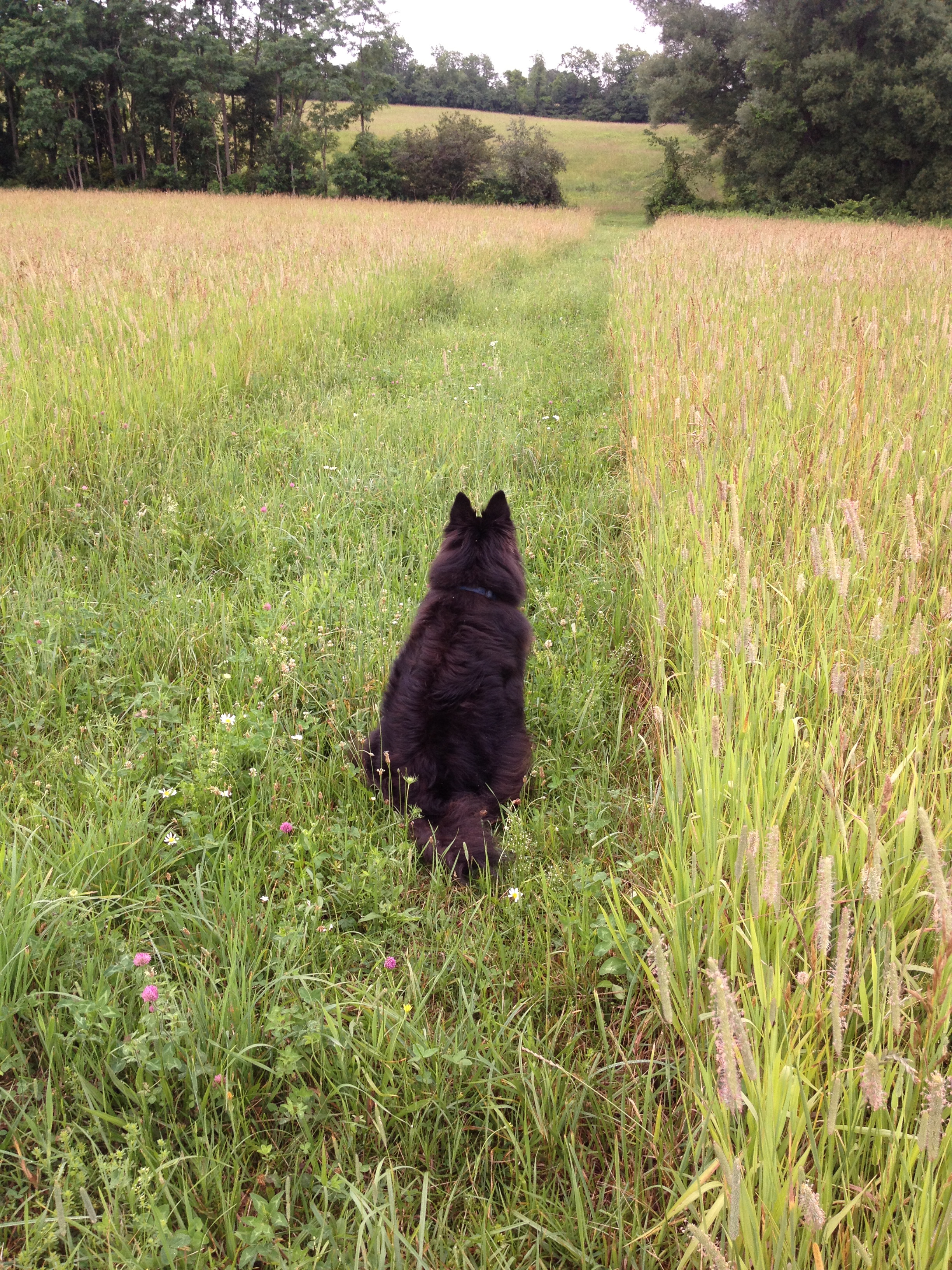
David, Belle (black speck), and Daisy (Jack's dog) in Bobolink Alley

David, Belle (black speck), and Daisy (Jack’s dog) in Bobolink Alley

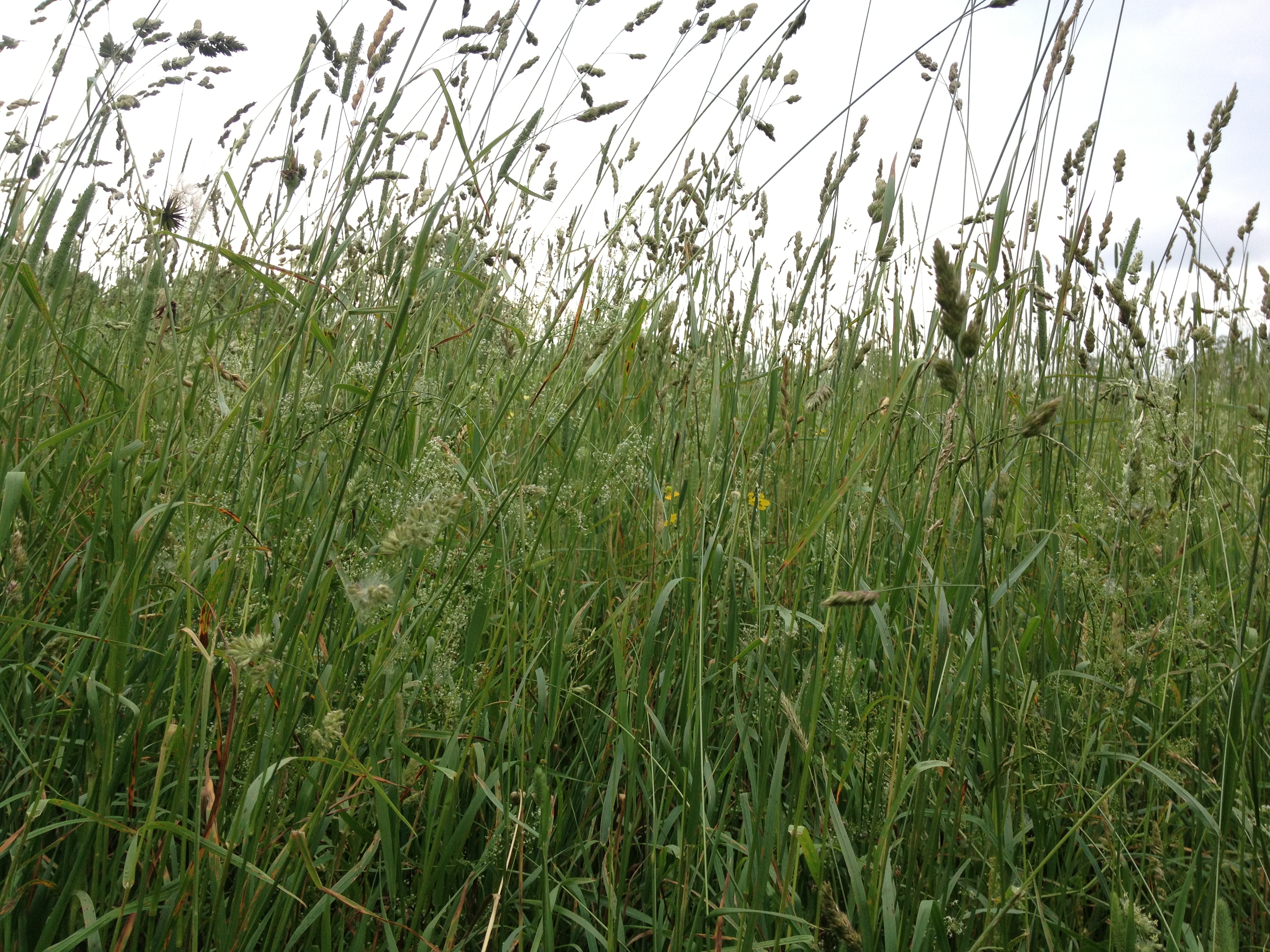
It is not easy to “get up close and personal” with a bobolink. Bobolinks nest on the ground in the dense undergrowth of hayfields. A hayfield can look serene, a sea of gently waving grasses, but if I make a little noise walking down Bobolink Alley with Belle the dog, suddenly dozens of bobolinks fluff out of the field, swirl and circle to assess the danger, before settling down, invisible once again. They are social and live in loose groups called chains (e.g., like a herd of elephants). The males are polygamous, deigning only to feed the young of their primary female, but other members of the chain help in feeding the young that are not their own.

My husband and I want to keep track of progress in these invisible bobolink nurseries in order to allow the nesting and fledging to proceed without harm. Bobolinks arrive in northern North America and Canada in May. About nine weeks later, mid-July, after fledging their young, they start their journey back to wintering grounds, the pampas of South America. This life cycle is at odds with recent agricultural practices of haying much earlier than in the early 1900s, to reap high-nutrient hay and to harvest several times a season. Mowing too early means loss of nests with eggs; mowing not at all means loss of the only habitat for which they are adapted to build nests. They need grassland. Not shrubland, nor brushland. The Bobolink Project, subtitled “Helping Farmers Protect Grassland Birds,” has organized for the purpose of mediating a compromise between the needs of farmers and the needs of bobolinks.[i]

The bobolink has been called the upside-down bird because of the noteworthy nature of the male’s mating attire. Unlike most North American birds, which are dark on top and light underneath, the mating male bobolink has a dark belly and a prominent “buffy yellow” patch on the back of the head and several bright white patches on the upper wings. While some commentators, like Professor David Spector, author of “Bobolinks: The Poets’ ‘Rowdy Bird’’ has called the attire a “clownish plumage,”[ii] I think that I might make the analogy to P. G. Wodehouse’s young men in love, who often present themselves in a whimsical sartorial manner (e.g., Young Men in Spats).  Certainly not classically beautiful like a bluebird, but distinctively bobolinkish. The female bobolink is described as a “buffy yellow brown” (musicofnature.org) or “large pale grassland sparrow” (Spector). “Buffy” seems a word that describers of birds use very freely. I would describe the female as being various shades of medium brown. I would say that the male’s yellow head patch, which is somewhat like the human Mohawk hairstyle, is cream yellow, not buffy yellow! The feathers seem to stick straight up, and the shape of the patch on the rear half of the head is odd.

IMG_3853

(On the subject of buffyness, I may be amiss. I have never observed a dead specimen closely, which is not a bad thing of course, but it is hard to evaluate the color of feathers from a great distance [which is why Audubon shot the birds he wished to paint]. I decide to check out the great bird song musicologist F. Schuyler Mathews, a source I greatly respect. While his major focus is bird song as music, he does describe the physical attributes of the birds. I find that he uses the words buff and buffy to describe both male and female bobolinks.[iii] He says the male’s head patch is “corn-yellow” and the middle of the back is  “cream-buff” and the female is “brown streaked with buff above” and the “head [is] dark sepia with a central line of green-buff; lower parts pale yellowish buff graded to buff-white”! I take back what I said. The word “buff” or “buffy” is used extensively to describe birds. I have been a plant watcher all my life, rather than a bird watcher, and buff and buffy are rarely if ever used in plant description. However—my husband and I once had an argument about the color of meadows in Highland County in winter sunlight. I said the meadows were tawny [meaning lion-colored] and he said they were dun, a word that sounded a little blah, depressing, and unevocative to me.]

The polygamous habit of the male bobolink necessitates a lot of energetic behavior. A pair of males will erupt out of a quiet hayfield for a competitive chase, settle down, and then erupt all over again, and again, and so on. Professor Spector writes that “A careful study of a meadow with displaying male bobolinks can provide occasional glimpses of [William Cullen] Bryant’s ‘modest and shy’ female that resembles a large, pale, grassland sparrow. She is all business, with no amusing antics. The male, too, of course, is all business, with his plumage, song, and display suited to attracting females—not to amusing us. The humor and clownishness we see is our perception, not hers.” One wonders about the female bobolink’s powers of perception. What does she perceive when she is not the primary female? But perhaps she is the primary female for another male, while being an accessory female for a different male? I am sure that there have been many studies of the mating behavior of bobolinks and it is all very interesting and complicated. But the difficulties of collecting accurate data about who is mating with whom in the bottom of a dense hayfield must be enormous!

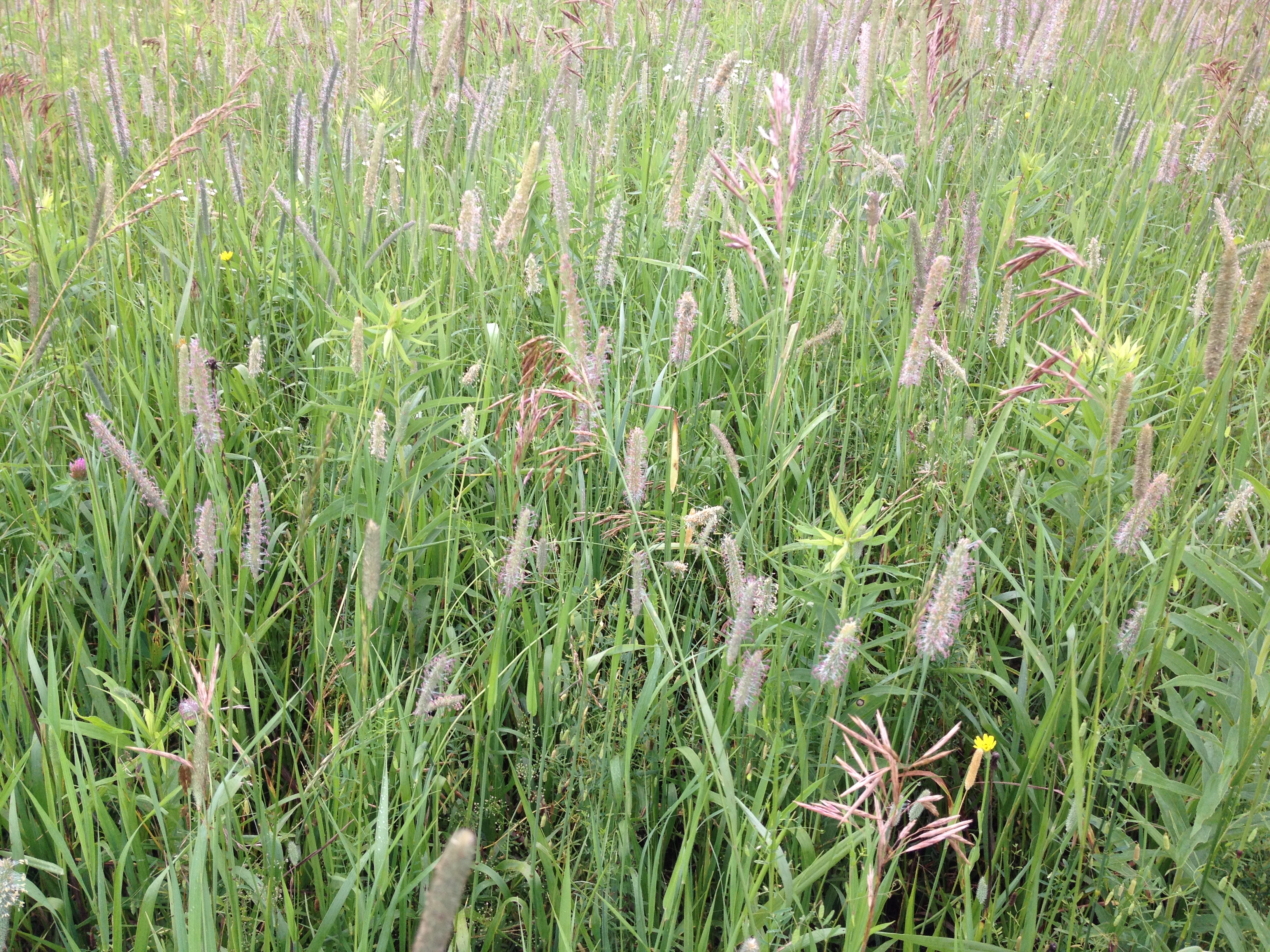
Dense hayfield in which much is going on that is invisible to the human eye.

Dense hayfield in which much is going on that is invisible to the human eye.

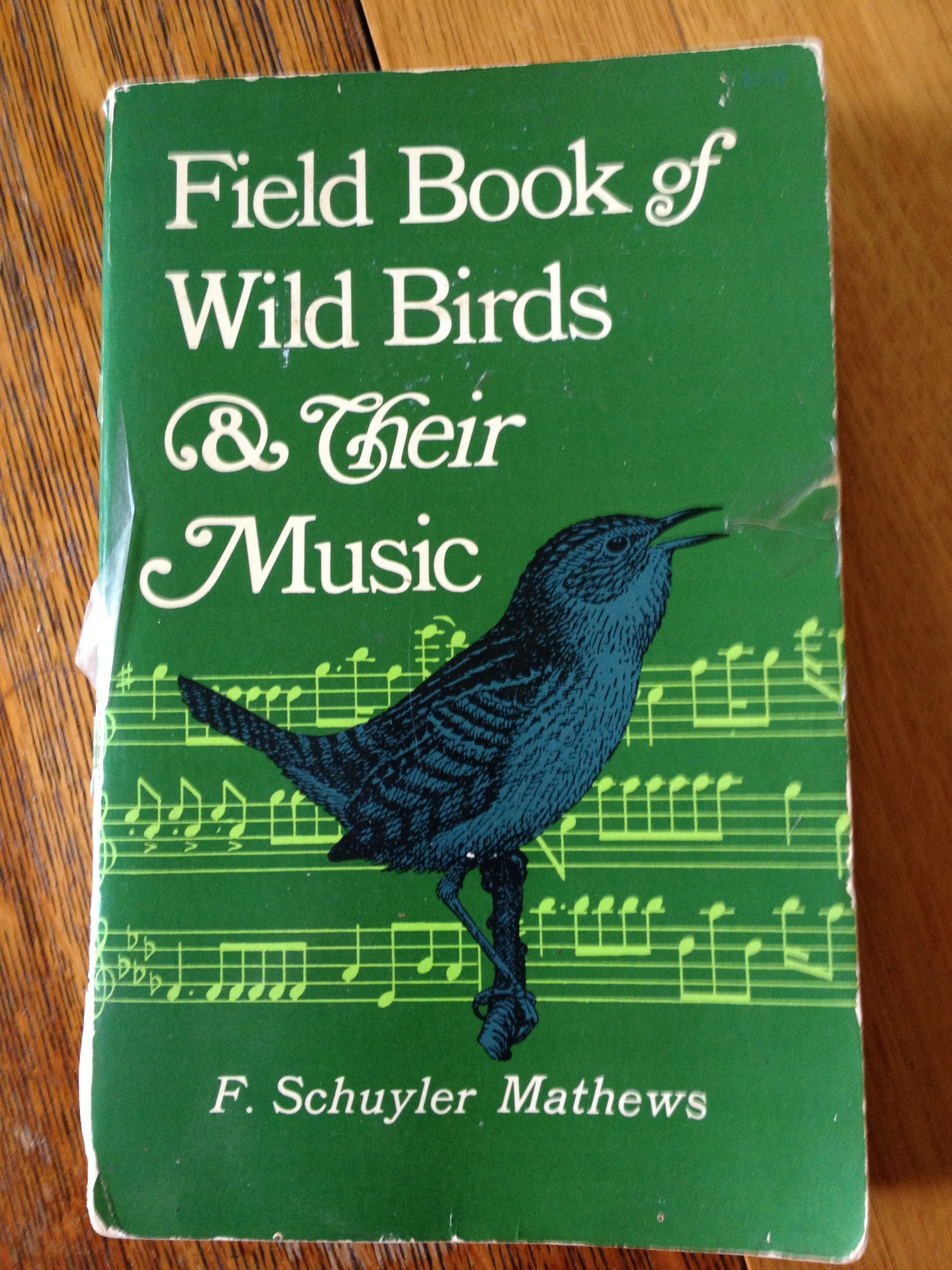
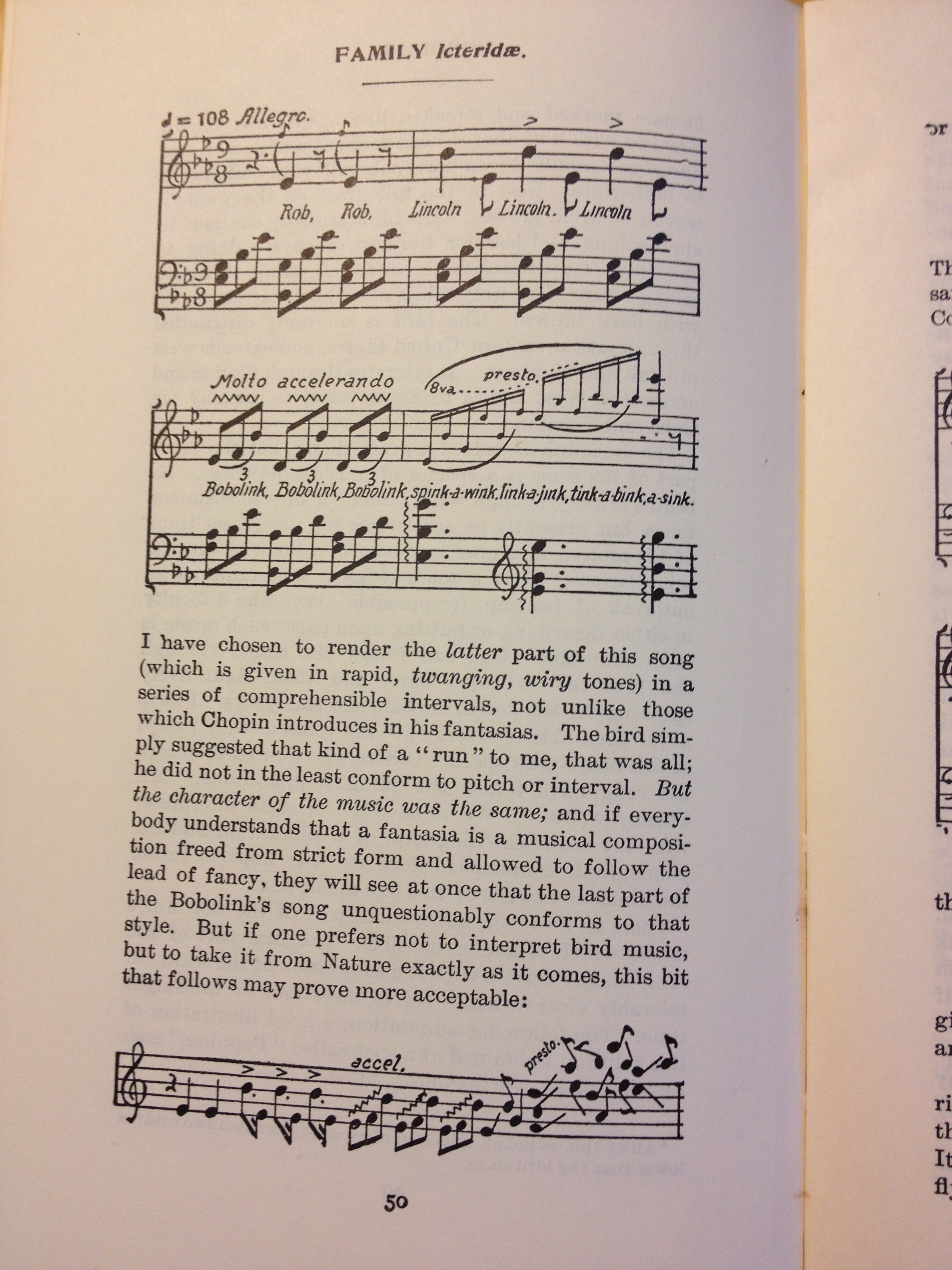
Male bobolinks can sing. Ecstatically. F. Schuyler Mathews, the bird song musicologist I referred to above, writes that “The Bobolink is indeed a great singer, but the latter part of his song is a species of musical fireworks. He begins bravely enough with a number of well-sustained tones, but presently he accelerates his time, loses track of his motive, and goes to pieces in a burst of musical scintillations. It is a mad, reckless song-fantasia, an outbreak of pent-up, irrepressible glee” (p. 49, Dover edition).  Another description of its song is “a bubbling delirium of ecstatic music that flows from the gifted throat of the bird like sparkling champagne” (musicofnature.org). The human ear can hardly comprehend the sequence of sounds.  I stood in Bobolink Alley a few days ago as a male flew around me. As he flew I turned, and as I turned he circled. Soon I was dizzy. Perhaps that’s the best way to “see” a bobolink, like a spinning top, the scents of the grasses, the clover, the milkweed, the teasel, the vetches, all of it mingling with the male bobolink’s exuberance.

IMG_3649

Mathews compares male bobolink’s song to Chopin!

I am always remembering connections to my natal territory in Vinegar Hollow. Bobolinks are related to red-winged blackbirds and meadowlarks, birds that also nest on the ground in hayfields. Once my father came rushing from the orchard meadow, his face solemn and concerned. “Elizabeth,” he said, “come with me. I have something to show you.” I was known, as a young girl, as the resident naturalist. He brought me to Roy, the mower, who stood looking at a patch on the ground. It was a meadowlark’s nest that had been chomped by the blades of the tractor. Some of the eggs lay smashed, oozing yellow yolk. What could I do? I realized that they wanted me to help by witnessing and mourning the destruction of the nest and the distress of the mother circling overhead.

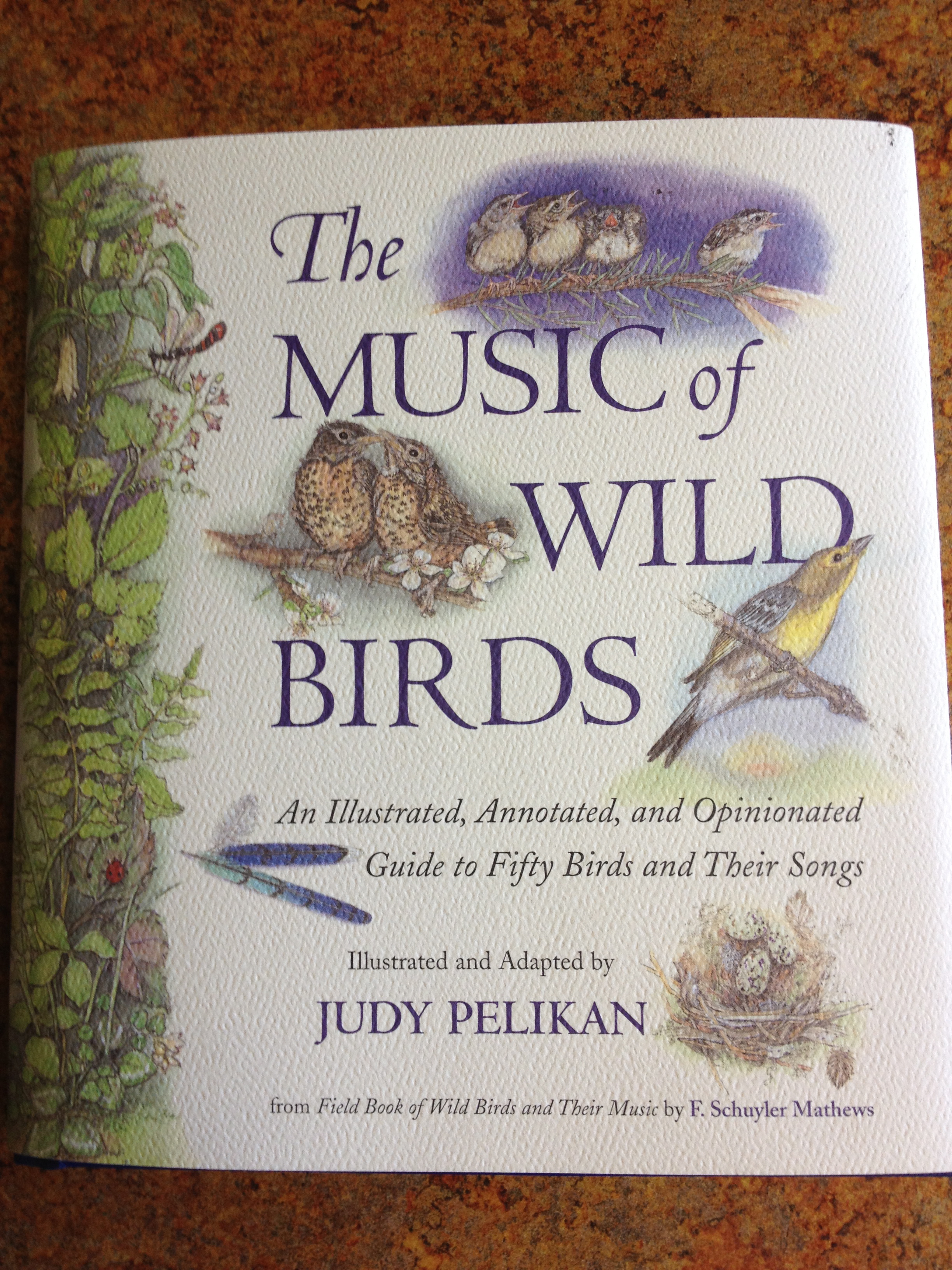
So, a mower at Seven Fields is standing ready, and the bobolinks are about to leave on an incredible journey. It has been recorded that one female bobolink travelled 1,100 miles  in one day (wiki). They will come back next May after a 12,5000 mile round trip. I hope. My husband has pointed out to me that they have a characteristic, and unusual, flying style. While most birds flap their wings in a near 180 degree arc, bobolinks never (rarely?) raise their wings above the plane of their body, creating a 90 degree arc.  F. Schuyler Mathews is critical of this flying style: “The Bobolink is a distinctive meadow character. He rises from the grass with a great deal more wing-action than the shortness of his flight would seem to demand. It is evident by the constant flipping of the wings that flying is an effort with him, where it is not effort at all with the Barn Swallow. Perhaps his constant foraging in the meadow grass has put him out of practice on the wing” (51-51). Mathews suggests that proof of their shaky flying is that they take the shortest route to South America, hugging land, Cuba and the Yucatan, rather than going over the ocean! Mathews is known for being opinionated, but this criticism is going too far!! Judy Pelikan has illustrated an expurgated version of F. Schuyler Mathews’ original Field Book, published in 2004 by Algonquin Press.

Beautifully illustrated (and expurgated) edition of Mathews' text.

Beautifully illustrated (and expurgated) edition of Mathews’ text.

Bobolinks will be called by other names in different places on their journey:  ricebirds in the South where they are shot for their love of rice, and butterbirds in Jamaica where they are eaten because they have gotten fat on rice. Sympathetic sorts, like poets, write about bobolinks, rather than shooting or eating them. Emily Dickinson observed bobolinks in the hayfields around her home in New England (“the Bobolink is gone, the Rowdy of the Meadow”)[iv]and Gertrude Stein, who wintered in South America, made an enigmatic reference to bobolinks in her famous poem “Susie Asado,” a tribute to a flamenco dancer (which made her lover Alice jealous).[v] The line is “a bobolink is pins,” which is not supposed to make any literal sense, but rather musical sense. The entire poem is aflash with “musical scintillations,” to use Mathews’ phrase about the male bobolink’s song. The poem is almost meant to be read as a bird song.

Fledglings in the sky.

Fledglings in the sky.

I want to be sure that the bobolinks are really ready. My husband and I have sighted groups of fledglings, intermingled young redwing blackbirds and young bobolinks, flitting to the hedgerows, but they are still descending to nestle in their invisible homes in the central parts of the hayfields in the evening. I am worried they don’t want to leave.

Bobolinks: listen for the mower and go.

Belle the dog in Bobolink Alley.

Belle the dog in Bobolink Alley.


[ii] Available online, published in the Daily Hampshire Gazette, a column entitled “Earth Matters,” a biweekly column from the Hitchcock Center for the Environment.

[iii] Field Book of Wild Birds and their Music (1909), Dover edition.

[iv] See reference in footnote 2.