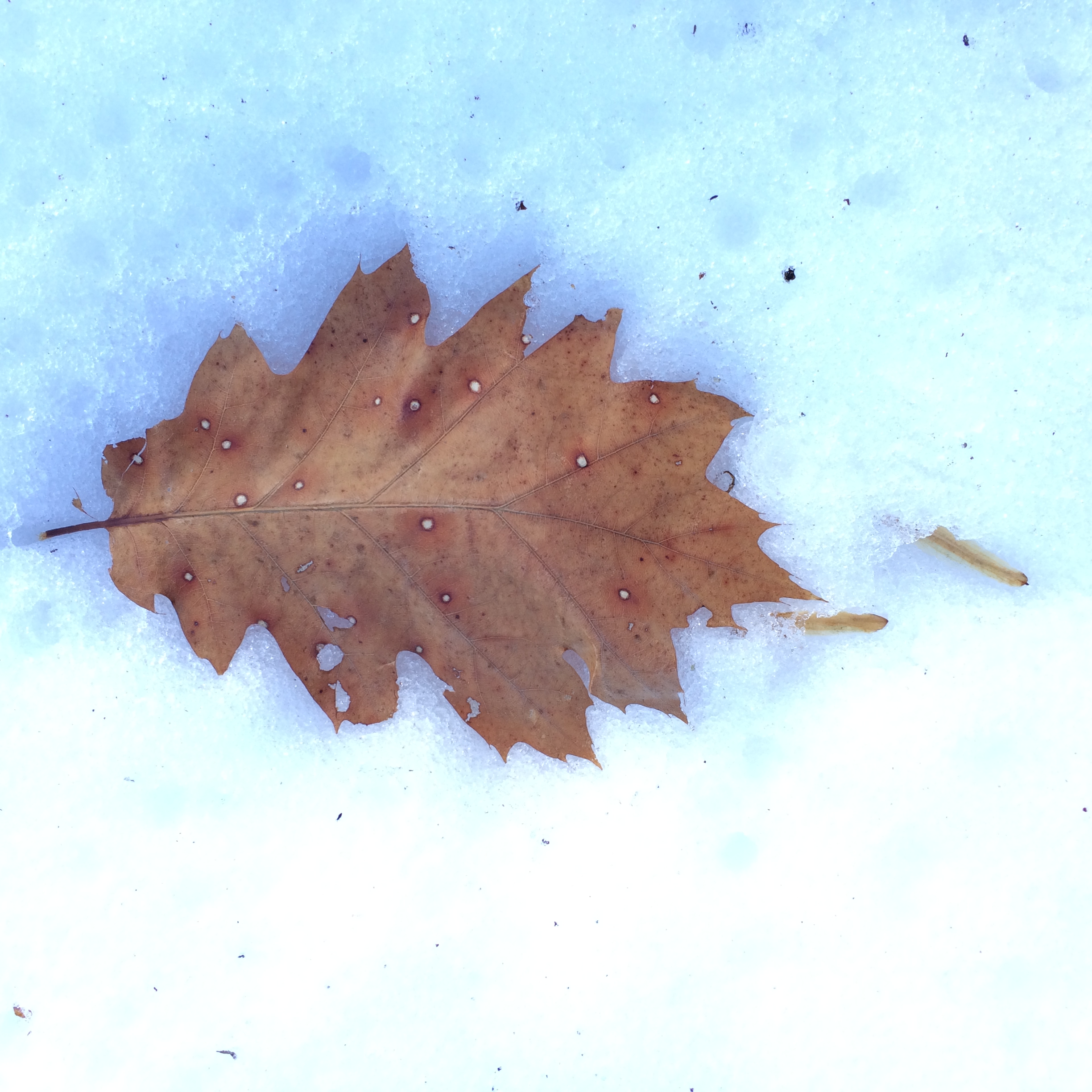
Where have all the flowers gone–and their Monarchs?

IMG_4847

Monarch visiting thistle in Vinegar Hollow, Highland County, Virginia.


It’s a lonely fall for those of us who love being observers of the annual migration of monarch butterflies (Danaus plexippus) back to Mexico, a 3,000-mile journey that is breathtaking for its scope and its beauty. If we could connect all the dots of all the trajectories and innumerable stops for nectar to fuel the journey, we would see a pattern, a living tapestry, so instructive of the importance of thinking ecologically.

I have recently been migrating myself, from Ithaca, New York to Harrisville, New Hampshire, back to Ithaca, and now south to western Virginia. Having heard that a 90% decline in migratory numbers was predicted for this fall, I have been looking for monarchs in old and new haunts. In Harrisville, I saw one monarch, in Ithaca three, and one in Vinegar Hollow. In past years,  significant numbers have accompanied me on my daily dog-walking rambles. Being with them, admiring their determined, zig-zaggy flitting, from blossom to blossom, I have felt part of the hero’s journey, the voyage home, a mythology rooted in biology.

Monarch on Verbena bonariensis in my garden in Ithaca, NY.

Monarch on Verbena bonariensis in my garden in Ithaca, NY.

Monarch visiting Verbena bonariensis in my garden in Ithaca, NY.

Underside wings of monarch still visiting Verbena bonariensis. It’s easier to write about monarchs than to photograph them, which is a dizzying experience.

The media have documented the decline in monarch numbers more authoritatively. The figure given since January 2014 is a 90% decline. For graphs, see the website of the Xerces Society for Invertebrate Conservation and an article in the Washington Post by Brad Plummer. Plummer reports a conversation with Lincoln Brower of Sweet Briar College, one of the world’s foremost monarch experts, who outlines three causes for the decline:  deforestation in Mexico, severe weather issues (e.g., the 2013 drought in Texas), and herbicide-based agriculture. I remember a lecture given by Brower at Cornell a few years ago, in which he noted that efforts to create a monarch reserve in Mexico had in fact led to more poaching by illegal loggers than before its creation. All monarchs have to fly through Texas, so not much can be done to prevent a decline due to drought. It is important to know, however, that monarchs flying south need to feed heavily on nectar, some of which they store for use during the winter “hibernation.”  You might say that blossoms are their gas stations. The issue of herbicide-ready agriculture is big and contentious.

Citing the figure of a 97% decline, Richard Coniff in a post on his “Strange Behaviors” blog is pointed in stating that it’s now a question of Monsanto vs. the Monarchs. Since Monsanto developed Round-up ready soybean and corn seed in the 1990s, the widespread of this seed, which enables large-scale herbicide spraying, in the Midwest has wrecked havoc with the life-supporting patchwork of milkweed species hanging out here and there in fields and along roadsides. It takes four generations of monarchs to hatch and breed and feed on milkweed foliage, on their way across the United States to Canada. Milkweed species are said to show a 67% decline in numbers.

Coniff notes that farmers are not the problem and believes that Monsanto has the money to establish milkweed-friendly zones around agricultural fields. Apparently Monsanto is presently studying whether the fear of monarch extinction is legitimate, and whether it wishes to be part of conservation efforts.

We can all plant milkweeds. There are 110-120 species, of which 32 are particularly helpful for monarchs. Coniff offers a link to supplier of milkweed seeds and plants. Milkweeds in themselves are a wonderful group of plants with a  unique floral structure (see this additional Xerces posting) (and this one showing the common milkweed [Asclepias syriaca]), complete with horns, hoods, and corpuscula. Many of us in the northeast know the common milkweed, its fleshy, drooping, dusty-rose flowers, hypnotically scented, but there are many other milkweed species
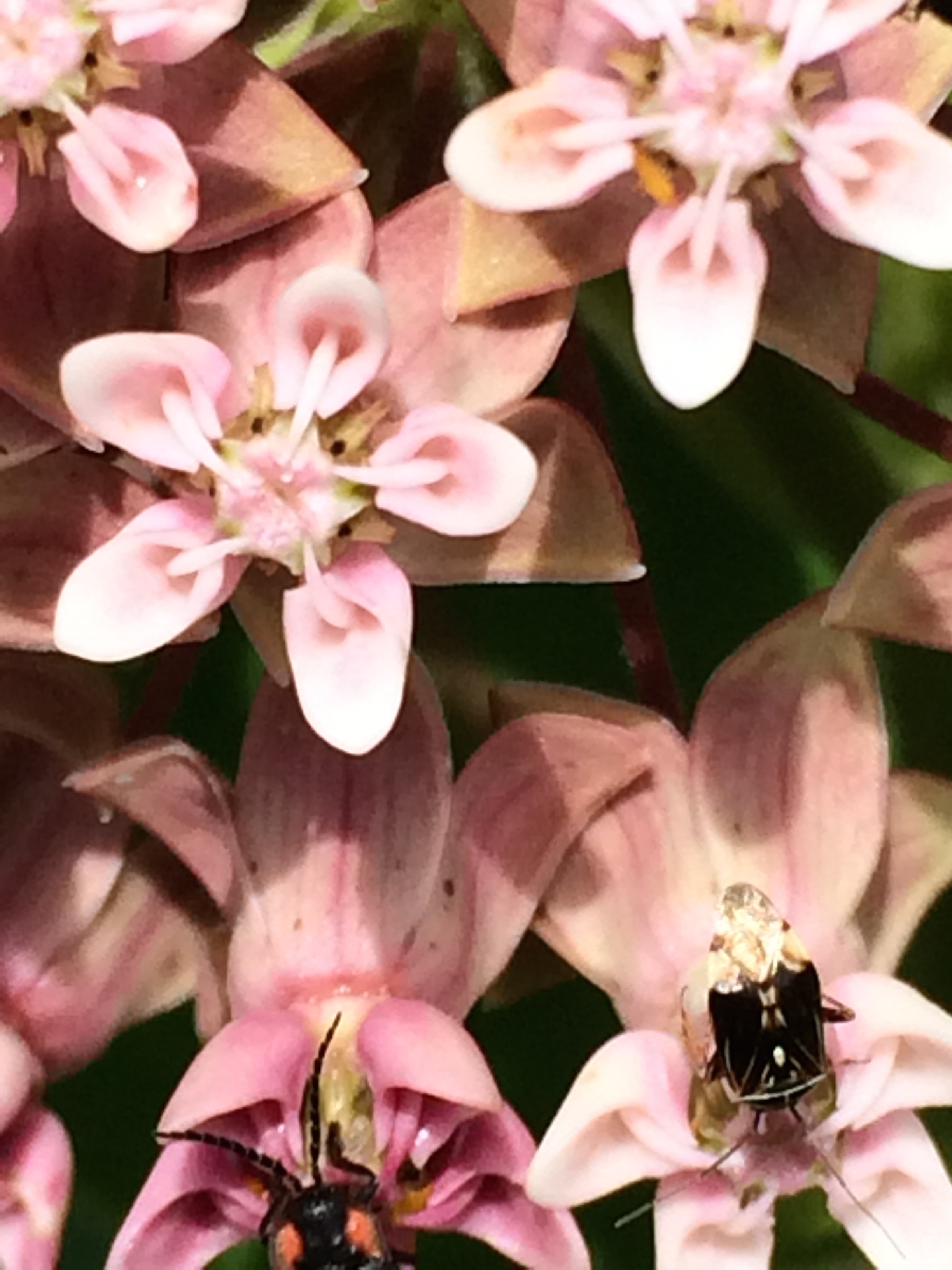
 

Milkweed flowers with visitor.

Milkweed flowers with visitors, seen summer 2014 (Enfield, near Ithaca, NY)

with the same fascinating flowers perfected in different sizes and shapes (scroll down to the bottom of this link).

MonarchWatch.org, led by Chip Taylor, is an excellent organization/website offering information on the biology of monarchs and milkweeds and on conservation efforts. Many people are now hosting monarch “waystations” under the guidance of MonarchWatch.

Monarchs have been called “iconic” and their flight “epic,” and rightfully so. Every school child in North America has known their story. Many have watched, as I have, the chrysalis become butterfly in just seconds, miraculously, as the molecules reorganize themselves from immobile jewel case into polka-dotted flight machine. And there is more to learn. Just last week, National Geographic posted an article on new discoveries about the genetics behind the white monarch and the efficiency of  flight muscles in the migratory monarch. They continue to inspire our creativity, as in this book shown below about a biologist coming home to Lake Erie to study monarch migration, or this new Harrisville Watershed yarn called “Monarch” (click on it, sitting to the left of “Barn Red,” for a close-up).

A new book whose title perhaps draws inspiration from the plight of the monarch.

A new book whose title perhaps draws inspiration from the plight of the monarch.

There are many good people working to ensure a future for monarchs, so that they do not become part of a mythic past. And there are many good weeds and wildflowers ready to be part of the ongoing story.

P. S.  For an article on the migration of Fall 2014, see this article titled “For the Monarch Butterfly, a Long Road Back” by Liza Gross.


The Importance of Mud Puddles!


Young man with stroller, little boy, and old man with young girl.

Hiking to pond at Topstone Park: young father with baby in stroller, young boy, and grandfather carrying young girl.

We are on an “adventure” with my son and the grandchildren, five and a half, two and a half, and twelve days old, on Labor Day. Restless people of all ages settle down in walking through a forest. So much the better if there is a pond at the end of the trail.

Beginning in 1970, a small number of residents of Redding, CT, formed the Redding Open Land, Inc. (R.O.L.I) initiative  to provide open space for the town. Topstone Park would eventually incorporate most of the land that comprised Edward Steichen’s farm on Topstone Road. Longtime resident of Redding, Steichen, the famous photographer and delphinium breeder, had decided to sell almost 400 acres of his farm at about the same time as R.O.L.I. started its work. The story of Topstone Park‘s creation proves that a small group of individuals can preserve open space for community use.

At the end of the trail we arrived at a curvaceous pond (scroll down to see many views of the pond), complete with a small beach and a beautiful expanse of rose-colored waterlilies. Steichen photographed extensively in this area.  One of his most famous “pictorialist” (tinted) photographs is “The Pond–Moonlight” (now known as “the world’s most expensive photograph”).  However, Steichen’s greatest contribution as a photographer is no doubt The Family of Man, the book that includes the 503 photographs he made for an exhibition under the same name at the Museum of Modern Art in 1955. Capturing images of human emotions in faces of people from many countries around the world, he shows viewers how similarly humans of diverse ethnicities and cultures feel. Love here, at our elbow,  is the same as love far, far away on the other side of the Earth.

Waterlilies at Touchstone Park.

Waterlilies at Touchstone Park. Little green heron settles just to the right of this scene. The lavender of pickerel weed just visible in lower right side of photograph.

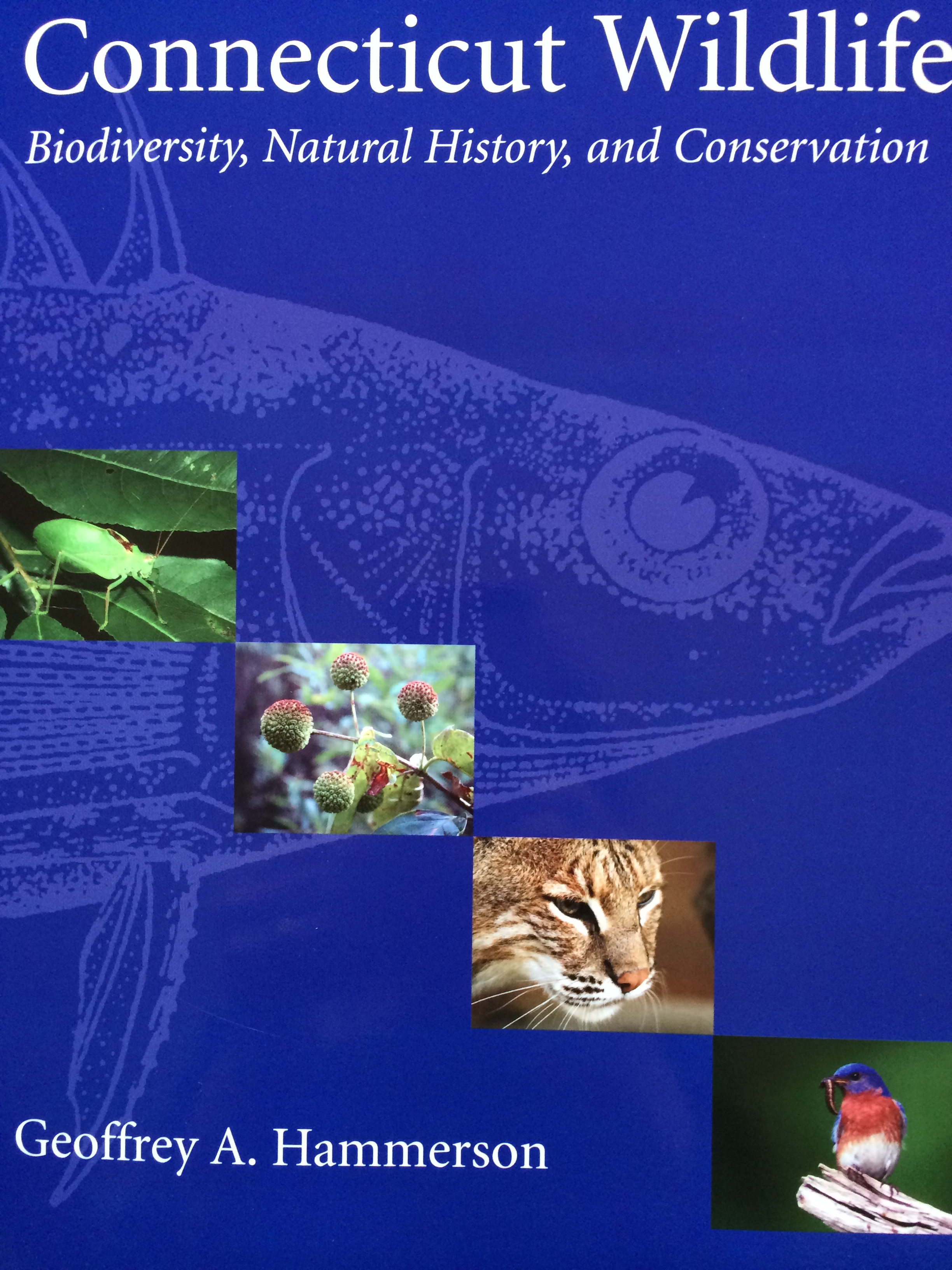
The children seize buckets left on the beach and start building a castle. I wade into the pond to fetch a few of the giant snails that sail, slowly, like an armada of Spanish galleons, underwater near shore. They are slightly slimy, covered with a gentle fuzz of green algae. The children make a fortress with a moat to enclose the snails but release them almost immediately as they discover that pouring bucket after bucket of water over them is fun. The moat slumps back into the sand in endlessly new wavy patterns and the snails sail back to sea serenely. I fetch more snails and encourage the children to touch the fuzziness of the algae on their shells. They are most likely the Chinese mystery snail (Cipangopaludina chinensis) or the Japanese mystery snail (Cipangopaludina japonica), according to information and photos in a wonderful book that I found:

Amazing reference work on Connecticut's flora and fauna.

Amazing reference work on Connecticut’s flora and fauna.

A little green heron  (scroll down to the sixth photo) soon joins us, settling on a dead branch poking out of the water lilies. The boy, who loves carrying his pint-sized binoculars with him wherever he goes, finally spots the heron, so perfectly camouflaged, his silhouette at the same jagged angle as the branch. He is thrilled, though I am not sure what he sees through the binoculars that he loves to brandish, but he does finally make out the well camouflaged bird with his naked eyes.

It is time to take baby back to mommy, so we  say good-bye to the pond, the snails, the water lilies, the little green heron, and the peacefulness. We walk back through the forest to the carpark. Here I photograph the encounter of boy and mud puddle.
He approaches.
He approaches.


“Can I?” he asks. “Sure,” I say.  He had already barreled into a puddle on our way into the park when no one was looking (and was told not to get his feet wet), but since we were the slow pokes bringing up the rear guard on the way back to the car, clearly no one besides ourselves would see where we were thinking of placing our feet.

He stares at it.

He stares at it.


The joy of wet, soggy feet.

The joy of wet, soggy feet.


“This is so much fun,” he says.

Does he see himself? The golden light of early morning? The ripples? There is so much to see.

I had not realized the sky was so beautiful until I saw its golden reflection in the puddles. It will be some time before baby can step in a puddle, but I am sure his adventure in Topstone Park registers somewhere in his small body.

It is a truism that the best things in life are free. Mud puddles fall into that category. Open space, open heart. All of us should have the opportunity to be in open space where we can experience the family of man becoming the family of all things on the Earth. The mud puddle has become a metaphor for childhood joy, a joy that is too often short-lived (please see the mission of The Muddy Puddles Project).

We must treasure the mud puddle at the very moment it appears in front of us–or, for sure, on our second chance because there is always a second chance.

Finding the Lonesome Pine


Vinegar Hollow. Stark's Ridge is the farthest bare mountain top (left of center). Back Creek Mountain stretches off on far top right.

Vinegar Hollow. Stark’s Ridge is the farthest bare mountain top (left of center). Back Creek Mountain stretches off on far top right.

Trekking abandoned logging roads by ATV with a chainsaw in the back of the vehicle is a new experience for me, but happily so. As a young girl I wanted to be a plant explorer in the great tradition of “Chinese” Wilson and Reginald Farrer, who brought back garden treasures from the remotest parts of lands still foreign to westerners at the time. Farrer roamed craggy mountains and misty valleys in Burma, China, and Tibet in life-threatening conditions armed with whiskey and a set of Jane Austen. So here I am, exploring remote mountain tops and glens of the Allegheny Mountains, fulfilling youthful dreams. I am home and do not need to carry whiskey and Austen.


Back Creek Mountain.

Back Creek Mountain  meets the sky above Vinegar Hollow.


The folds of Back Creek Mountain, which forms one of the north-south borders of Vinegar Hollow, looks impenetrable and pristine from Stark’s Ridge, the highest point directly opposite on the other side of the hollow. The wooded undulations of the mountain range reveal little of the history of human use of the landscape. In fact, it has been logged and relogged for the last several hundred years. Rough trails criss-cross the forest floor in a maze of switchbacks and curlicues. The forest giants are long gone, but secret gardens remain and a hoary pine native to the Appalachian Mountains.

Younger son on ATV.

Younger son on older son’s ATV.


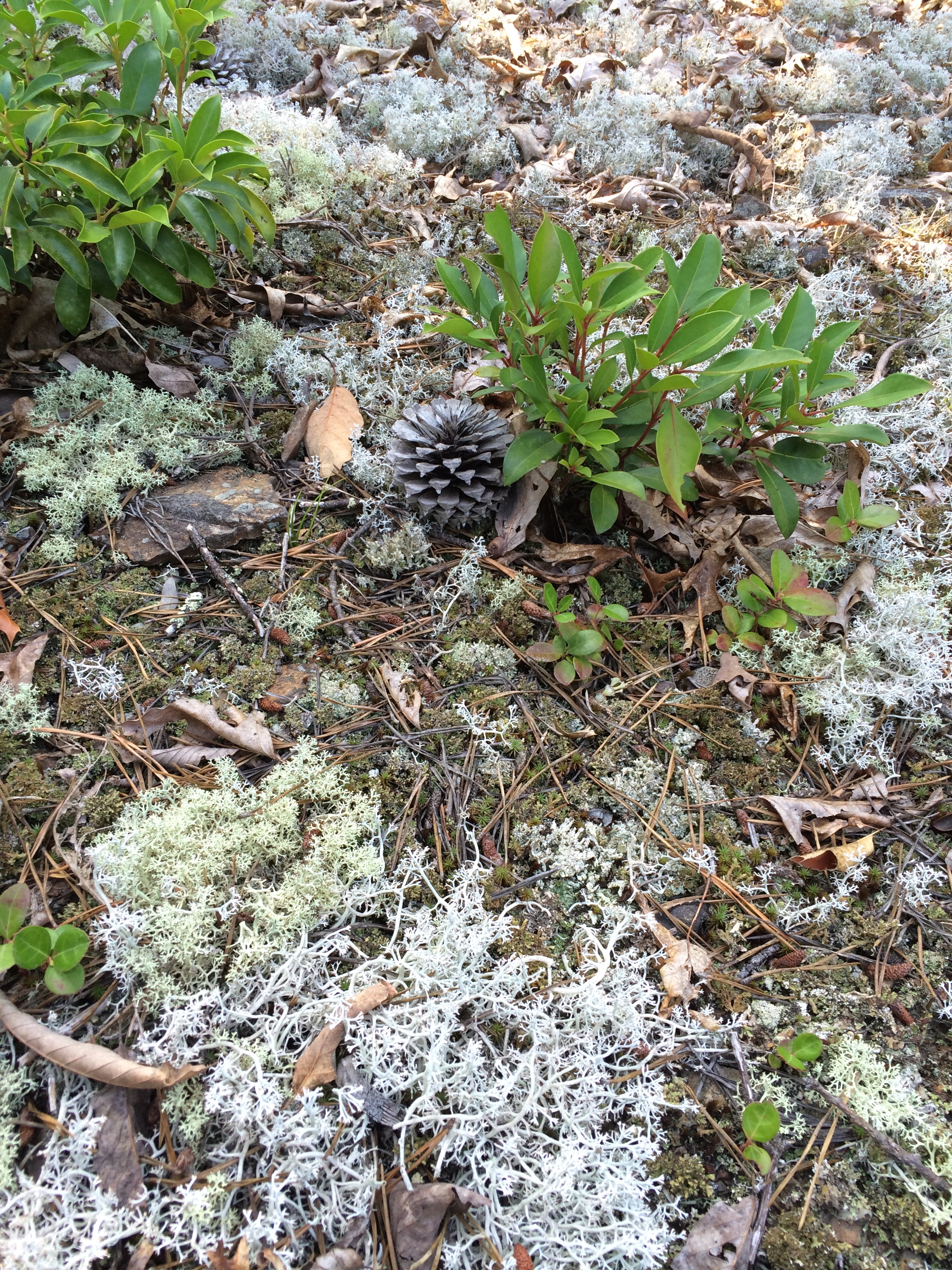
ATVs are bumpy, noisy, and smelly, but they aid enormously in botanizing and can be turned off while one explores on foot. My husband and I had driven up this part of the logging trail maybe half a dozen times, but never stopped to get out at this particular turn in the road. Maybe it was the morning light shining on an expanse of silvery pale green lichens that caught our eyes, but soon enough we were trying to hop about on delicate feet, in thrall to the wonders underfoot in what I am calling the pine cone garden.

Lichens and pine cone.

Lichened branches and pine cones.


Pine cone and lichens.

Pine cone and lichens.

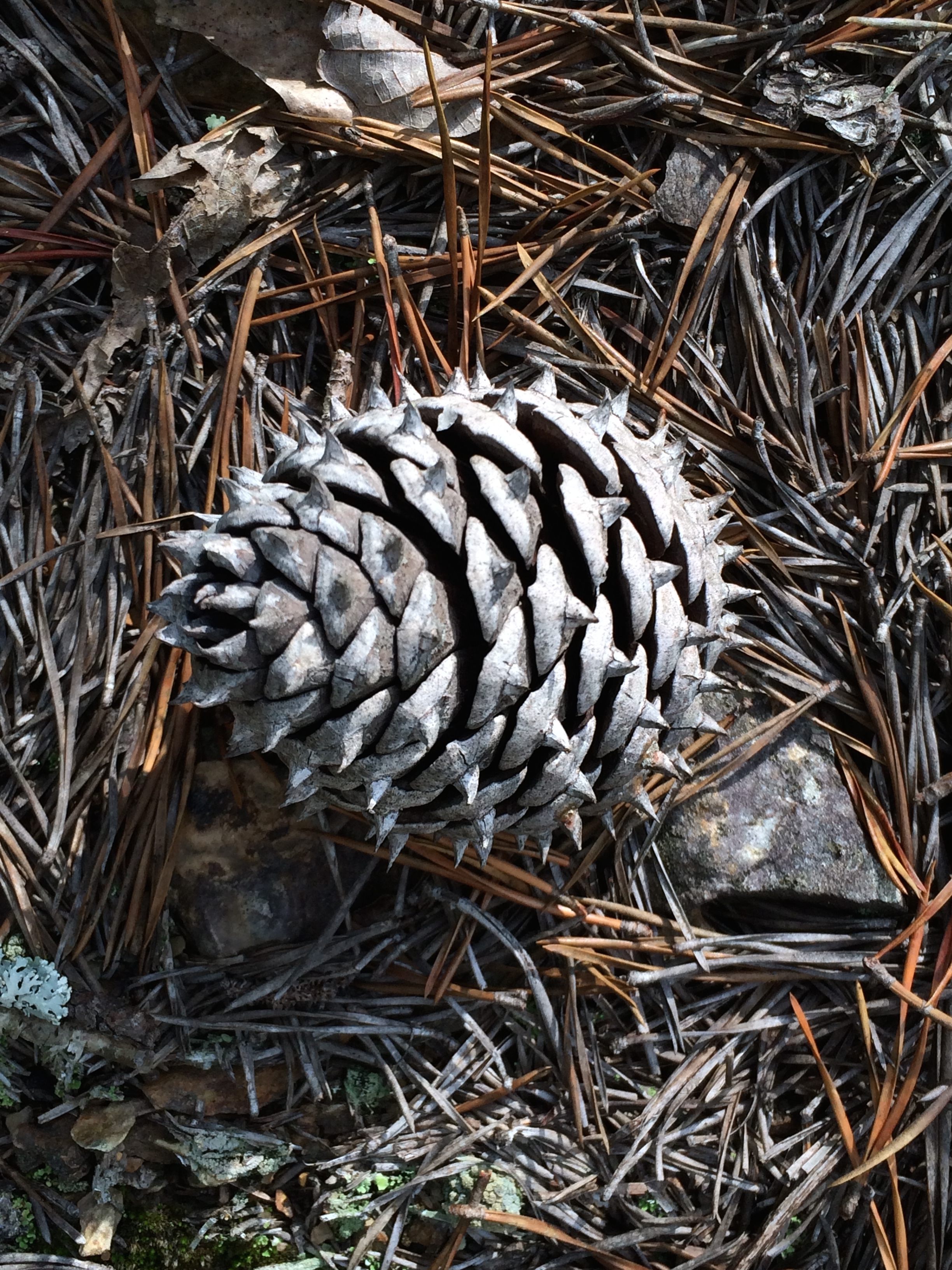
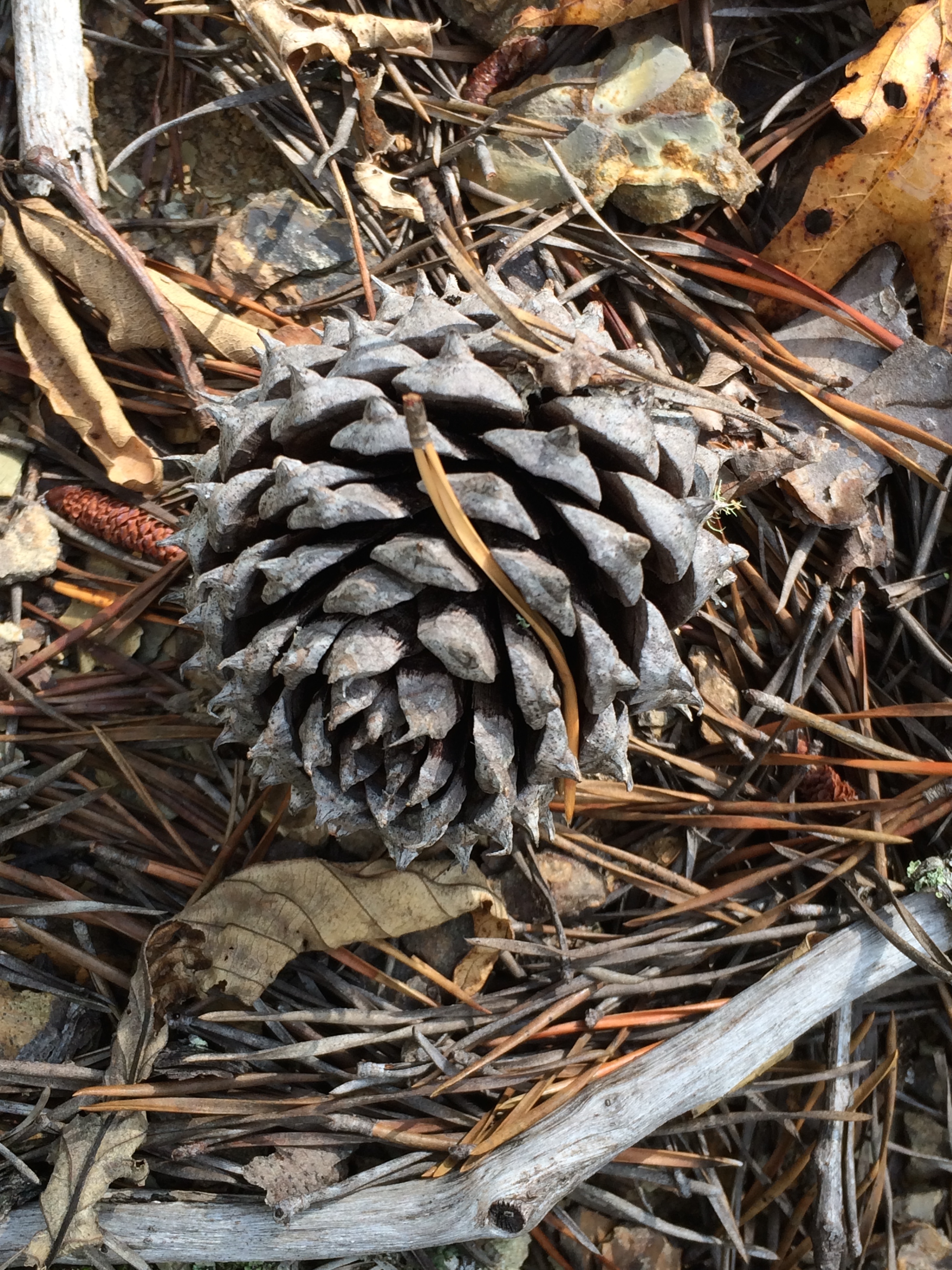
Whether nesting in lichens or pine needles, each cone seemed to be at home. Like sunflowers, pine cones have a deeply satisfying architectural form, the scales overlapping in an arrangement reflecting a sequence of numbers called the Fibonacci series. These cones are striking for their silvery gray brown shading and the curving, decorative prickles at the end of each scale.

Pine cone.

Pine cone.


Pine cone.

Pine cone.

The cones are stalkless, seemingly having sprouted out of stout branches.

Fallen branch with cones.

Fallen branch with cones.

But where was the parent tree? I looked up finally.

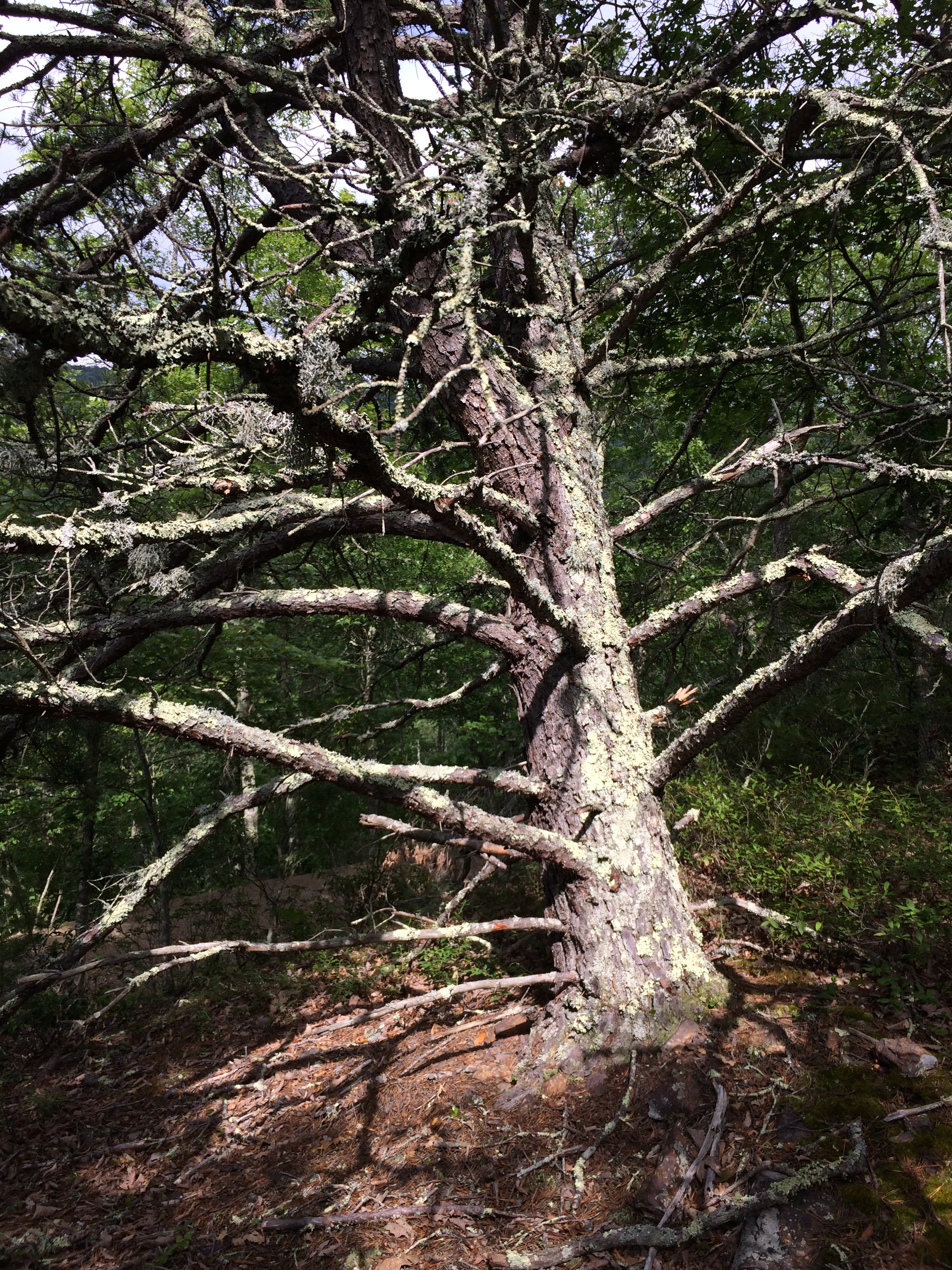
Parent tree.

Parent tree.

The morning light shone on its lichened, outstretched arms. One branch lay blasted on the ground.

Branch bent to the ground.

Branch of parent tree bent to the ground.

Lichens covered the bark exuberantly.

Lacy lichen.

“Lacy lichen” on parent tree.


Lichen on parent tree.

“Hoary lichen” on parent tree.

Further walking on this rocky slope by the side of the logging road revealed some dainty lichens displaying a  lovely pastel, slightly orange-pink coloration, something that forest fairies might have planned.

Fairy lichen.

Pink earth lichen.


Dainty lichen.

The extremely photogenic pink earth lichen again.

I know I wrote in my last blog about the importance of identifying small life forms, but I decided not to pursue lichen identification here (it would be like Alice falling into a wonderland of splendid but strange forms and vocabulary) because my primary goal now is to honor the pine and its cones. “Hoary lichen” and “lacy lichen” are just my own bland names, not proper common names. It turns out (courtesy of my husband’s research) that the lichen with the pink knobs is easy to identify via Google images. It is known by a lovely common name–the pink earth lichen. Its scientific name, Dibaeis baeomyces, is not at all user friendly. Project Noah offers a photo with a description offering the information  that the knobs are filled with “cottony fibers.”

My husband and I got busy taking measurements and assessing characteristics that would identify the pine.

Pine cone display technician David Fernandez.

Pine cone display technician David Fernandez.


A 2-3 needle pine!

A 2 (-3) needle pine! Apparently the number of needles per bundle is not totally constant.


One thing that makes pines fairly easy to identify is that there are not many different species of them in the world. Further, pine needles are arranged in little bundles bound in a common sheath, and the number of needles in the bundle (fascicle) is distinctive for each species. The familiar white pine, distinctive for its long, graceful needles, has five needles per bundle, for example.  So, it’s pretty easy to count the number of needles per bundle on a pine sample–we found two needles per bundle in this pine–and look up a list of 2-needle pines in North America. The list is not that long. Also, the pine cones of our pine were unusually prickly, which proved an excellent identifying characteristic. First we settled on Pinus echinata, the shortleaf pine, because it has prickle-tipped cones and it’s native, but its growth habit (overall shape) wasn’t right. We moved on through the list of 2-needle pines.

Voila Pinus pungens, commonly known as the prickly pine, table mountain pine, and hickory pine! Prickly pine  is certainly a suitable common name because of the cone, and table mountain because of the high elevation at which it likes to grow, but hickory pine? A hickory tree is in a completely different family and order and is known for its shaggy bark and edible nuts. I love it when the common names of life forms become interesting metaphors, connecting the unlike through some hint of likeness, so I puzzle over its derivation.  Hickory trees are often gaunt and gangly in shape, which is perhaps the likeness that inspired the common name of hickory pine because Pinus pungens is  described as having a “rounded, irregular shape.” Another possibility is that the common name recognizes the fact that Pinus pungens likes to grow with hickories. However, there were no hickories on this rocky hillside.

It is a lonesome pine. Unlike most species of pines, this pine is known for growing as scattered individuals, rather than in large groves.  Lonesome but not unsung. John Fox Jr. made this species famous in his book The Trail of the Lonesome Pine, a top-ten bestseller of 1908-1909, and a book still dramatized in yearly pageants in Big Stone Gap, Virginia where John Fox died in 1919. Fox’s book beautifully describes the Appalachian mountain culture and landscape, and the confusion and disruption that occur when modern civilization arrives, here in the form of the train and coal mining. Fox describes the lonesome pine repeatedly so that it becomes a character in its own right, representing the isolated individual struggling to retain identity. The main human protagonist is a young man from “civilization” who arrives to bring change to the area but is nevertheless sensitive to the value of what he finds there. Fox writes from the point of view of this character:

He had seen the big pine when he first came to those hills—one morning, at daybreak, when the valley was a sea of mist that threw soft clinging spray to the very mountain tops: for even above the mists, that morning, its mighty head arose—sole visible proof that the earth still slept beneath. Straightaway, he wondered how it had ever got there, so far above the few of its kind that haunted the green dark ravines far below. Some whirlwind, doubtless, had sent a tiny cone circling heavenward and dropped it there. It had sent others, too, no doubt, but how had this tree faced wind and storm alone and alone lived to defy both so proudly? Some day he would learn.

–John Fox, The Trail of the Lonesome Pine   

He suggests a parallel and a connection between the plight of the lonesome pine and the human being. Defiance in the face of unaccountable whirlwinds, like World War II. My parents loved this book for its description of the mountains they settled in post my father’s service in the war. With all their hearts they aspired to be mountain folk, fierce individuals never at peace when far from lichen-covered trees and forested vistas. Their grandson has now purchased some of this mountain land to protect–from the “green dark ravines far below” to the rocky slopes of the ridge tops where the lonesome pine survives, casting its prickly cones into a garden of fantastical lichen, both tender and tough.

IMG_3329

Trees rising from one of the deep, green glens of Back Creek Mountain.


Fieldwork 101: Identifying the “Infinite in the Small”


Summer in the northeast United States is a time for a bounty of life forms, little bugs munching leaves and landing out of nowhere in our midst and tiny weeds decorating “waste” places trying to show us that life can be lived in the most unassuming of places. Seemingly they have come from nowhere and humbly they will disappear at frost. Having a minor  reputation in my neighborhood as a naturalist, I am presented with various creatures for ID, and then one simply fell into my lap (precisely speaking, onto my page), and then there is the case of the striking stranger that came for the cat food. I write about them in the spirit that the least among us deserves recognition and has a story to tell–part of the Big Story of Life on Earth.


Carrion beetle on my kitchen counter.

Burying beetle on my kitchen counter.


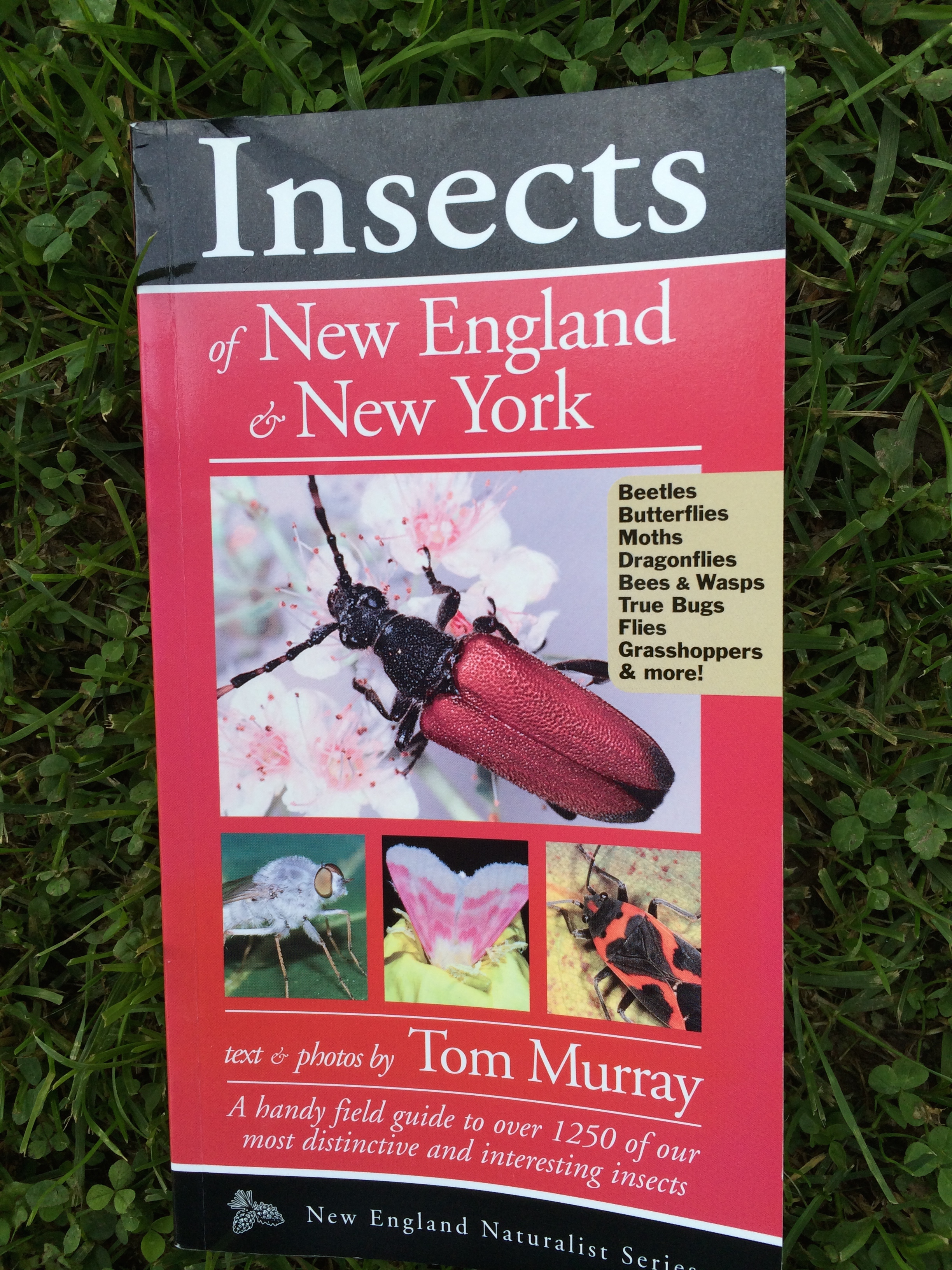
This handsome beetle popped out of an empty cat food can in my sink.  We had gone to Columbus, Ohio, for a wedding, leaving Rex Fernandez the cat in the care of an expert cat sitter who left the nearly empty Fancy Feast cans in the sink as requested.  Upon tidying up I encountered this large, dramatically colored beetle. I was surprised but not horrified. As most naturalists would, I decided to photograph it with my iPhone for identification. Darwin, famously, put a beetle, or was it two, in his mouth for safekeeping to carry home for study, because his hands were full with specimens and equipment. I had just acquired Insects of New England & New York by Tom Murray, so it was a simple matter of flipping through pages of photographs of beetles to find one like this.

Insects of New England and New York by Tom Murray, published by Kollath + Stensaas Publishing.

Insects of New England and New York by Tom Murray, published by Kollath + Stensaas Publishing.

Simple-minded or not, this is my first approach to identification. It was quickly apparent that this individual belonged to the family of Carrion Beetles (Silphidae) and more particularly to the genus Nicrophorus, commonly known as Sexton (Burying) Beetles. Murray writes,

“In the Northeast we have 9 of the 15 Burying Beetles species. Adults bury the carcass of a small mammal or bird, and then lay eggs on it and are dedicated parents, feeding the larvae bits of carrion.”

That’s how life continues, by not wasting available resources and good parenting. I narrowed from genus to species. It looked exactly like the photo of Nicrophorus defodiens in Murray’s book, which I stumbled upon online as well. These beetles get around. One comment beneath the online photo indicates they are a pest on the Isle of Skye in western Scotland, or I should say a wee pest (the go-to lingo of the Scots). I am sure that I could not put this kind of beetle in my mouth.

And then in further tidying I discovered a note and a container from the expert cat sitter by the telephone.

“Elizabeth. I’m trying to find a home for this strange bug–also to find out what kind of bug he is. Maybe the [grand]children would be interested?! I consulted an insect ID book to no avail. Anyway he is a fascinating little (very) creature. Susan”

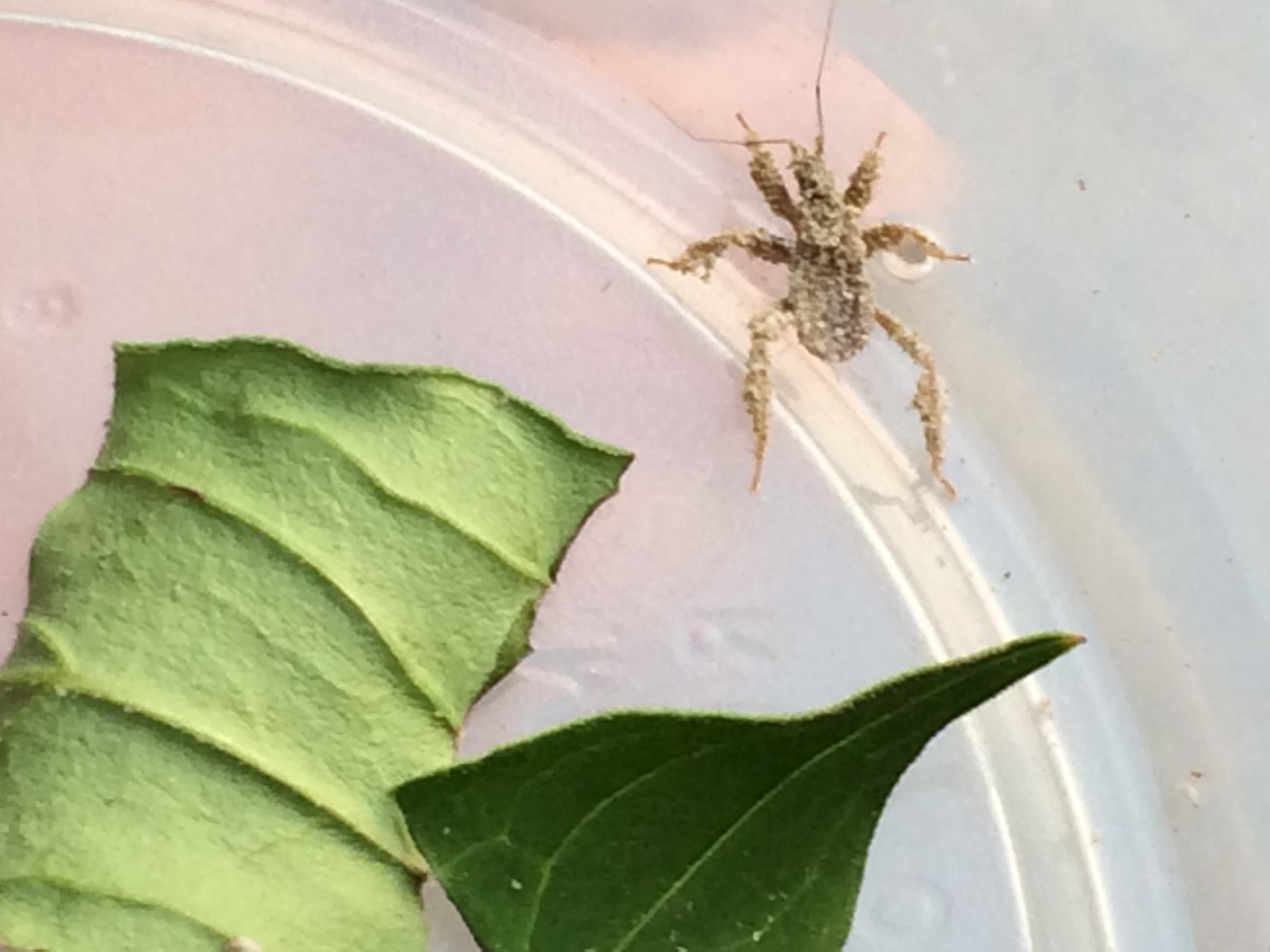
The Wegman’s Olive Bar container had beautiful little holes in the lid and nothing in it at first view. Near some shredded leaf parts I saw a tiny, very tiny as she had said, fuzzy little bug.

Susan's bug.

Susan’s bug, magnified considerably.

Higher magnification of Susan's bug.

Higher magnification of Susan’s bug. Note the widened “flanges” of the hind legs.


I went off on a wild goose-bug chase. The chances of ID-ing such a tiny bug, especially one that appeared to have been rolling around in gooey dust  seemed futile. I observed it, photographed it, and then let it go because I didn’t want it to die while I was on my chase. The hind legs were distinctive.  I immediately thought of leaf-footed bugs, known for “leaf-like expansions” (Murray) of their hind legs, and a photo in Murray’s book of the Distinct Leaf-footed Bug (Merocoris distinctus) bore some likeness. Murray’s description reads: “These little, fuzzy bugs can be found on flowers throughout the eastern U.S., except Florida where M. typhaeus occurs.” Susan said that she had found it on her shower curtain, but this unusual location did not necessarily rule out the Distinct Leaf-footed Bug because bugs get around for various reasons. Such a tiny bug could have blown on a gentle breeze from one of the flowers in her garden to her shower curtain, possibly. I wasn’t satisfied, however. The Distinct Leaf-footed Bug was supposed to be 9 mm or so, and Susan’s bug was smaller I thought. But perhaps it could be just a nymph, an immature stage in maturation of insects. It would get bigger and then look more like the photo in Murray’s book perhaps, especially if it was cleaned up. But that line of thinking was definitely fuzzy. I puzzled on.
Browsing around online, googling search terms like “tiny, fluffy bug” or “tiny, fuzzy bug” or “tiny, sticky bug,” I can’t remember exactly, I stumbled on Doug Green’s Simple Gifts Farm (www.simplegiftsfarm.com) with a great photo of a lookalike. You have to scroll down past the wooly aphid to get to the photo of the nymph of the Masked Hunter Bug (similar to Susan’s bug). The fascinating little creature on the shower curtain was a member of the Assassin Bug family, specifically Reduvius personatus. Called Assassin Bugs, because they hunt and kill other bugs, they like to be indoors and can, if disturbed, inflict very painful bites upon humans. The Masked Hunter is so-called because the nymphs go around covered in dust as a camouflage. The adults are not half as fascinating looking, as shown on Michigan State University’s webpage, written byHoward Russell, who notes that they have a “sizable beak” with a “needle-like mouthpart.” I am more entranced by the Masked Hunter with its costume of dust.

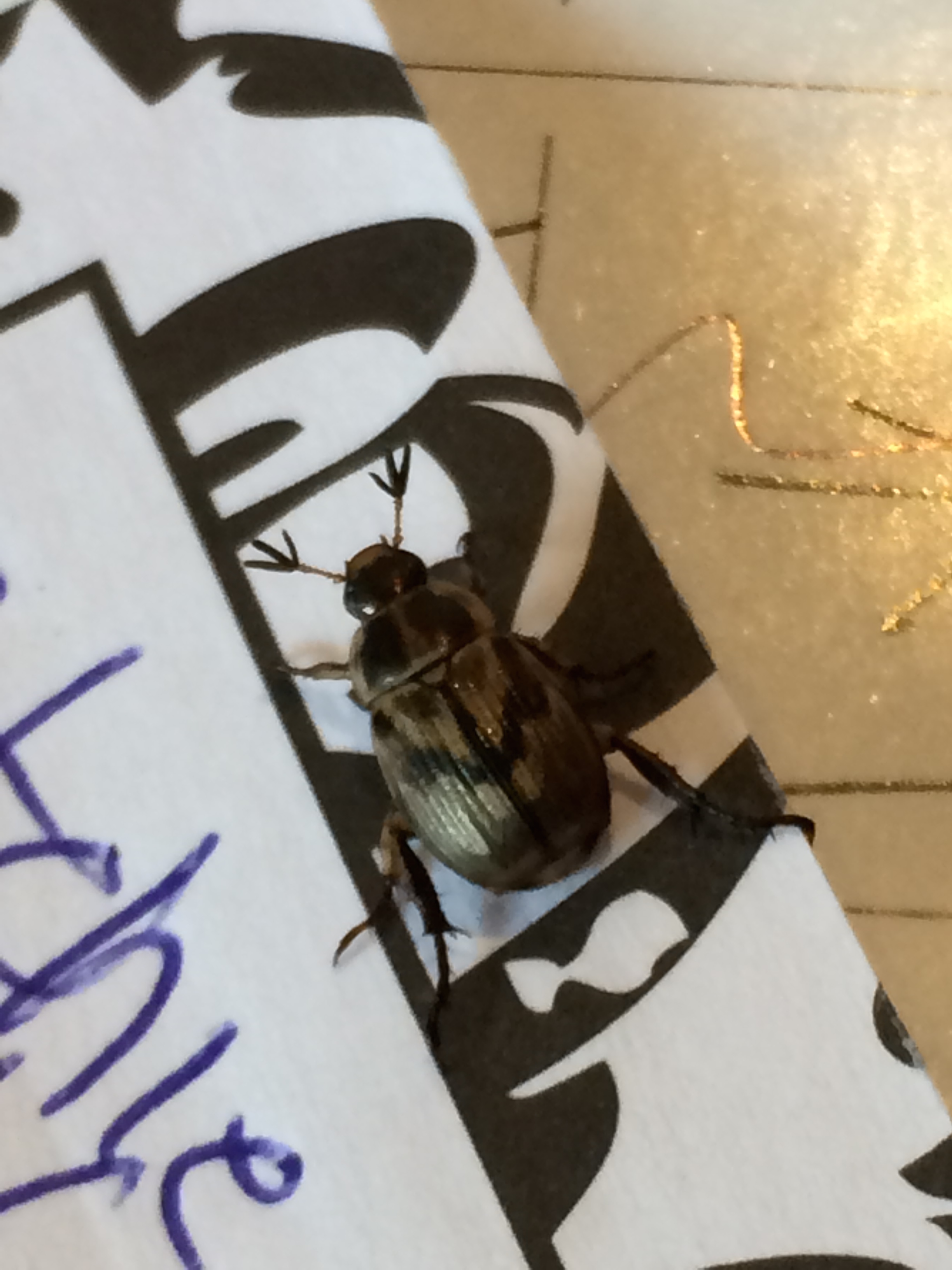
My third identification adventure occurred in a coffee shop. I was sitting with my portable, paper 2014 Edward Gorey’s The Evil Garden Calendar (Pomegranate) open and my coffee, plotting to get my life in order when a beetle dropped onto the page.

Beetle on calendar.

Beetle on calendar.

I had been immersed in beetles and bugs, and here was another one begging for attention. Had it dropped off the ceiling? my hair? At least it wasn’t an assassin bug. It seemed cheerful and actively explored my page.

Beetle on the move.

Beetle on the move.

The pattern on the back was interesting but not outstandingly helpful. After escorting the beetle outside to an ornamental planting by the parking lot, I started looked through all beetles that had three-pronged, black antennae. There were a lot. I narrowed it down to some type of scarab beetle, and after much wandering among beetle photographs decided that it was mostly likely the Oriental Beetle, Exomala orientalis (synonym Anomala orientalis). My photographs match those on bugguide.net almost exactly. Various accounts point out that the pattern often varies this way and that (i.e., no two snowflakes are alike), and sometimes it is completely black, as shown in Murray’s book. It is an immigrant from Asia, and frequents rose and hollyhock blossoms. The grubs live in the ground and feed on turfgrass roots.

In graduate school I took courses that gave me practice in some of the arts of identification–Agrostology, the study of grasses, at the University of Texas at Austin, and Entomology, the study of insects, at Cornell.  It’s not so much the name per se that a naturalist seeks, but knowing and honoring the individual through seeing well–discriminating between details of appearance with appreciation. I cannot fly around the world like David Attenborough, but I can engage in adventures that everyday life presents, and they are nonstop.

I found a wonderful website called Beetles in the Bush created by entomologist Ted MacRae. He posted  ID Challenge # 23on July 12, 2014. I was too busy investigating my own challenges to undertake his challenge, but I urge readers to get involved and accept challenges. For example, here is a long-legged insect that I found ensconced on peony fruit capsules in my Secret Garden.

Long-legged green insect on peony fruit capsules.

Long-legged green insect on peony fruit capsules.


Here's a higher magnification.

Here’s a higher magnification.

I think it is a katydid. The challenge is what kind of katydid? I also pose this challenge in the spirit of the  “revisioning the insect-human connection,” the subtitle of a wonderful book by Joanne Elizabeth Lauck titled The Voice of the Infinite In the Small. This is a beautiful book about tuning in to our smallest brethren and shedding human self-centeredness in order to really belong to the delicate lace of life on planet Earth. I for one feel that my life is more in order when I try to identify my fellow life forms.

A classic: The Voice of the Infinite in the Small: Revisioning the Insect-Human Connection by Joanne Elizabeth Lauck.

A classic: The Voice of the Infinite in the Small: Revisioning the Insect-Human Connection by Joanne Elizabeth Lauck.

A walk on the wild side: Highland County, Virginia

View of Vanderpool Gap, Highland County, Virginia

View of Vanderpool Gap, Highland County, Virginia, looking west into Blue Grass Valley.


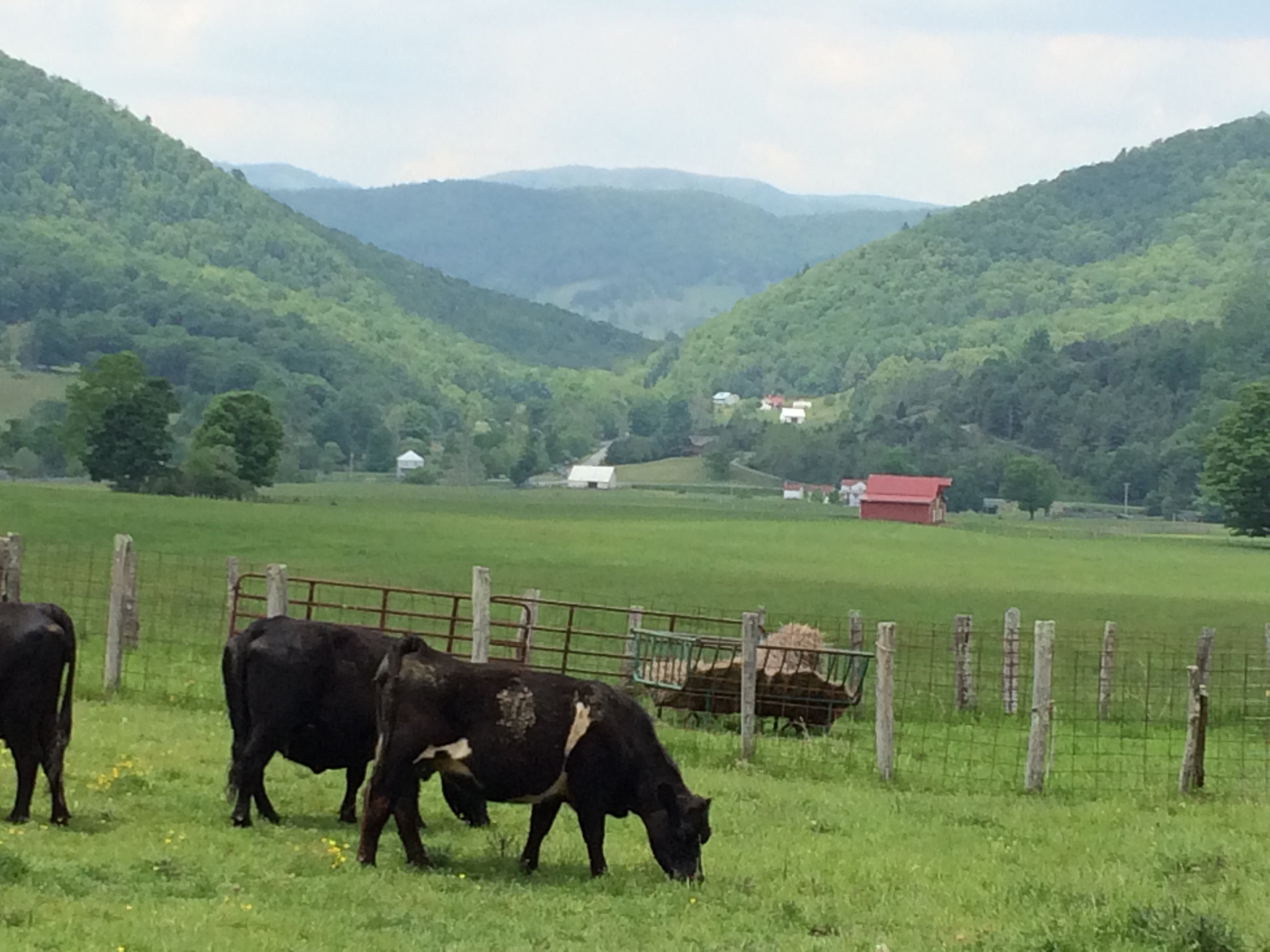
I am back, in Highland County, Virginia, exploring again, starting off a few feet from these cows. We are headed east in jeep and on foot into a parcel of land that was once cleared, but is growing back into the wild in places. As is usual here, we have to go through several gates before we are into the parcel.


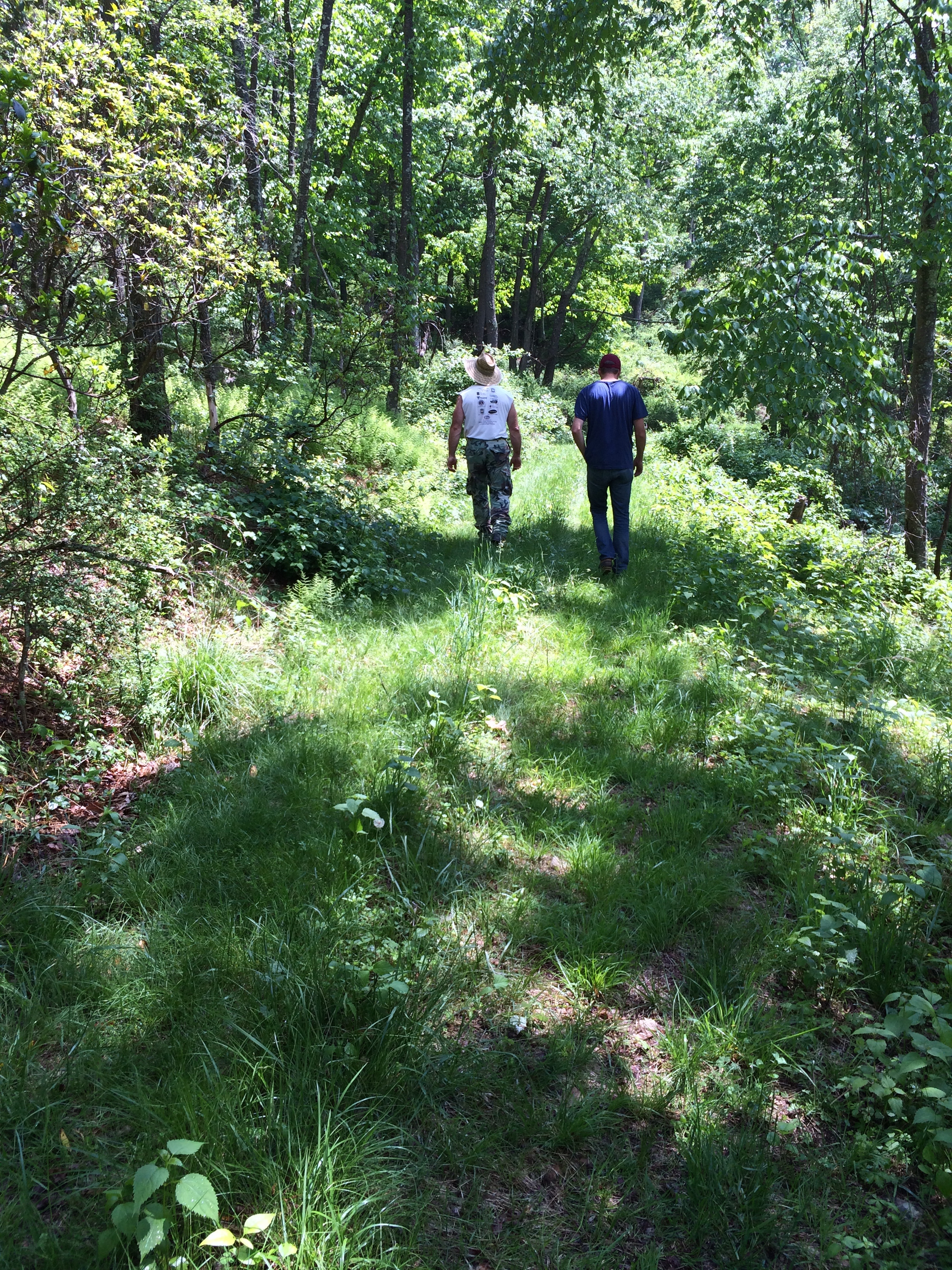
My walking companions.

My walking companions.

We are trying to get a sense of the entire topography of this 700-some acre parcel. It’s varied, rarely flat.  We surprise a golden eagle and a bevy of vultures. They scatter in a leisurely fashion, in no hurry to leave the carrion they have found. When we have passed along, they will be back. I am not quick enough to capture the golden eagle with my iPhone, even though it is huge and moving so slowly.


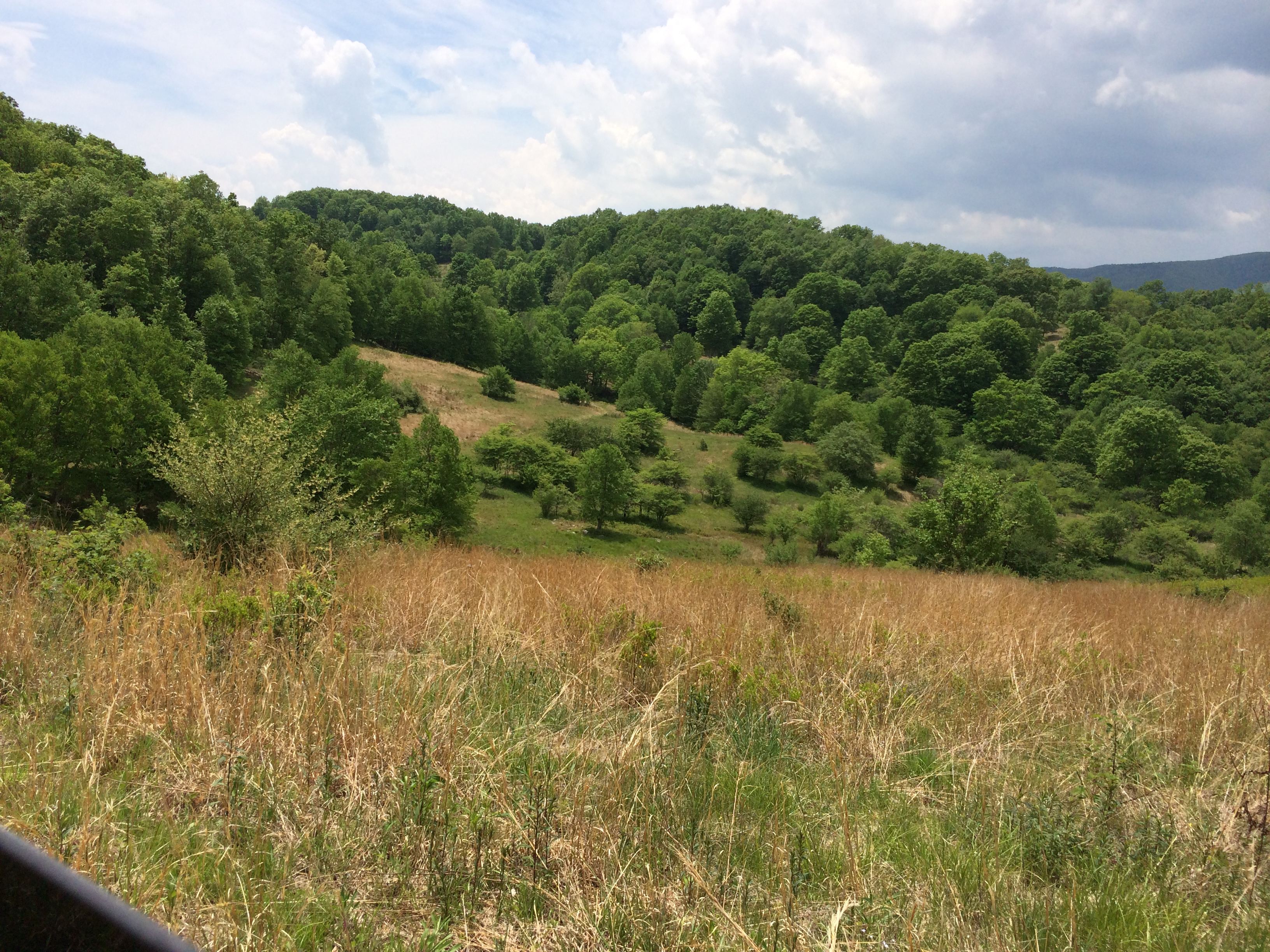
Halfway to the top.

Halfway to the top.


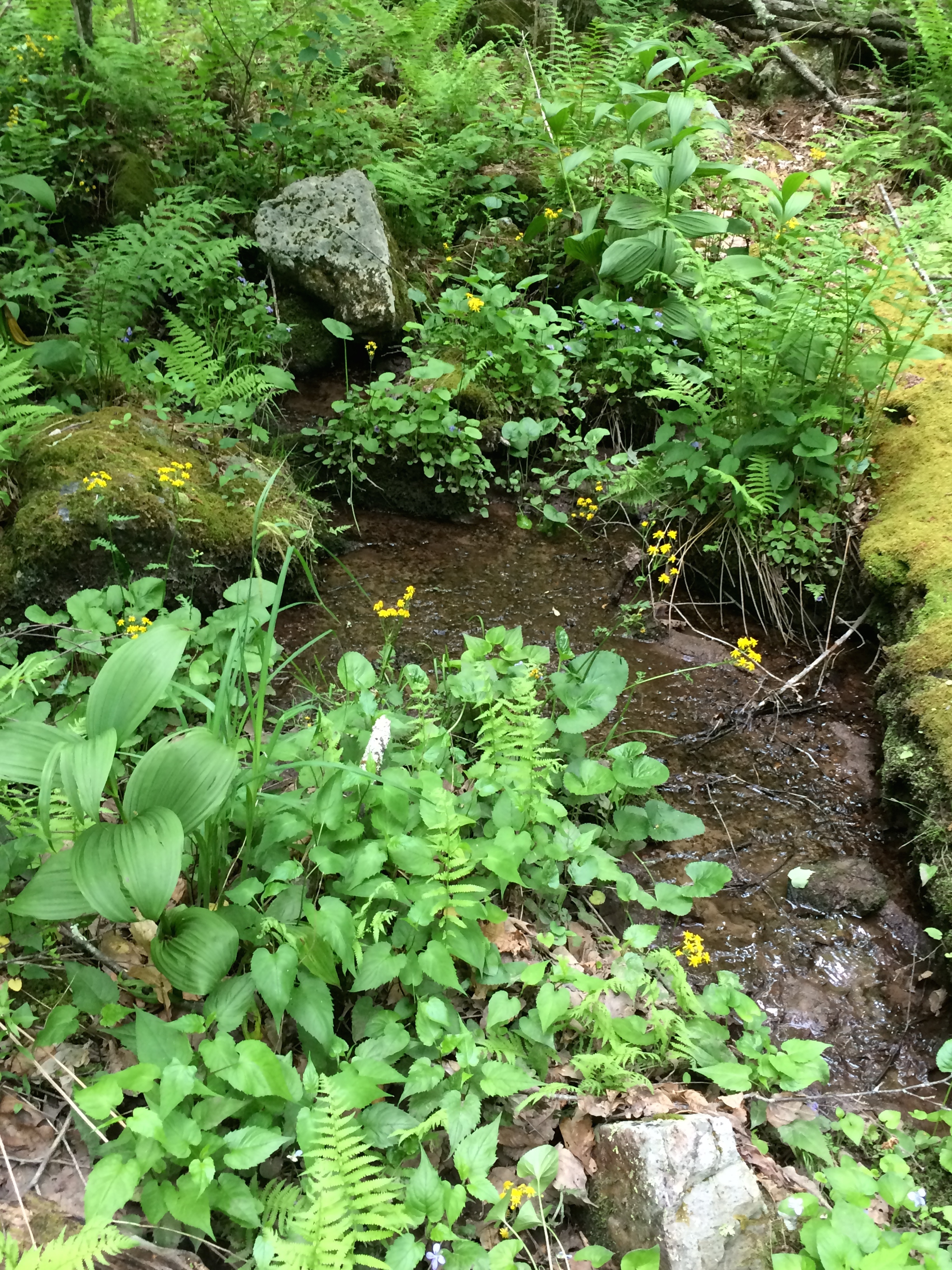
We arrive at a little glen with a beautiful stream. It’s sparkling and luxuriant with vegetation.

Mountain stream.

Mountain stream.

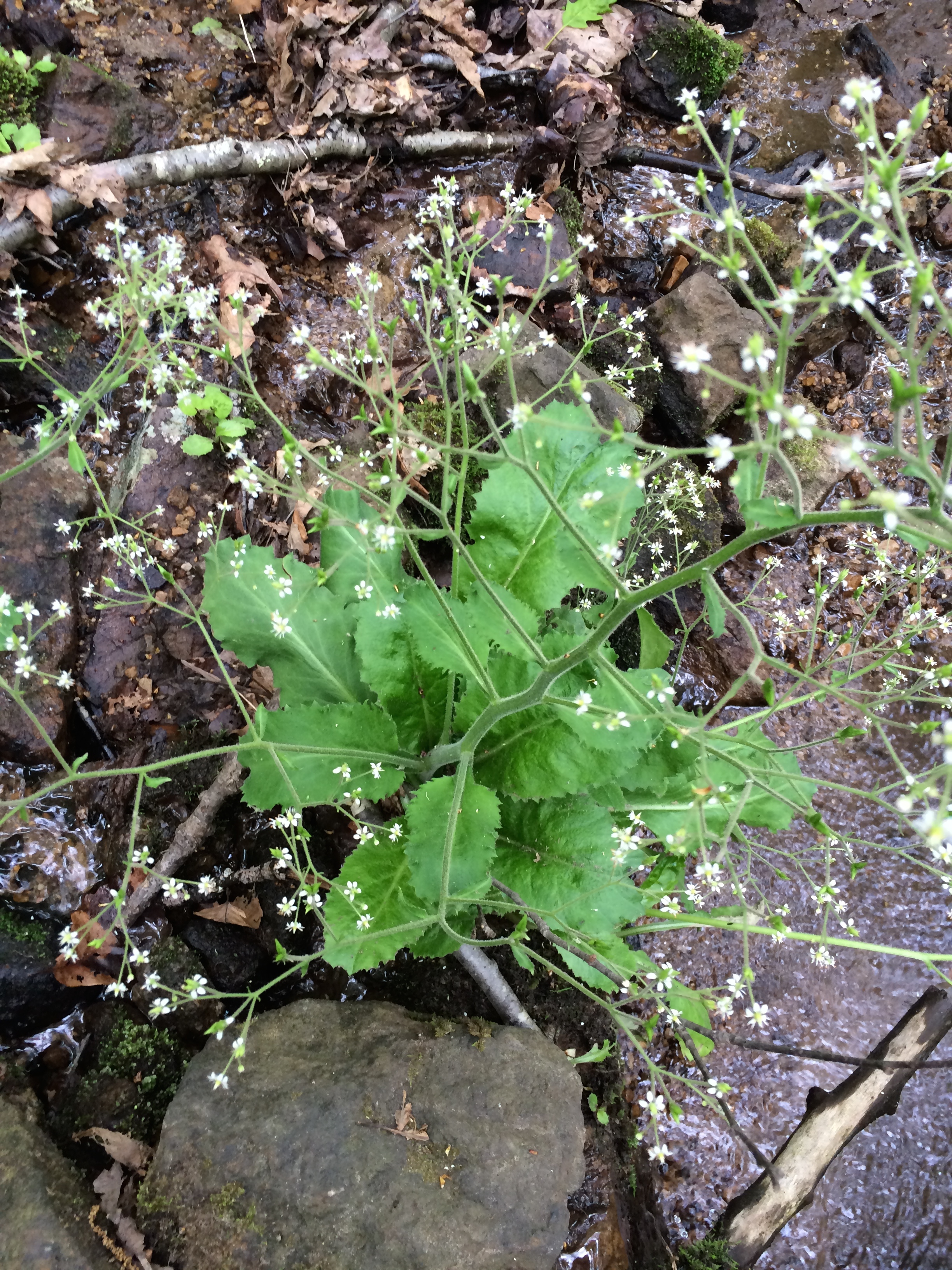
Here I find a notable Appalachian wildflower: Saxifraga micranthidifolia, commonly known as branch lettuce or mountain lettuce. Native to the Great Smoky Mountains, it flourishes in cold, fast-moving mountain streams and is one of the first plants to show itself in early spring. The early settlers found it palatable and a welcome salad green after a long winter.


Mountain lettuce (Saxifraga micranthidifolia).

Mountain lettuce (Saxifraga micranthidifolia).


It is not in Roger Tory Peterson and Margaret McKenny’s A Field Guide to Wildflowers, so when I discovered it as a young girl in Vinegar Hollow I felt like a genuine plant explorer. I finally tracked it down in Joseph E. Harned’s Wildflowers of the Alleghanies, a book I found by chance at a second-hand bookstore. It has been called “a monumental book,” and there is no doubt that it is–written with grace and comprehensive in scope. “Micranthidifolia” remains one of my favorite botanical tongue twisters.

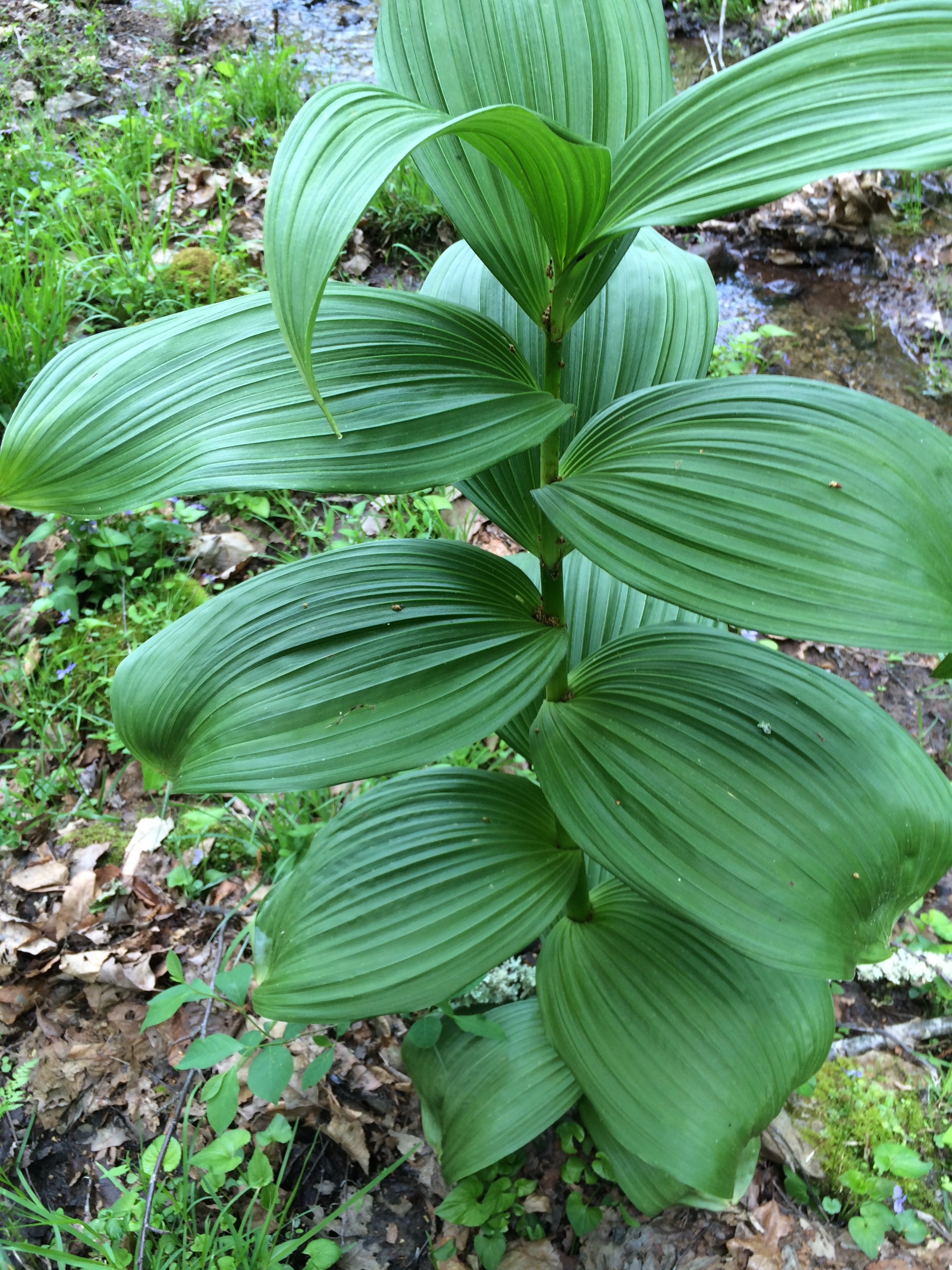
The mountain lettuce are abundant and so is the plant shown below, which is new to me.


False hellebore (Veratrum viride).

False hellebore (Veratrum viride).


It takes several hours of searching online to find the name  because for once Peterson and McKenny’s A Field Guide to Wildflowers fails to give me an identification, probably because it was such a big presence there in the stream, but quite small, practically hidden in the top right corner of  p. 370 among the “6-part flowers, lengthwise leaf veins, Lily Family (Liliaceae).” Peterson and McKenny instruct through arrows, using them to point to distinctive, often little-noticed features. They do have an arrow to the “heavily ribbed” leaves. I should have noticed that arrow, but I missed it.


Drawing of false hellebore (shown left of center on top) from Roger Tory Peterson and Virginia McKenny's A Fieldguide to Wildflowers (pp. 369-379).

Drawing of false hellebore (shown left of center on top) from Roger Tory Peterson and Virginia McKenny’s A Fieldguide to Wildflowers (pp. 369-379).


False Hellebore is also known by a host of other names, including Poor Annie, Tickleweed, and Devils Bite. This plant is not palatable, in fact just the reverse. According to one website, it is highly toxic and can cause “birth defects, gastrointestinal distress, salivation, prostration, general paralysis, spasms, irregular heart beat, difficulties breathing, and death.” That sounds like just about enough results for its toxicity. Large patches of bluets carpet the path the follows the stream up the glen.


Bluets or Quaker Ladies (Houstonea caerulea).

Bluets, also known as Quaker Ladies, Innocence, and Little Washerwoman (Houstonia caerulea).


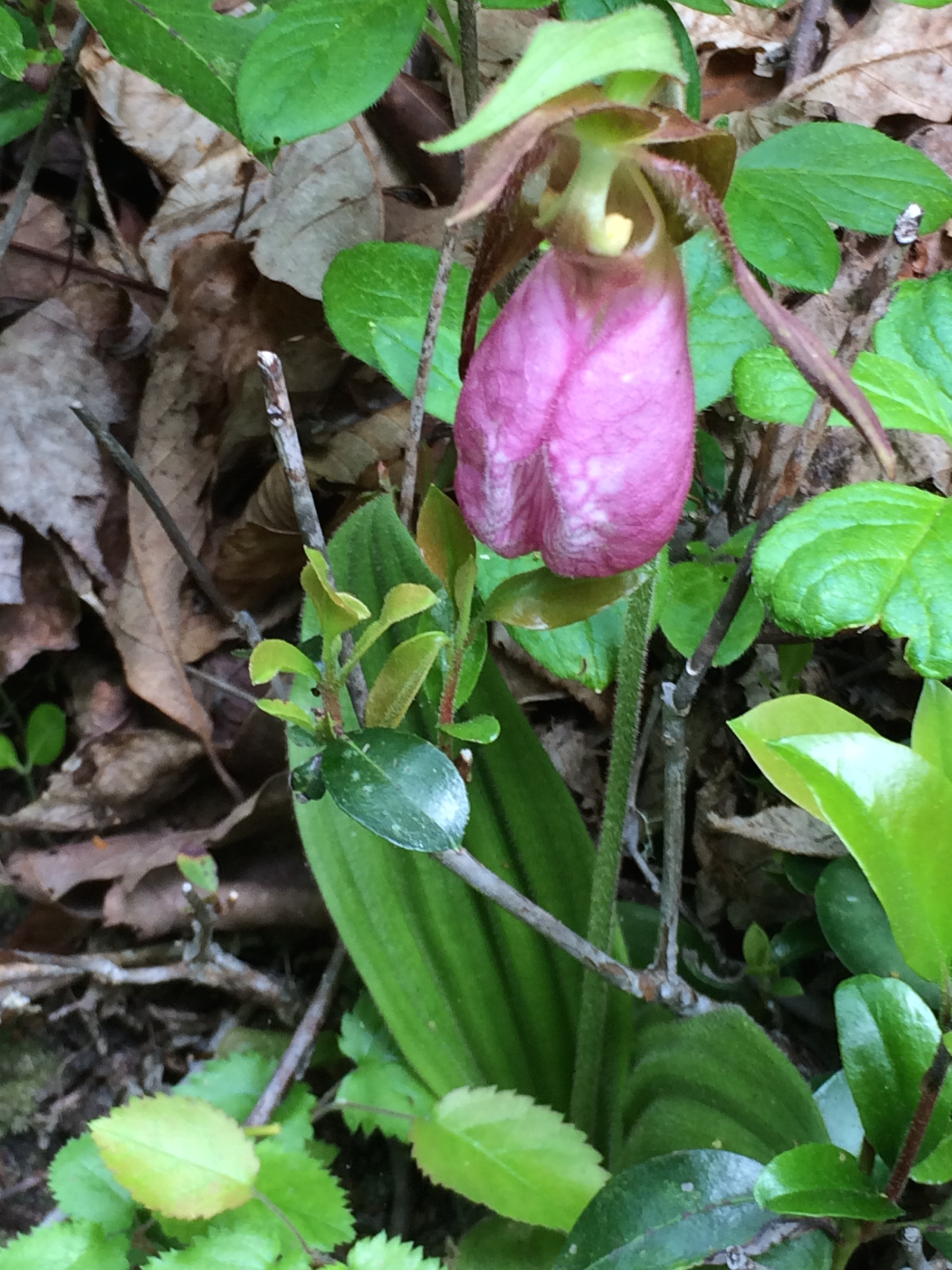
Bluets go by many names as well and are extremely  photogenic. It is certainly a pleasure to walk along a path so blue, though I am hopping because I do not wish to crush a bluet or a Quaker lady or a little washerwoman. They are in the bedstraw or madder family (Rubiaceae). The settlers are said to have stuffed their mattresses with the common bedstraw (Galium sp.), which grows in hay meadows and has a sandpapery feel. Probably because I am so dazzled by the mountain lettuce, the false hellebore, and the bluets, I fail to notice two species that we see on our way back through this part of the parcel: the pink lady’s slipper and the pinxter flower, a kind of rhododendron.


Lady's slipper orchid

Lady’s slipper orchid (Cypripedium acaule).


Flame azalea nestled into trunk of tree with fern.

Pinxter flower nestled into trunk of tree with hayscented fern.


I was dazzled, but now I am delirious. These Appalachian plants touch me deeply. Pinxter flower has had several scientific names, from Rhododendron nudiflorum to the current Rhododendron periclymenoides. Nudiflorum makes perfect sense (flowering without leaves), but I will have to do further research to understand how periclymenoides adds to an understanding of the biology of this species.

We trek on, discovering an old friend from Vinegar Hollow, hound’s tongue, a member of the forget-me-not family–“downy, with a mousy odor; maroon flowers …embraced by velvety calyx scales” according to the description by Peterson and McKenny.

Hound's tongue (Cynoglossum officinale).

Hound’s tongue (Cynoglossum officinale).


I think I have caught its downiness in my photograph (enhanced by the slight out of focus). This is limestone country. One of my companions has worked with stone. He points to a rock with a lot of character and shows us where bear have overturned rocks to get at ants.


Limestone rock showing fossil creatures.

Limestone rock showing fossil creatures.


We lock gaze with a deer.


Deer in the undergrowth.

A deer.


We reach the top of the parcel.


At the top of the parcel.

At the top of the parcel.

The Vanderpool gap is still visible. Two stick-like black locusts stand in the center of view. The locusts are very late leafing out this year. One hopes that a blight or new pathogen is not attacking this very valuable and beautiful species. As we walk back down to the jeep, ticks, rather large ticks, attach themselves conspicuously to our pants and soon appear on our arms. My youngest companion, wearing medium-weight blue jeans, shoos away more than 30 ticks, while my companion with camouflage pants has less than half that amount, and I, with rubber wellies, only attract 10 or so. We speculate about the relative merits of what we are wearing with regard to attracting ticks, but are most preoccupied with just getting the ticks off of our clothing and bodies. One of my companions describes a nature program that showed a moose in Canada driven mad by blood-engorged ticks covering its body. We lament how hard it is to feel charitable towards this particular species. A superfluous hostility, however, should be avoided. Basically little arachnids, ticks are an old species,  having been found in fossil amber dating back to sometime in the Cretaceous (65 to 146 million years ago), according to some researchers. They make their living in an unsavory way, but then so do some humans.

The pinxter flower, the mountain lettuce, the false hellebore, a golden eagle, a deer, vultures, and ticks. These species and many more we have encountered on our walk. We are fortunate to have had this opportunity to walk in the Appalachian mountains of western Virginia in Highland County.

Upon returning to where we started, I find horses by the barn near where the cattle grazed, and a view through a window of that barn.

Back to the beginning. A horse grazes. Vanderpool gap visible through window in barn.

Back to the beginning. A horse grazes. Vanderpool gap visible through window in barn.


Our walk is like a view through the keyhole. We have seen so much, but not everything. A parcel of land on the wild side is immense. The diversity of life forms, from bluets to ticks, inspires in me wonder and happiness.

P.S. An excellent article on the topography, biodiversity, and habitat loss of this area, titled “Appalachian-Blue Ridge forests” is available on the World Wildlife website.


My friends, the liverworts!

Homage to the bobcat at the end of a double row of flowering pears at Cayuga Landscape tree nursery.

Bobcat at the end of a double row of flowering pear trees at Cayuga Landscape tree nursery in late afternoon of overcast spring day in mid-May.

May 12, 2014. Late afternoon. I am off to my husband’s tree nursery to walk the dogs. I have two now, Daisy the golden and Belle the Belgian shepherd.  Daisy, Jack’s dog, comes occasionally for a week of  camp with grandma. There is abundant visual interest in the late afternoon under a brooding spring sky that spits raindrops but not too seriously. The dandelions, the pear trees, and the green grass. That is enough to marvel at after such a long winter plagued by polar vortexes. I have walked here for years and I watch the trees grow and am sad when they depart. I walk desultorily (I constantly remind my husband that my country walks are not  fitness hikes), looking at what’s going on–the leafing out and the sprouting and the spreading and the bubbling of algae in the two little marshy ponds. I absorb the energy of exuberant growth.


I walk around the end of field 2 with its rows of young conifers and boxwoods, enjoying the swoosh of the tails as the doggies go in and out of the hedgerows sniffing and peeing. They are happy to be off leash in the country and that makes me happy too. I come to the end of field 2, which has a huge compost pile, a great site for giant teasel and monster mustard weeds in the summer and late fall, and a fenced enclosure for growing specialty trees and shrubs. It is not appealing to see anything fenced in, but there is so much loss to deer browsing already in the nursery that my husband reluctantly decided to fence in a small area.

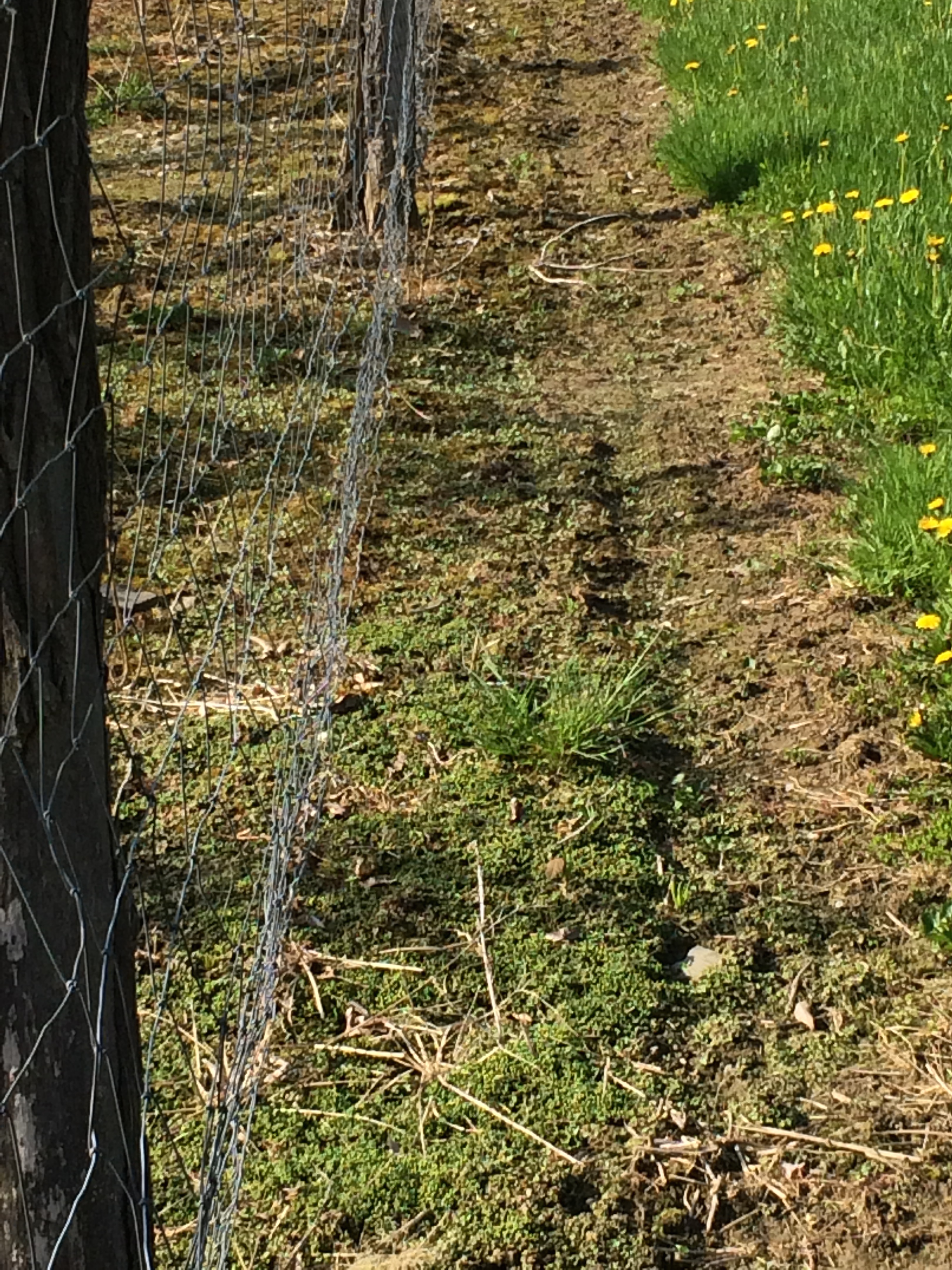
Disturbed soil underneath fence line.

Disturbed soil underneath fence line of enclosure.


I walk near the fence line of the enclosure. I see bare earth and something more.

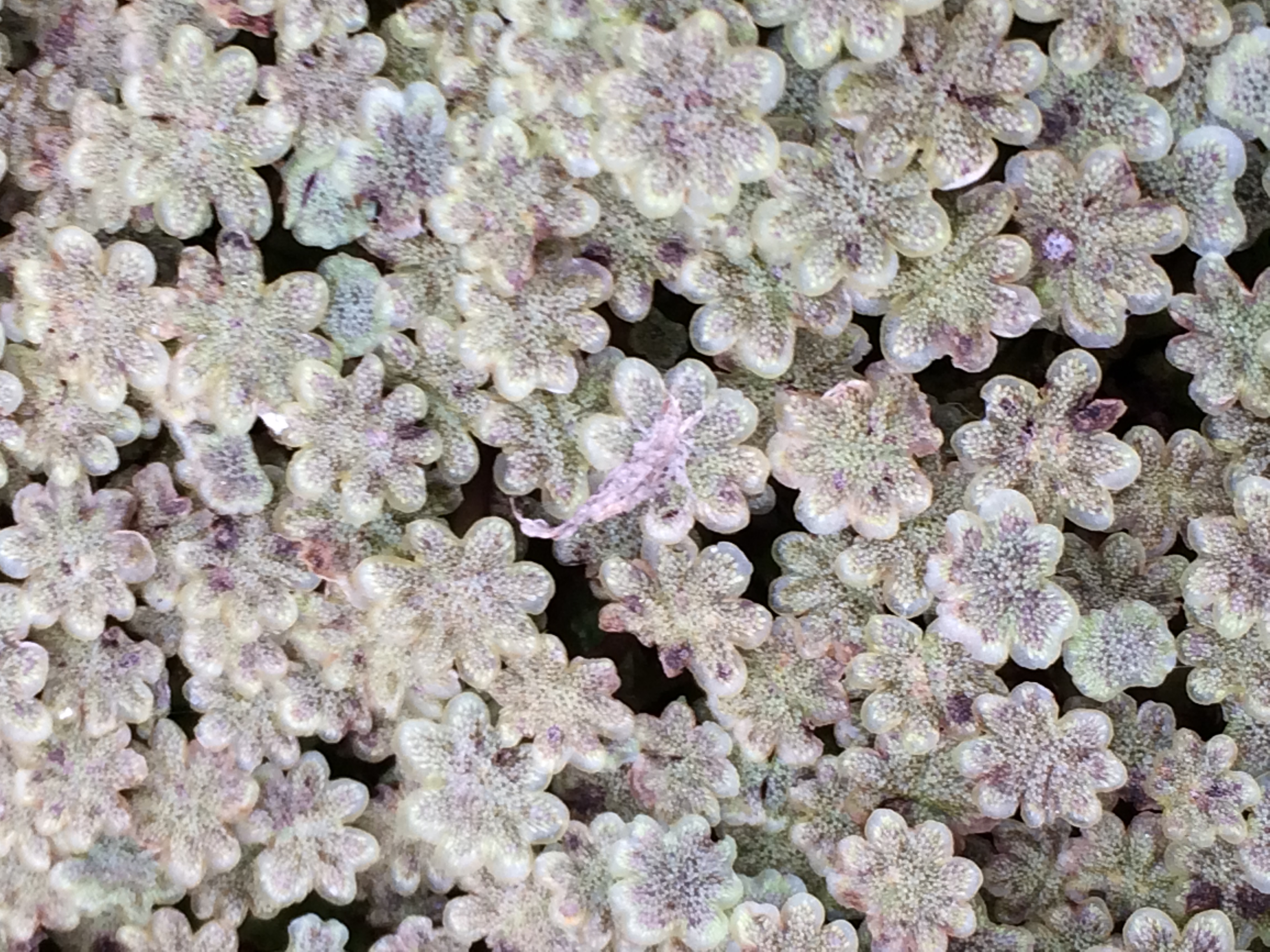
Pale pink pattern of male fruiting bodies of the common liverwort.

Pale pink rosettes of male fruiting bodies of Marchantia polymorpha.

A beautiful pattern on the mud.

Zoomed in image of the one above.

I stopped, thrilled to see an old  friend, the common liverwort (Marchantia polymorpha). Years ago as a graduate student in the Botany Department at the University of Texas at Austin I spent hours looking at slides of every aspect of the life cycle of this primitive, nonflowering plant under the tutelage of the great botanist Professor Harold C. Bold. He was a stickler for life cycles, and this plant has several ways of reproducing itself.

A view of  the female umbrellas of the common liverwort.

A view of the female umbrellas of the common liverwort.


Zoom-in view of photo above.

Zoom-in view of photo above.


View of gemmae cups, which are a means of asexual reproduction. Sometimes called splash cups, the they hold little balls of tissue that splash out in the rain, spreading the plant vegetatively rather than sexually.

View of gemmae cups, which are a means of asexual reproduction. Sometimes called splash cups, the they hold little balls of tissue that splash out in the rain, spreading the plant vegetatively rather than sexually. (I apologize for the focus, but I find it hard to hold my iPhone steady while on my hands and knees with the dogs breathing down my neck, intensely interested in what I am doing.

I walk on, finding a patch with male and female reproductive structures near each other, which means that sperm may easily swim from the underside of their “umbrellas” to the underside of the female “umbrellas,” where sexual union may take place if circumstances (like water) are conducive. Liverwort “love” results in a very little plant, the sporophyte, which only lives on the underside of the female umbrella for a short time, producing spores. There are further explanations about “life cycle” and “alternation of generations” and “haploid vs. diploid” that I could delve into but will dash on instead to basic liverwort stuff.

Male and female reproductive structures relatively close together. Gemmae cups apparent also.

Male and female reproductive structures relatively close together. Gemmae cups apparent also.


The “body” of a liverwort is called a thallus, and is considered primitive because there is nothing much to it at first glance, or second glance, or third glance. A thallus looks like the underside of a very skinny old green bathtub mat, the kind that has suction cups.  Or maybe I should just say that spreading thalli look like pond scum that has found its way to land, which is probably what happened millions of years ago. They do not stand. There is no water-conducting or structural tissue in the thallus. Only the reproductive structures lift themselves from the horizontal. There are so many wondrous aspects of liverwort biology that I could go on about, but I know that blogs are better short than long. I went home and dug up some of my liverwort literature. There is the grand three-volume The Hepaticae and Anthocerotae of North America by Rudolf M. Schuster.

The classic

The classic three-volume The Hepaticae and Anthocerotae of North America by Rudolf M. Schuster.


Volume I.

Volume I.

Volume I.

Volume II.


Volume III.

Volume III.

I have photographed the covers because these are Schuster’s own illustrations (the Foreward notes that he drew 98% of the illustrations in the three volumes) to give a sense of the beauty of these minute plants. In the Preface Schuster writes that he traveled 175,000 miles over the 20 years of his research. His travels took him from Key West, Florida to Ellesmere Island, part of the Qikiqtaaluk Region of Nunavut, a Canadian territory–“within 80 miles of the northernmost edge of land.”  He wanted to see each species as a “living, dynamic entity.” I, a native of the Appalachian mountains, take particular interest in his comment that there is a high degree of endemism in the southern Appalachians. His wife Olga typed and retyped his manuscript and critiqued his work. Professor Schuster  includes an epigraph for the book on a page directly  after the title page:

Quote used in prefatory material to Volume I.

Quote used in prefatory material to Volume I.

There is no epigraph for Volume II, but there is one for Volume III.

Quote in the prefatory material to Volume III.

Quote in the prefatory material to Volume III.

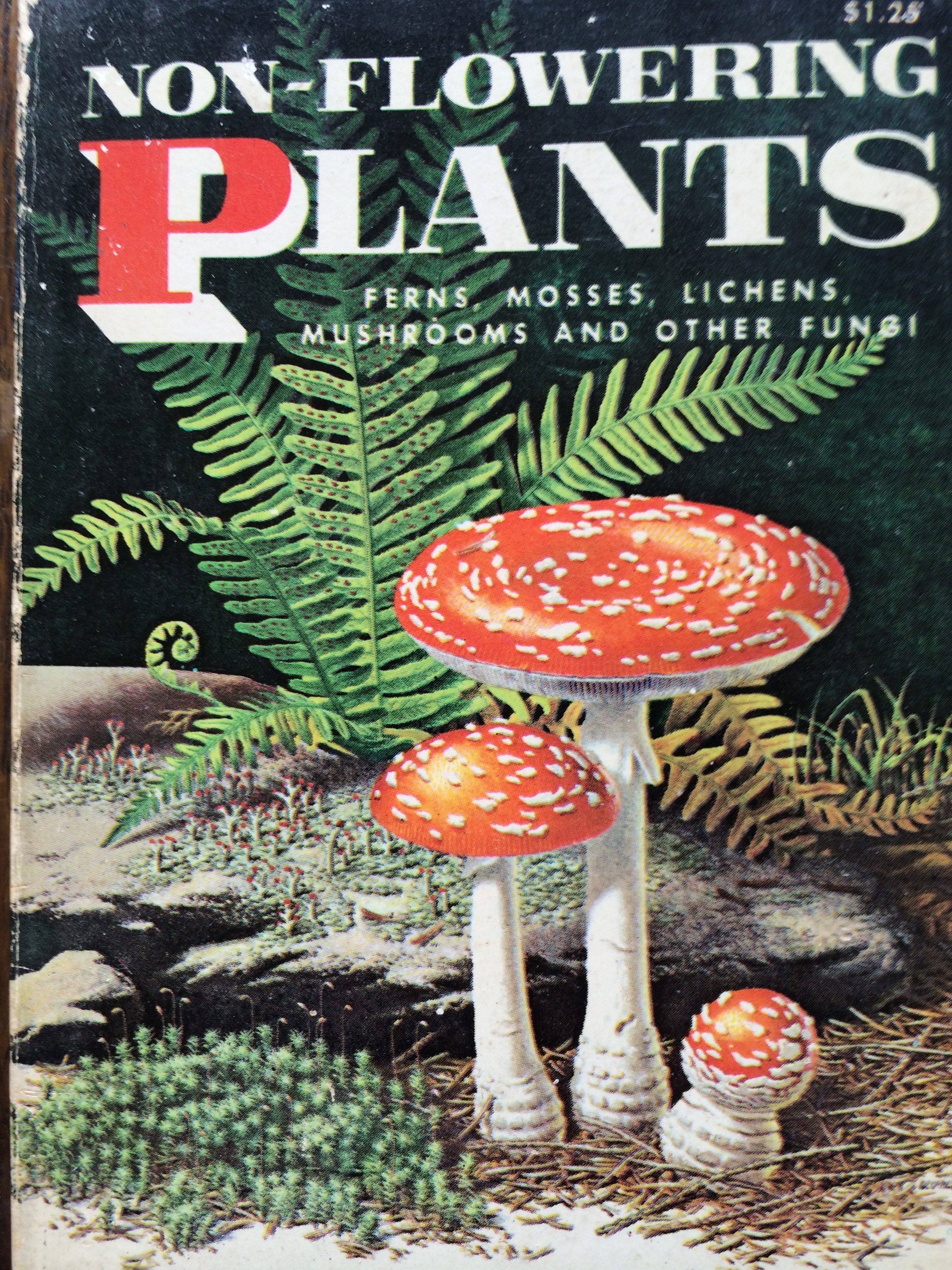
Schuster’s three volumes are a work of art and, as the epigraph above suggests, one good reason for lack of brevity is a textual appreciation for the diversity of flora and fauna found on planet Earth. I have learned that Professor Schuster only recently died, at 91, after a lifetime as a professor, world explorer, bryologist (one who studies mosses), botanist, and writer. Early in his career he studied at Cornell University, which is where I completed my graduate studies in botany, and not very far from where I am writing this blog. The scope of Professor Schuster’s three-volume work is daunting. For the beginner hepaticologist I recommend Non-flowering Plants, a  Golden Nature Guide. This is a wonderful series and I often go to one of their guides to get my bearings in some aspect of the natural world–minerals, spiders, seashells, fossils, ….

Non-flowering Plants, a Golden Nature Guide by Floyd S. Shuttleworth and Herbert S. Zin.

Non-flowering Plants, a Golden Nature Guide by Floyd S. Shuttleworth and Herbert S. Zin.

In defense of little plants, like the mosses and liverworts grouped in the plant family known as the liverworts, the eminentVictorian botanist and plant explorer Richard Spruce, who spent many years collecting, among other plants, the very beautiful leafy liverworts of South America, wrote:

The Hepaticae are by no means a ‘little family.’ They are so abundant and beautiful in the tropics, and in the Southern Hemisphere generally that I think no botanist could resist the temptation to gather them. In equatorial plains, one set creeps over the living leaves of bushes and ferns….In the Andes, they sometimes hang from the branches of trees in masses that you could embrace with your arms….I like to look on plants as sentient beings, which live and enjoy their lives–which beautify  the earth during life….When they are beaten to a pulp or powder in the apothecary’s mortar, they lose most of their interest for me. It is true that the Hepaticae have hardly as yet yielded any substance to man capable of stupefying him or of forcing his stomach to empty its contents, nor are they good for food;  but if man cannot torture them to his uses or abuses, …they are, at the least, useful to, and beautiful in themselves–surely the primary motive for every individual existence.” (epigraph to Schuster’s Introduction of Volume I)

I take to heart what Spruce says about the primary motive for existence–to be useful, and beautiful, to oneself at least. Motivated by his love of mosses and liverworts, Spruce explored, at great expense to his health, and in doing so found bitter bark quinine and introduced it to Europe. Liverworts are useful as well as beautiful. They are known to colonize burned areas, their thalli flattened on the soil like bandaids. Indeed, my husband said that he used RoundUp (it is a commercial nursery) along the fence line of the enclosure, so it should be no surprise to find liverworts there.


Seeing the liverworts reminded me of my days as a young botany student, when I thought I could learn everything about all the species in the plant kingdom (and other kingdoms) and be the richer for it–richer in appreciation for the “endless forms most beautiful” (Darwin) that grow around us.”Studying little things”–I did a great deal of that for a number of years, peering into various kinds of microscopes in the laboratory and on my hands and knees in the field. I am the richer for it, or I would not have noticed, and respected so greatly, what was going on in the mud along the fence line of the enclosure at the tree nursery.


P. S. If anyone does want to know more about the life cycle of the common liverwort, please let me know! And here is my homage to Professor Harold C. Bold of the University of Texas at Austin. There is probably no book in my beloved library that I have ever read so closely as his text:

My copy of the Third Edition of Professor Harold C. Bold's Morphology of Plants.

My copy of the Third Edition of Professor Harold C. Bold’s Morphology of Plants.

I underlined almost every sentence, in pencil, as a young graduate student. Unfortunately, the  more “primitive” a plant (I put primitive in quotes because sometimes a seemingly simple organism is actually a reduced version of something that was once more ornate [elegance is often the result of the trimming of the extravagant), the more Dr. Bold expected that we students should be able to visualize and comprehend the significance of every cell in the plant body (the thallus mentioned above). It was a struggle for me then–the elaborate vocabulary (male umbrellas were anteridiophores and female umbrellas were archegoniophores), the strange convolutions of the life cycle.  I, a human being, wandered in a marvelous botanical garden.

Pages from Bold's Morhology of Plants, illustrating the cellular anatomy of the common liverwort.

Pages from Bold’s Morhology of Plants, illustrating the cellular anatomy of the common liverwort.

A day’s walking in early May

May 2, 2014

6:30 am. I set off around the block with the beast, Belle the Belgian shepherd, who likes to herd everyone she meets. She terrifies passersby, with good reason, because she doesn’t want them to pass by, so I go out early and late.

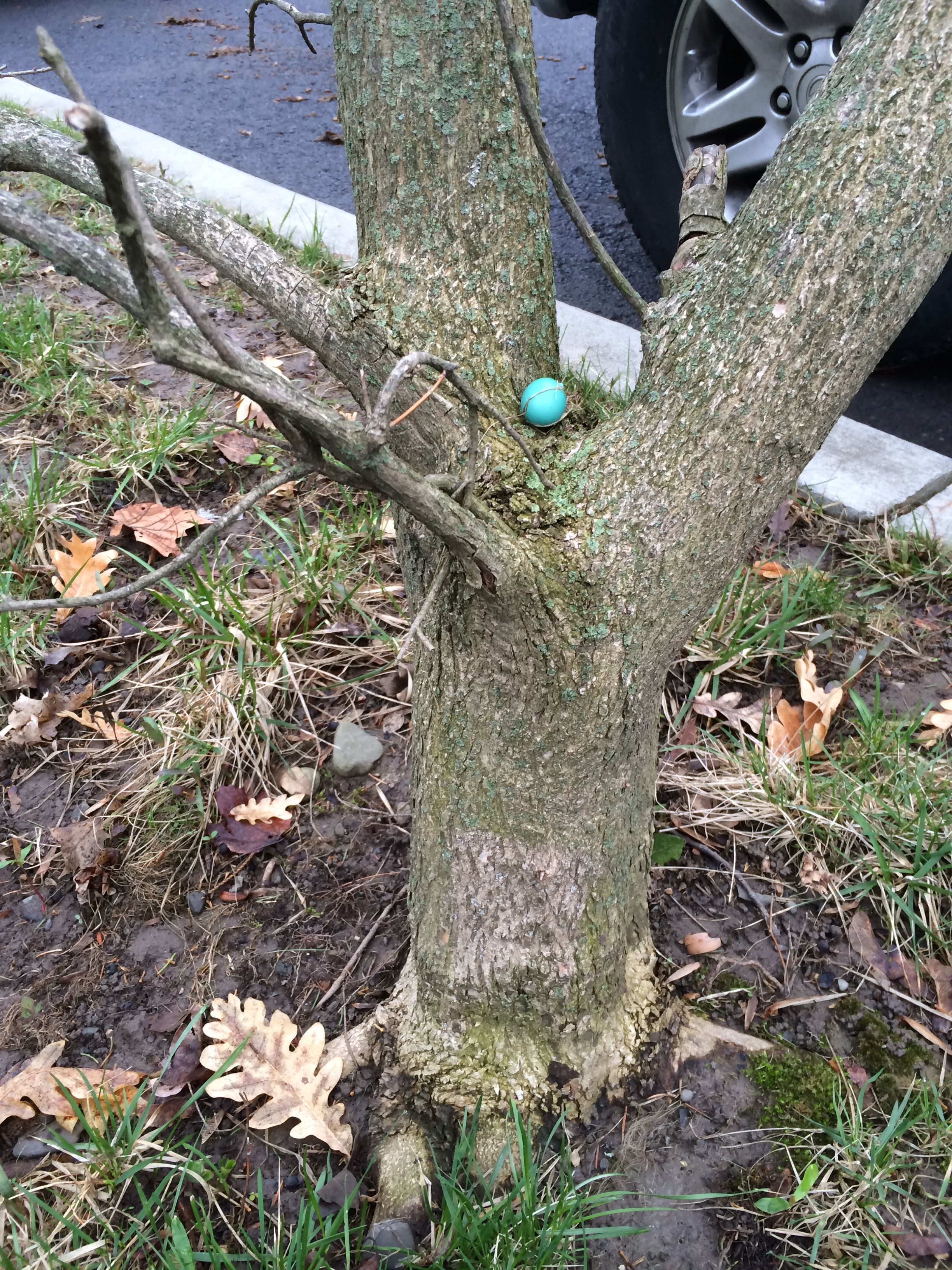
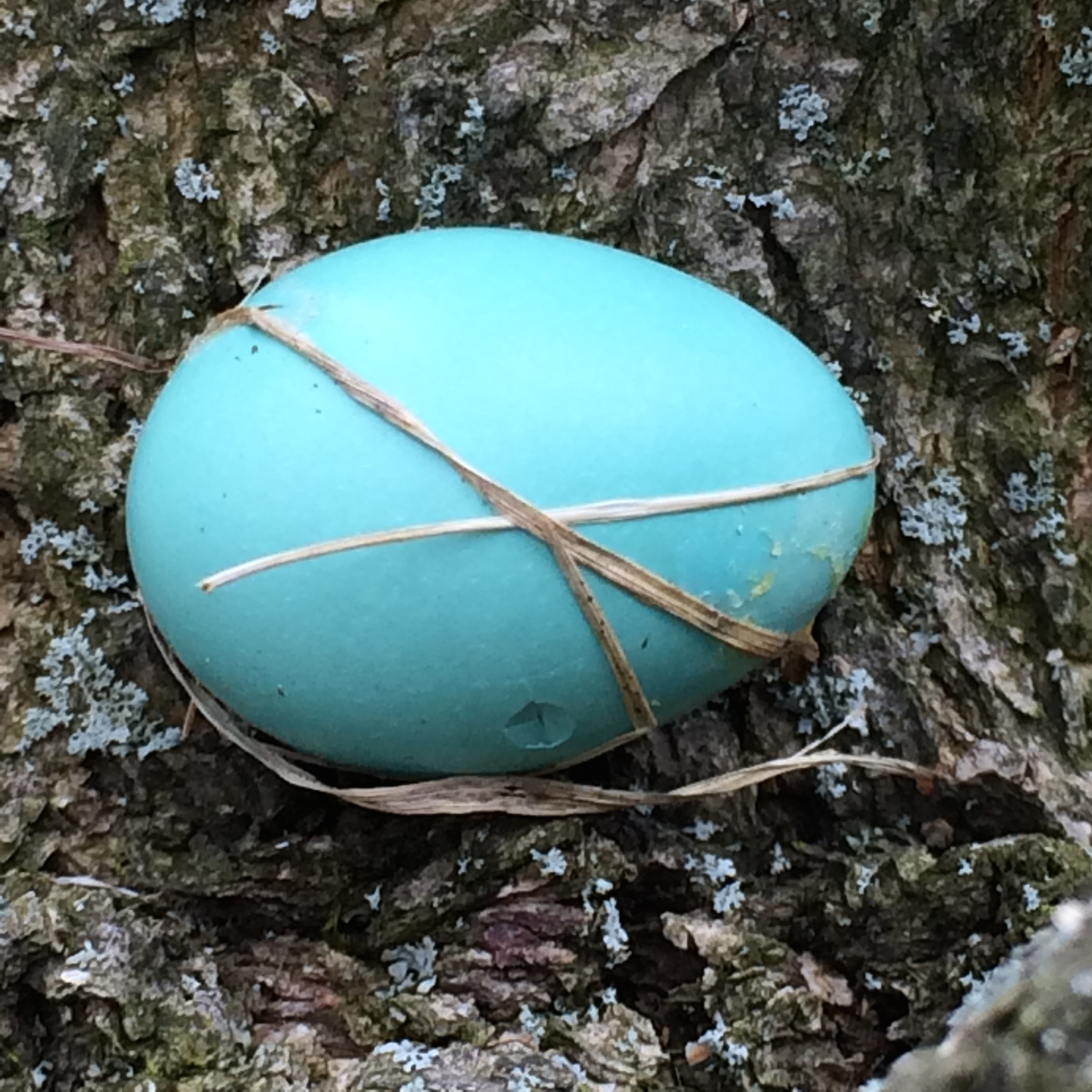
We find a mysterious robin’s egg.

IMG_1128

Robin’s egg in notch of exotic but struggling maple tree (part of Cornell University experiment in urban planting).


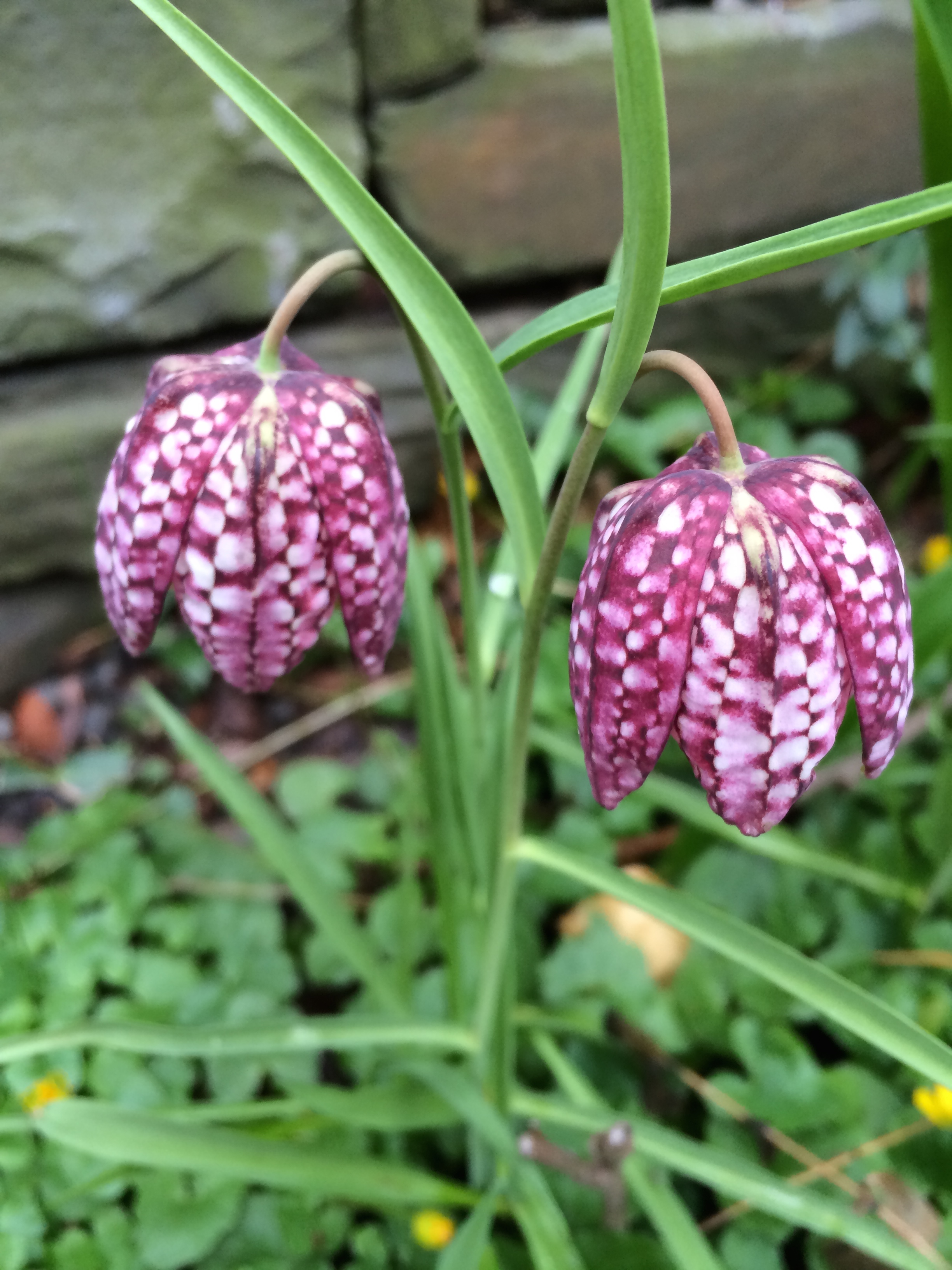
We find the purple of the snake’s head fritillary.

Snakeskin fritlllary in my own front yard.

Snake’s head Fritillary (Fritillaria meleagris) in my  front yard, flowering from bulbs planted years ago.


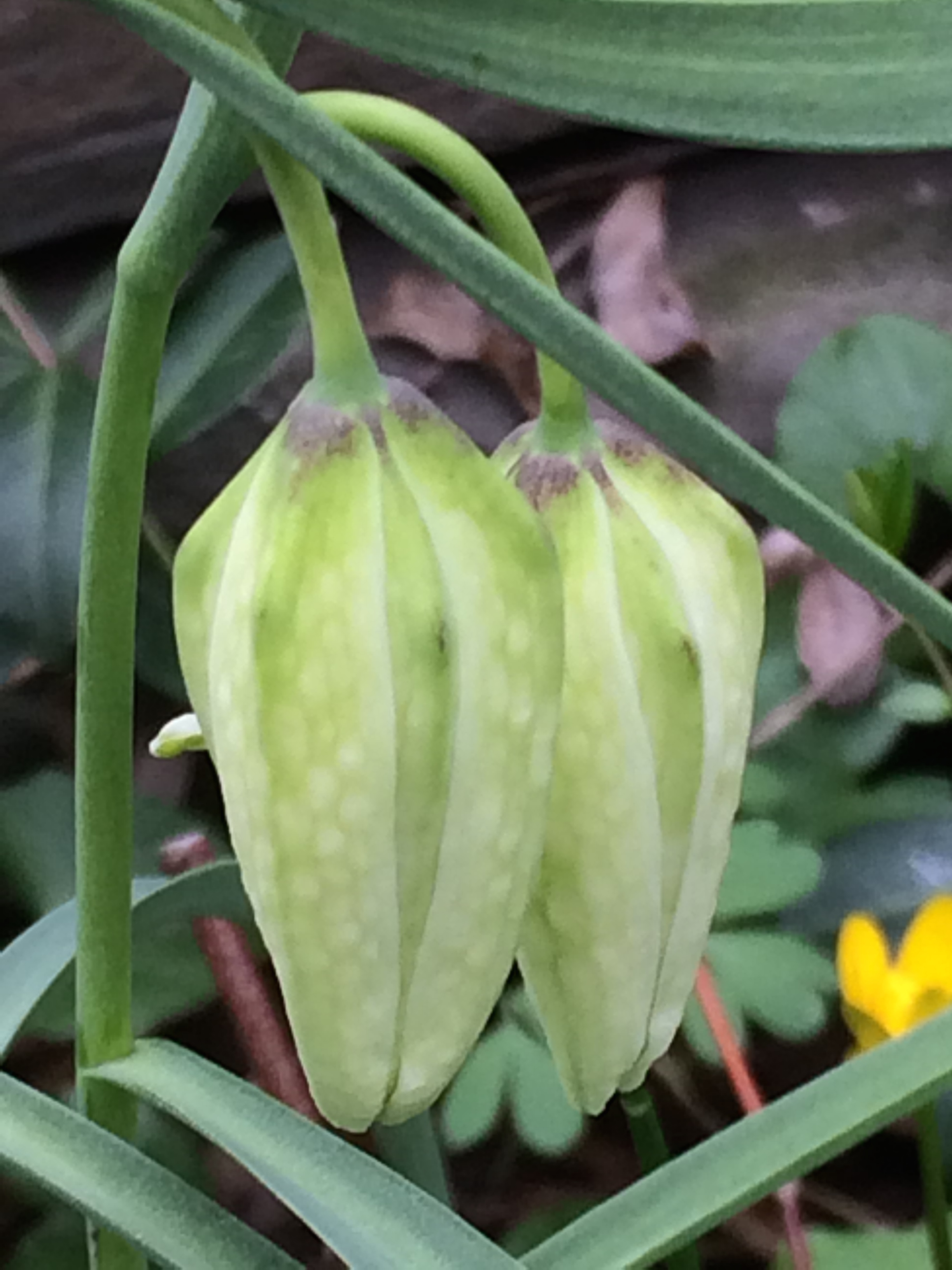
In the UK, they drop the punctuation and simply call it the snakeshead fritillary. There are many other common names for this member of the lily family, but really snakeskin fritillary would be the most apt. The nodding, bell-like flowers do not look like a snake’s head to me, but the checkered pattern is reminiscent of certain snake skins.The buds of the fritillary are at first deep magenta, and then when open exhibit the light-and-dark checkered pattern seen above.


Immature buds of the snakeskin fritillary. They look out of focus even as one looks at them, especially as all stages are present at the same time.

White-flowered variant of the snakeshead fritillary. The blossoms look out of focus even as one looks at them.


Mid-afternoon. I set off to the Cornell Plantations, Cornell’s botanic garden, with a friend to go primrose hunting. There are masses of primroses, but they are not flowering yet.

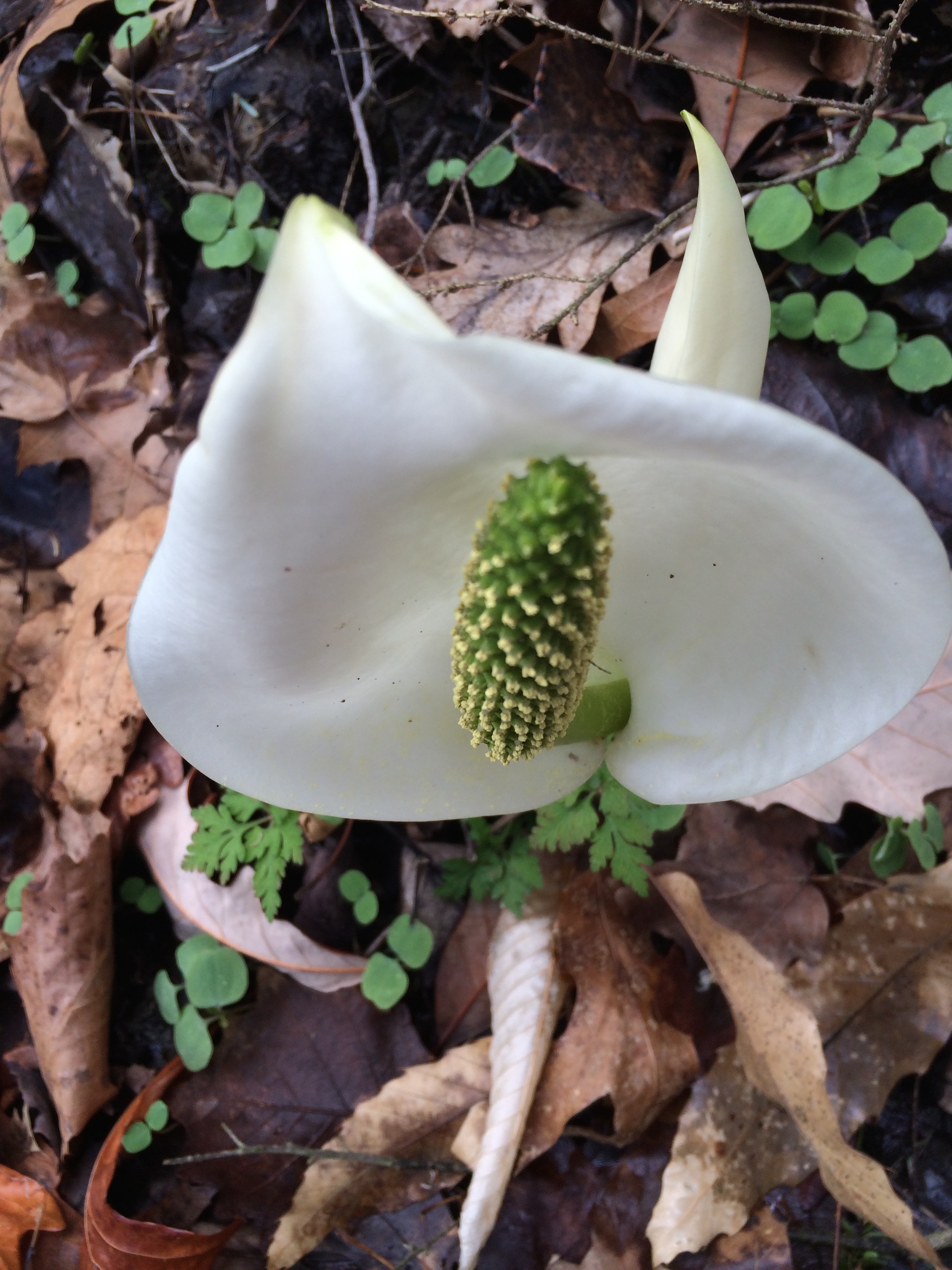
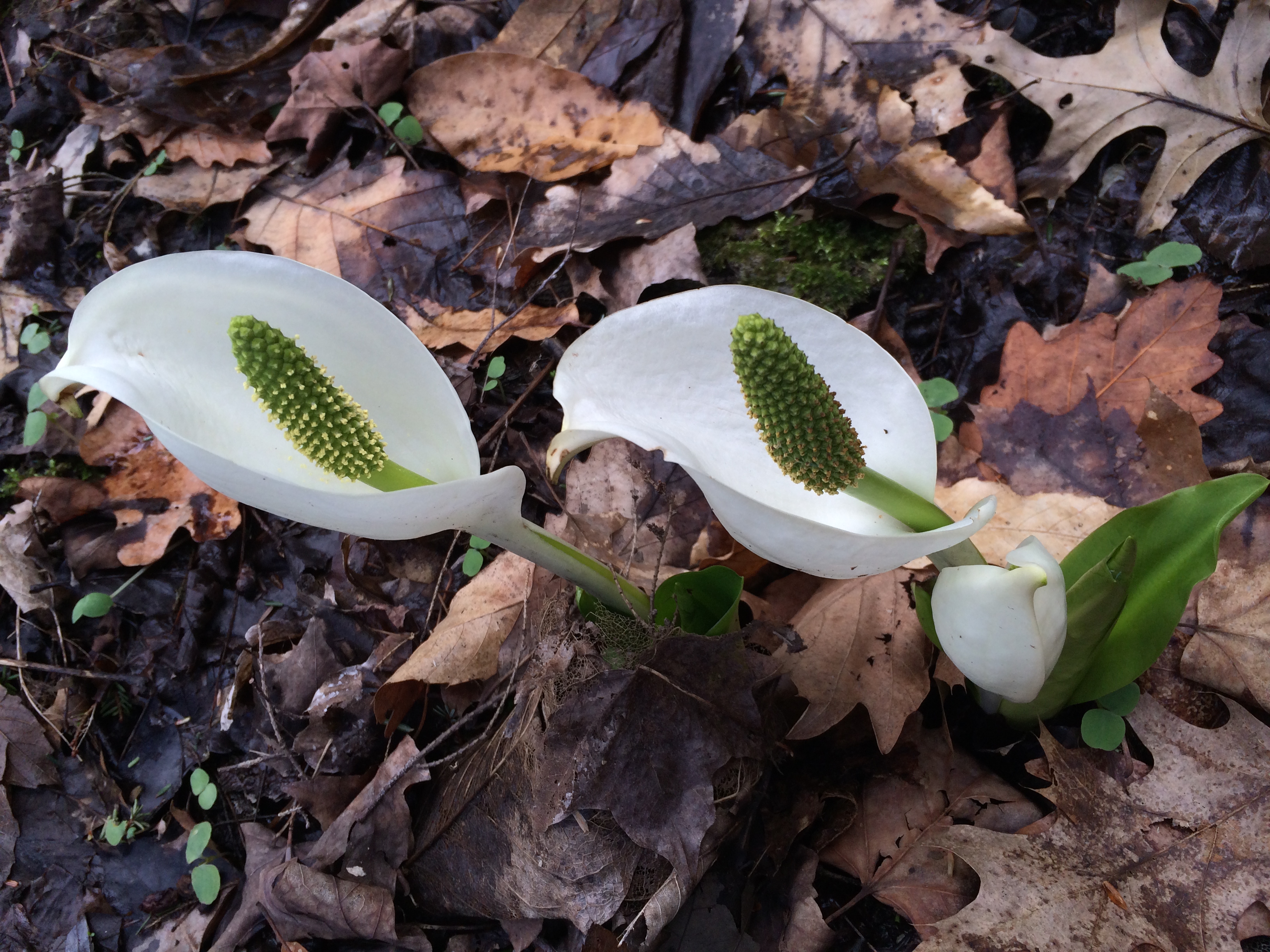
We find a Japanese skunk cabbage instead.


Japanese skunk cabbage at the Cornell Plantations.

Japanese skunk cabbage at the Cornell Plantations.


And then more and more, their white flags artfully furled to catch our attention.


More Japanese skunk cabbage.

More Japanese skunk cabbage.


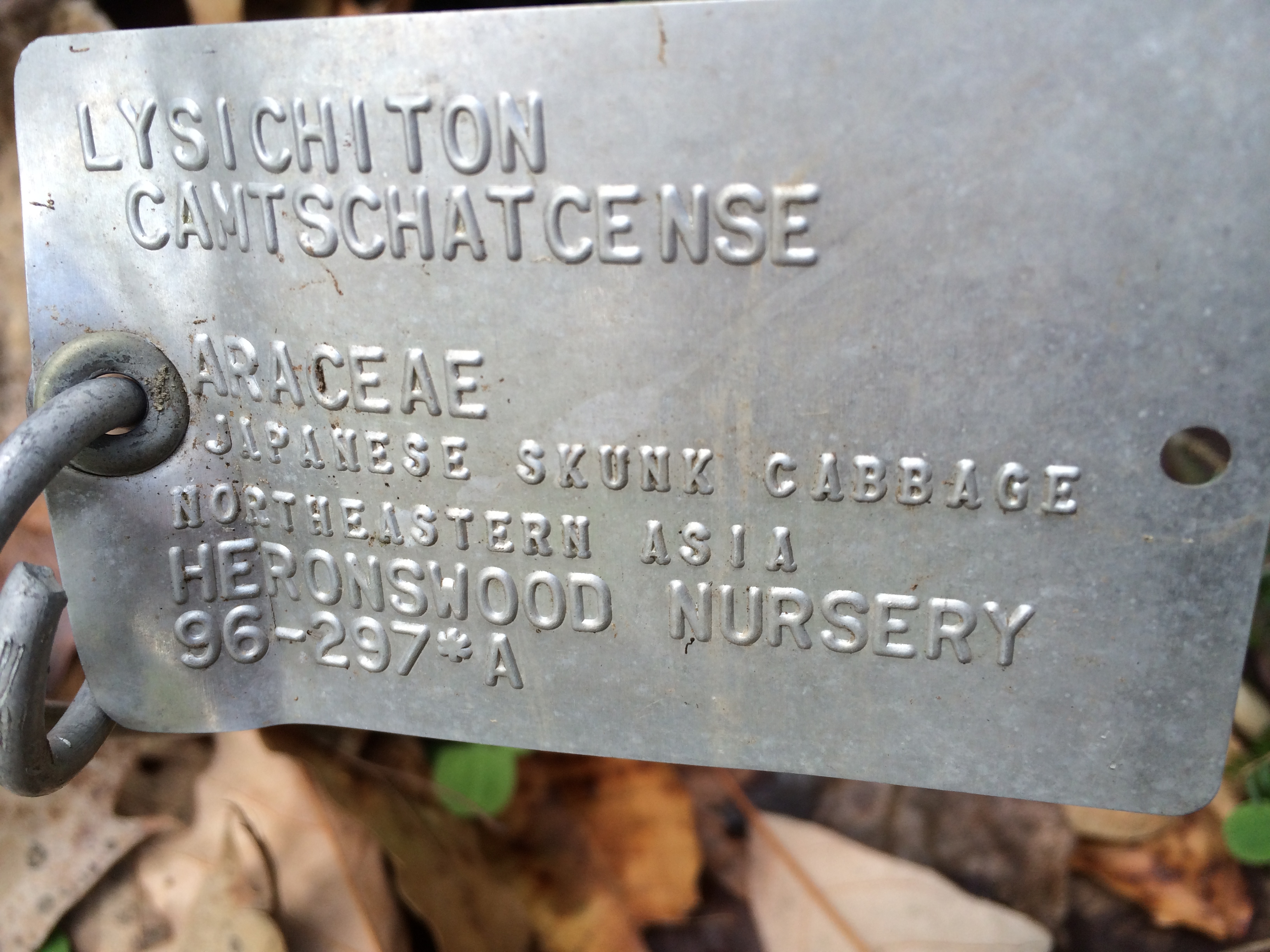
The Latin name of the Japanese skunk cabbage is unpronounceable and unspellable.


Identifying label for Japanese skunk cabbage.

Identifying label for Japanese skunk cabbage.


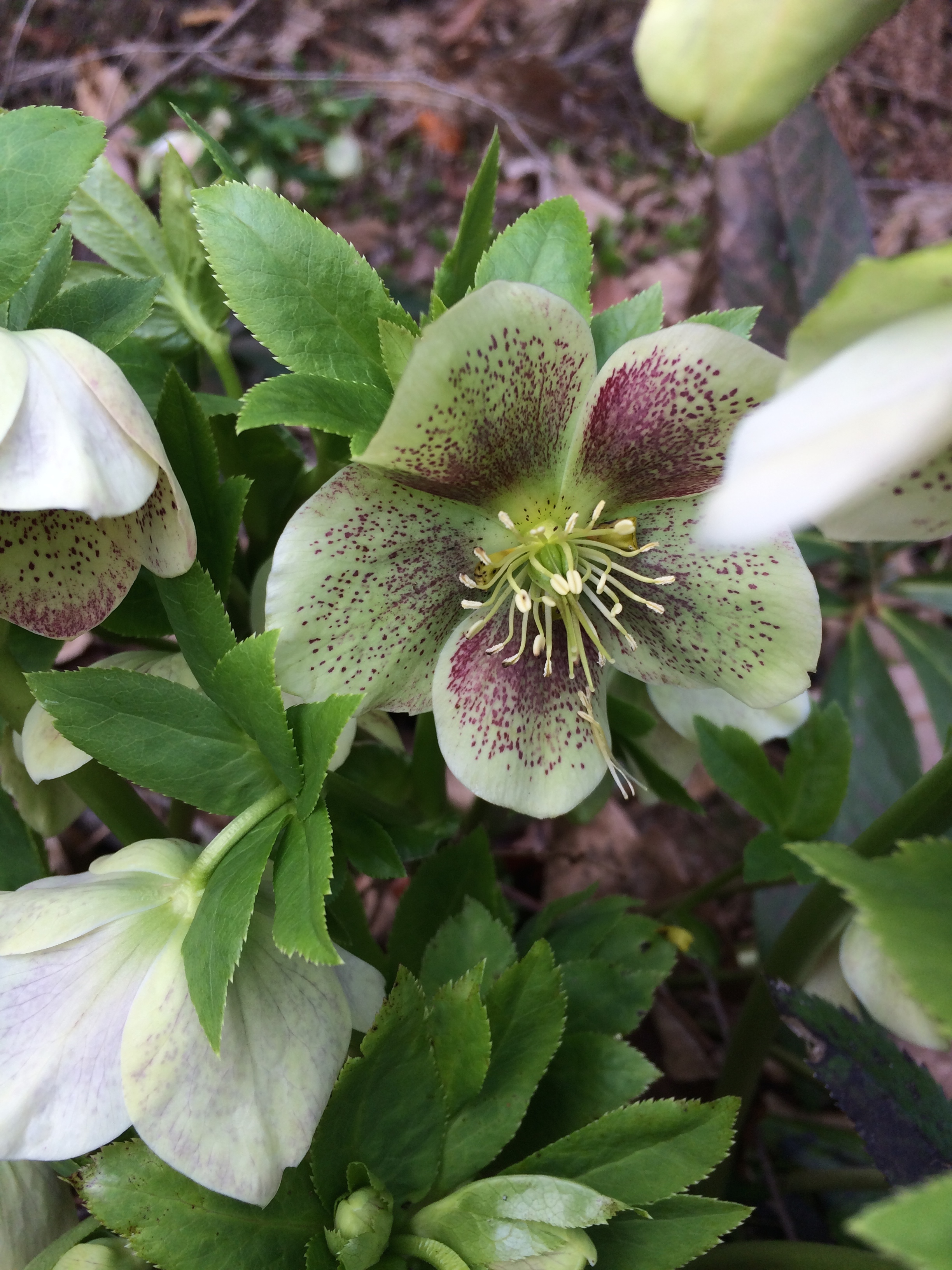
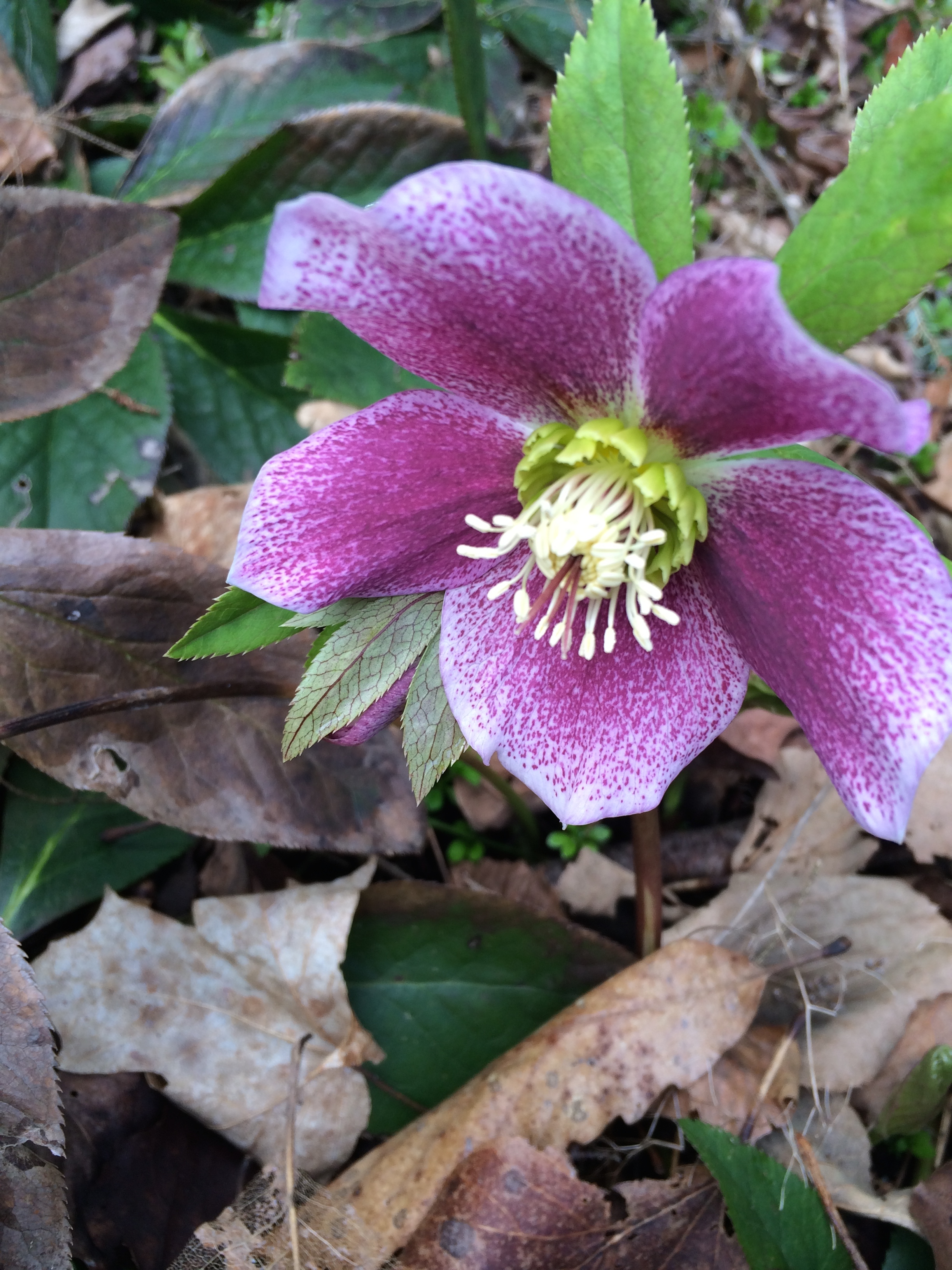
We find the speckled petals of the hellebore (Christmas rose).


Hellebore (member of the buttercup family) at the Cornell Plantations.

Hellebore (member of the buttercup family) at the Cornell Plantations.


Hellebore flowers come in many shades--from pale cream to pale green to pale pink to deep maroon.

The background color of hellebore flowers varies–from pale cream to pale green to pale pink to deep pink, rose, and maroon.


Late afternoon. I am still thinking about the robin’s egg so I take Belle around the block again.  The egg is still there as perfect as before. I had invented a story that maybe the wind wafted it there, but it would surely have broken, so that was not a good story. The robins came back about a month ago, in fact, so many that my neighbor called me. There must have been forty to fifty robins gabbling and babbling in our combined back yards. My husband pointed out that they were feasting on a plentiful crop of last year’s crabapples. The afternoon of the second day of their appearance the temperature plummeted. The weather report called for low teens that night. I worried about the robins and was happy to watch the whole group of them swoop one by one into the dense ivy that has covered almost the entire trunk of a locust tree in our front yard. As the sun went down, they chattered their way into the ivy’s foliage. By dark not a peep. No one would know that the bedraggled winter-burned ivy sheltered so many robins. Robins are quite territorial and thus sometimes termed antisocial, but they do travel in flocks when they migrate. The collective noun for a group of robins is a “wave.” Three or more robins together constitutes a wave!  Surely my neighbor and I shared a tsunami of robins those few days before they moved on. So, I wondered about the robin’s egg. This time I turned it slightly. There was a hole on the back. Clearly a human hand had found it and placed it there in the notch of the tree. I have a new story in my head about how it got there. I’ll save it for further personal embellishment.

As Belle and I continue around the block, we find one of my favorite plants.


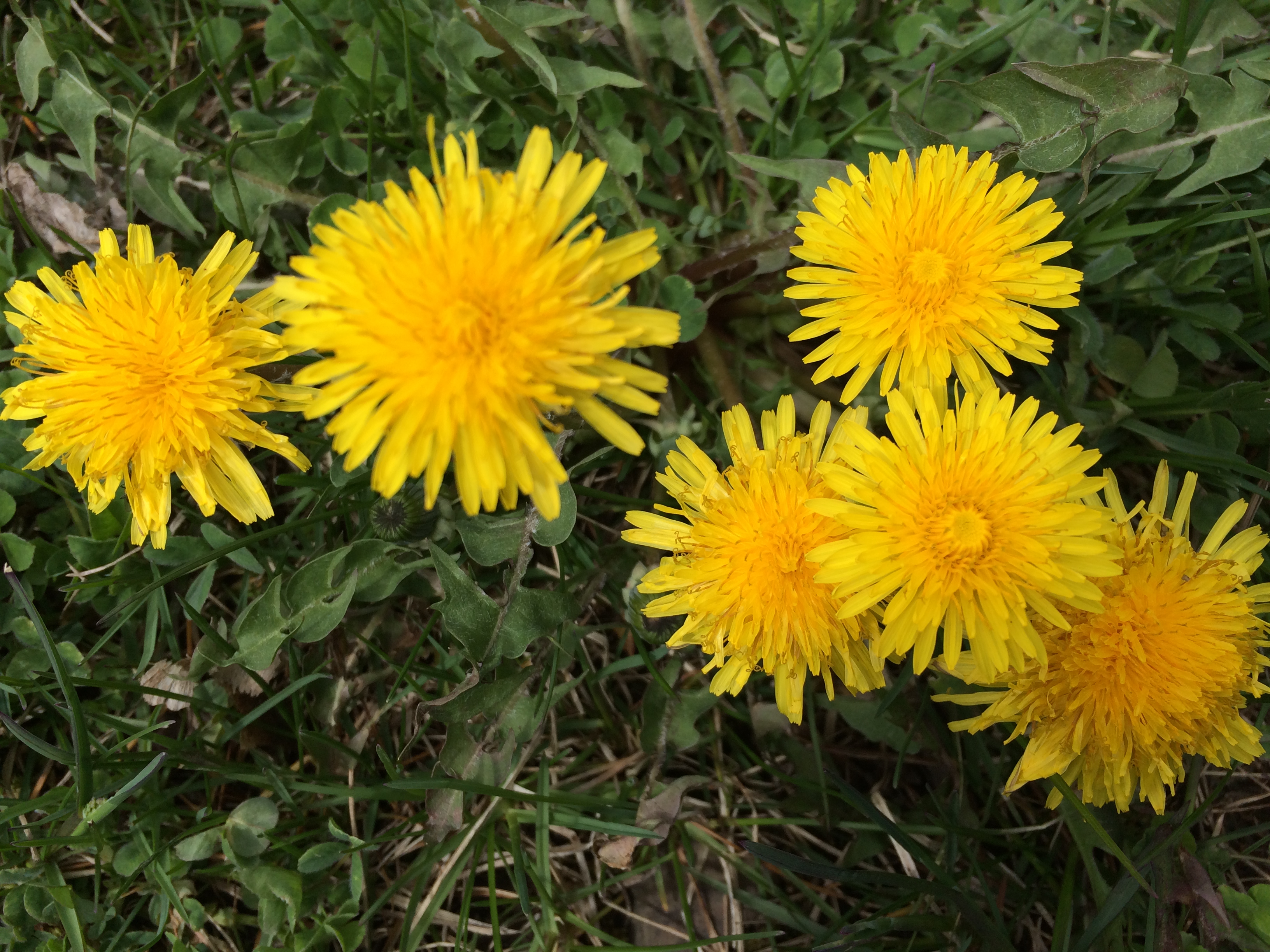
One of my favorites, the dandelion.

The dandelion.


There are so many reasons to admire the dandelion. There can never be too many.

Keep walking, I remind myself. All it takes are footsteps. One walk leads to another.

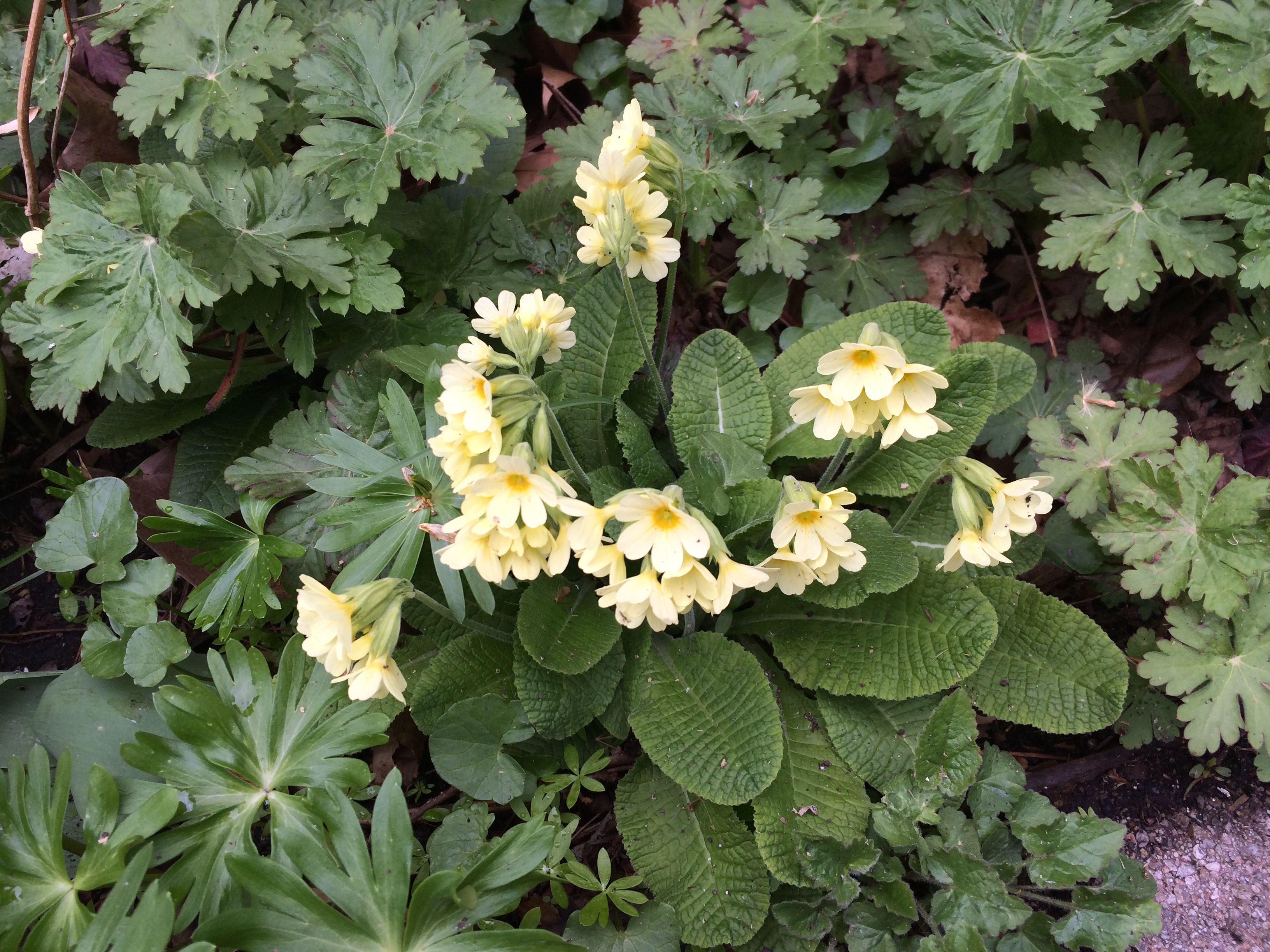
We find a primrose I have grown from seed by the back door.


IMG_1201

My homegrown primrose.


Night. The day is almost over, but I am still thinking about the luminous color of the robin’s egg seen in the half light of early morning.


The robin's egg.

The robin’s egg.


I suppose I am simply amazed that the robin can create such a blue, and this particular egg was wrapped like a gift.  I’ll keep walking.

P. S. I went to check on the fritillaries two days later and not one snake’s head was there nodding in the corner of the wall and the fence. The deer had eaten all five of the blossoms.   The foliage remains, however, and the bulbs are safe underground. For an interesting article on Fritillaria, see “A checkered history” by Andy Byfield of Plantlife.  Endangered in the wild because of habitat loss, the snake’s head fritillary has been rescued by horticulturalists.

Falconress: A Facebook Avatar

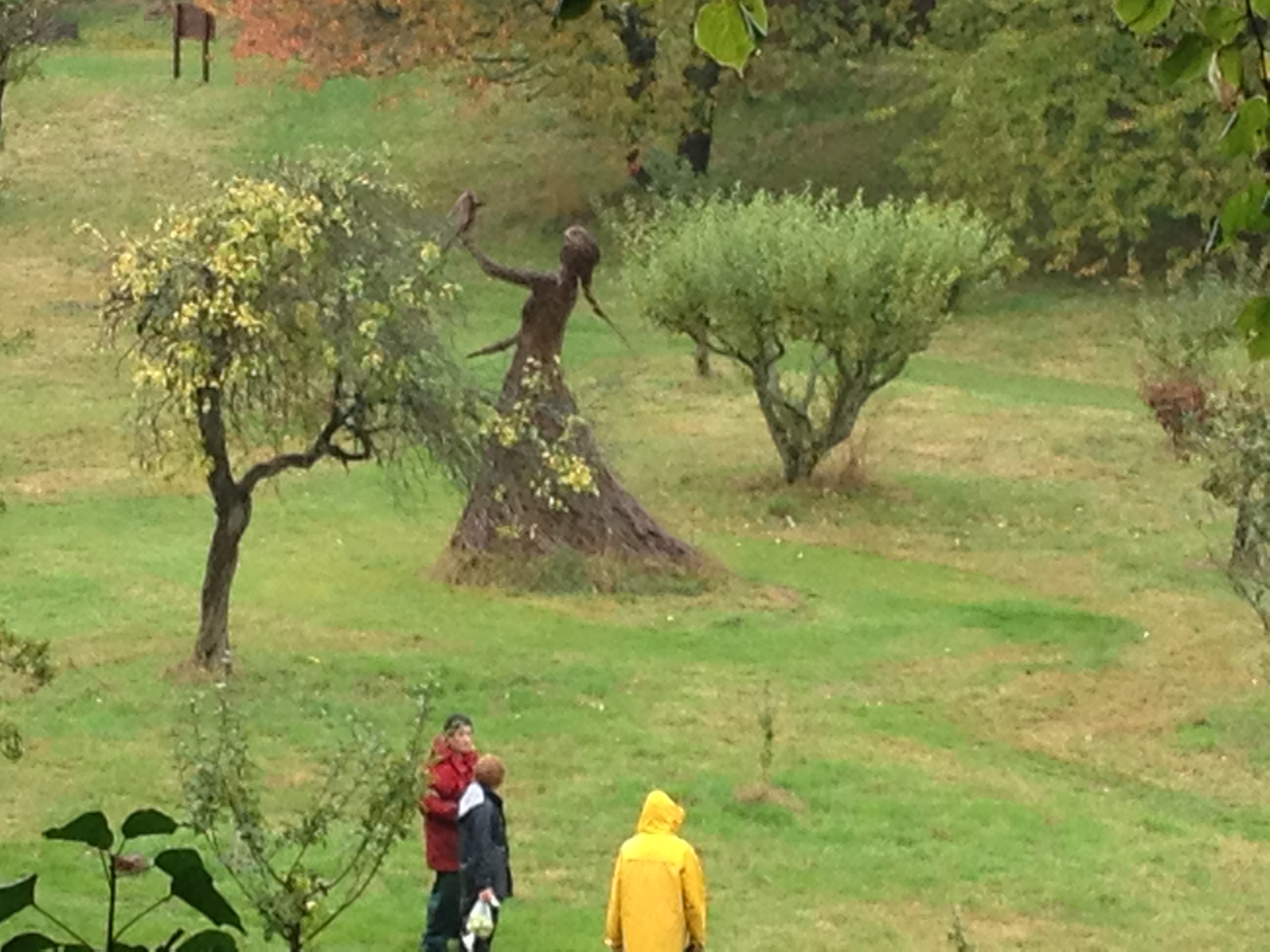
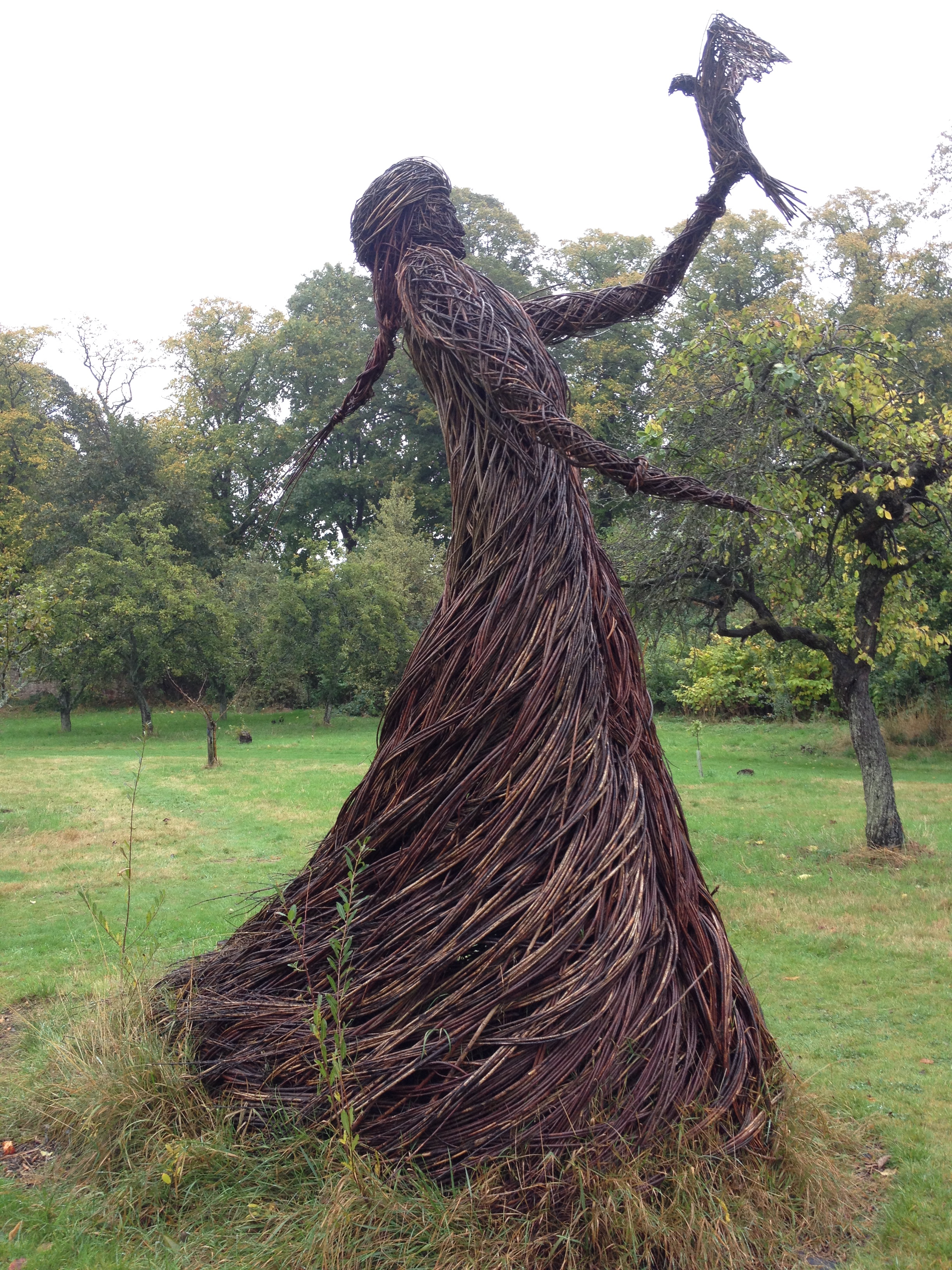
Trevor Leat's sculpture of a falconress (perhaps meant to be Mary Queen of Scots) at Falkland Palace, Kingdom of Fife, Scotland.

Trevor Leat’s sculpture of a falconress (perhaps meant to be Mary Queen of Scots) at Falkland Palace, Kingdom of Fife, Scotland.


My friend and professional mentor Jill Swenson had reminded me once again—“no egg heads on Facebook.” I figured it was time to take action. I have been slow to join Facebook because I struggle with reticence, but having found Twitter a treasure trove of interesting associations and even new windows into the natural world, I decided to dive into Facebook and solve the egg head problem.

But, what image should signify my presence in the world of Facebook? Myself? A photograph of me taken 30 years ago recently turned up. I could photograph that with my iphone and use it, but it seemed so vain to use my youthful unblemished self. On the other hand, my newer, older, self is less pleasing—the neck wrinkles, the liver splotches, the creases around the eyes. I love old faces, but mine is in transition, a work in progress, not fully perfected. When I have, hopefully, reached the fullness of true old age, I intend to love my wrinkles.


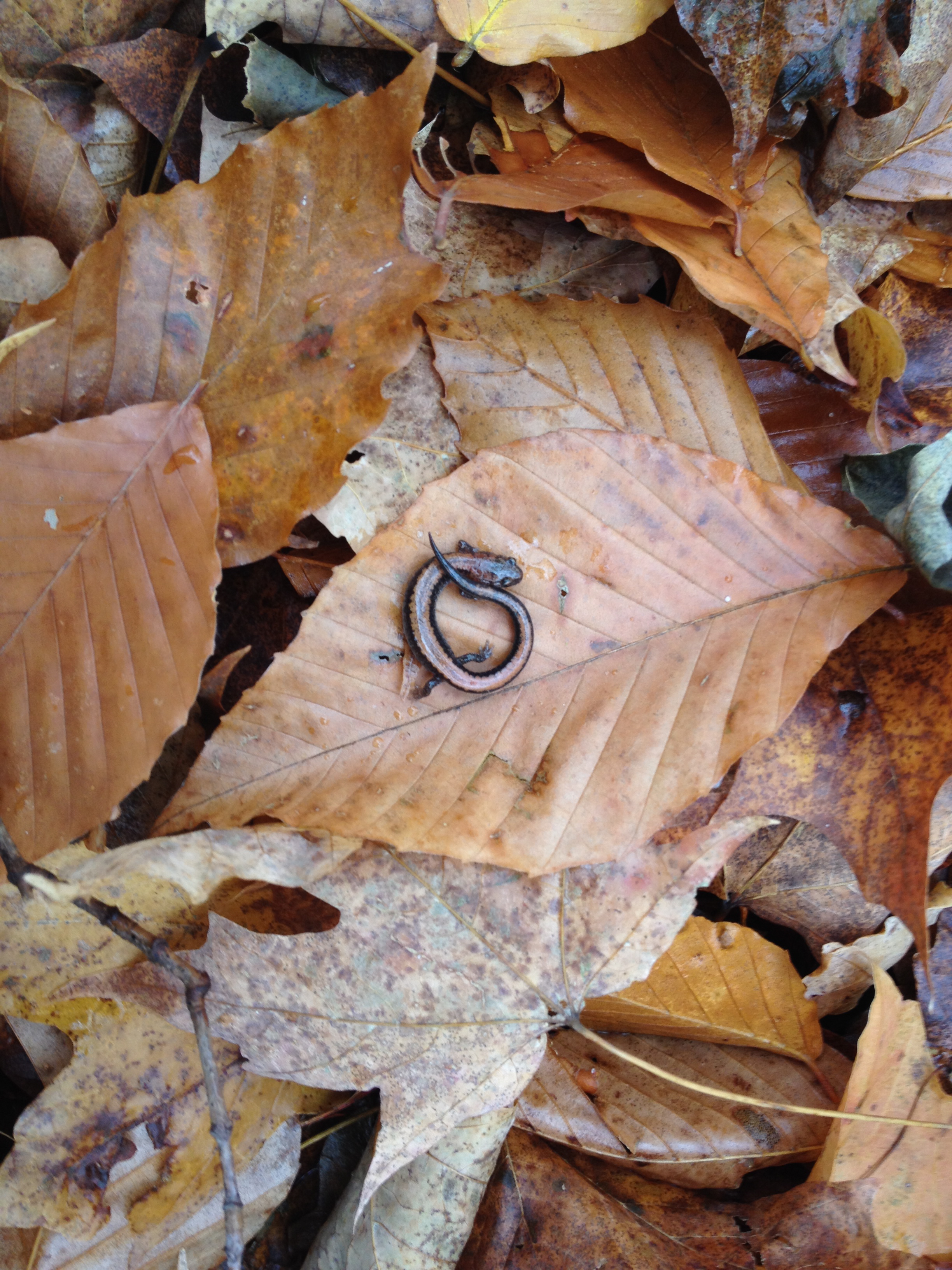
Salamander on fall leaves.

Salamander on fall leaves.


I started looking through my digital photos, quickly, because the whole idea of choosing an image, the opposite of an egg head,  made me nervous. A lovely salamander appeared, coiled like a rune or a Buddhist symbol on overlapping, damp leaves. So lovely, but perhaps indecipherable when reduced in size. I stopped at a beautiful purpley red sunset. A cliché?

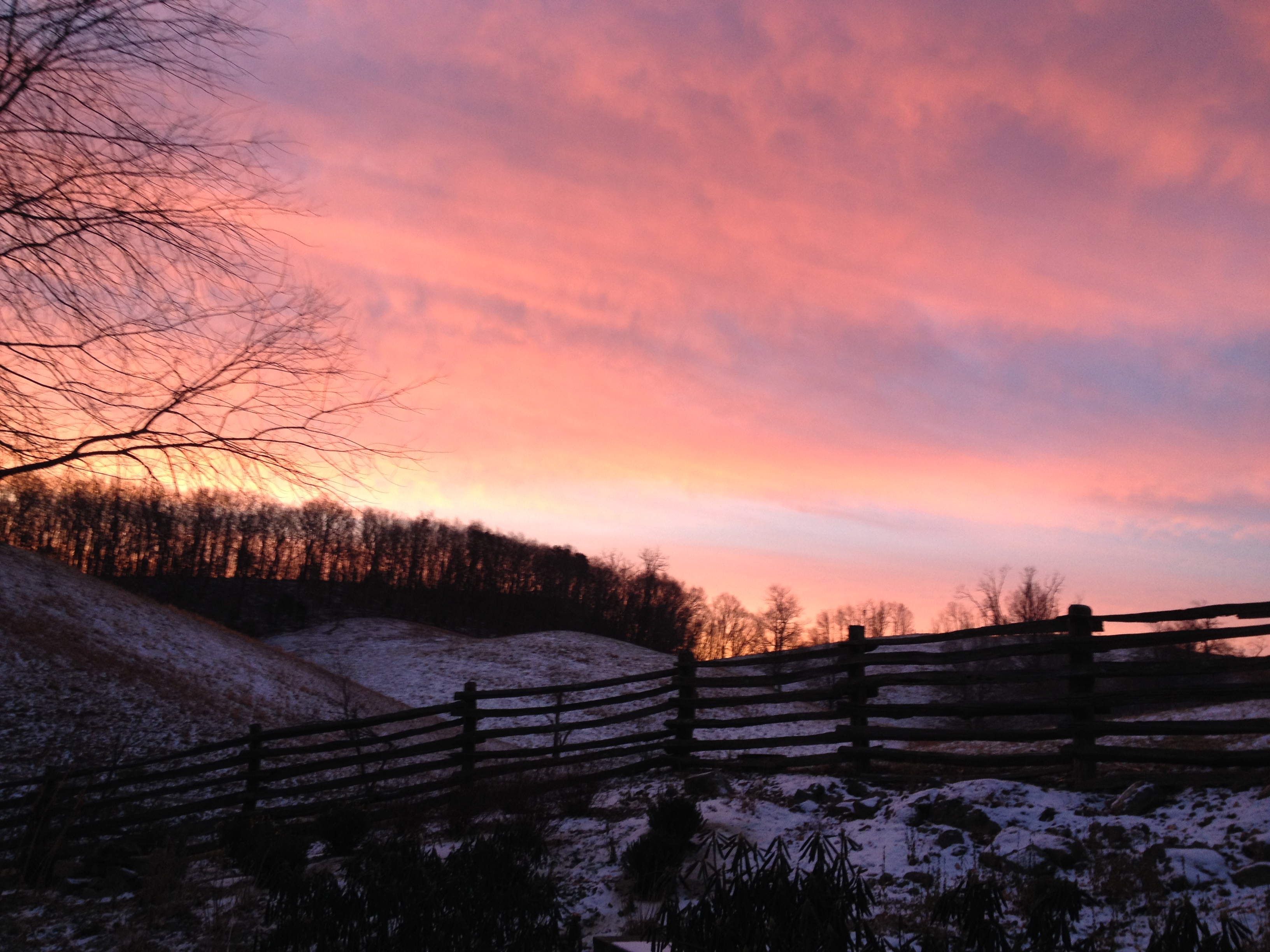
Sunset in Vinegar Hollow, Highland County, Virginia.

Sunset in Vinegar Hollow, Highland County, Virginia.

A sunset should never be taken for cliché, but, out of context, brought into Facebook as avatar, no, I would not want to reduce the beauty of any sunset to the level of cliche–the danger of representation at the hands of an inept human. Then the pond at Seven Fields appeared. Countless times I have tried to catch reflections in this pond:  the crooked tree, the branches, the necks of the geese. I love this tree and this pond, but reduced, perhaps not the tribute I would most wish.

Pond, trees, and ducks.

Pond, trees, and geese at spring-fed pond, Seven Fields, Enfield, Ithaca, New York.


Then I moved into photos taken on a recent trip to Scotland to see younger son, the golfer, who was studying at St. Andrews, Scotland for a semester.

The historic golfing landscape of the Old Course at St. Andrew. (Photo credit: David Fernandez)

The Old Course at St. Andrews, Scotland. (Photo credit: David Fernandez)

While the golfer was studying, writing gobbets, my husband and I roamed the Kingdom of Fife, happening upon Falkland Palace, and there she was, the one I am calling the Falconress, the work of Scottish sculptor Trevor Leat, who creates large, expressive sculptures made from many varieties of willow that he grows organically. Some of his large pieces are burned at festivals, like Edinburgh’s Hogmanay celebration.

Trevor Leat's willow falconress.

Trevor Leat’s willow falconress.


Mary Queen of Scots spent a few happy years at the palace as a young woman. We saw her tennis court (she was an avid player) and her ornately carved bed. However, after seeing her death mask, it was a relief to go outside, though it was a rainy, misty day in mid-October. Tall dark-brown stalks of giant delphiniums tilted against a long stonewall. Giant cedars towered luminously, blue-green in the mist. A small greenhouse glowed with climbing geraniums in all shades of red. Two large garden beds were entirely planted with pale lavender-grey phacelia, a species good for soil improvement the sign said. Falkland has received awards for being one of the most floriferous villages in Scotland. The perennial beds of Falkland Palace must be one its glories in summer.


Close up of the woven willow.

The many hues of  the sculpture’s weathered willow branches.


The gallery of sculptures, posted on Leat’s website and available elsewhere, shows that he is drawn to archetypal forms, like the stag and the human female. Leat’s female figures have flowing lines and generous proportions, and their earthen colors, golden browns, beiges, and greens, glow in an outdoor landscape.  Although his women are tall and robust, their arms taper to delicate wisps. Apparently some of the sculptures bud out in spring, I suppose because some of the willow branches are still green enough or root into the ground a bit. Willow sculptures in the outdoors transform gradually, broken down by sun and rain, often just lasting five years.


The falconress trails a verdant gown.

The falconress leaves a verdant train in her wake.


A history of Falkland Palace states that the Stewart monarchs used the palace to practice falconry, so it is fitting that Leat’s sculpture of the Queen shows her in the attitude of falconress. A brief perusal of the life of Mary Queen of Scots is enough to put one off a royal life for an eternity. The intrigue, the double dealings, the difficult men, it was all dastardly and over the top. She handled the beheading, apparently, with equanimity and grace, thankful perhaps that her life was finally over. During her imprisonment she was allowed to fly a merlin in and out her window. This must have been a pleasure, being so close to a wild creature, a vicarious experience of freedom. One can imagine her listening to the swoosh of feathers through the air at take off and her watching the bird disappear into the sky.

I have never been attracted to falconry, though I am a great fan of T. H. White’s The Once and Future King, where the art of falconry figures,  and The Goshawk, an account of White’s tempestuous relationship with a young hawk he tried to “tame,” his first, and last, attempt at being a falconer.  For a current account of falconry practiced in North America, see Rachel Dickinson’s book Falconer on the Edge:  A Man, His Birds, and the Vanishing Landscape of the American West. White’s Merlyn is a great fictional character. He advised (my paraphrase):  when you are sad, learn something. This is good advice.

Some historians speculate that falconry began between 4000 and 6000 BC.  A Japanese historical narrative of 355 AD, Nihon-shoki, states the first falconer in Japan was a woman, whose daughter followed in her footsteps. Women in 19th century England were said to outshine men in proficiency. The word “falconress” is not in the OED, however. The only use of the word I have come across is in a poem by Robert Duncan called “My Mother Would Be a Falconress.” The poet compares the relationship between mother and child to that of the falconress and her falcon. It’s a dark, moody poem reflecting some of the strangeness of the relationship at the heart of falconry–and at the heart of parenting. Nevertheless, Leat’s sculpture appeals to me. Both bird and woman appear poised for flight. She is both sinew and grace. How lovely to be made of willow!

A final view of Trevor Leat's falconers.

A final view of Trevor Leat’s falconress.


The jade vine blooms!

Orchids on display at New York Botanical Garden's orchid show.

Cattleya orchids on display at New York Botanical Garden’s annual orchid show (March 9, 2014).

“So, what’s your vote? What’s the most amazing flower here?” a father asked his two young children. He sat on the knee-high edge of a long reflecting pool that ran the length of a stately glasshouse. There was no answer as his children were too busy trailing their hands among the water lilies. It was the second weekend of The Orchid Show: Key West Contemporary being held at the New York Botanical Garden (March 1- April 21, 2014). I was there with my son and grandson, just two.

Son and grandson in a conservatory of the New York Botanical Garden:  son pointing finger one way and grandson pointing  finger the other way.

My son and grandson pointing to different routes in the conservatory of the New York Botanical Garden. The two year old led the way.

“I vote for the jade vine,” the father said, looking up.

Raceme of jade vine flowers dangling over the reflecting pool at NYBG.

Raceme of jade vine flowers dangling over the reflecting pool at NYBG.

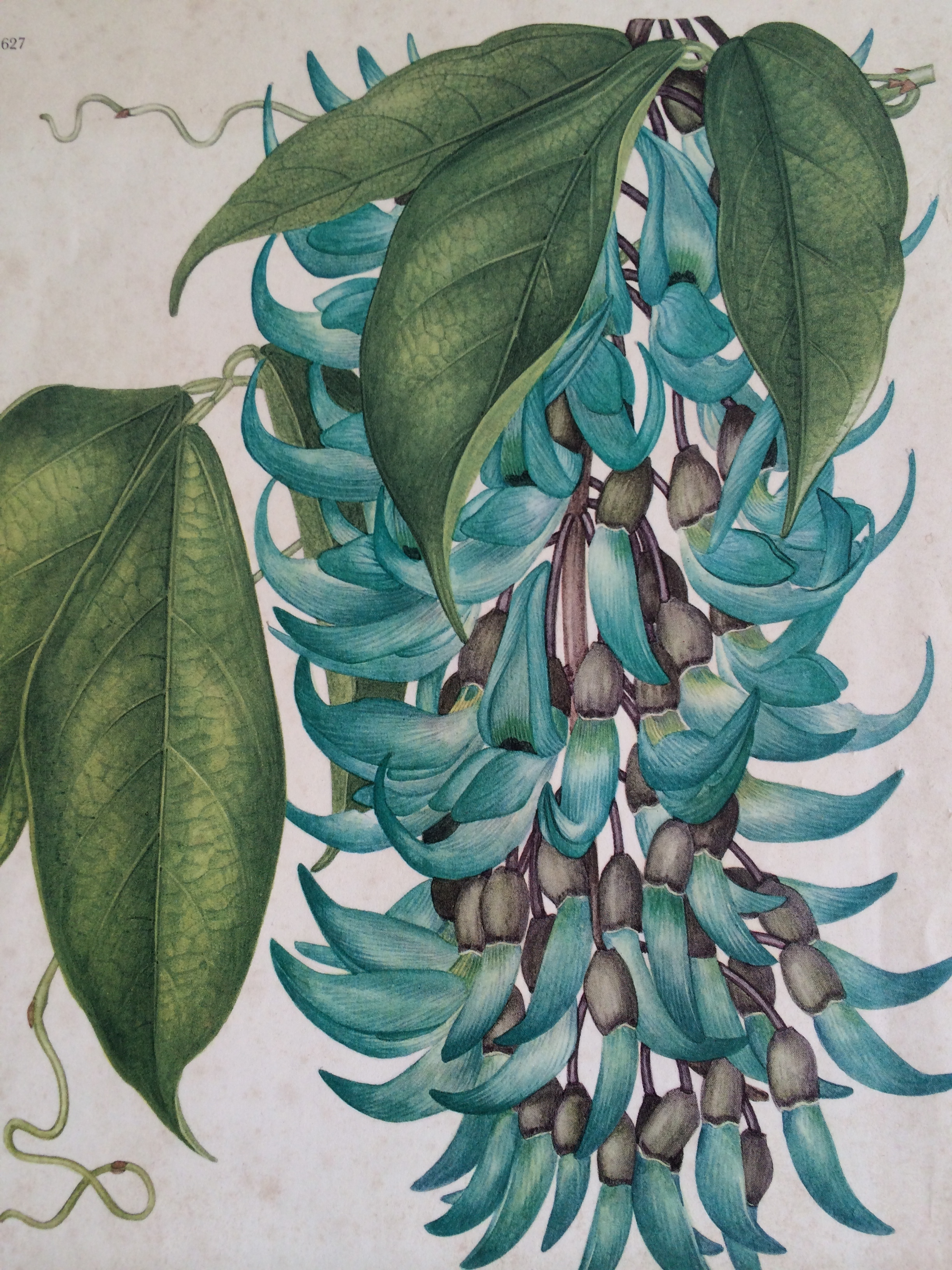
I answered the man. “Yes, I agree. The jade vine wins.” After college, I worked for a year at the Royal Botanic Gardens in Kew, UK, as a work-study student. There I met my first jade vine, and came home with a botanical drawing by Margaret Stones that I have carried with me ever since.

Botanical artist Margaret Stone's rendering of the jade vine.

Botanical artist Margaret Stone’s rendering of the jade vine.

To a budding botanist, Kew Gardens was heaven, but my entry into heaven was rough—and the ordeal was orchid related. I arrived in September for my first day of work with a terrible head cold contracted in the dry air of the British Airways flight over. I still remember the skimpy navy blue blanket I huddled under and how cold I was the entire trip. Mr. Pemberton, the director of students, had said he would put me “under glass” in the orchid house for the first three months because (it was clear during my interview that he didn’t like Americans) he assumed that I was a pampered sort I suppose. (I proved him wrong.) We have heard about orchid thieves and orchid addicts, but has anyone heard the story of a naive, young preparer of orchid potting medium? The supervisor of the orchid house set me to work making orchid “soil.” In my botanizing in Highland County, Virginia as a child I had met a number of orchids, beautiful species like the slender ladies’ tresses, which were terrestrial and hid sweetly among the meadow grasses. I was shocked when I saw how tropical orchids were arranged in the propagating house, attached to little gravestone-like boards, hanging row on row, on the side walls of the greenhouse. The “public” never entered this greenhouse. In the jungle these tropical orchids live as epiphytes high up on tree branches on leaf litter, absorbing nutrients through their peculiar spongy roots that protrude like branches into the air. They don’t live on the ground in soil. However, there were a number of tropical orchids that resided in clay pots on waist-high benches in the central part of the greenhouse. They didn’t need “normal” potting soil, but rather a special nutrient-poor potting medium.

Photograph of drawings of ladies' tresses orchids (Spiranthes) from Peterson & McKenny's A Field Guide to Wildflowers.

Photograph of drawings of ladies’ tresses orchids (Spiranthes) from Peterson & McKenny’s A Field Guide to Wildflowers (p. 18). The slender ladies’ tress grows in Vinegar Hollow, Highland, County, Virginia.

Making orchid compost with a bad head cold proved to be a nightmare. First, I snipped clumps of dried sphagnum moss into smaller pieces with scissors. Sphagnum moss is a wonderful vehicle for water retention when it is moist, but dry, it’s like fiberglass insulation. Luckily I didn’t know about sporotrichosis, the rose-gardener’s disease, but maybe that’s why I suffered so. Bits and pieces flew around and went up my nose where they tickled and prickled, causing profound irritation. Then I had to separate clumps of charcoal into smaller pieces using sieves the size of dinner plates. Clouds of charcoal dust surrounded me, invading my nostrils and sinuses.  The final step was to mix the chopped sphagnum and charcoal chunks with shredded bark. Hooray for shredded bark, a relatively “quiet” substance. After mixing, voila, a suitable substrate to anchor the orchid in its pot where it never wanted to be! I made orchid potting medium for a month and got sicker and sicker. I could hardly breathe and I couldn’t sleep at night for the coughing and snuffling and expectorating of greeny black effluent. Each day when I got on the tube to go to my flat, I looked like a chimney sweep, blackened snot dripping from my nose, my hair gray, my eyes red.

Another treasured moment from my year at Kew Gardens, a print of the squirting cucumber (Ecballium elaterium).

Another treasured momento from my year at Kew Gardens, a print of the wild squirting cucumber (Momordica [Ecballium]  elaterium), a copy of an 1842 Burnett botanical print). I met the squirting cucumber in the order beds, where species were arranged by family, and  watched fruits explode.

  Fortunately things just got better (no, I forgot about the horrible, horrible episode of potting up practically an entire greenhouse of Primula obconica, one of the woolly primroses, from which I got a gargantuan [not quite the right word here, but I am trying to make the overall point clear] case of hives that drove me insane). For my last “tour of duty” at Kew, I spent three months in the great Palm House, doing this and that (other stories…).  It was full of palms, obviously,  historic cycads, tall gingers, and many other wonderful tropical plants that dazzled me. There were vines too, dripping from the rafters of the greenhouse. I was lucky. For the first time in many years the jade vine flowered when I was there. Just one raceme in late winter that dangled to the top of my head in the North end of the glasshouse, as I yelled “Closing Time” in my best British accent. Just as stuffy as Mr. Pemberton in my own way, I didn’t think it proper that an American should be doing the honors at such an important moment. When the jade vine puts on a show in the conservatory of a botanic garden, it usually makes headlines in the local newspapers. On April 7, 2003, The Oxford Times ran a piece with the headline “Our vine isn’t jaded” and quoted curator Louise Allen who said “It’s incredibly difficult to grow and you can never guarantee it is going to flower.” They were proud to have 60 flowers “spikes” according to the newspaper. The more proper term is raceme to describe the huge pendant clusters of wisteria-like flowers. The headline in The Hindu Times on July 2, 2005 included the words “as precious as jade.”

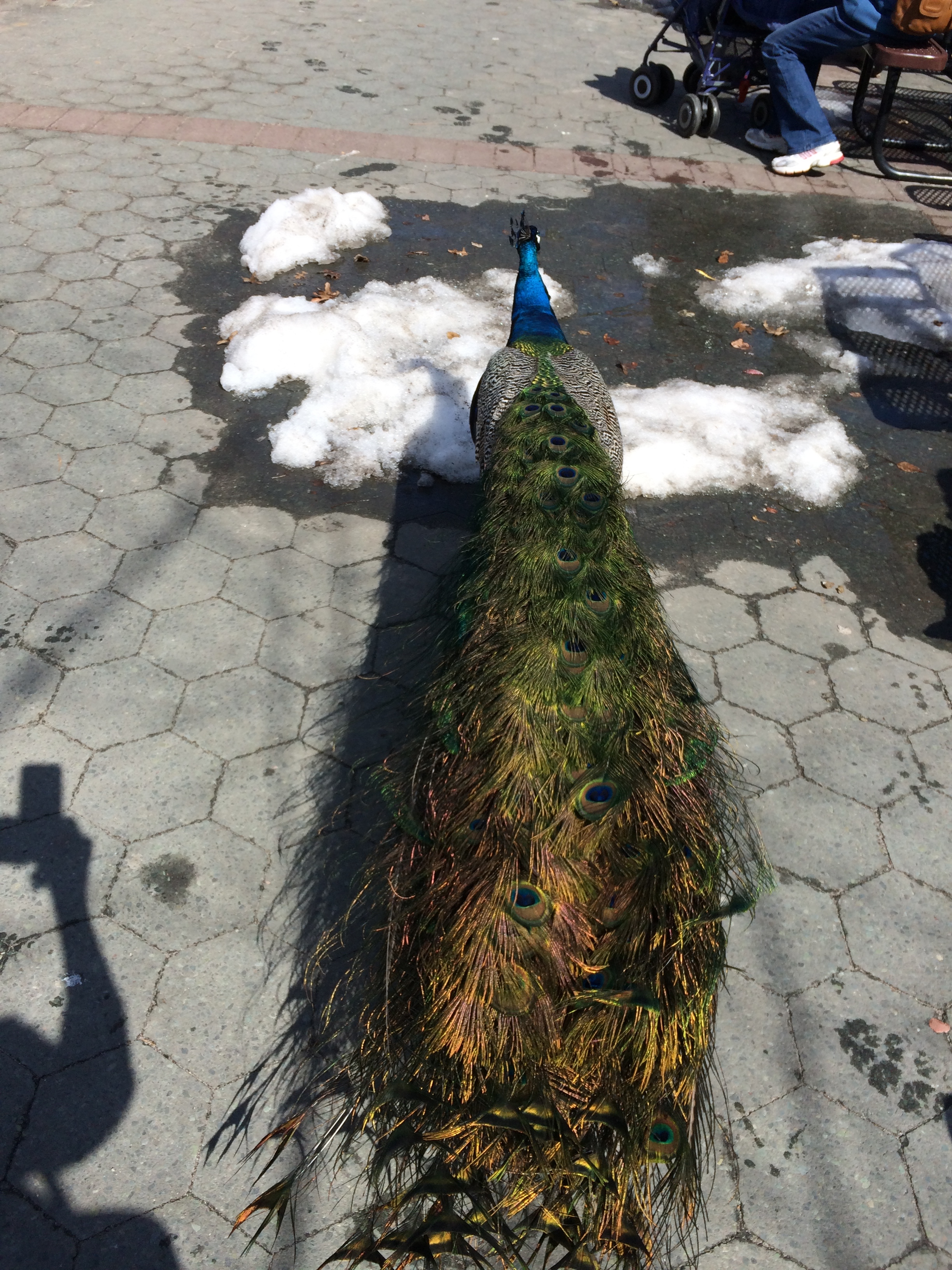
Peacocks roam the outdoor eating area at NYBG scarfing up french fries and the like.

Peacocks roam the outdoor eating area at NYBG scarfing up french fries and the like.

I would say the specimen at NYBG is growing like topsy, as “rampant” and “rank” and “aggressive” (all words applied to the growth habit of the jade vine) as it can get in the still relatively confined space of a conservatory. In the wild of its native Philippines, it can grow to 80 feet and each raceme can carry 100 flowers. But it’s the color that makes you stop dead in your tracks.  I think it safe to say that there is no other flower in the plant kingdom so strangely, alluringly, and bizarrely colored. It is like jade, but the hue in plant tissue takes on a startling iridescent sheen. I picked up a blossom that had fallen to the floor and put it in a small plastic address box I carry. By evening the blossom was shot through with the colors of the northern lights– pinkish, pale bluish, lavenderish, pale jadish.

Close-up of Margaret Stones' botanical drawing of the jade vine.

Close-up of Margaret Stones’ botanical drawing of the jade vine.

Its shade has been scrupulously characterized in a lovely book published in 1976, Flowering Tropical Climbers by Geoffrey Herklots.  The author, botanist and ornithologist, developed a hobby of cataloguing sightings of the great tropical vines of the world and drawing them, beautifully, both in color and in line drawings. For the jade vine, he names three colors with numbers, probably in reference to an artist’s color chart that apply—Jade Green HCC 54/1 and 54/2, Viridian Green HCC 55/1, and Chrysocolla Green HCC 56/1. Interestingly, jade, viridian, and chrysocolla are all mineral stones. There is something mysteriously unplantlike about the color of the jade vine, as if it’s the result of being crossed with a lizard or a chameleon or rare gemstone.

Rampant, "agressive" growth of jade vine.

Display of jade vine’s vigorous growth.

The shape of the each blossom adds to the intrigue. A member of the Fabaceae (Leguminosae) or Pea Family, the blossoms have the characteristic architecture of pea flowers, but on a grand scale. The jade vine’s awkward-sounding Latin name derives from the Greek “strongylodon” meaning spherical and “botrys” meaning raceme or cluster.  Grouped en masse, the blossoms’ “claws” or “keels” zigzag swingingly down the stalks, sultry scimitars just looking for a fight. The flowers are the opposite of flimsy, often described as “fleshy” or “waxy.”

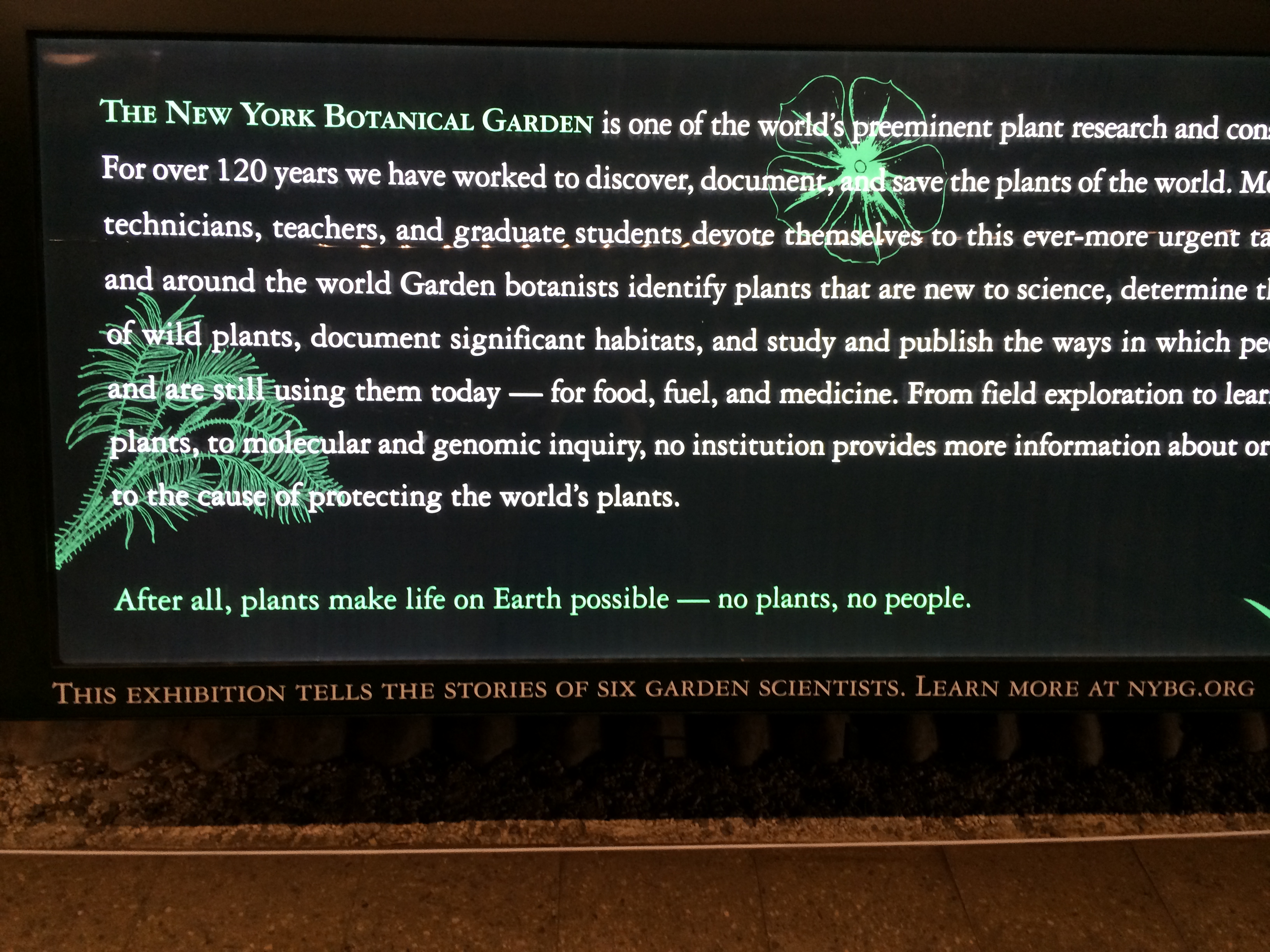
Informative display in the greenhouse, reminding us "no plants, no people!"

Informative display in the greenhouse, reminding us “no plants, no people!”

The jade vine is losing its place in the wild, although a recent expedition of botanists to Palanan Point in the Philippines has found locations where it still climbs freely. Known to be bat pollinated, specimens have not been happy setting seed in the conservatory setting, but researchers at Kew Gardens have recently enabled a plant to set fruit. A few years ago their website showed a heavy pod attached to the vine with a little help from a supporting macramé like mesh. In Puerto Rico, bees are vigorous pollinators, tearing apart the flowers for nectar in the process. So what is the world’s most beautiful flower? The question is unanswerable. Is it one of the orchids– the voluptuous cattleya?  the delicate slender ladies’ tresses? or is it the sea-foam green jade vine flower? (Or is it the peacock’s tail?)

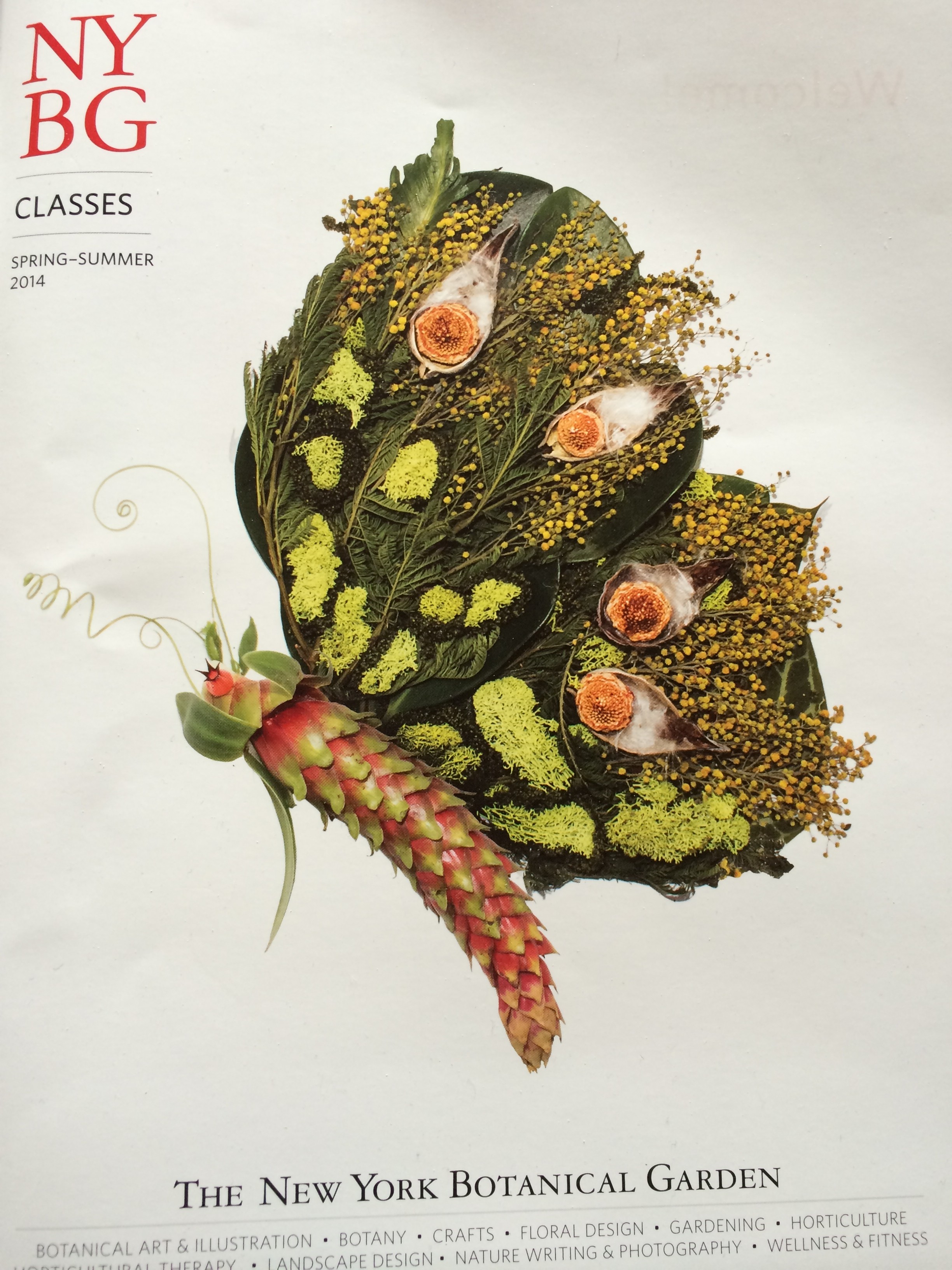
Cover of NYBG's Spring/Summer Catalogue, listing classes and events.

Cover of NYBG’s Spring/Summer Catalogue, listing classes and events.

Who is the fairest of us all? That is not a good question, and the young father did not ask that question. He asked, “What is the most amazing flower here?” Yes, the jade vine. It was then in early March, and still now, the most amazing flower at the orchid show at NYBG and the most amazing flower I saw during my year at Kew Gardens. The fairest?  Each organism is the fairest of us all. We need every speck of diversity, as E. O. Wilson, the great naturalist has said over and over. Working with plants, in horticulture–sowing seeds, digging, planting, weeding, mulching–has always made me feel grounded, literally and spiritually. Plants have been for me, from a young age, a lifeline to sanity (except for those few experiences mentioned above). I look at each individual plant and feel rooted in partnership as his or her neighbor on the Earth. Support your local botanic garden. Take classes. Draw plants. Write about plants. Grow plants. Weed, yes, but place the weeded gently in the compost. Remember the words on NYBG’s display sign: “After all, plants make life on Earth possible–no plants, no people.” If we are what we need, then people are plants, and, why not consider the reverse,  plants are people.

Tending foxes: real and imaginary

A few days ago I drove past a dead fox on a road I travel frequently. I stopped and backed up carefully. I feared it was my fox.

IMG_0343

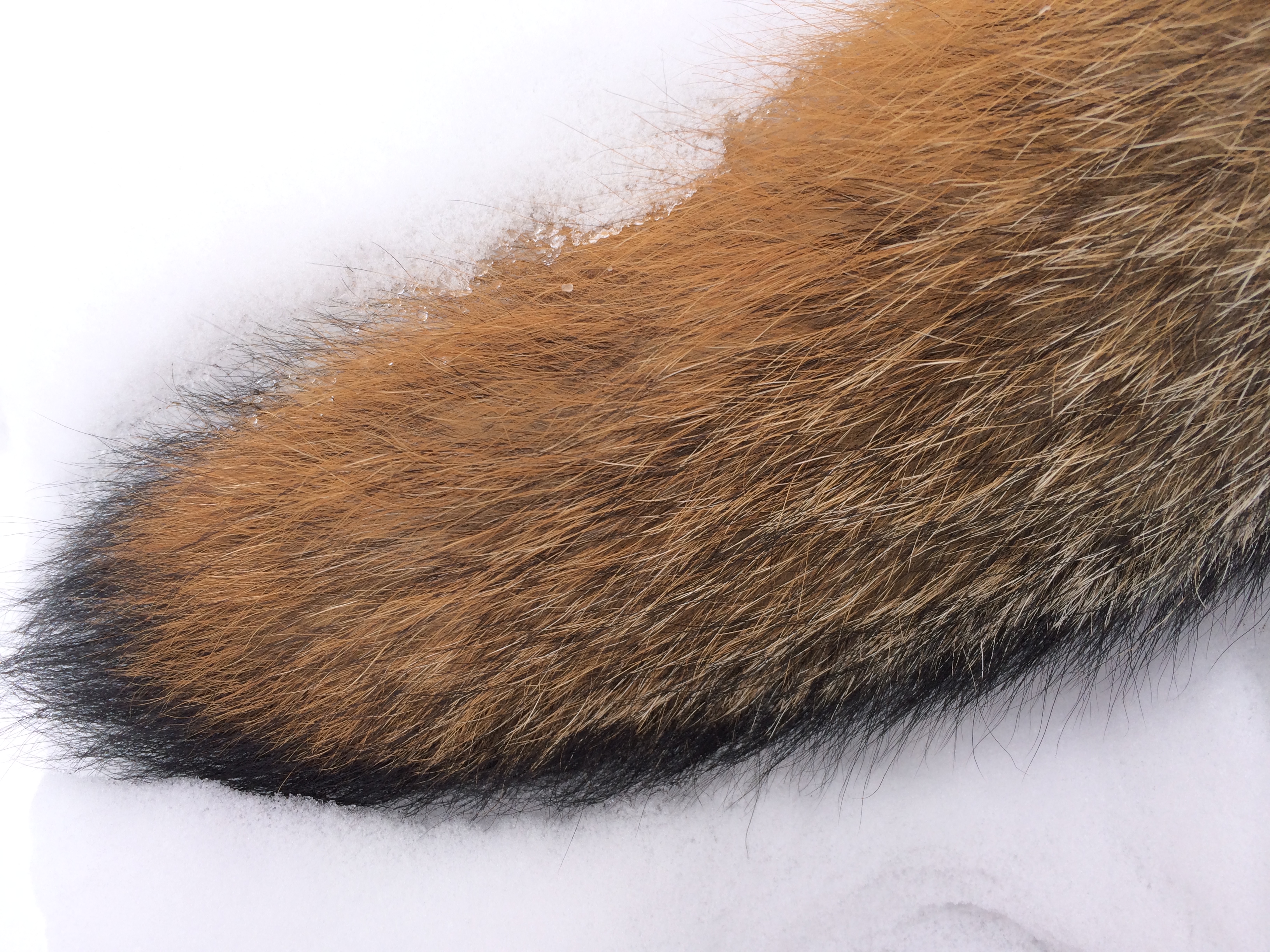
The tail of my fox.

The fox lay a short distance from the entrance to a small parcel of land, 9/10ths of an acre that my husband and I recently purchased from a Ms. Fox (a real person) as a writing/gardening retreat (this writer needs to be close to the land in order to write). Ms. Fox told me that a fox was living under the garden shed and that she would block the entrance because of the musty smell. I could see the scooped out place at the entrance to the shed and imagined a fluffy red tail disappearing into a safe hiding place under my writing desk. I said that I didn’t mind the smell (because in fact I couldn’t smell anything unusual) and I would like to share the shed with the fox, and I came to think of Ms. Fox’s fox as my fox. Ms. Fox told me that the garden “wants to be wild” but she had wrested, with her pruning shears, weed wacker, and true grit, sinuous beds for hardy, tough perennials. My husband and I planted three different kinds of foxgloves (Digitalis)  (the woolly foxglove, the salmon-pink Foxglove ‘Glory of Roundway,’ and the golden-apricot Foxglove ‘Goldcrest’) to attract pollinators and glove the fox.

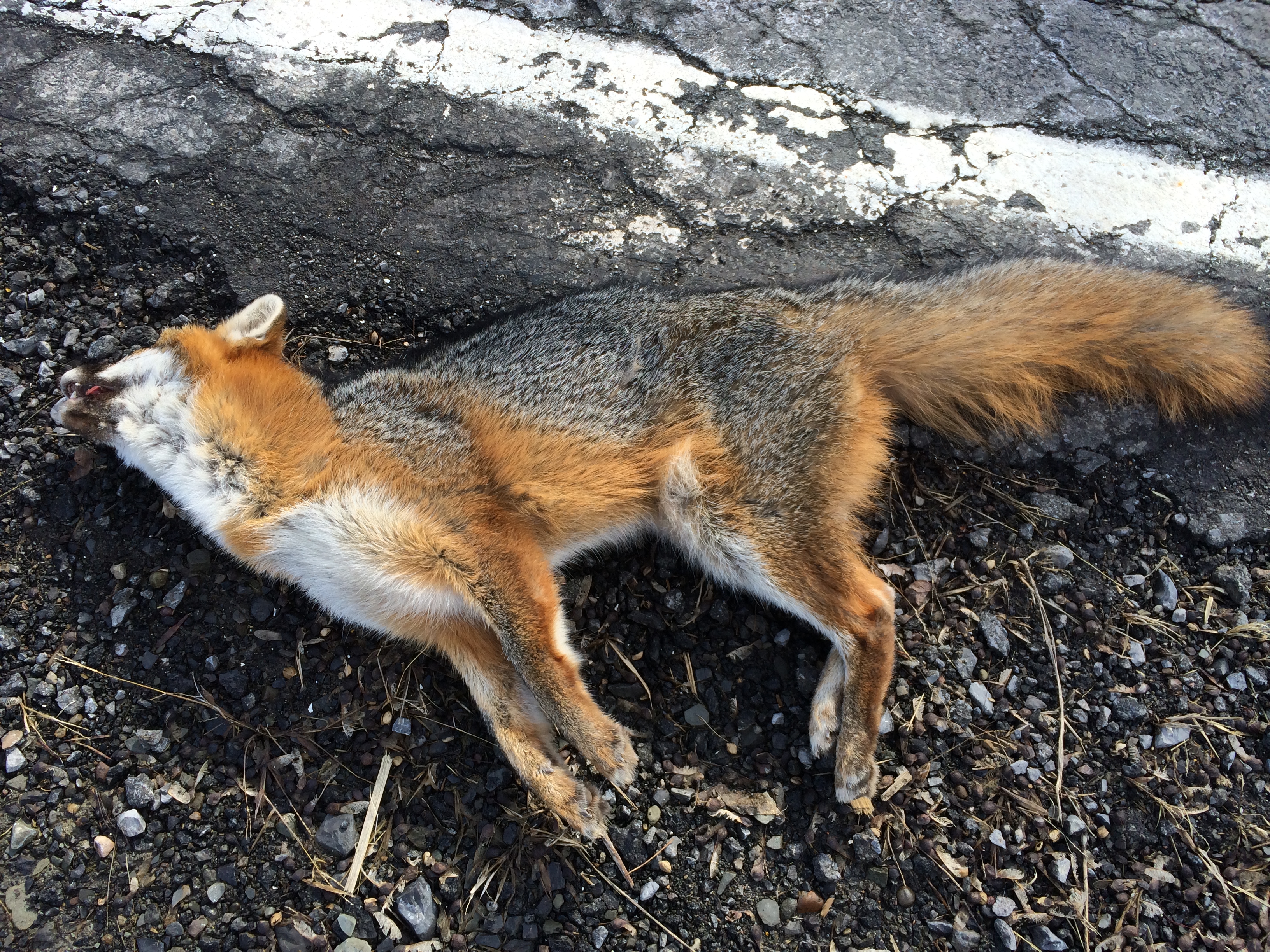
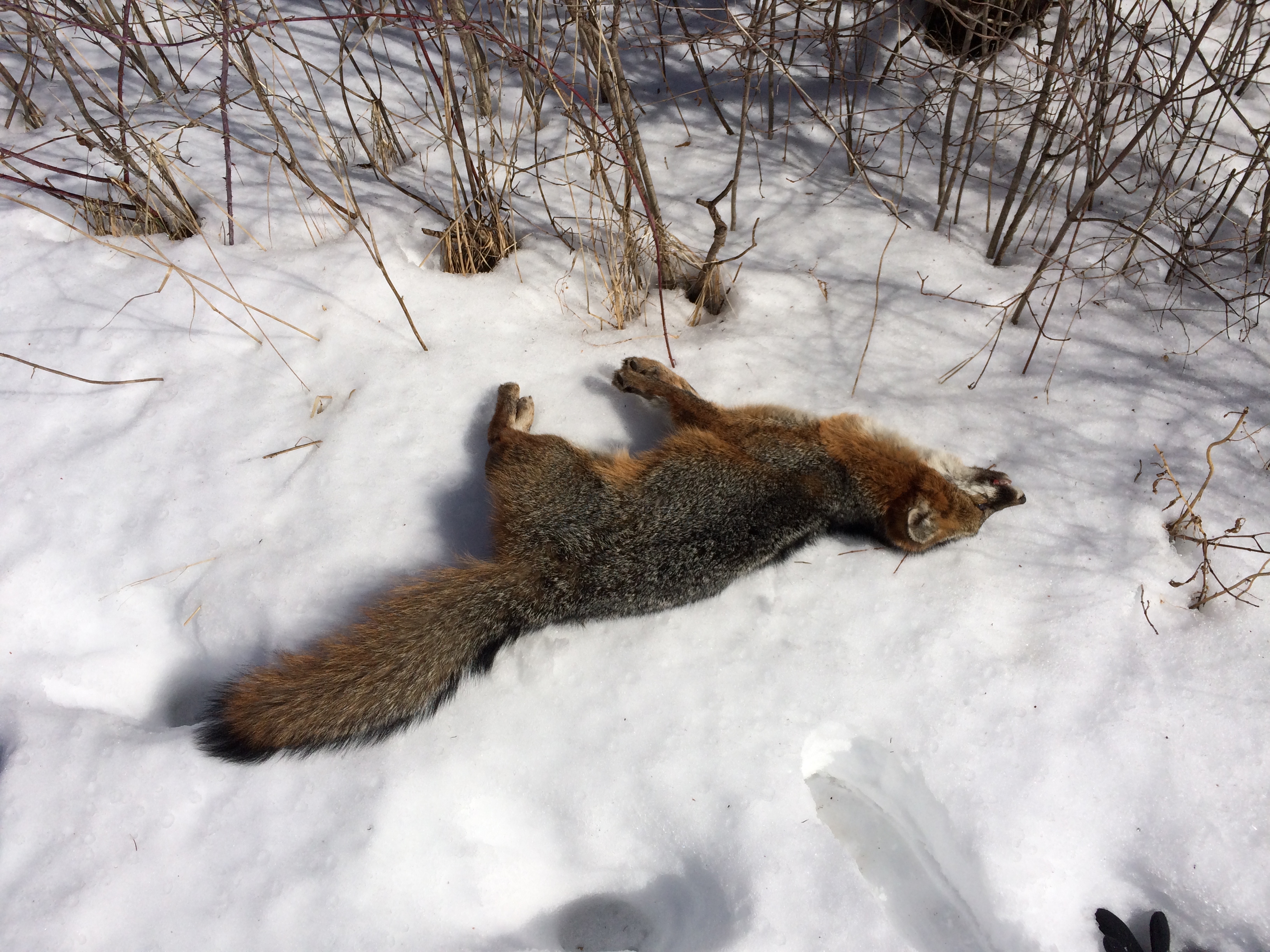
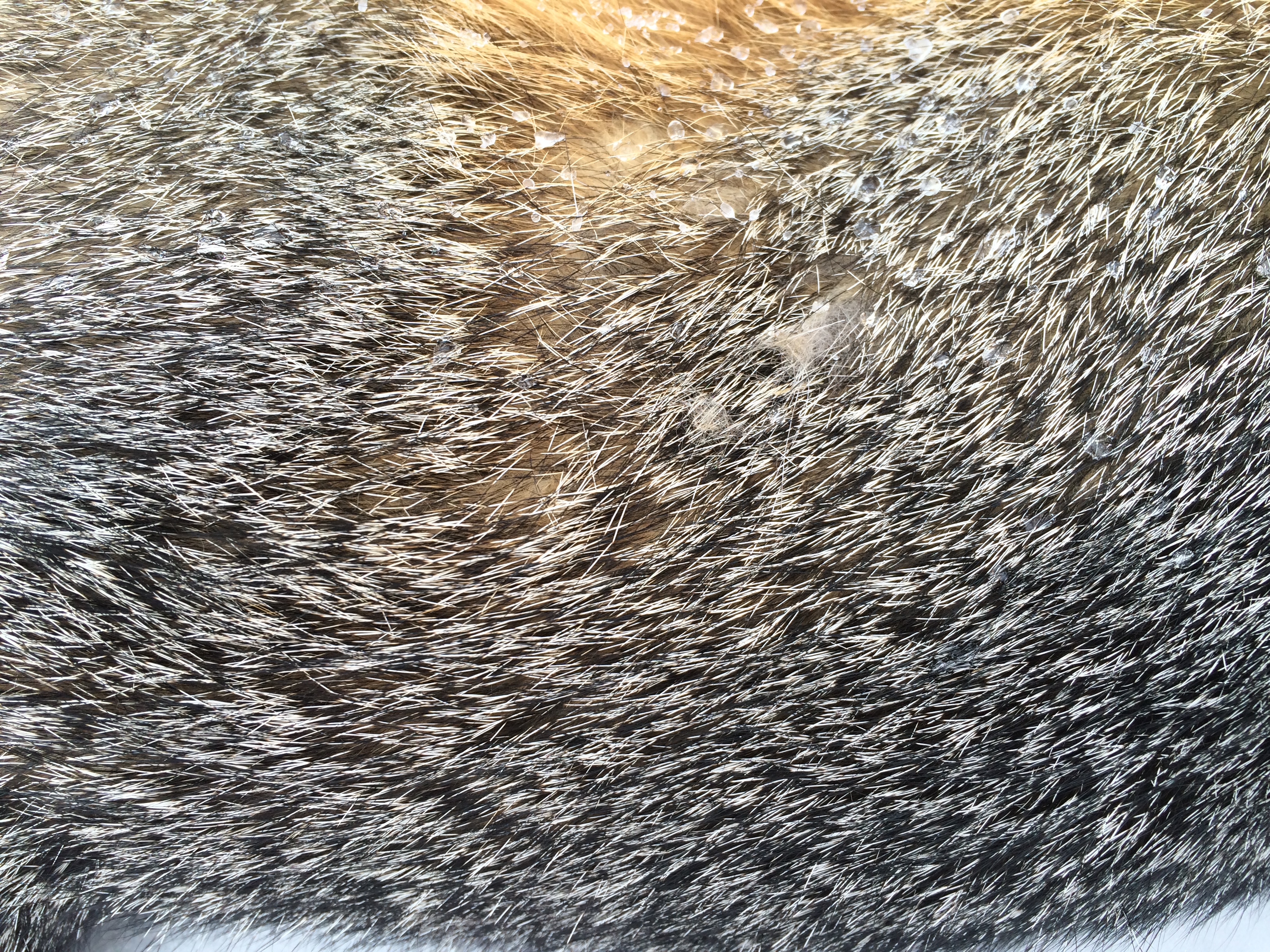
So when I saw the dead fox near the entrance to the secret garden, I felt a sense of loss and a need to take responsibility for the body. I got out of the car, put on my gloves, and went to the fox. She (he?) was in perfect condition. There was no blood nor any visible external blemish. I picked her up, she had stiffened in rigor mortis, and brought her inside the entrance, set her on a patch of clean snow behind the gate, and admired her beauty. The tail was magnificent, bushy, long, and full. The ears were lovely, delicate, pointed, furry. The tip of a pink tongue peaked out from her mouth. Dainty feet! What whiskers! Gray or red fox? I thought gray because  each tawny hair was white tipped. From a distance it looked like a dusting of snow covered the body. A perfect way to be gray.

IMG_0342

The fur of my fox.

Ithaca was in the grips of another polar vortex, so the body remained frozen, and the ground as well, so that we could not bury her. My husband and I decided that nature’s way was best, that letting vultures or coyotes nourish themselves upon her body was beneficial to the ecosystem. That was the decision—but nothing happened. I kept visiting my fox. After 48 hours she lay there as pristine as ever, though I had seen signs of  winter creatures eating other winter creatures everywhere.

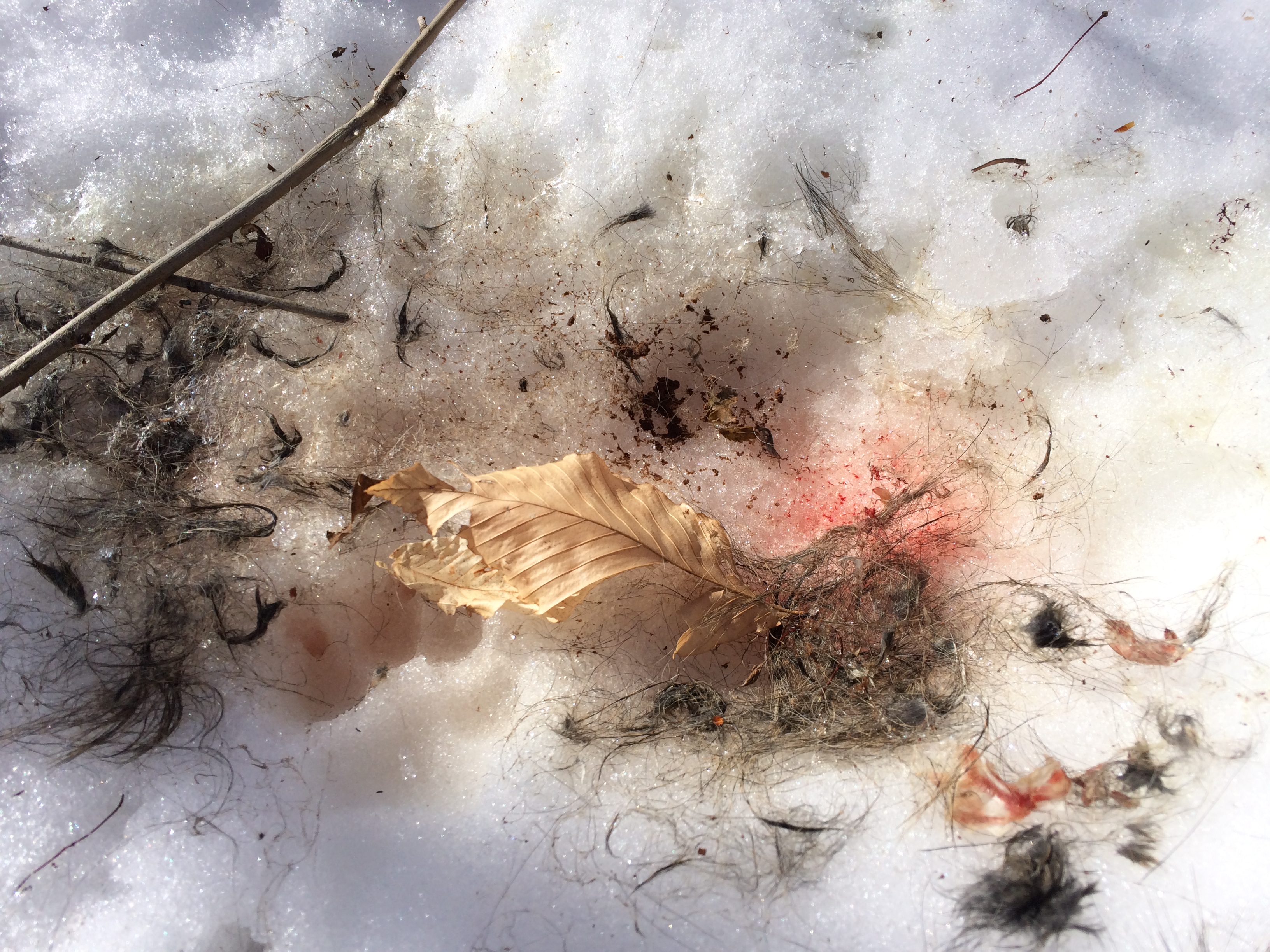
Blood, fur, and pawprint:  a meal has been eaten in the forest.

Still life of blood, fur, and pawprint: a meal has been eaten in the forest.

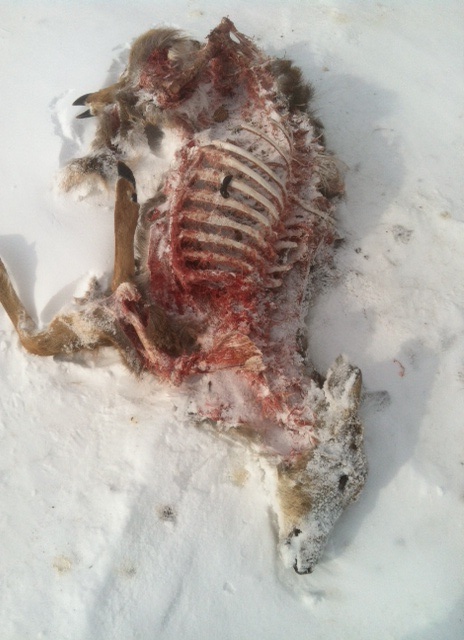
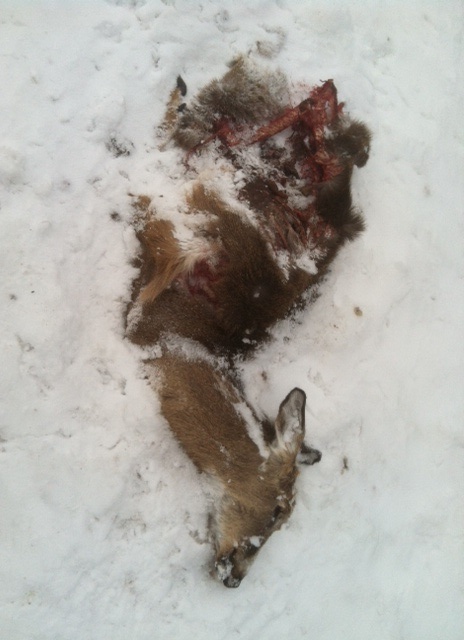
At Seven Fields my husband and I observed a frozen deer carcass be eaten to the bone over several days. I worried about my dog becoming interested  in my fox if a thaw set in and decomposers had not found the body.

Deer carcass at Seven Fields, Enfield, Ithaca, NY.

Deer carcass at Seven Fields, Enfield, Ithaca, NY.

Deer carcass at Seven Fields cleaned by scavengers (scat of scavenger visible on ribs).

Deer carcass at Seven Fields cleaned by scavengers (scat of scavenger visible on ribs).

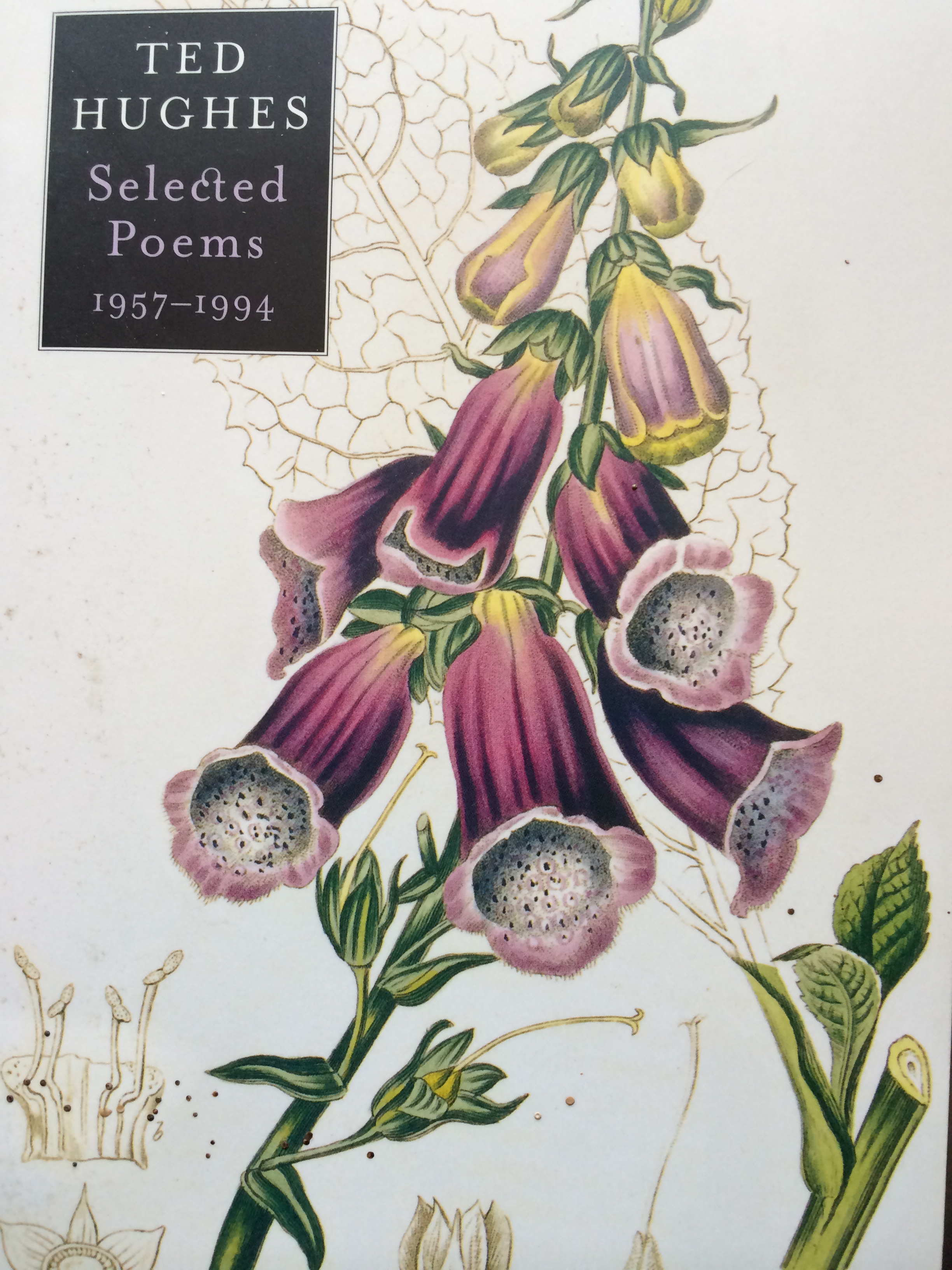
Meanwhile, at the same time, on a completely different tangent, hunting for a poem to memorize, I opened Ted Hughes: Selected Poems 1957-1994.

IMG_0474

Botanical illustration of foxgloves on cover  of Ted Hughes: Selected Poems 1957-1994 (Farrar, Straus and Giroux 2002).

The first poem in the volume  is “The Thought-Fox,” which I read many times with my writing-as-a-naturalist students in a different book, Hughes’ superb Poetry in the Making: An Anthology. It is a collection of informal talks he gave for the BBC designed for interesting children in poetry.  In the essay called “Capturing Animals,” he describes his youthful interest in animals, how sometimes as a boy he stuffed 30-40 live mice in his pocket that he had plucked from sheaves at threshing time, and the genesis of his poem  “The Thought-Fox.”

TED HUGHES Poetry in the Making: An Anthology ( Faber and Faber, 1967)

TED HUGHES Poetry in the Making: An Anthology ( Faber and Faber, 1967)

Hughes writes: “An animal I never succeeded in keeping alive is the fox. I was always frustrated: twice by a farmer, who killed cubs I had caught before I could get to them, and once by a poultry keeper who freed my cub while his dog waited. Years after these events I was sitting up late one snowy night in dreary lodgings in London. I had written nothing for a year or so but that night I got the idea I might write something and I wrote in a few minutes the following poem: the first ‘animal’ poem I ever wrote. ”

So as I was visiting my fox I was thinking of Ted Hughes’ “thought-fox.” I completely agree with Hughes that immortalizing an animal in a poem has many advantages, but I had a body to think about.

My fox as I found her.

My fox as I found her.

I agonized, checked the yellow pages, made a phone call, and then made a decision on the third day. I drove back out to the secret garden a few hours after my morning visit, wrapped my fox in a blanket, put her in the back of my car, and took her to a taxidermist.

My fox behind the gate in the secret garden.

My fox behind the gate in the secret garden.

I was apprehensive about my decision, but happily a positive adventure ensued. I handed my fox over to a lovely couple in their ‘70s who run a retirement business in taxidermy. He, tall, bright-blue-eyed, youthful baseball cap on his head, and she, beautiful, gracious, and friendly, gave me a complete explanation of the processes involved in taxidermy, which I will omit here for the sake of brevity. Their ranch house looked unremarkable from the outside, but soon my head whirled, as I found myself nose-to-nose with several elk, a turkey vulture, crow, huge mountain goat, and numerous deer. These taxidermists work terribly hard. After a career in construction he retired to taxidermy and championship archery, and she, after 39 years working for the local trust company retired to be his indispensable helpmate and companion in the taxidermy business. They know a lot about animals of all kinds, well, mostly the furred and feathered. He told me that the grey fox (Urocyron cinereoargenteus) is a creature of the brush and has the footprint of a cat. Coyotes tolerate this most  ancient member of the dog family (Canidae), which can climb trees to escape predators.  He said the red fox has the footprint of a small dog and favors wooded areas.

Taxidermy was a critical job skill that helped Charles Darwin gain his position as naturalist on the H.M.S. Beagle. In Edinburgh, when he was studying (unhappily) as a medical student at the university, Darwin had lodgings two doors away from those of a freed Guyanan slave named John Edmonstone, whom Darwin hired for a guinea a week to teach him the art of taxidermy. Darwin and Edmonstone formed a congenial friendship, based on mutual natural history interests, that Darwin remembered all his life (see his Autobiography). In the process of rewilding, a movement whose aim is to bring extinct animals back to life (see Nathaniel Rich’s “The Mammoth Commeth” in the New York Times, Feb. 27th, 2014),  taxidermied specimens may offer the DNA fragments that will allow geneticists to reconstruct the original genome of the extinct animal. Thus, Darwin’s specimen of the now-extinct Floreana mockingbird may sire descendents one day.

In his BBC talk, Hughes tells children,  “in some ways my fox is better than an ordinary fox. It will live for ever, it will never suffer from hunger or hounds. I have it with me wherever I go. And I made it.”  Hughes wanted children to understand that poets are pacifists, but there is a paradox in his words. There would never have been a thought-fox without the real fox, which first appeared 3.6 million years ago.

Taxidermy has been called the art of death.  I cannot offer a rational explanation for why I took my fox to the taxidermists. However, in a few months, a fox, more than a thought but less than real, will keep me company in the shed as I think about the lovely taxidermists and the poet, thought-foxes and real foxes,  and mortality and extinction.

I want lots of foxes and foxgloves in my garden, all real. I want to see fluffy tails disappearing into tangles and thickets, and spires of speckled peach and rose colored foxglove flowers. Like Hughes, I want foxes of all kinds to live forever. One problem with extinction is how barren human imaginations will become if we destroy all the models for our flights of fancy.

Winter leaf lies quietly.

Oak leaf on snow, holding out against decomposition.