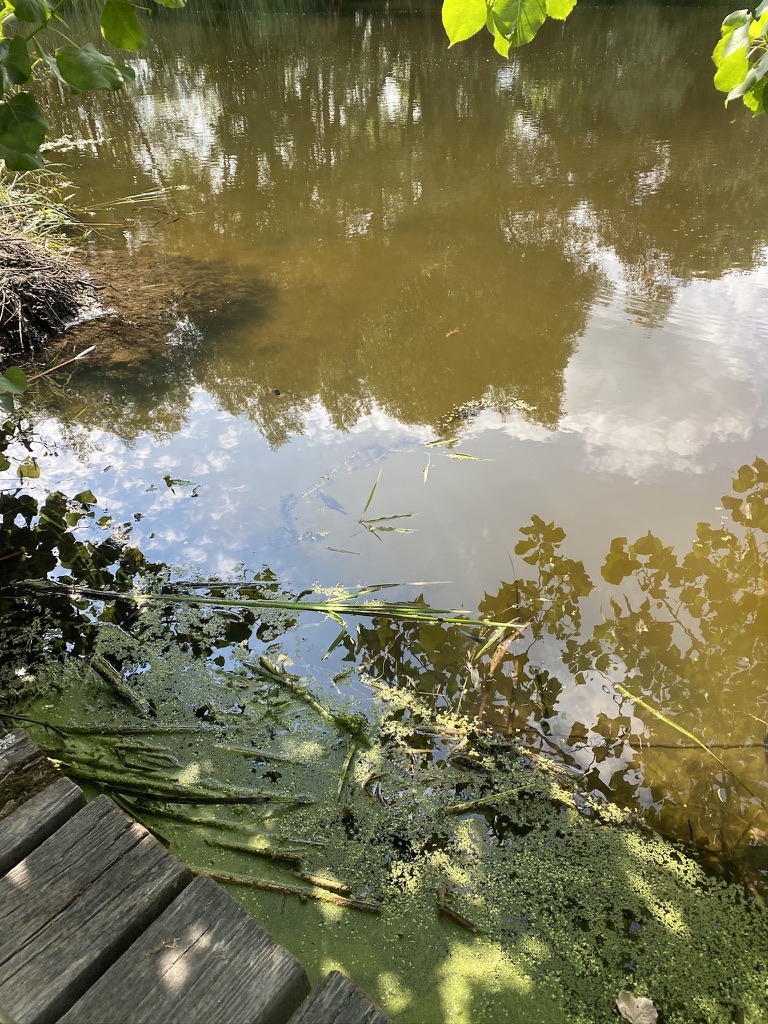
Years ago I encountered a large dragonfly, or rather s/he encountered me. It came zooming around the corner of our farmhouse, hovered inquiringly inches from my face, and left abruptly. Startled and taken aback, I had questions of my own. Where had she come from and where was s/he going? How could s/he make such abrupt turns? How did s/he live? These questions lingered as I went to college, pursued post-college work/degrees in botany, horticulture and writing, and raised children.
Most people have a passing acquaintance with dragonflies, but perhaps not damselflies. Evolutionarily speaking they are “sister” groups. Having diverged from a common ancestor millenia ago, they became reproductively isolated (unable to mate). While “dragonfly” used to be an umbrella term for both, it is more common now to recognize their equal status as “sister” groups.
There are spelling errors in the transcription of the speaker’s words in this video, but in general it does a good job in pointing out many of the differences. The point that the dragonfly “does not prefer water” may be a little misleading. Both damselflies and dragonflies emerge out of water, but dragonflies are able to fly greater distances away from natal freshwater sources.
They have speciated successfully, in parallel, sharing similar lifestyles and similar habitats. At the time of a 2021 publication, there were 2,967 dragonflies and 3,332 damselflies (Manpreet Kohli et al., “Evolutionary history and divergence times of the Odonata as revealed through transcriptomics,” ScienceDirect). While some species may have been lost, new species continue to be discovered, especially in tropical areas. Damselflies and dragonflies, like humans, are not robotic–individuals have unique behaviors that observed and recorded become valuable additions to our understanding of how they live. Collectively, damselflies and dragonflies are called the odonates by entomologists.
Field guides often say that damselflies and dragonflies are “easily observed,” but after two seasons of amateur fieldwork, I can only say that my ability to observe and identify them has been hard won. Becoming accustomed to the energetic behaviors of damselflies and dragonflies requires strategy and patience. In the beginning when I was frustrated by my inability to observe them in a leisurely manner, as a botanist is able to do with plants, I took videos of their flight patterns as they appeared in the shadows of clouds on the pond we now own in a feeble attempt to “capture” them.
We are fortunate in Ithaca to have a local guide, Where to Find Dragonflies and Damselflies In the Cayuga Lake Basin and the Vicinity by Meena Haribal, a retired chemical ecologist and well-traveled, all-round naturalist. I acquired a copy after attending a guided tour of damselfly and dragonfly habitats that she gave at Stewart Park in Ithaca, one Saturday in spring/summer 2025. It was invaluable in opening my eyes to their presence in places where I had never noticed them. In addition, a two-week evening course by zoom with Dr. Ronald Butler, Emeritus Professor at the University of Maine-Farmington through the Eagle Hill Institute in Maine educated me in many aspects of their biology and behavior. Damselflies and Dragonflies of Maine and the Canadian Maritime Provinces by Butler and co-authors is due out in March 2027. There are guides for many part of the United States and the rest of the world.
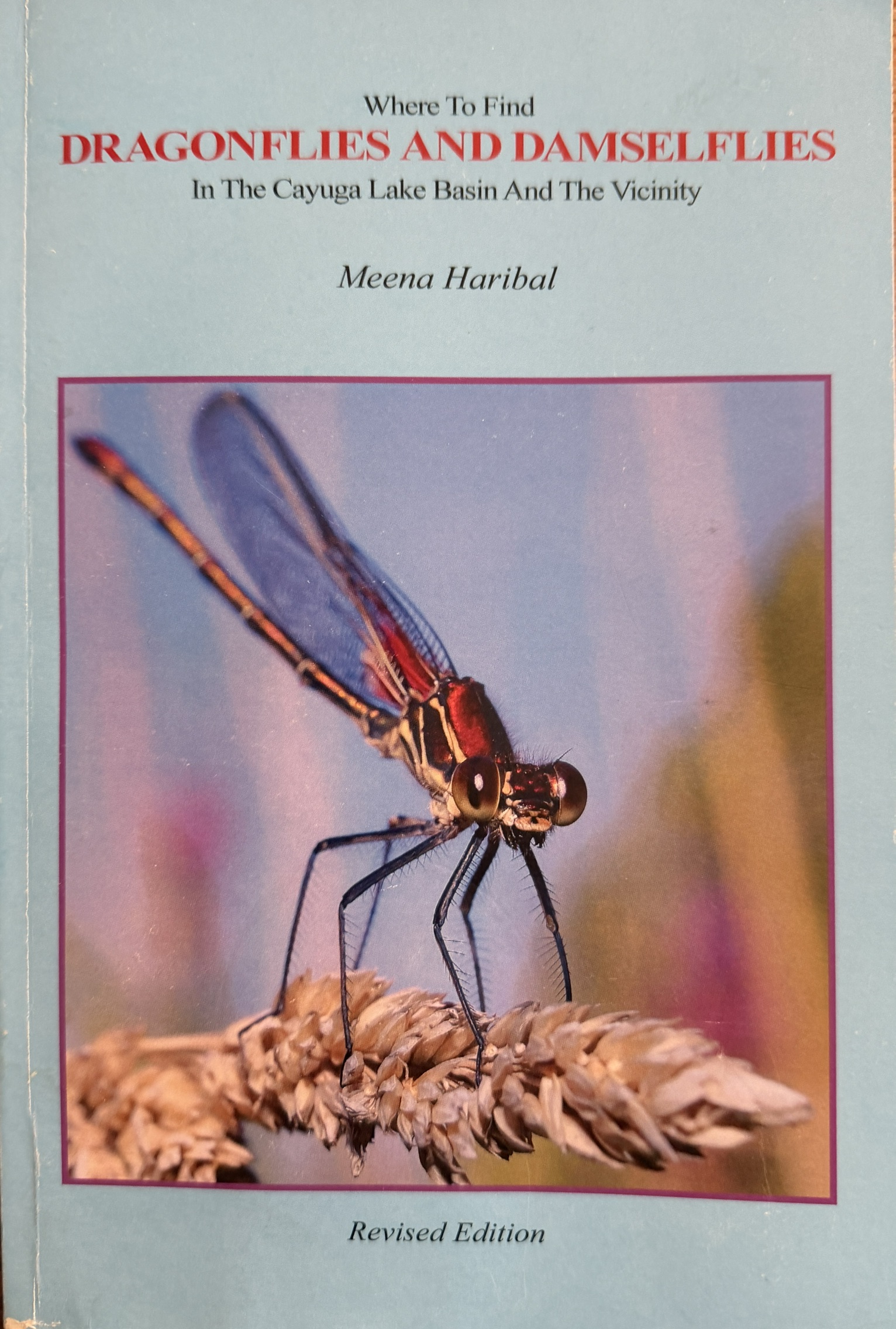
A damselfly is on the cover of Meena Haribal’s book. Note the eyes at the sides of the transversely elongated head and the wings held together over the back of the abdomen when perching, both defining characteristics of damselflies.
My intent in sharing my “where’s Waldo” photos of dragonflies and damselflies is to prove that one can learn to discern their presence with the unaided eye and develop a search image despite the distractions of their habitats. Most photos for this blog were taken with an iPhone 11, but late this summer I was given an iPhone 17 by my older son. For some individuals I provide links to higher magnification photos taken by gifted photographers who offer free use of their images on Wikimedia Commons and to gifted naturalist photographers who maintain blogs. After hours sitting by various ponds and streams and walking along hedgerows I am now sensitive to moving shimmers of lights and shapes that are not vegetative. It’s an adventure to be an amateur pursuing a group of fast-moving insects. Since I cannot outmove them, I have had to adapt, making observations near their habitats where I can wait for them.
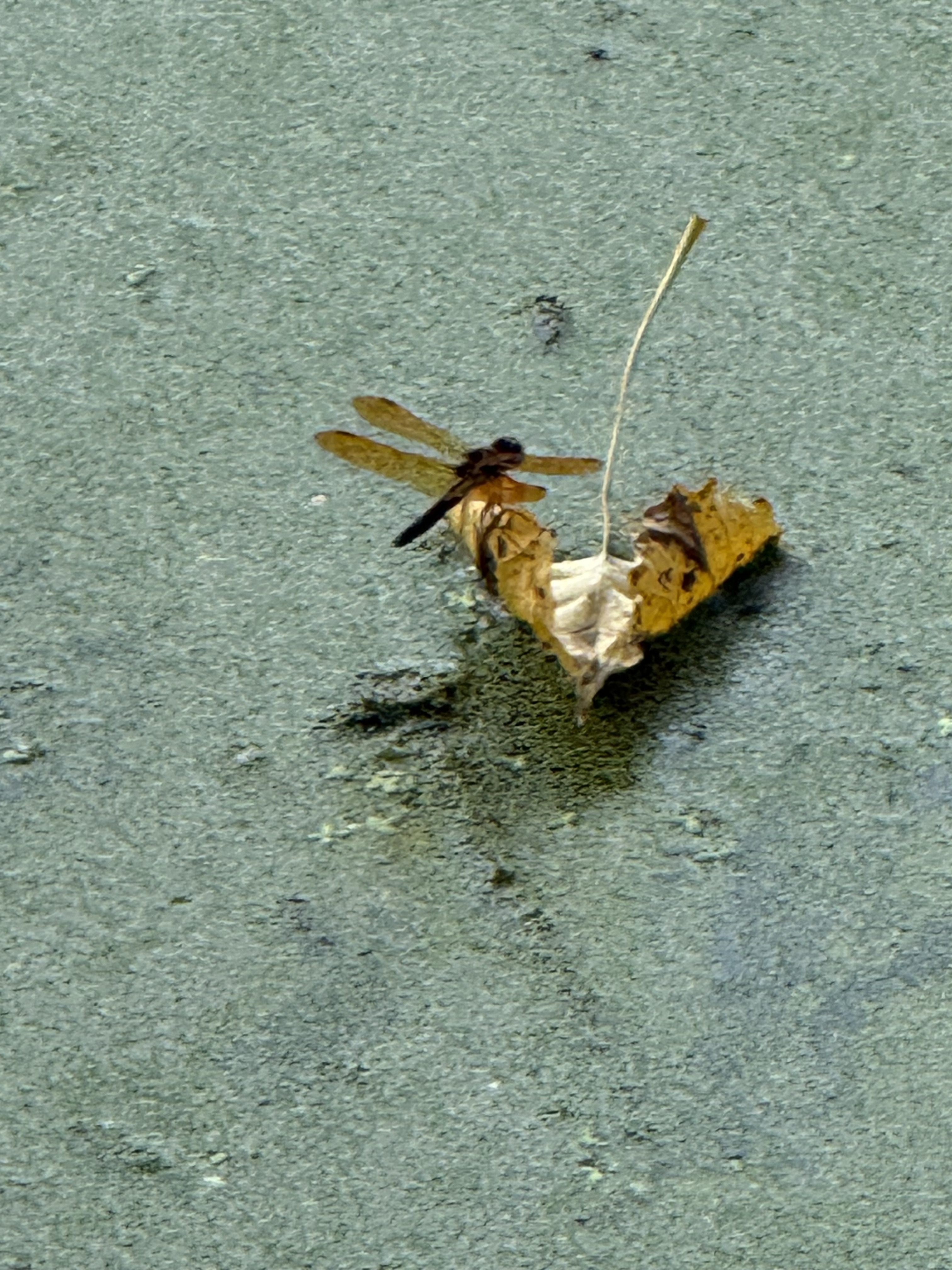
This is a closer view of a male Eastern Amberwing (Perithemis tenera) shown in the first photo. They are busy, small dragonflies of an inch or less. One can become mesmerized by the patterns of the floating vegetation and the animated behavior of these small dragonflies.
Amberwings belong to the largest family of dragonflies, the Libellulidae, commonly called the skimmers. The Eastern Amberwing is said to be a wasp mimic due to the patterns of color and movement. Sitting still while watching the rest-less activity of a group of male Eastern Amberwings is like going to a ballet of frantic performers lifted on glimmering wings pirouetting acrobatically with sallies and flourishes galore, dashing frantically on and off stage. Though small (2.0-2.5 mm, 0.8-1.0 inch), their charisma is irresistible.
Female Eastern Amberwings do not join the male-only ballet; they are usually far from water (Meena Haribal, p. 155), awaiting a time when a male who has defended a suitable habitat for egg-laying claims them. Male Eastern Amberwings expend a great deal of energy in protecting reproductively appealing habitats against intruders. They also exhibit a strategy called site fidelity, which means they will bring a female back to a site where they have successfully induced egg laying with a female previously. Though defensive battles are “non combat,” they can be evicted, especially by younger males (see Kate Redmond’s “Eastern Amberwing Redux:” https://riveredgenaturecenter.org/bug-othe-week-eastern-amberwing-redux/).
Damselflies, on the other hand, can be often almost invisible and less busy.
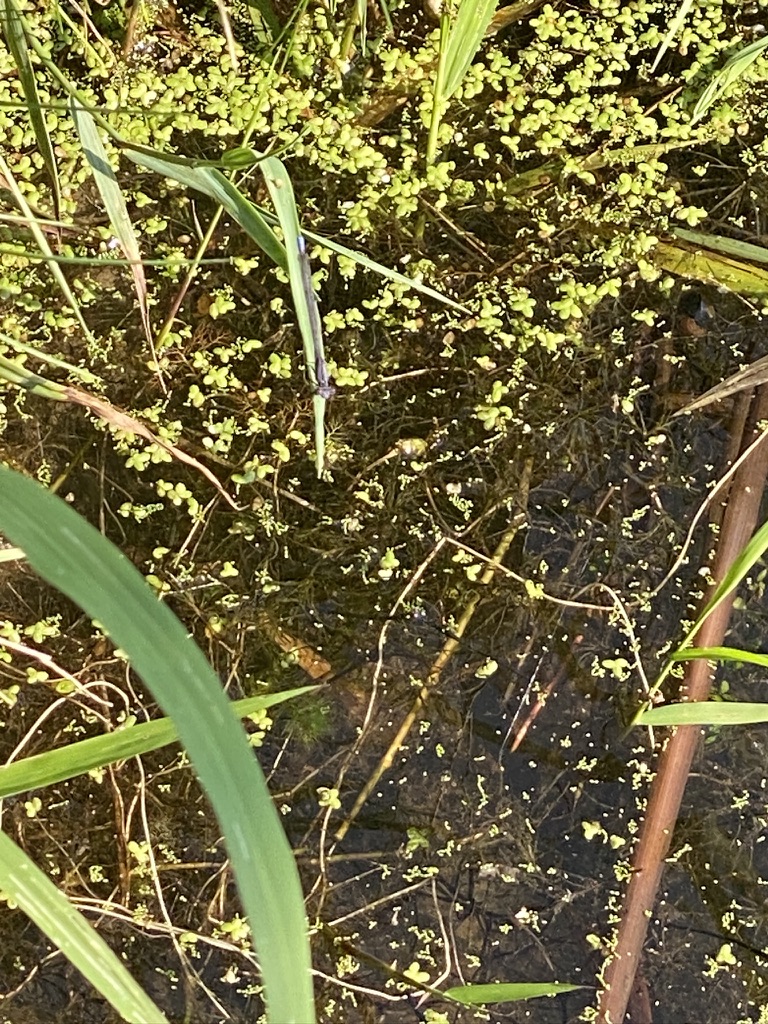
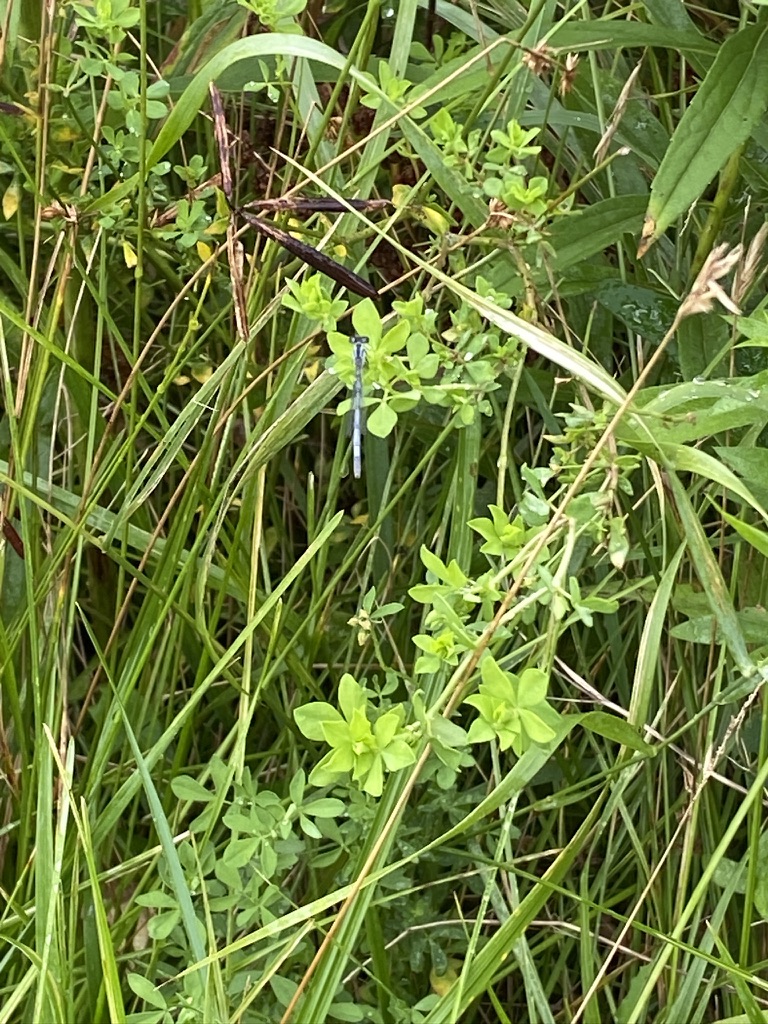
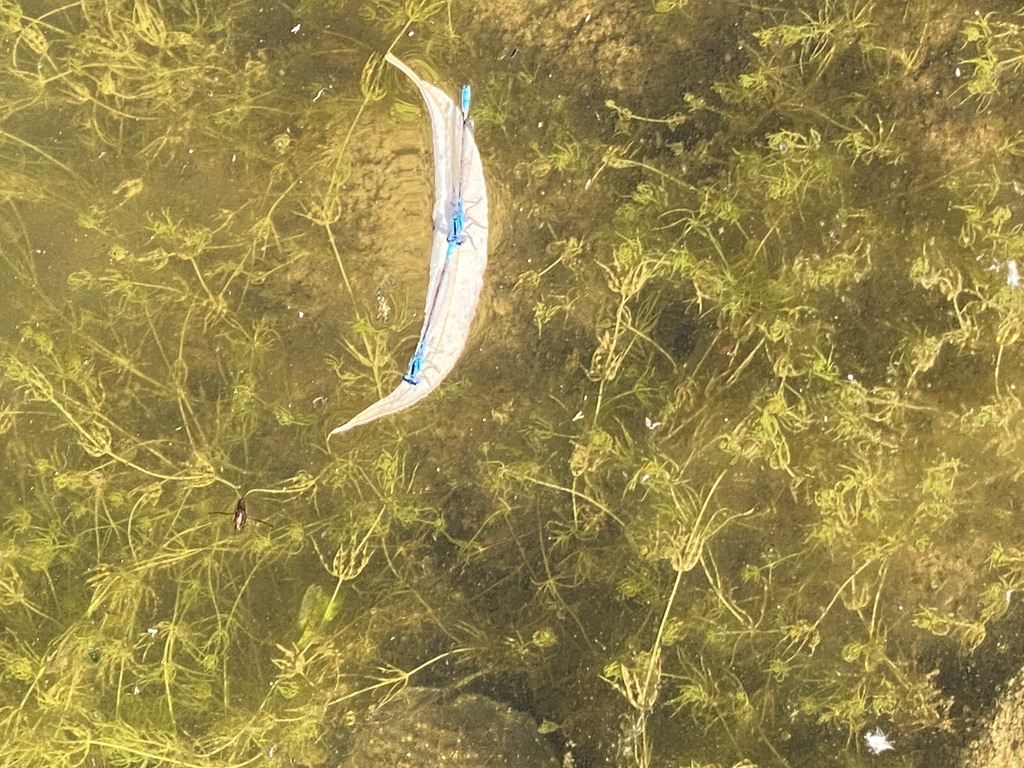
The two photos of the female Eastern Forktail (Ischnura verticalis) above show how easily some damselflies can be overlooked. Although the human observer might infer gentleness from their delicate appearance, they are, like all odonates, aggressive hunters. Meena Haribal writes in her guidebook, “Once I saw an odd-looking female [forktail], with two sets of eyes looking at me. It turned out the female was feeding on a male forktail” (p. 95). Recently an Ithaca resident posted a video of an Eastern Forktail cleaning his or her eyes. Eye cleaning behavior is common in damselflies and dragonflies, who can use their spiny forelegs dexterously so as not to injure the thousands of ommatidia that make up their compound eyes.
The damsel below, the Skimming Bluet (most likely Enallagma geminatum), is not so easily missed.
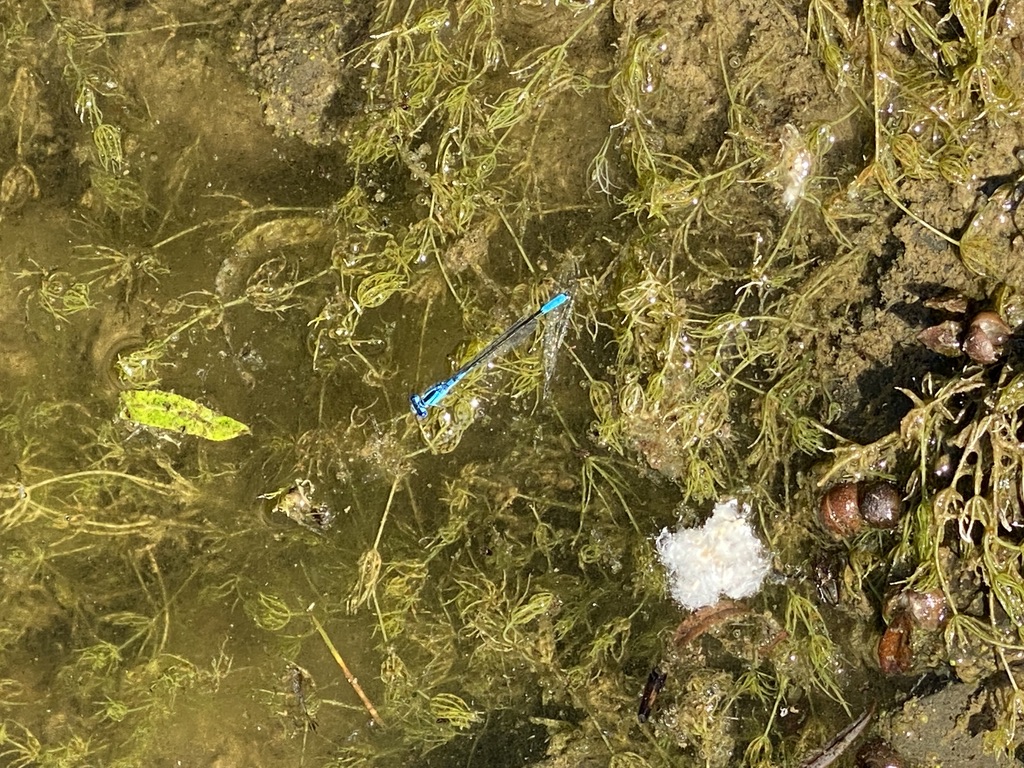
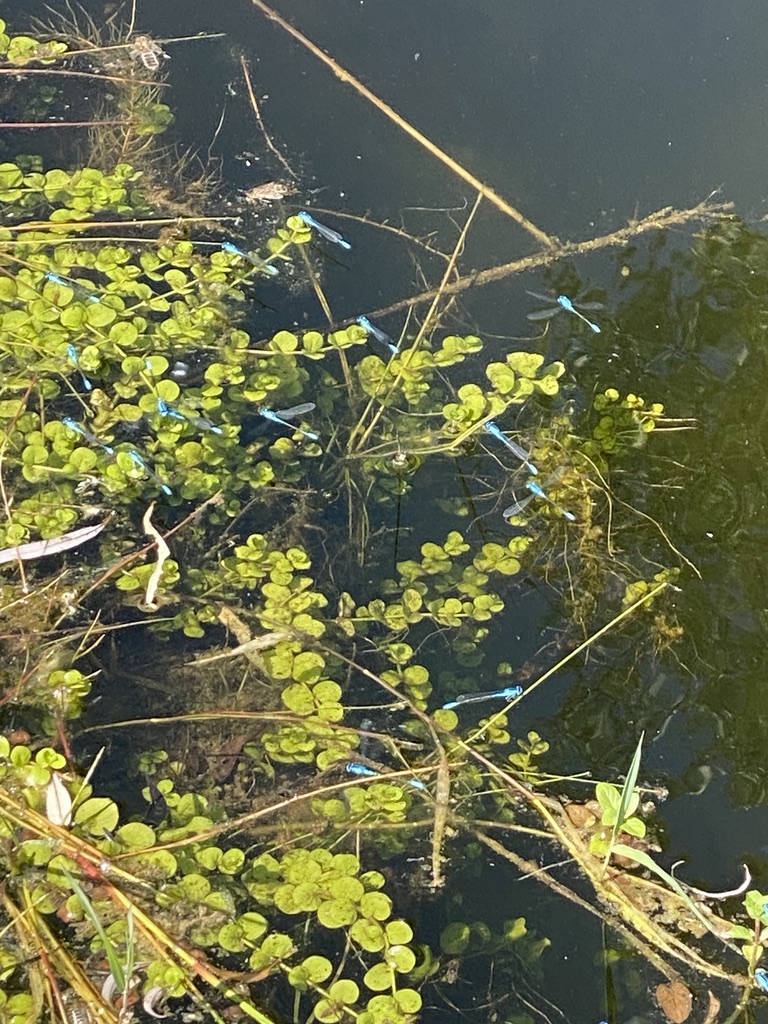
It is a startling sight watching two to three hundred or more neon-blue individuals lighting up a murky habitat. They like to rest on lily pads and floating vegetation. New York State has 23 species of bluets, sixteen of which are listed in Meena Haribal’s guide. Not all bluets are blue. There exist also the Orange Bluet, Cherry Bluet, and others further south, like the Purple Bluet and Burgundy Bluet (see Giff Beaton’s Dragonflies & Damselflies of Georgia and the Southeast, 2007).
In contrast to the narrow-winged damselflies above, there is a group called the broad-winged damselflies (Calopterigidae). In August 2026 I was fortunate to see a group of male Ebony Jewelwings. My daughter had notified me of a sighting at the base of Ludlowville Falls near Ithaca, so I made the perilously steep descent to the base of the falls, where I found a bevy of scantily clad sunbathers and families with children. There was a rope at the top to hold onto for the first half of the challenging descent. Nevertheless, upon safe landing I was greeted by a group of active male Ebony Jewelwings (Calopteryx maculata). I perched on an uncomfortable boulder and sat watching them come and go. I knew from the guidebook that males are brilliantly iridescent, while the females have subdued coloring that is elegant in a different way. The males constantly defend territory. The individual below came back to this resting spot numerous times after chasing away male rivals.
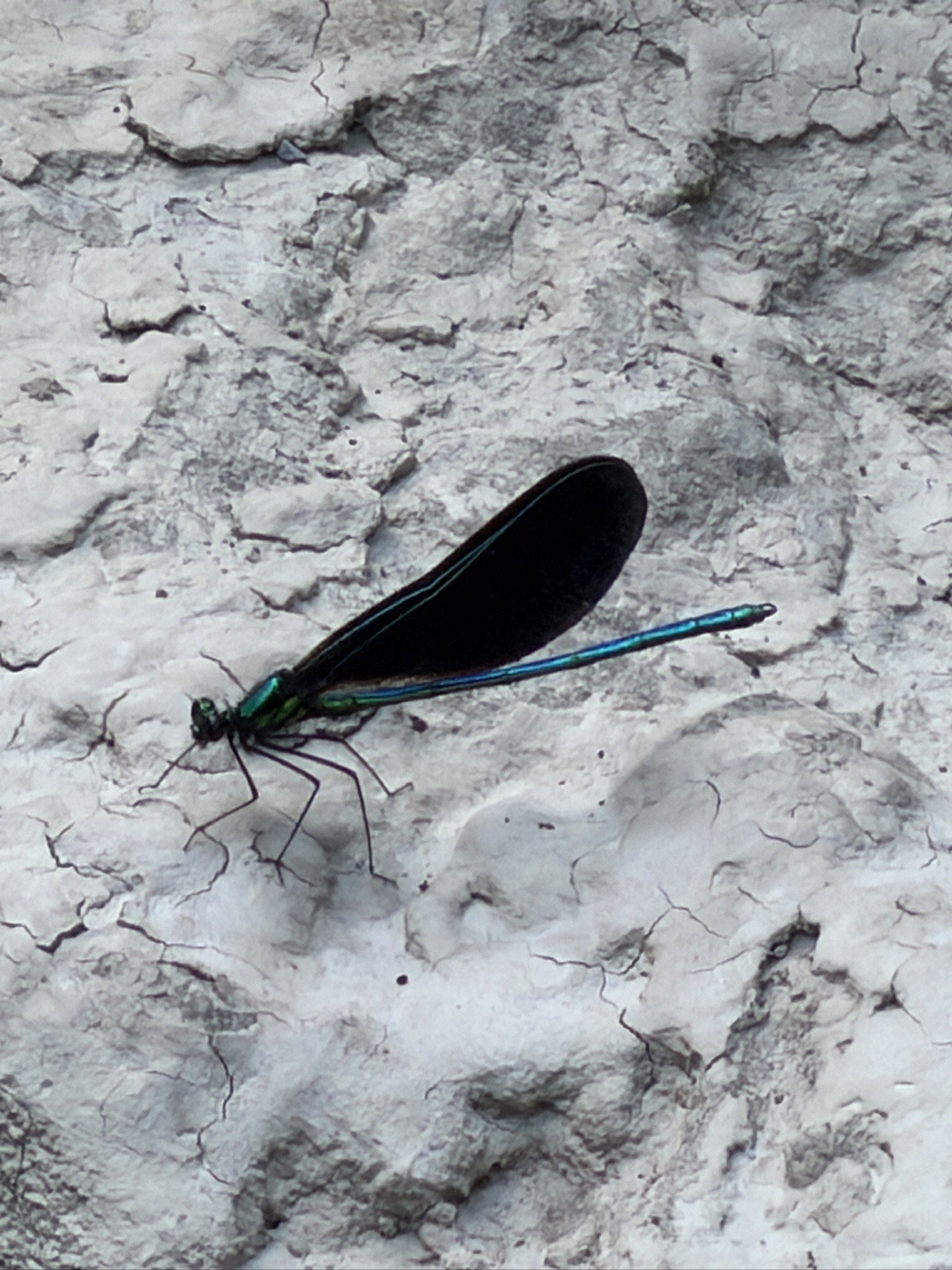
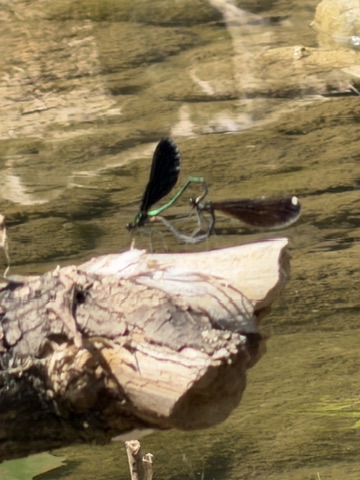
I found that despite my physical discomfort, it was a good strategy to retain my perch, much like the male Ebony Jewelwing. The above photo is the best of numerous attempts to capture the male’s dramatic appearance. Having caught this image, I let my eyes wander over the scene. Miraculously, at least to me, they picked out a little tangle of damselfly bodies, which I realized were two Jewelwings joined in the mating wheel, said to be one of the most unusual mating systems in the animal kingdom. I didn’t get up but just hoped my cell phone would pick up a useful image from a distance of probably 20 feet or more.
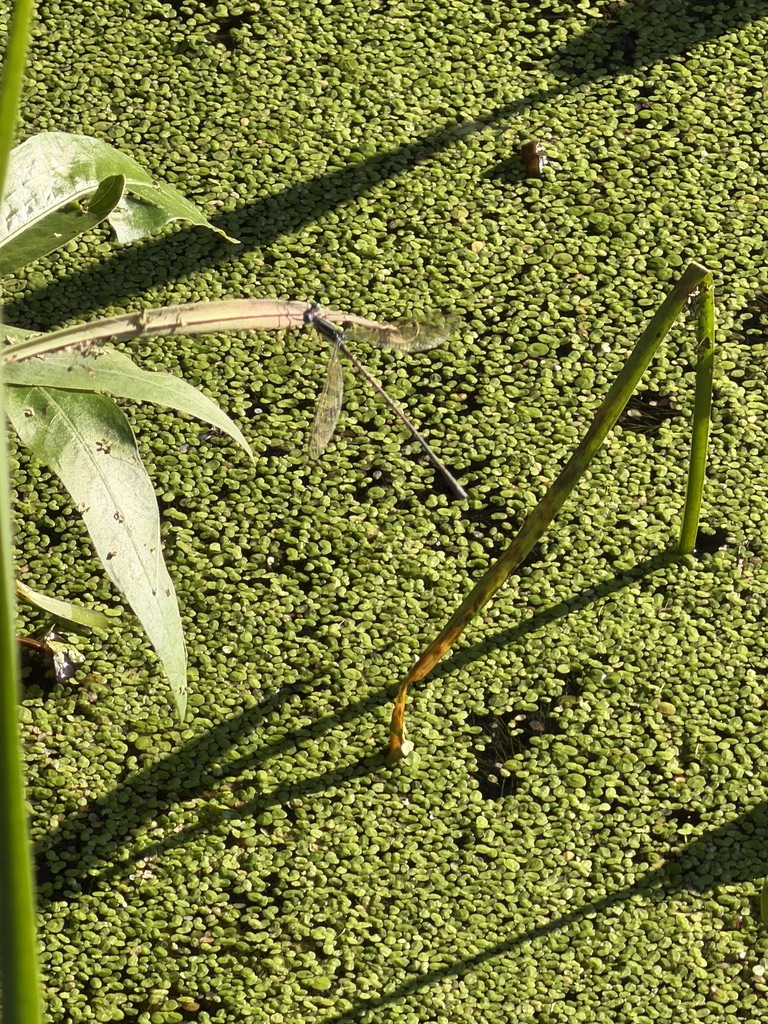
So there are narrow-winged damsels, broad-winged damsels, and … spreadwings (Lestidae). They like to shelter in thick cover. As the name suggests, they hold their wings partially spread when at rest and tend to have extra long and skinny abdomens. The one I observed at Stewart Park was practically invisible at rest, except for the way the overall pattern of the individual popped out against the pattern of the duckweed.
The light caught the shimmer of wings as this individual was fluttering around, but s/he seemed more like an apparition than a real life form maneuvering through the untidy shoreline vegetation. Probably it is because I have peered at so much emergent vegetation and pond “scum” in recent months that the slanted shape of the damselfly’s abdomen caught my eye when s/he came to rest.
When life at the pond quieted down, and I was caring for my younger son’s dog, I went to the top of Seven Fields far from the road. Here I found another star among the small dragonflies. I was quite surprised. It is one thing to read in a guidebook that a particular species can be found along a hedgerow far from water, but it is another to learn to see it in the field. At first I didn’t notice them at all. Like the Eastern Amberwing, it is red and small, only 1.2 to 1.4 inches (26 to 35 mm). After much walking along the hedgerows and numerous cell phone photos later, I caught the image below.
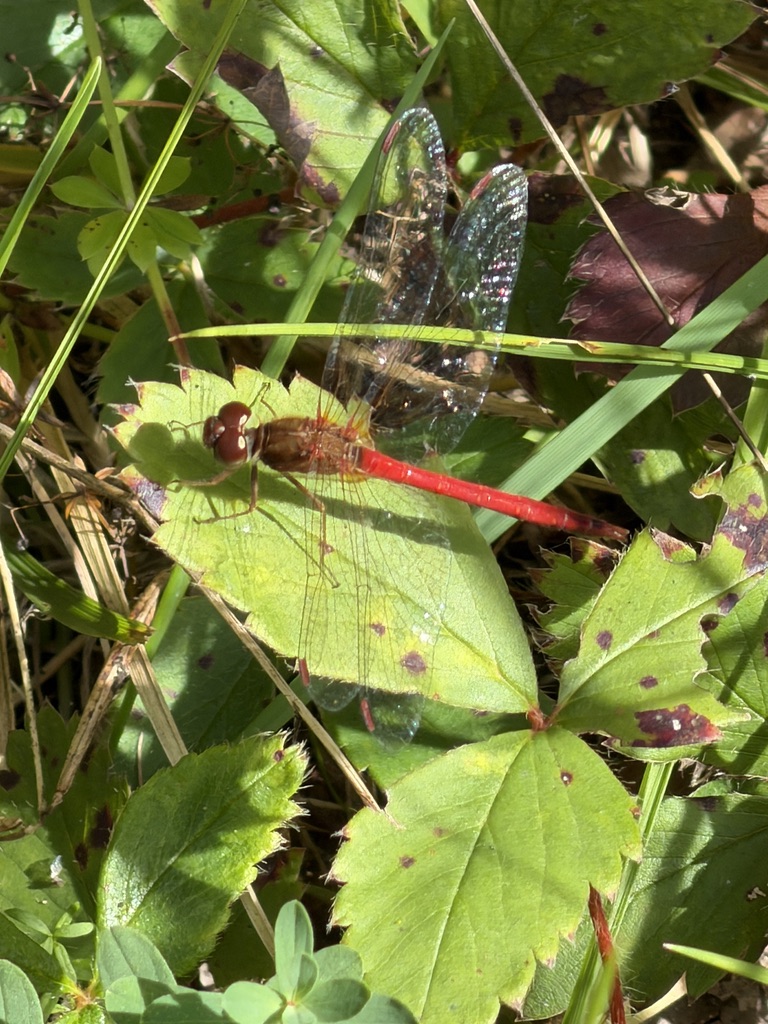
Autumn Meadowhawks stay close to the ground, but take to the lower canopy of the trees if disturbed. One online source noted that they are slow, but hard to follow, an observation with which I concur. They flutter rather than zoom, but so haphazardly that one cannot predict their direction. One of the pleasures of fieldwork is seeing life forms intermingled in different ways as in this photo below.
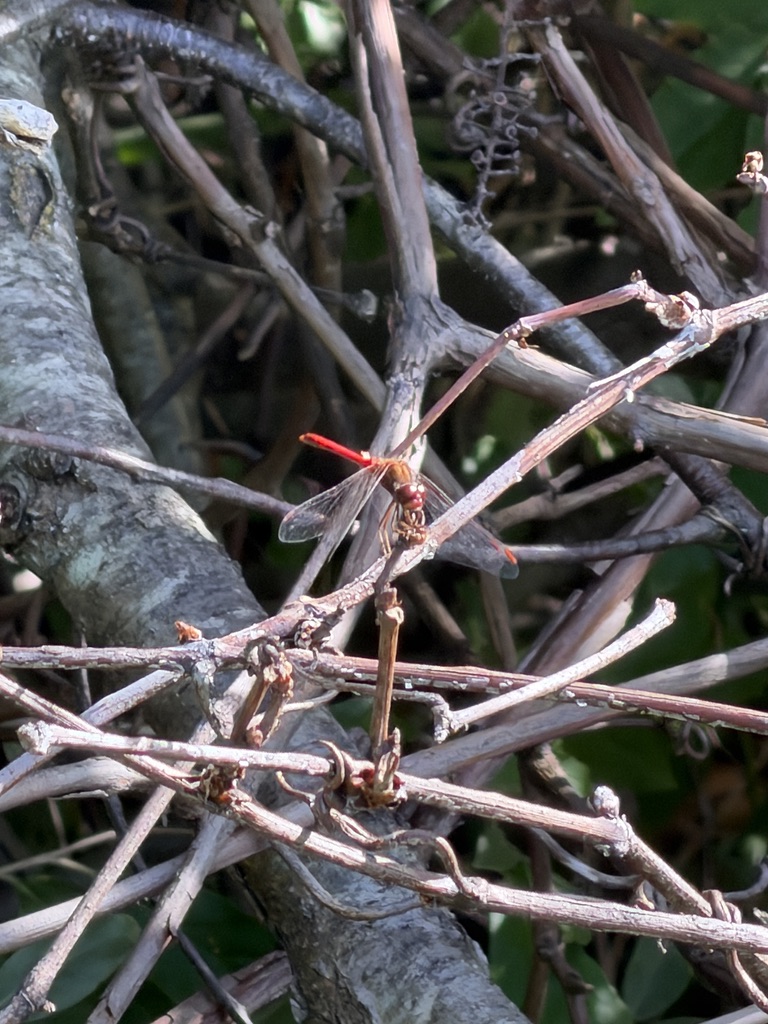
Damselflies and dragonflies have direct flight muscles. In other words, each wing is attached to its own set of muscles, so they can move all four wings independently. They adopt different positions at rest for different reasons, among them thermoregulation and balance. The individual in this image, flying in late September, may be angling forward its wings in order to create a greenhouse effect to warm the flight muscles where they are attached to the thorax.
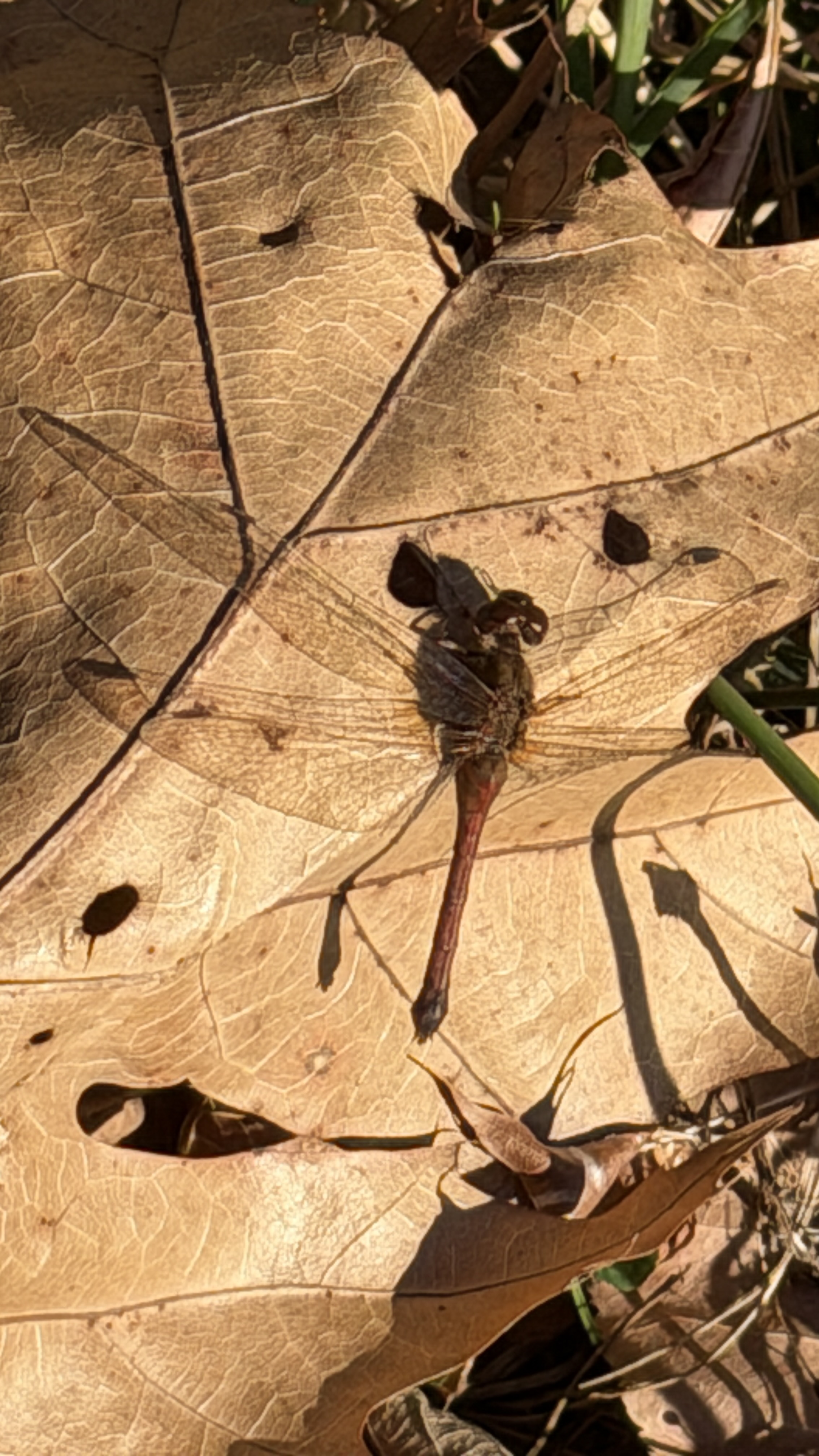
For the last two to three weeks I have been trailing Autumn Meadowhawks along one particular hedgerow that faces south at a particularly good angle it seems, because there are other south-facing hedgerows at Seven Fields, but this is the only one where I have found Autumn Meadowhawks. Meena Haribal writes, “They can be very docile when the temperature is too cool for them to fly. At such times you can easily pick them up on a finger and do what you want to them. They sit and stare at you as they do not have the feisty energy to dash around that they had in early October. They twist their head and look at you” (p.172). One cool but sunny day I tried putting my finger down next to a leaf where an individual was resting. S/he climbed onto my finger obligingly, but I could not hold my crouching position very long, so s/he flew up out of my reach when I stood up.
to be continued……


