Taking Measurements on a Cucumber Magnolia Tree

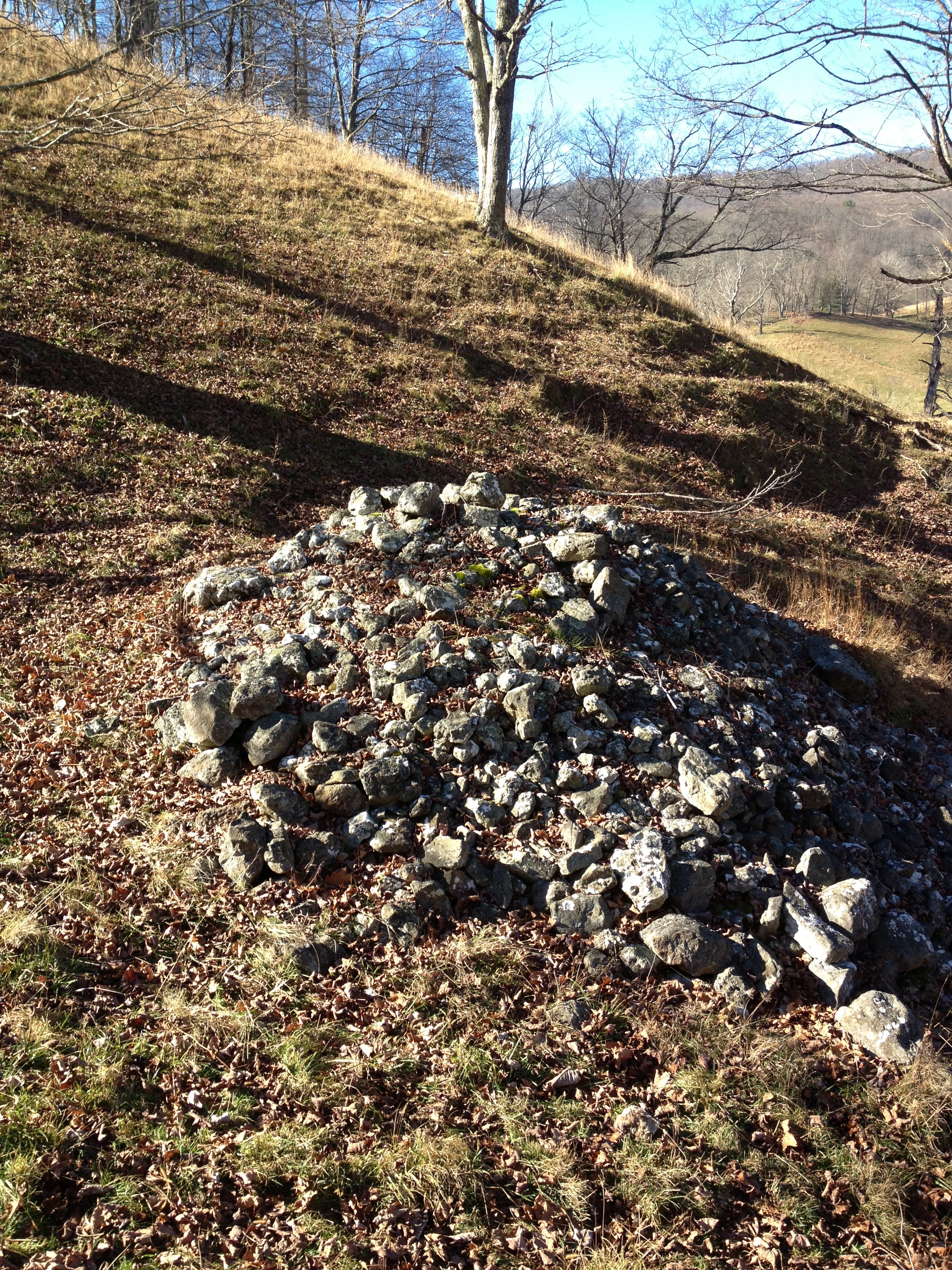
Old rockpile on the flank of Stark's Ridge.

Old rockpile on the flank of Stark’s Ridge.


“I found a ball of string. Let’s go to Stark’s Ridge and measure the cucumber tree.”

I looked at the ball of string my husband held in his hand. The string looked frail, dusty, and old, like so many of the things in my parents’ abandoned farmhouse. A ball of string, however, is always useful.

“And I found this metal tape measure,” he adds. It is the hard, roll-out kind that’s too stiff for wrapping around a tree.

Violent windstorms in July 2012 had toppled trees out of the Earth in Highland County, Virginia, like toothpicks. The other old giant cucumber tree had lost its top, and a young giant had fallen over, its root bundle exposed to the air. Only a few cucumber trees remain on Stark’s Ridge, an elevated mountain crest full of limestone outcroppings.
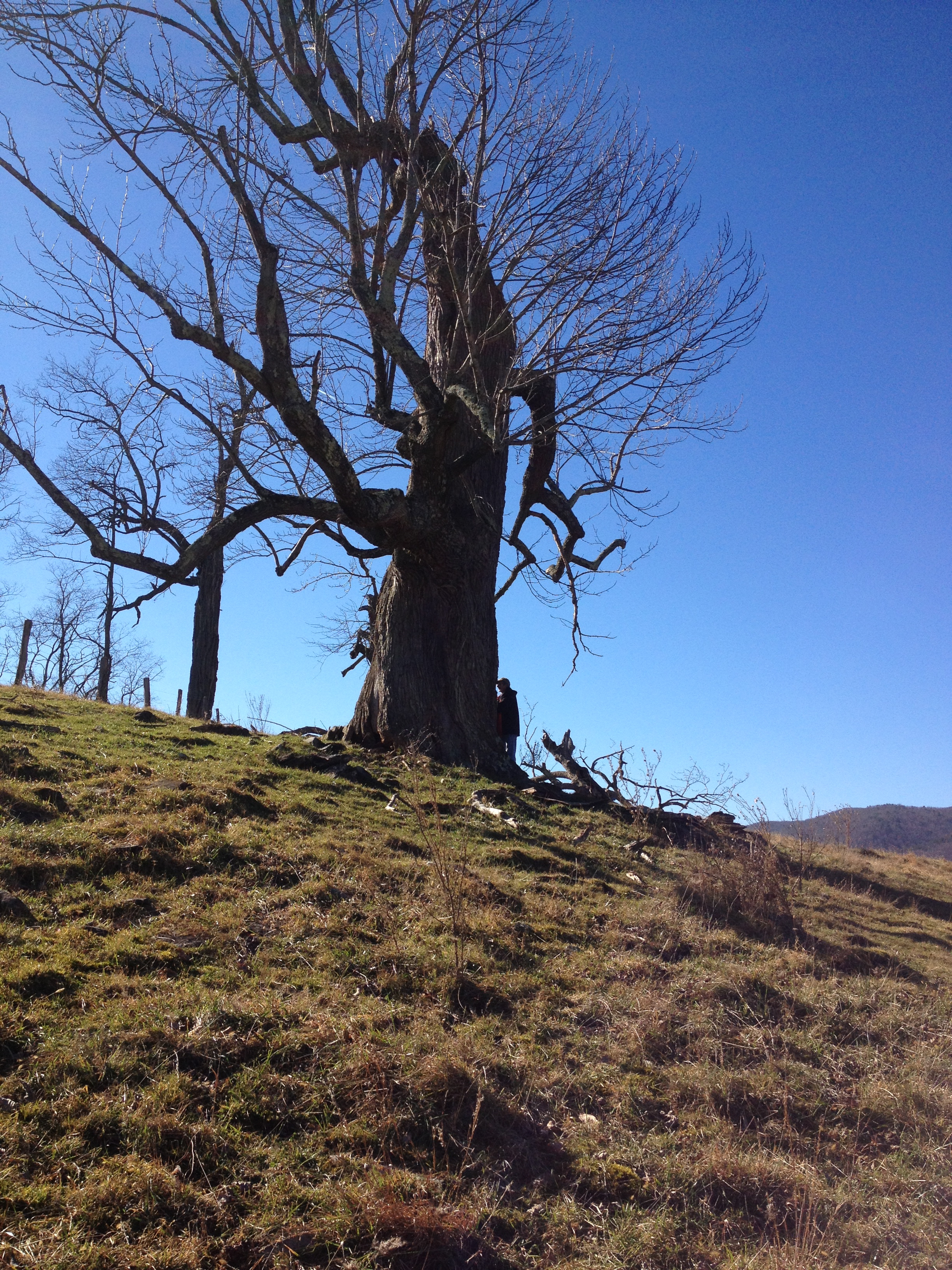
 

Cucumber Tree

Cucumber tree with small figure of head measurer to the right of the trunk.


“Sure,” I said. My husband knows trees. He grows them from skinny little whips, He prunes them, watching their identifying features develop– leaves, flowers, buds, and bark. I think he has forgotten that I measured the tree a few summers ago and reported my measurement to him. However, I am willing to watch his methodology because I know that repeated measurements yield better data.

Getting to the top of Stark’s Ridge requires exertion, if not downright huffing and puffing. The top of the ridge, thankfully, is long, narrow, and pretty flat, interrupted only by the occasional beautiful rock pile and locust tree.  The pair of old giants stands on a gentle promontory, or undulation, of the ridge. From their trunks, one has a grand view of Vinegar Hollow and folds and folds of blue hills stretching for miles to the south and east. The view to the west is the solid flank of Back Creek Mountain.
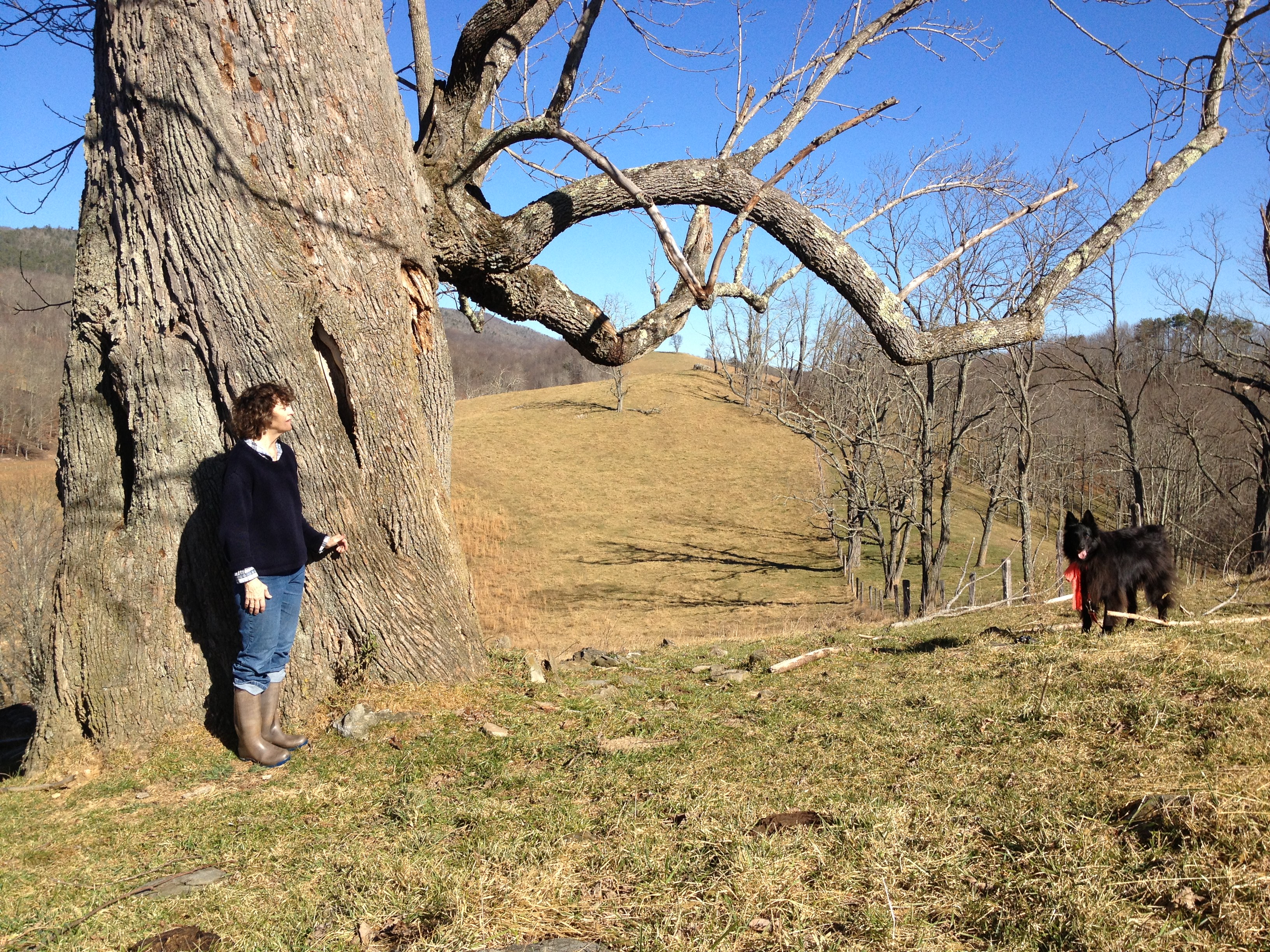
 

Author measures herself against the tree. Belle the dog observes.

Author measures herself against the tree. Belle the dog observes.

In recent years I have approached the old cucumber giants with the acknowledgement that they were dying, losing long limbs faster than they were growing new leaves. The Latin, or scientific name, for the cucumber tree is Magnolia acuminata L. (L. stands for Linnaeus, the Swedish botanist who invented binomial classification). As an aging personage, akin to an old tree myself, I am interested in wrinkled, hardened beings. In order to understand the cucumber tree better, I consult my mother’s copy of Charles Sprague Sargent’s Manual of the Trees of North America in Two Volumes. The back book jacket advertises the fact that Charles Sprague Sargent is “the greatest dendrologist America has ever produced.” It further asserts that these two volumes allow the tree lover to identify any native tree in the United States through keys. Do not believe that such an assertion is easily followed.

The keys for identification of the mountain magnolia that C. S. Sargent presents are based on flower color: the cucumber tree keys out first based on its flower color. It has greenish petals vs. the canary yellow petals/white petals/pale yellow or creamy white petals of other native magnolias. Of course, there are no magnolia flowers in November. Keys are beguiling because they make identification look so straightforward, but horribly frustrating to those observers who are out of season with the keys’ chief identifying characteristics. The cucumber tree is named for its aromatic gherkin-like fruits, from which, when ripe, bright red seeds dangle on white elastic threads.

Measuring begins. I tie Belle the dog to a branch of the tree that has fallen on the ground to keep her out of the way. Trees are usually measured at breast height (dbh, diameter at breast height). My husband ties one end of the frail string to a piece of hard bark that protrudes from the cucumber tree at his breast height. He continues wrapping it around the stupendous girth of the tree adjusting its placement for dbh at each step, because there is a two-foot slope difference from one side of the tree to the other.  Then he calls for my assistance.

“Now we need to measure the string.”

We searched for somewhat level ground so that he could stretch his string forth in a straight line. He tapped a little stick in the ground to secure the end of the string. Then he stretched the metallic tape measure alongside the string. The tape ended about two-thirds the length of the string—15 feet. A readjustment of the tape measure along the string yielded another 7 feet! So—the giant measured 22 feet in circumference. My husband, through a quick mental calculation, translated that to 7-foot diameter. Charles Sprague Sargent allows  3-4 feet as the usual diameter for mature cucumber trees in North America.
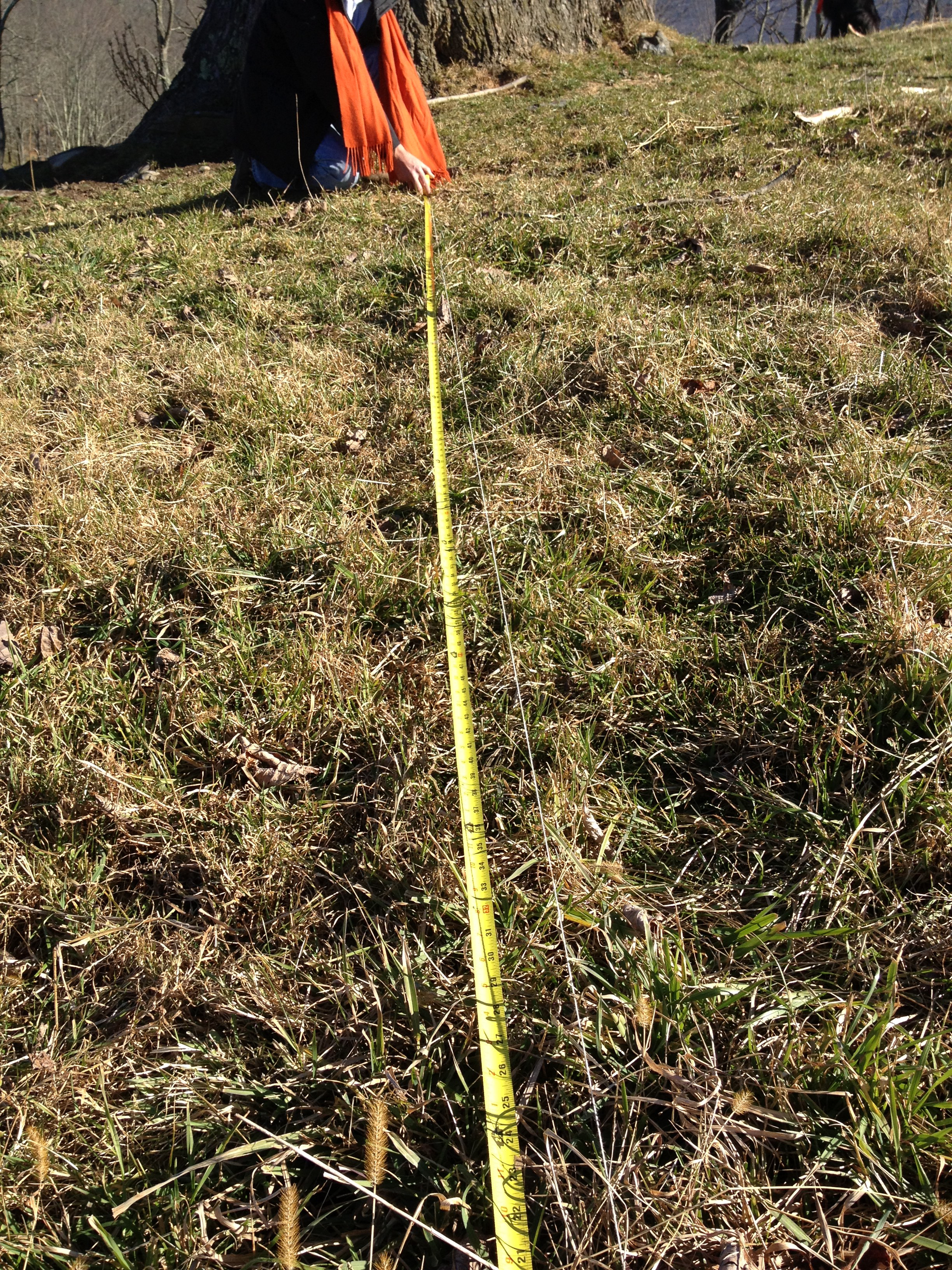
 

Measuring the string

Measuring the string


My measurement, taken two years ago with my husband’s orange plastic nurseryman’s tape, was 21-foot circumference. (I simply wrapped the tree with the bright orange tape, broke the tape at the full circle point, put the length in my pocket, and brought it back to Ithaca to measure with a yardstick. I don’t think I corrected my dbh for slope.) I am happy that this tree came in at 22 feet around. I was sure that it was a tree for the books. A champion. Sargent describes the ideal shape of the tree as “pyramidal.” However, because cucumber trees are weak wooded, such a tree on a mountain ridge has suffered many weather-related assaults that have twisted its growth patterns, and led to loss of limbs and subsequent clumps of dense younger growth in remaining limbs. It reminds me of the Little Prince’s baobab tree in Saint-Exupery’s book of the same name.
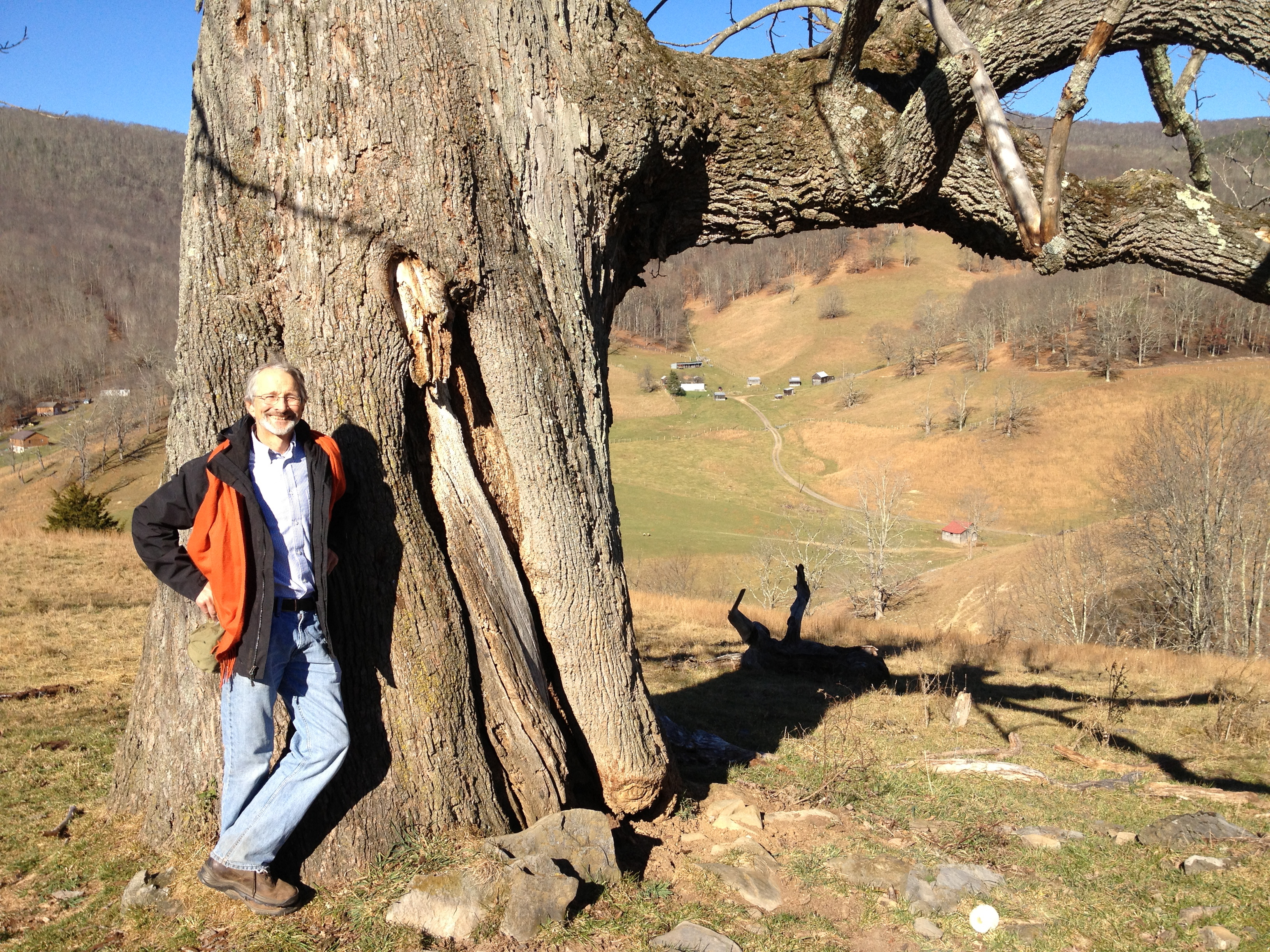
 

Head measurer David Fernandez stands by tree. Vinegar Hollow visible in the background.

Head measurer David Fernandez stands by tree. Vinegar Hollow visible in the background.


I am happy that we have spent this time circling the tree, honoring its girth and its presence in this small hollow. There are other cucumber tree lovers out there. Please see this thread posted on the Native Tree Society by Will Blozan (http://www.nativetreesociety.org/fieldtrips/west_virginia/cucumbertree/speaking_of_cucumbertree.htm). A scroll through the thread offers some wonderful photographs (particularly one of a tree pruner’s shadow joined into the shadow of the tree) and information on the tree and its medicinal properties.

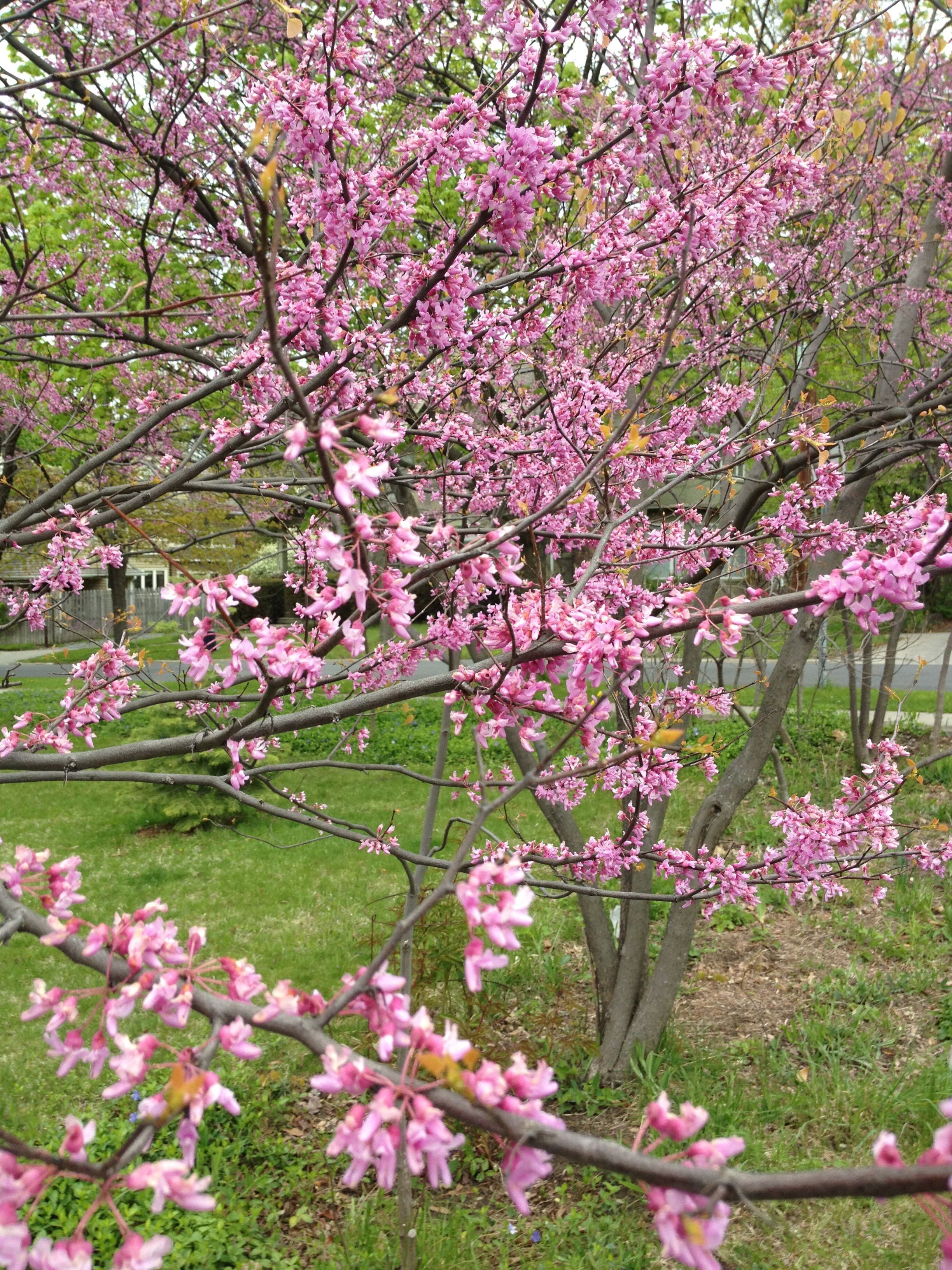
Spring’s Pinks

IMG_0699


The surprise of spring in Ithaca, New York is color. Winter’s tones here are the off-whites of the sky, the greys and browns of bark, and the beiges of field stubble and beech leaves that shiver all through the season. Sometimes there’s a blue sky, in the shade that my mother always called copen-blue. Copen? To prepare you for what lies ahead in the way of my attempts at slightly nuanced color descriptions, I provide a definition of the color “copen” : “a variable color averaging a moderate blue that is redder, lighter, and stronger than pompadour, bluebird, azurite blue, or Dresden blue and greener, lighter, and stronger than luster blue” (Merriam-Webster’s online). A ha! I thought so.

Recently, taking a walk around the block with my dog, I stumbled into a swath of pink-flowering shrubs. I felt as if I was seeing pink for the first time. Suddenly, in a short section of sidewalk bumpy with tree roots and littered with the odd soda can and wrinkled dusty plastic wrapper, I was rubbing shoulders with spring pink in four shades —the redbud (Cercis canadensis) and lilac (Syringa sp.) to my right, and the dogwood (Cornus florida rubra) and honeysuckle (Lonicera sp.) to my left.

Redbuds are one of the glories of eastern North America. Its pink is unique and mysterious, especially as the flowers are clustered tightly against the grey bark and appear well before any leaves. Often called a rosy pink or a purple-pink, it is definitely more complex than such simple names suggest. I would call it a French-blue pink.


Redbud

Redbud


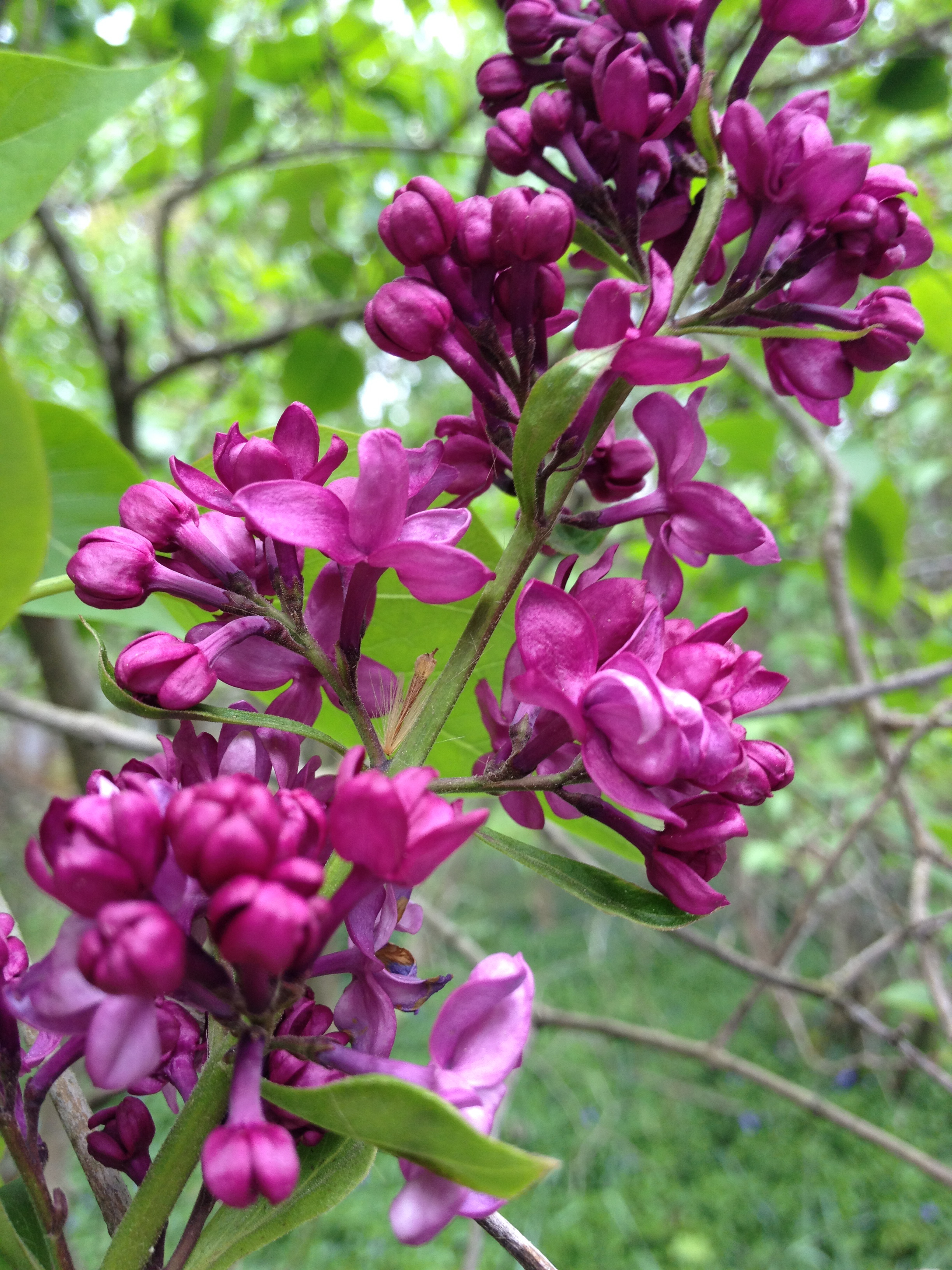
There’s a hint of blueberry in its shade, and in fact the hooded little pea flowers can only be pollinated by long-tongued bees, such as blueberry bees and carpenter bees. The pink-flowering dogwood is a peachier, orangier pink. Perhaps with a tinge of apricot. I would like to offer my pink descriptions with the same beguiling eloquence as those writers of wine descriptions. Continuing in that vein, perhaps I could add that the dogwood’s pink has a hint of apple? While there are those who consider the honeysuckle weedy, old fashioned, and invasive, various bushes in my neighborhood offer pinks that vary from pale, uncomplicated pink to a coppery sort of pomegranate pink. Some may criticize me for including the lilac in my cast of pink-hued characters, however a lilac in bud is pinkish-reddish rather than lavenderish (and lilacs are often in an between state, half in bud and half in full flower).


Lilac

Lilac

Honeysuckle

Honeysuckle


We enjoy these shades of pink courtesy of chemical compounds called anthocyanins that can be present in all parts of a plant, but are particularly apparent in flowers, which contain little to no chlorophyll (the compound that makes the plant kingdom green). Such colors protect plants from sun stroke, signal pollinators, and offer diners antioxidants.  In comparison to anthocyanin, pink is a lovely word. It has the soft, comforting sound of the letter “p,” and the zippy verve of the letter “k.” According to etymologists, it is an old word whose first use occurred between 1565 and 1575, but its origin is unknown. At some point its history became connected to a garden flower known as the cottage pink or China pink, belonging to the Old World genus Dianthus, whose flowers come in various shades of white-speckled pink and red and  have frilled edges–thus the naming of pinking shears. How nice to take a walk around the block, thinking about different shades of pink, practicing the art of discernment!

Enthused with this bit of fieldwork in the neighborhood, I came home to my garden and made a bouquet of tulips in different hues of rose to continue my exploration of spring’s pinks under a copen-blue sky.


Tulips

Tulips

My Sword Garden!

Rex Fernandez the cat detects signs of life in amaryllis bulb

Rex Fernandez the cat detects signs of life in amaryllis bulb


The Red Lion is out! He has sprung, finally. It is a brief moment, considering the year of care that he required of me in order strengthen him for this burst of movement upward. Though, I confess that I was not thinking of him every day of this past year. And he is not the only Red Lion. I have others and I am loyal to them all, and to his relatives who go by other names—Vera, Clown, and Novella.  They are everywhere in my house—six in the dining room, three in the study, three in the kitchen, three in the alcove, and eight in the basement, where four on the washer and four on the dryer gyrate to the sudsing and tumbling of clothes to no ill effect apparently. They comprise my bevy of amaryllis bulbs, and they are too many–a true plethora, a surfeit, a glut. Why so many amaryllis? It’s not my fault. My husband runs a landscape design/garden center business. In early January he brings home the amaryllis bulbs that did not sell during the Christmas season.  We give them away to friends, but still there are more. I pot up the orphans because I cannot resist what I know they will do with just a little soil, water, and light.  I moisten potting soil in my biggest mixing bowl and pot up the fat brown bulbs, taking care to stuff down their wiggily spongy roots (unlike the roots of tulip and daffodil bulbs, amaryllis roots remain living all year, whether potted or unpotted). The bulb planter then becomes a bulb watcher, looking for signs of life. Just when one is ready to state that this is the bulb that will not do it, just then it does! The tip of a green sword emerges. From then on the bulb watcher should not leave the premises. The large flowering bud at the tip of the green sword opens in a ballet dance of shimmering, iridescent seductive curves. Individual flowers join petal tip to petal tip, forming ring-like umbels.


The Red Lion

The Red Lion

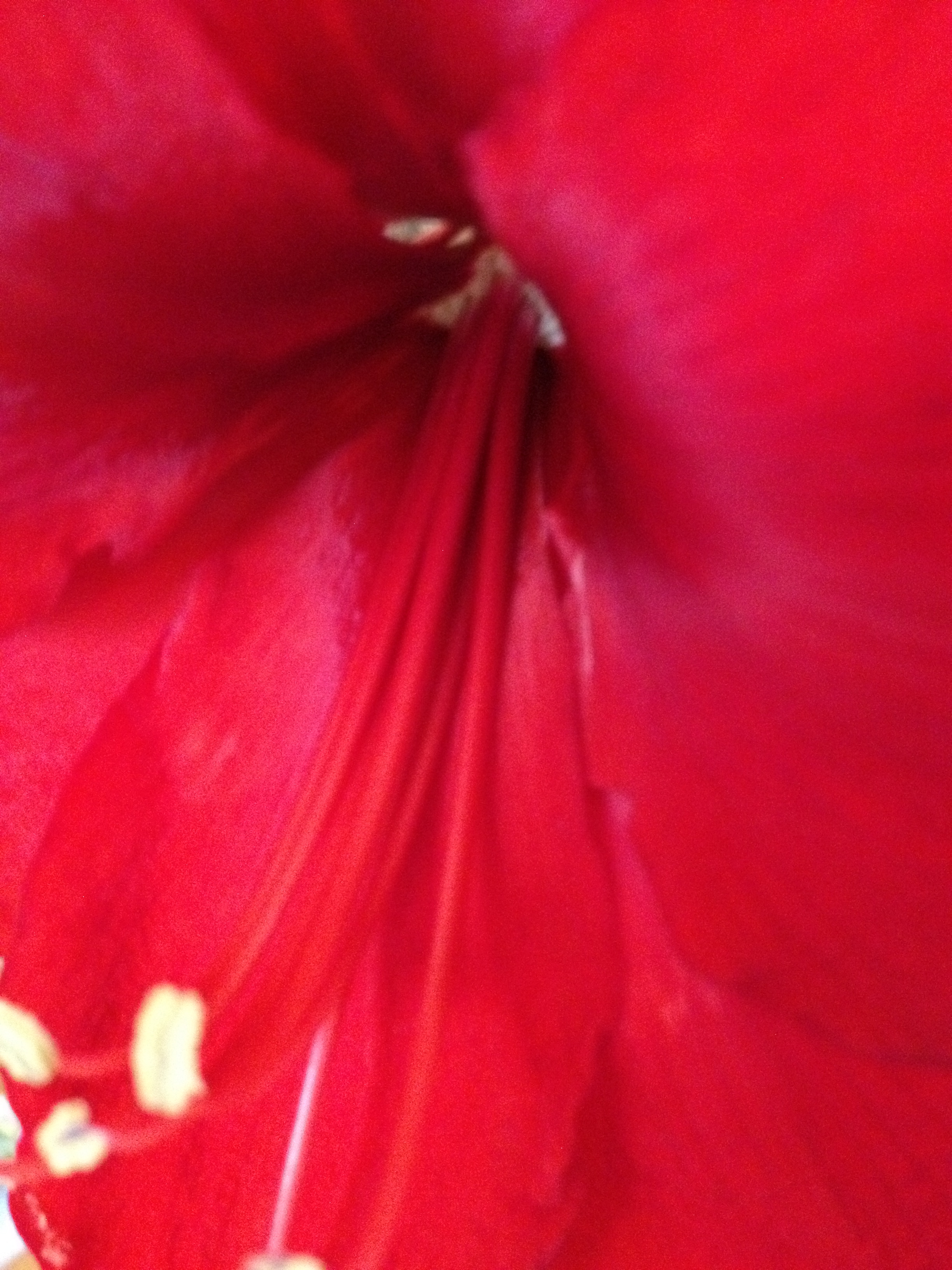
The Red Lion posing!

The Red Lion posing!


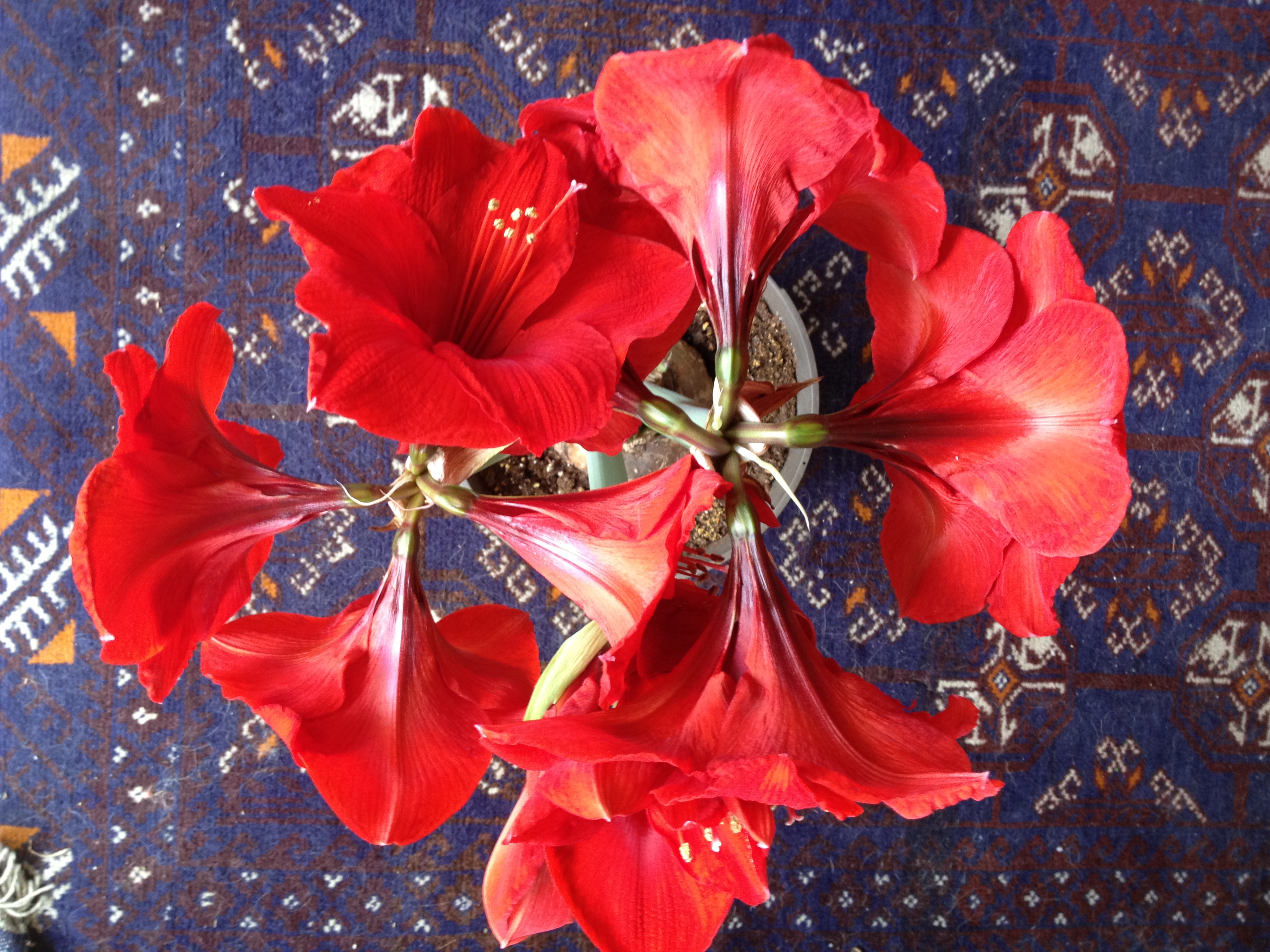
I carry the Red Lion from room to room, hoping to find the perfect spot for the perfect photograph, but my efforts do not do justice. Several writer photographers have done so, however—Starr Ockenga, author of Amaryllis, and Ken Robbins, author of A Flower Grows—in very different ways. Ockenga ordered 90 kinds of amaryllis bulbs and spent a year documenting their growth in her greenhouse. Robbins follows the growth of just one bulb in hand-tinted photographs. Finally, standing on a table, I view the Red Lion from above.


Red Lion seen from above

Red Lion seen from above


The scientific name of the amaryllis is Hippeastrum, or horse star. In 1837 the Honorable Reverend William Herbert, Dean of Manchester named the genus thusly perhaps after a holy water sprinkler, whose shape had its antecedents in a medieval weapon used by knights, known as the “morning star.” The common name, amaryllis, has a more troubling origin. A lovely nymph named Amaryllis fell in love with a handsome shepherd named Alteo, who was impervious to her love. He said that all that he desired was a flower—one that was new to the world. Amaryllis wished to comply with this desire. She consulted the Oracle of Delphi who advised her to dress in white, plant herself at his doorstep, and pierce her heart with a golden arrow for 30 nights. She did this. When Alteo finally opened his door, there was a red flower. Her blood, so slowly dripped, had become the amaryllis.


The Red Lion again!

The Red Lion again!


The Scottish poet and garden writer Muriel Stuart (1885-1967) writes in her book Fool’s Garden (1936) that “There is a sex appeal in flowers, no less than in human beings. Unguessed, unexplained, but present, shown by the garden lover’s preference for rose or magnolia, for orchid or gillyflower, for tree or rock plant. Strong and irrestible, the wherefore they know not, the mysterious drawing power is there, some potency distilled from stem or stamen, curved petal-lip or watching eye. And so we are drawn to certain flowers by some sex appeal of growth and colour, no less than to certain people by hand or eye, or wayward toss of hair or turn of chin. Show me a garden and I will show you the gardener’s soul” (p. 195). Stuart, more English than Scottish, wrote poems, whose themes were sexual politics and horticulture, that were admired by Thomas Hardy. Her gardening book is full of sweet stories about the “whimsies” that she and co-worker, her young son Adam, contrived in their garden, one being a special “sword garden,” for plants whose leaves are “swordy and austere.” Their vision was a garden full of “stately spears” and “tiny daggers” and “lance lifters.” Muriel  writes that she and Adam, the fools of her title, learned much in the planting of their “unorthodox” garden.

It occurs to me that my collection of amaryllis is a sword garden–and what could have more sex appeal than the Red Lion? For me, however, the sex appeal is not so much in the flower, but in the tip of green just beginning to show itself from the brown bulb, like the spire of a cathedral in a dull place. Every year when it’s warm enough I carry the tired bulbs outside to replenish themselves in the shade. The slugs, leaving trails of silvery slime, nibble them to shreds,  and the resident groundhog and rabbit may feast a little as well. I splash water on them in the droughts of August. By fall their tattered leaves have yellowed, but the bulbs are plump again with stored food reserves made by the leaves. Just as frost arrives, I carry them inside and wait for the tip of the green spire to appear. Many gardeners consign amaryllis bulbs to the compost pile, but they can live and flower for 75 years. Perhaps I will be nurturing my fool’s garden of amaryllis for some time to come.