A Winter’s Day in Vinegar Hollow

The night before had been snowy.

The night before had been snowy.

As the sky lightens in the east, toothpick trees standing like steadfast tin soldiers row upon row take shape, straight and thin. Rosy pink gives way to layers of pale gold and pale gray blue. The scene is still, perfect in its way, but a calf died in the barn in the early morning.

Light appears to the northeast.

Light appears in the east.

During calving season Mike checks the barn at regular intervals.  He had checked at 3 am, despite his flu, the cold, and the fresh snow that made the road slick into Vinegar Hollow from his house on Route 220. When he came back at 7 am, a calf lay dead on the hay in the stall with its mother.  The death of a calf is both an economic and an emotional loss.

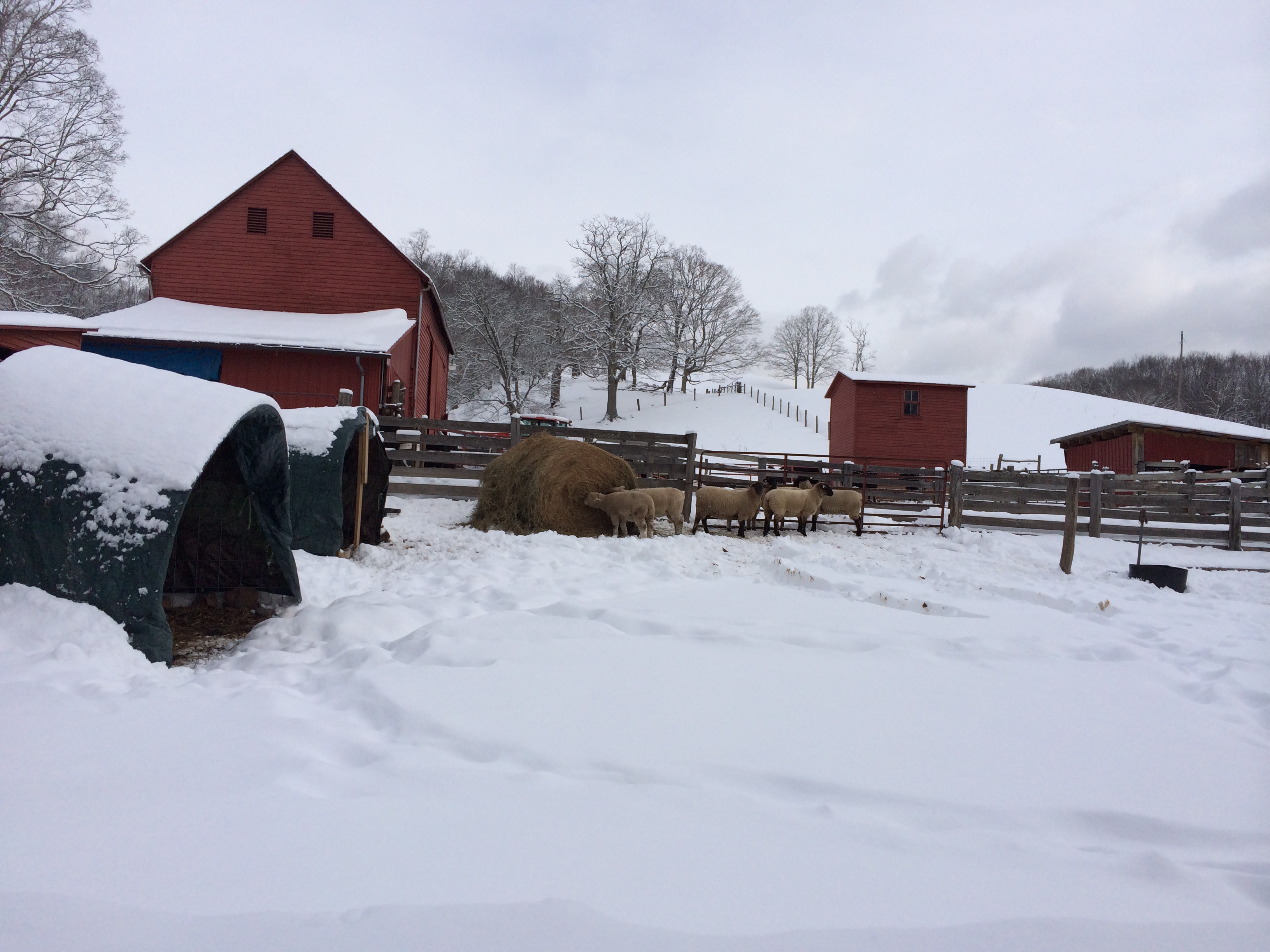
Cow-and-calf shelters to the left, yearling sheep near center

Cow-and-calf shelters to the left,  and yearling sheep near center with straw barn behind.

“I can’t sleep beside them all night,” Mike says, his voice roughened by flu and tiredness. The cow could have stepped on its calf by mistake, or failed to lick the sac off fast enough, or maybe it was born dead, or…. There is no way of knowing what happened in those few hours as the cow and calf enacted this farm tragedy. The cow will feel her loss for some time in the pain of swollen udders. Sometimes there is a solution. It may be able to take on one of a set of twins.

image

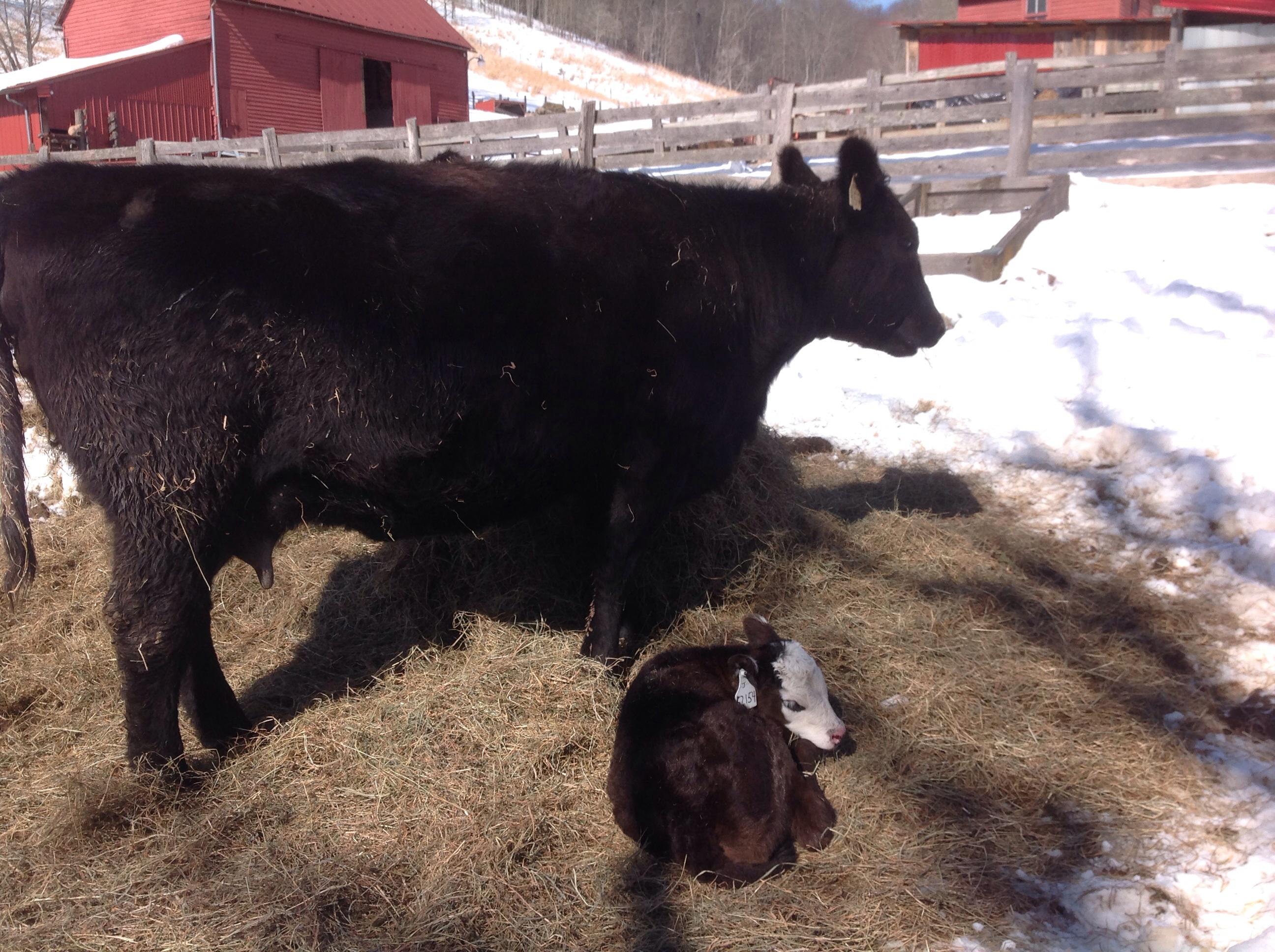
Cow and calf enjoying the noonday sun.

Young California Red (has some fat-tailed, red-faced Tunis in his background).

Alert young California Red (has some fat-tailed, red-faced Tunis in his heritage).

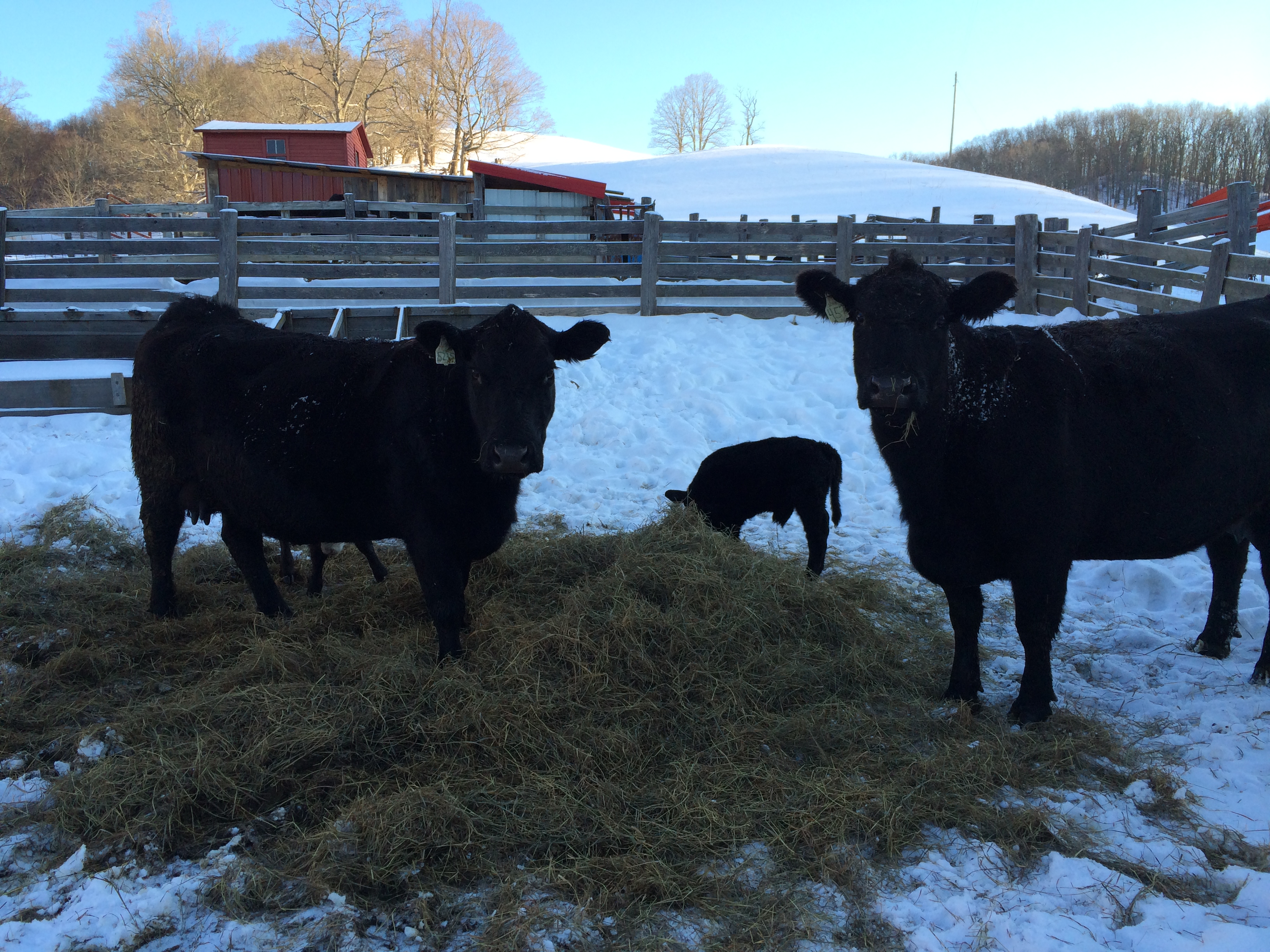
A few hours later, two crows appear in the blasted walnut tree in the sinkhole. One crow leaves. One remains. Lovely, simple math. Now there are two again. One flashes away, then the other. Back and forth they go. If they left contrails like planes, it would be quite a tangle in the sky. By midday the juncos are visiting the cows and yearling sheep in the pen by the old house picking up hayseed. They are very busy. The crows take an interest as well.  Two cows and their calves sit soaking up the sun. Occasionally one rises to spray steaming manure or lick the face of her calf, but mostly they sit, face to the sun, soaking up heat, to balance those minus 15-degree nights of the week before. Black crow on white snow. Black Angus on brown hay on white snow. Juncos gray and white. Butterscotch barn cat lolls along in the sled tracks, confident that the dogs are worn out, asleep.

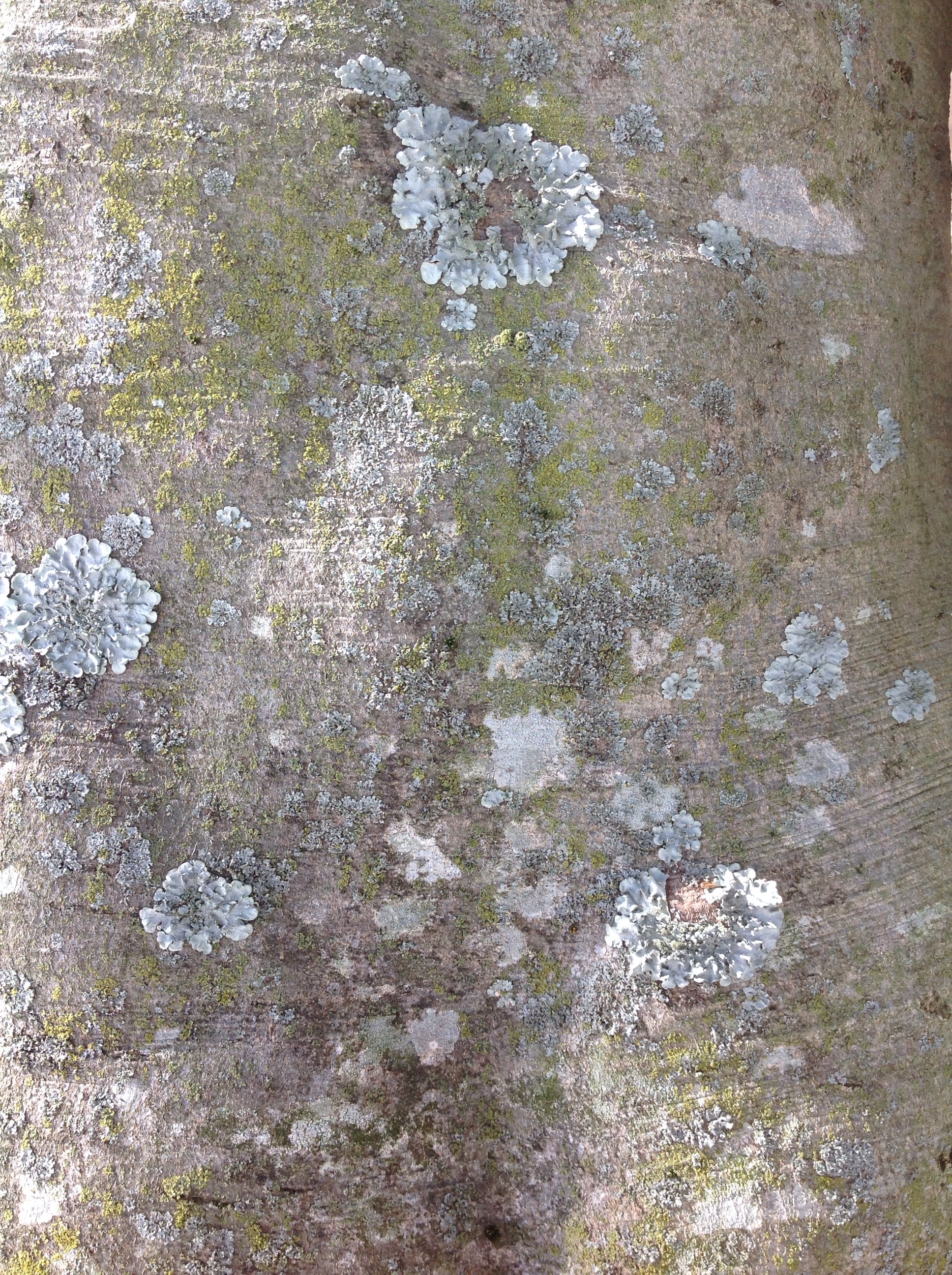
Lichened bark of the copper beech.

Lichened bark of the copper beech.

Tree trunks in the garden become art objects, their surfaces intricately sculpted.  No doubt much is going on beneath the lichened bark of the beech and the owl eyes of the red spruce as the juncos visit the bare ground at their base. Days like this in late February set in motion the whirring cogs of spring. Snow and ground are melting.  A large bluejay floats from branch to branch of the beech tree.

"Owl eye" of the red spruce.

“Owl eye” of the red spruce.

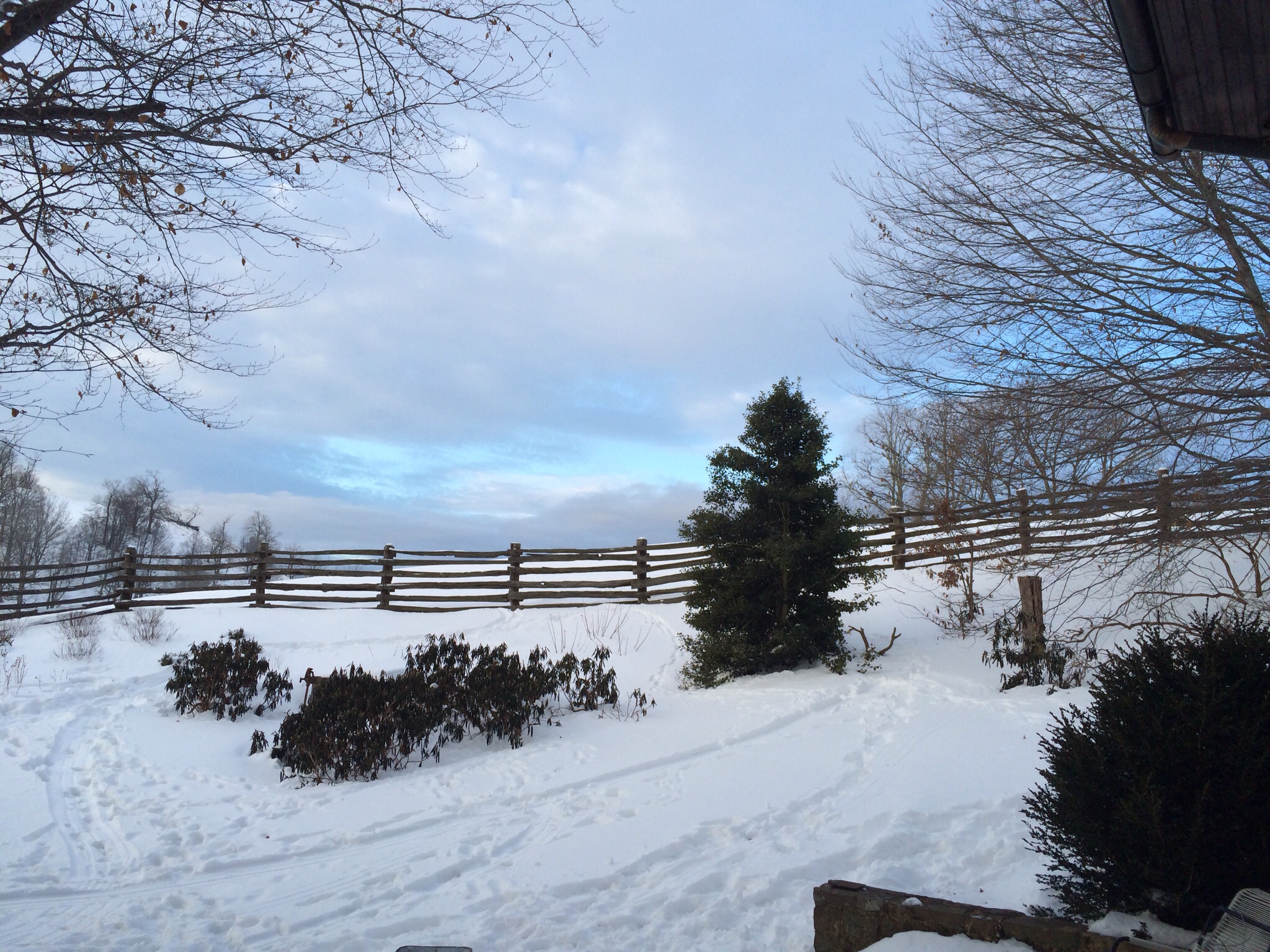
The hollow, like a reflecting pool, shimmers with each movement of the sun and clouds. Mid-afternoon is a time of shine and shadow.

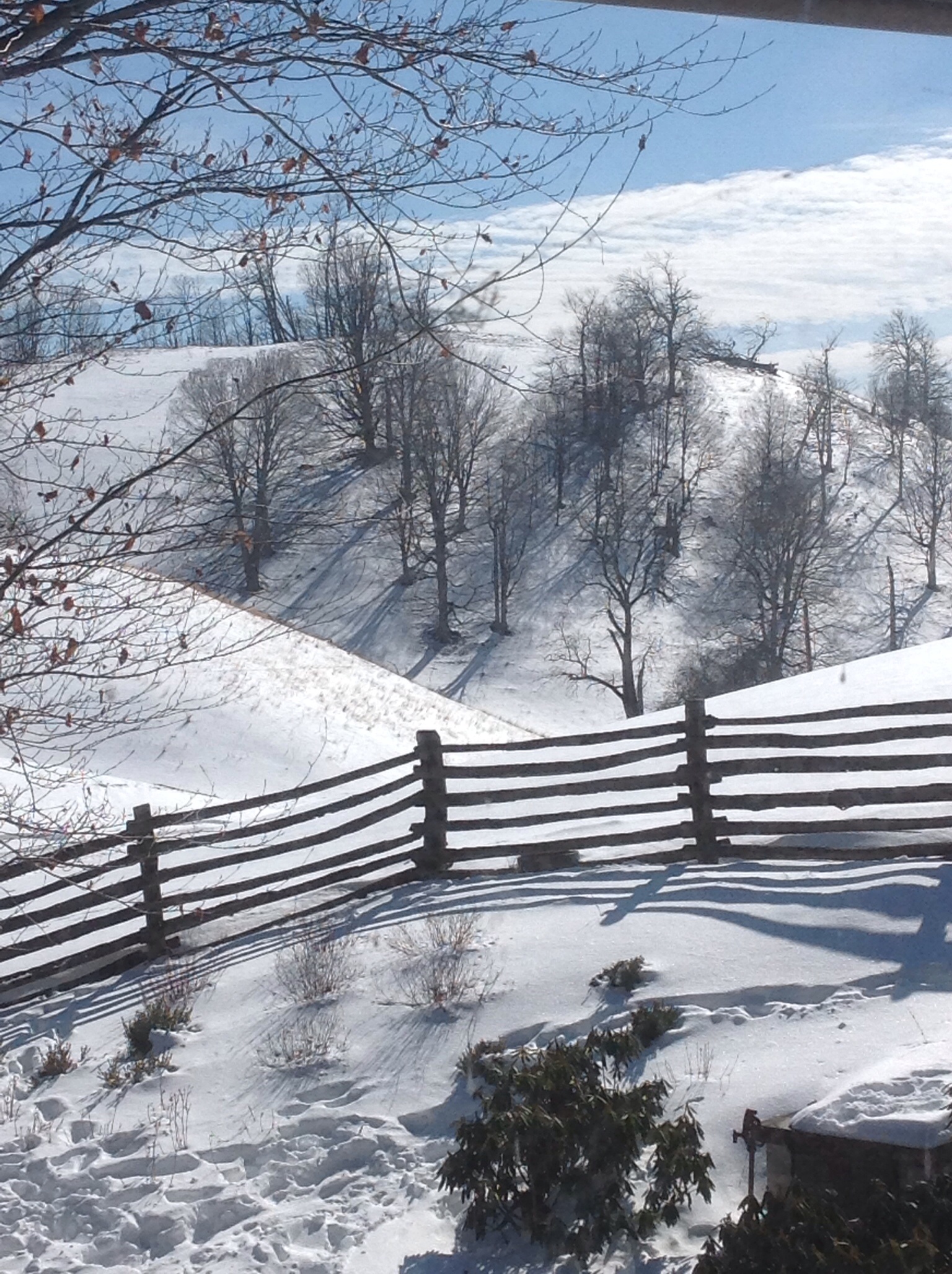
Trees on flank of Stark's Ridge cast shadows. Top of hill is Lawson's Knob (named after John S. Lawson).

Trees on flank of Stark’s Ridge cast shadows. Top of hill is Lawson’s Knob (named after John S. Lawson).

Calves have only a day or two in the barn before they must face the elements to release space for the next cow near birth. The cows and their new calves may take to the shelters Mike has made for them or they will remain embedded in the hay close together.

Sky to the north becomes turquoise in later afternoon.

Sky to the north becomes turquoise in later afternoon.

The day begins to fold in for the night. Shadows grow darker and bigger. Juncos take shelter in the overgrown boxwood and yew.

View to the south in later afternoon.

View to the south in later afternoon..

Where the hollow tapers, to the south, the sky colors in hues of apricot, lavender, chocolate. I rush out to catch them but they have gone. It is all happening so fast. Night comes, and it will snow again.

Cows headed to the barn in the early morning.

Cows headed away from the barn meadow the next morning.

After a day here, hollowed, I feel as if I have been spinning around the entire world. There are no places I am not part of when I plant my feet in Vinegar Hollow. Oh, little calf that never even experienced a day!

Fieldwork 101: Naturalist defers to Polar Vortex, but Pair of American Black Ducks Carries On

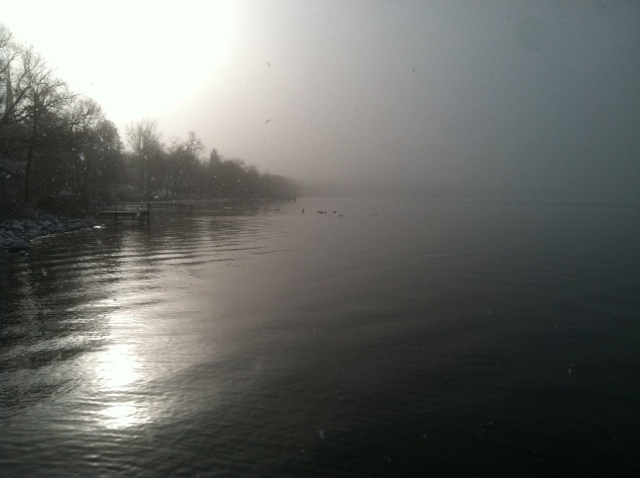
Cayuga Lake, one of upstate New York's Finger Lakes; Aurora, New York (photo by David Fernandez; Christmas, 2013)

View of Cayuga Lake, one of the Finger Lakes in upstate New York; Aurora, New York (photo by David Fernandez; Christmas, 2013)


A naturalist of the modern era—an experientially based, well-versed devotee of natural ecosystems—is ideally among the best informed of the American electorate when it comes to the potentially catastrophic environmental effects of political decisions. (Barry Lopez, “The Naturalist,” pp. 120-121 in Vintage Lopez, Random House, 2011)

One of my 2014 New Year’s resolutions is to devote a part of each day to living as a naturalist, observing all species and nonliving forms (like clouds), and reading and writing in response to those observations.  That means fieldwork first, wherever the field might be (even the corner of a bathroom if an interesting spider resides there), carrying on despite snow, rain, heat, gloom of night, and fear.

The contemporary naturalist, it has turned out—again, scientifically grounded, politically attuned, field experienced, library enriched—is no custodian of irrelevant knowledge, no mere adept differentiating among Empidonax flycathers on the wing, but a kind of citizen whose involvement in the political process, in the debates of public life, in the evolution of literature and the arts, has become crucial. (Barry Lopez, p. 121)

One can argue that we all, at every moment, have this opportunity, but we do not realize it. We are not in the naturalist’s “trance,” E. O. Wilson’s word for the observational state of mind of the naturalist.

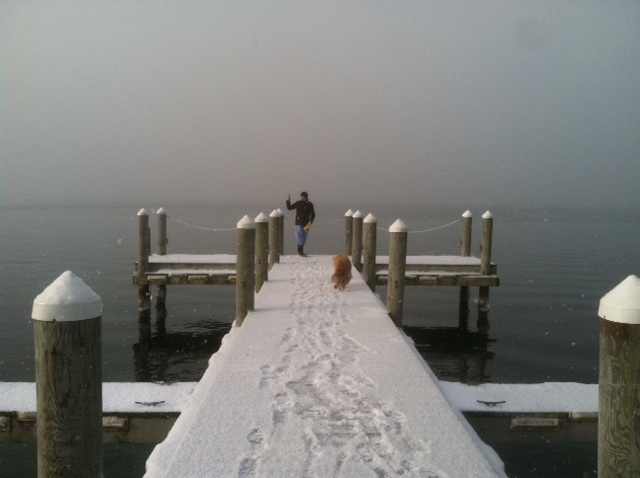
Jack and Daisy on Aurora Inn Dock (photo by David Fernandez; Christmas, 2013)

Jack and Daisy on Aurora Inn Dock (photo by David Fernandez; Christmas, 2013)


Shortly after New Year’s Day I found myself tending a house with no furnace. The house faces the western shore of Cayuga Lake in upstate New York. Like a gang of wailing banshees, the winds of the Polar Vortex  from the north swept into town, causing furnaces to fail, schools to close, and a wind chill of double digits below zero. Seven space heaters and a constant fire were keeping the house at plus/minus 52 degrees.

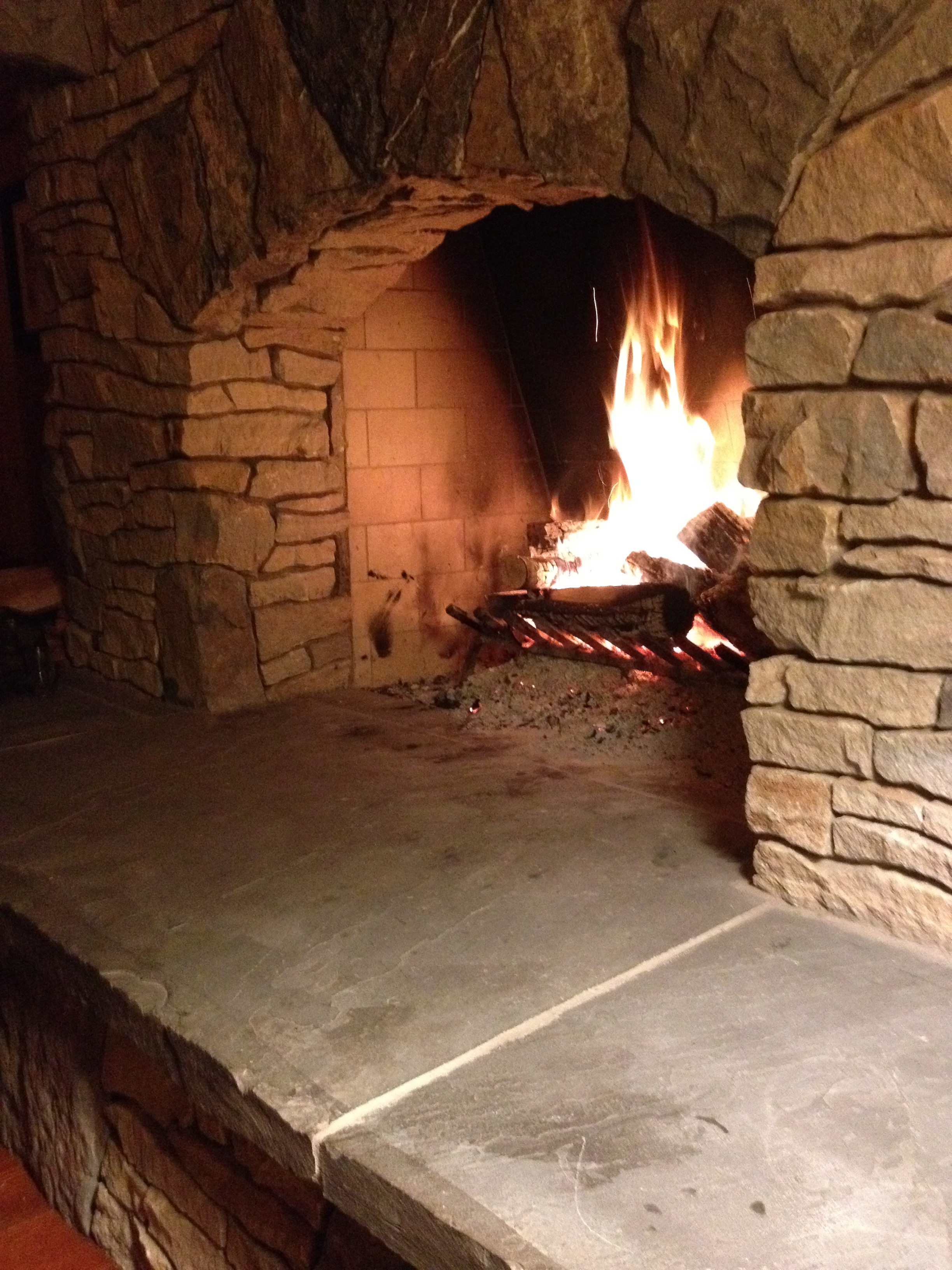
I set my chair up on the stone hearth to be as close to the fire as possible. When I felt toasted on the left side, I turned the chair the other way to warm my right side. Even with long underwear, a long woolen coat and hat, I needed to be about a foot from the fire. I had work to do, reading about bees in preparation for a submission to an upcoming anthology about pollinator decline.

Hearth with small fire

Hearth where “naturalist” hung out during Polar Vortex


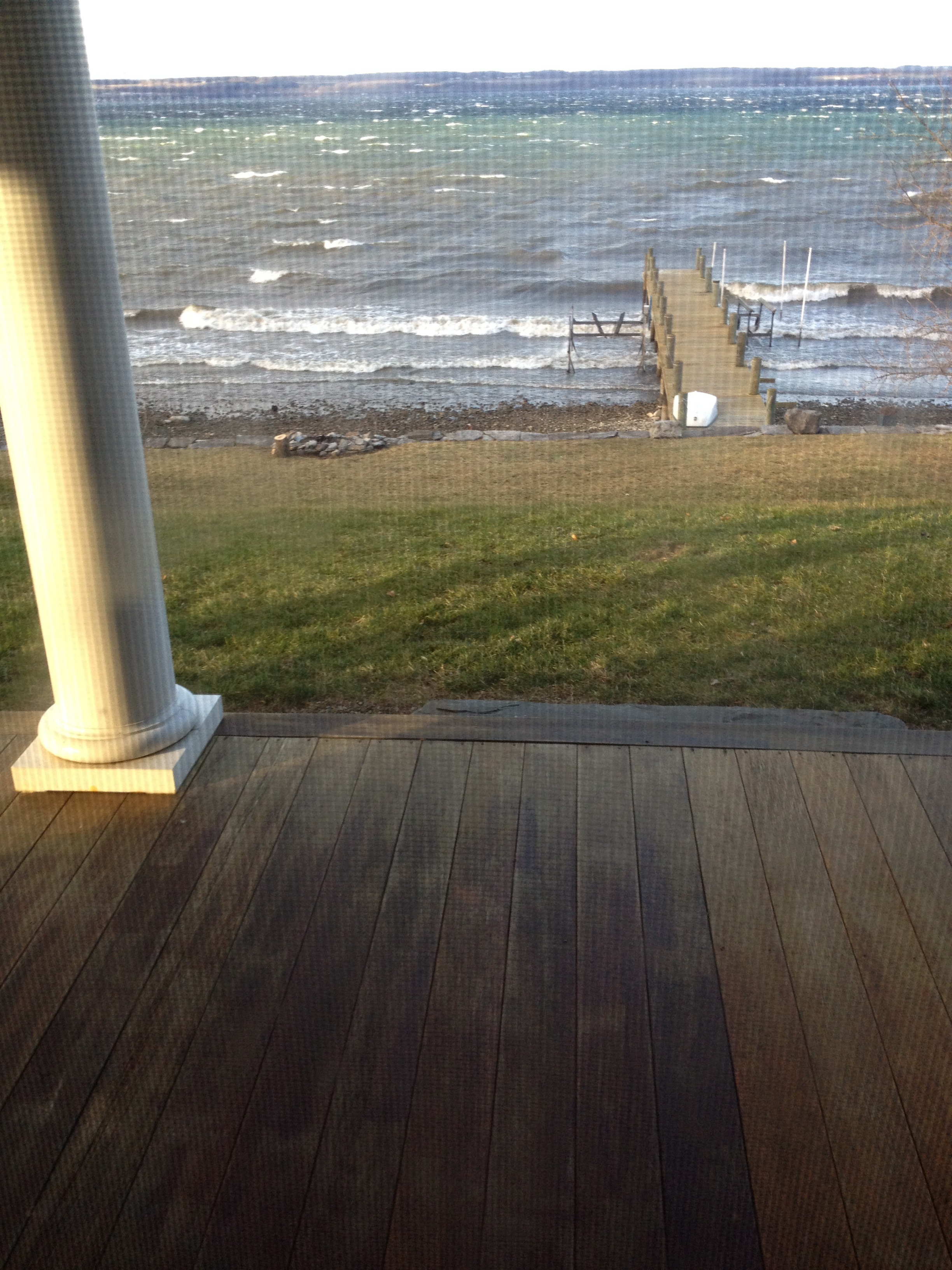
On Day 3, the furnace service technician still elsewhere (at a doctor’s office we were told), I continued my vigil, heaving wood into the fire assiduously. When toasting my left side up on the hearth, I had a good view of Cayuga Lake. Just a few weeks earlier, huge flocks of Snow Geese (called “rafts”) had settled on the lake in long, white ribbons, which parted into immense threads in the sky when they arose, alarmed by hunters’ gunshots. Now there were only two ducks, riding the tumultuous white caps side by side about two feet apart, near the dock. Although very Mallard like, their plumage was darker. I knew they were American Black Ducks (Latin species name: Anas rubripes, in French: Canard noir, in Spanish: Anade sombrio Americano). The plumage is actually dark brown, alleviated from somberness by an iridescent, violet patch (called a speculum) on the shoulder. As if sentinels or appointed companions to me, they rode the waves all afternoon within my view, side by side, until as the sun was setting they drifted under the dock, to parts unknown. The next morning the white caps had frozen into place. The ducks did not return.

Modest wintry white caps in January 2013.

Modest wintry white caps in January 2013.

The bugbear in all of this—and there is one—is the role of field experience, the degree to which the naturalist’s assessments are empirically grounded in firsthand knowledge. How much of what the contemporary naturalist claims to know about animals and the ecosystems they share with humans derives from what he has read, what he has heard, what he has seen televised? What part of what the naturalist has sworn his or her life to comes from firsthand experience, from what the body knows?  (Barry Lopez, “The Naturalist,” p. 121, Vintage Lopez)

I realize now that I failed, missing an opportunity to be a true naturalist in unusual, extreme conditions. I should have gone down to the dock, observed the American Black Ducks in the conditions that they were enduring, and photographed them. I wish I had, because I miss that particular pair.  I watched white caps pound them out of sight, but they bobbed up, again and again. American Black Ducks are “dabbling” ducks (as opposed to “diving” ducks), frequently tipping over headfirst to feed. I would distinguish their “bobbling” behavior during the winds of the Polar Vortex from what I have seen of “dabbling.” I would say it was more a matter of take-the-wave headfirst and reappear at all costs.

Cost is an important word. It “costs” in the form of energy to move any part of the body, to swim, to forage, to fly. I found a Master’s of Science thesis online entitled “Constructing a 24-hour Time-Energy Budget for American Black Ducks wintering in coastal New Jersey,”  by Orrin E. Jones III. Jones, a graduate student in Wildlife Ecology at the University of Delaware, logged in 11, 542 observations of black duck behavior to find out just how much energy it takes for an American Black Duck to get through a day and night (the DEE or daily energy expenditure). In other words, he tried to calculate their personal balance sheet for maintaining existence. Activities like flying cost a lot. A bird under stress flirts with death if stored body energy reserves cannot support the cost of flying, for example. Jones’ research was partly funded by the Black Duck Joint Venture: An International Program to Conserve the Black Duck.

I shivered just watching the ducks, moving closer to the fire each time one of the pair disappeared into a wave. Having now reassured myself about the duck’s beautiful adaptations for surviving cold weather (greasy feathers and a special countercurrent heat exchange system in their legs and feet , I know that the human being, naked in so many ways, is much more in need of sympathy in a polar vortex than a duck. However, would it be too anthropomorphic to consider that they might have been uncomfortable in duck terms? Surely, any living species can experience discomfort?

Apparently ducks are associated in many people’s minds with “silliness and humor.” Not for me. As I revisit the image in my mind of the pair of American Black Ducks bobbling in the white caps on Cayuga Lake, I think about how all species struggle with their personal balance sheet, the wonder of biological adaptation, and the pleasure of spending an afternoon en-“tranced” by a pair of ducks. I treasure Barry Lopez’s description of the naturalist. I can’t think of a better job description for every human being.

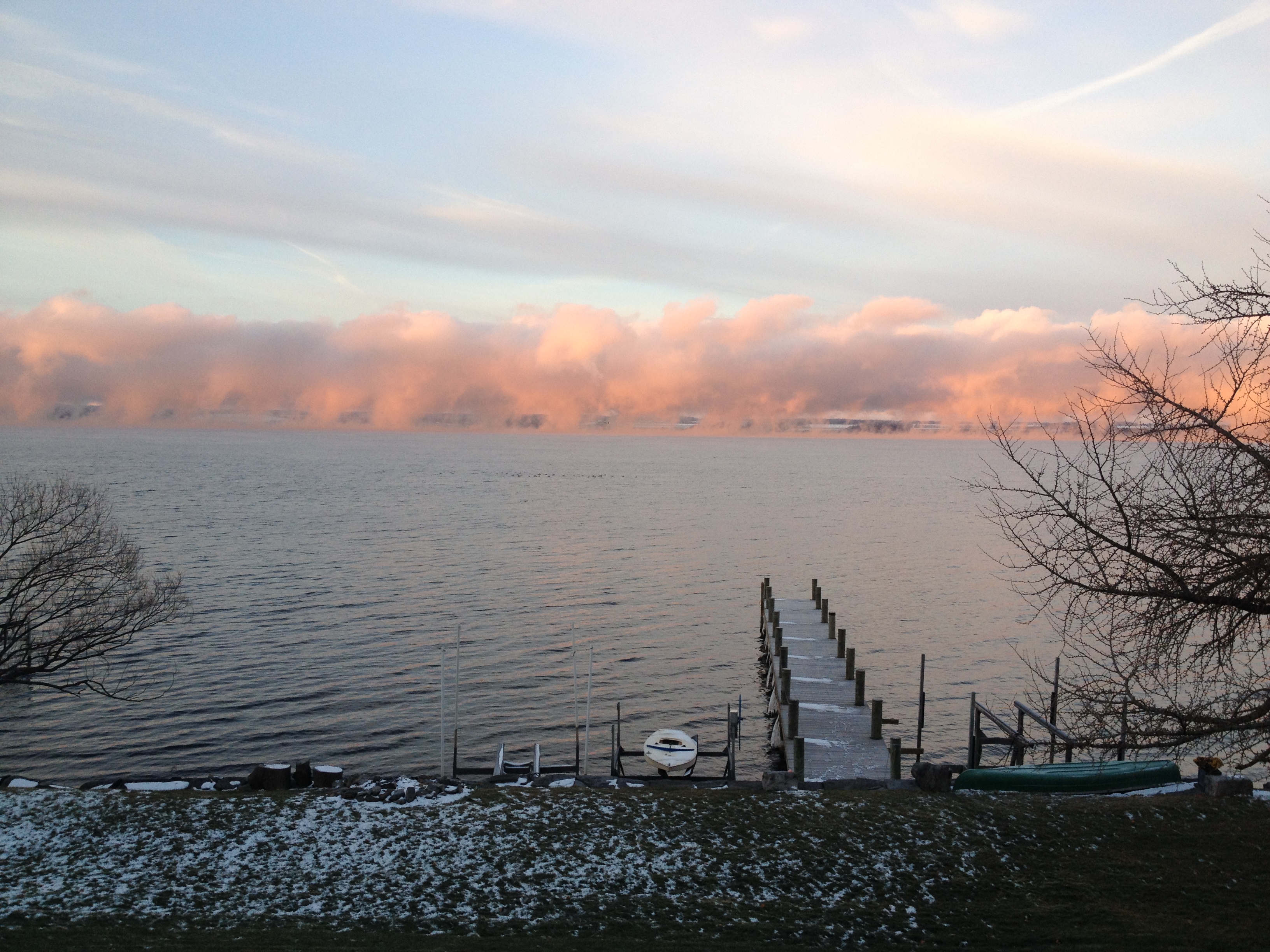
Western shore of Cayuga Lake in early morning (November 2013).

Western shore of Cayuga Lake in early morning (November 2013).


P. S. For photos of American Black Ducks “on ice,”  please visit the website of naturalist/interpreter Gerald Wykes and read his  “Naturespeak” blog post “Black Ducks on Thin Ice,” which gives information as well about their dwindling numbers. Having diverged from their “sibling” species, the Mallard, about a half million years ago, they are now converging, it seems, as a result of interbreeding. See also Gerald’s photoessay “Picture a Polar Vortex,” which shows the ferocity of the vortex and various creatures “hanging out” in it.

Bobolink Alley

Bobolinks. At first it was just a passing acquaintanceship. After all, they are birds, flying by quickly. But now, having spent time in Bobolink Alley and surrounding hayfields, I have become charmed by everything about them, the fact of their bobolinkishness, and, I, a forlorn lover, am mourning their imminent departure for Bolivia, Paraguay, or Argentina.IMG_3873
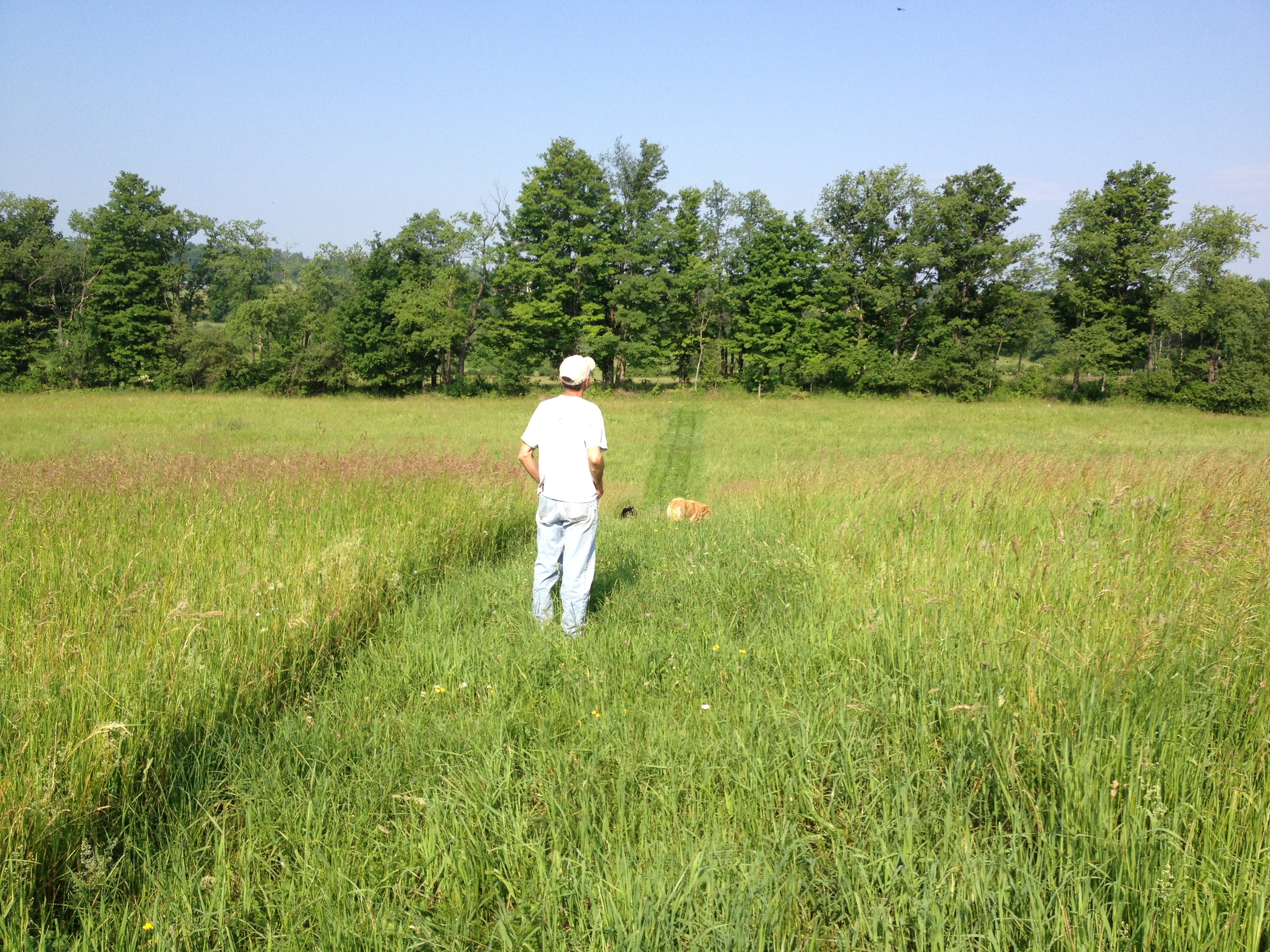
Like the bobolinks, I am migratory, returning to home territory in Highland County, Virginia. When I am gone, my husband David spends his evenings vegetable gardening, seeing friends, mowing, and bird-watching from a chair in a hedgerow in some hayfields we newly own, which we call Seven Fields. So, I first heard about bobolinks on the telephone. David would rave on about the numbers of bobolinks in the hayfields in Enfield, near Ithaca, and what he was learning about their endangered status. Since then we have discovered that our hayfields are natal territory to a significant number of bobolinks. Watching bobolinks from a distance, even with binoculars, is difficult. They are the usual songbird size, 7”-8” long, and whirl and swirl about with the typical fleetness of such birds, i.e., they don’t pause in prolonged introspection like a great blue heron. David decided to mow a walkway through the middle of the largest, most open of the hayfields in order to observe them more closely.  This walkway is Bobolink Alley.
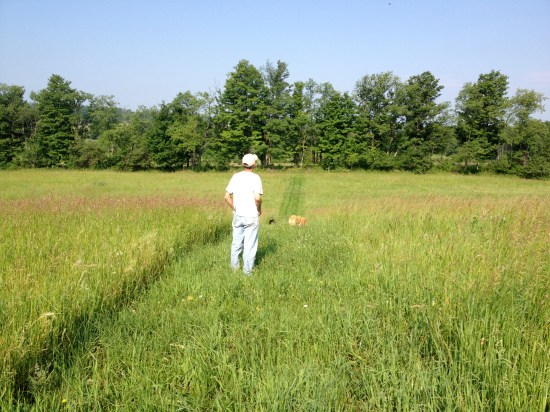
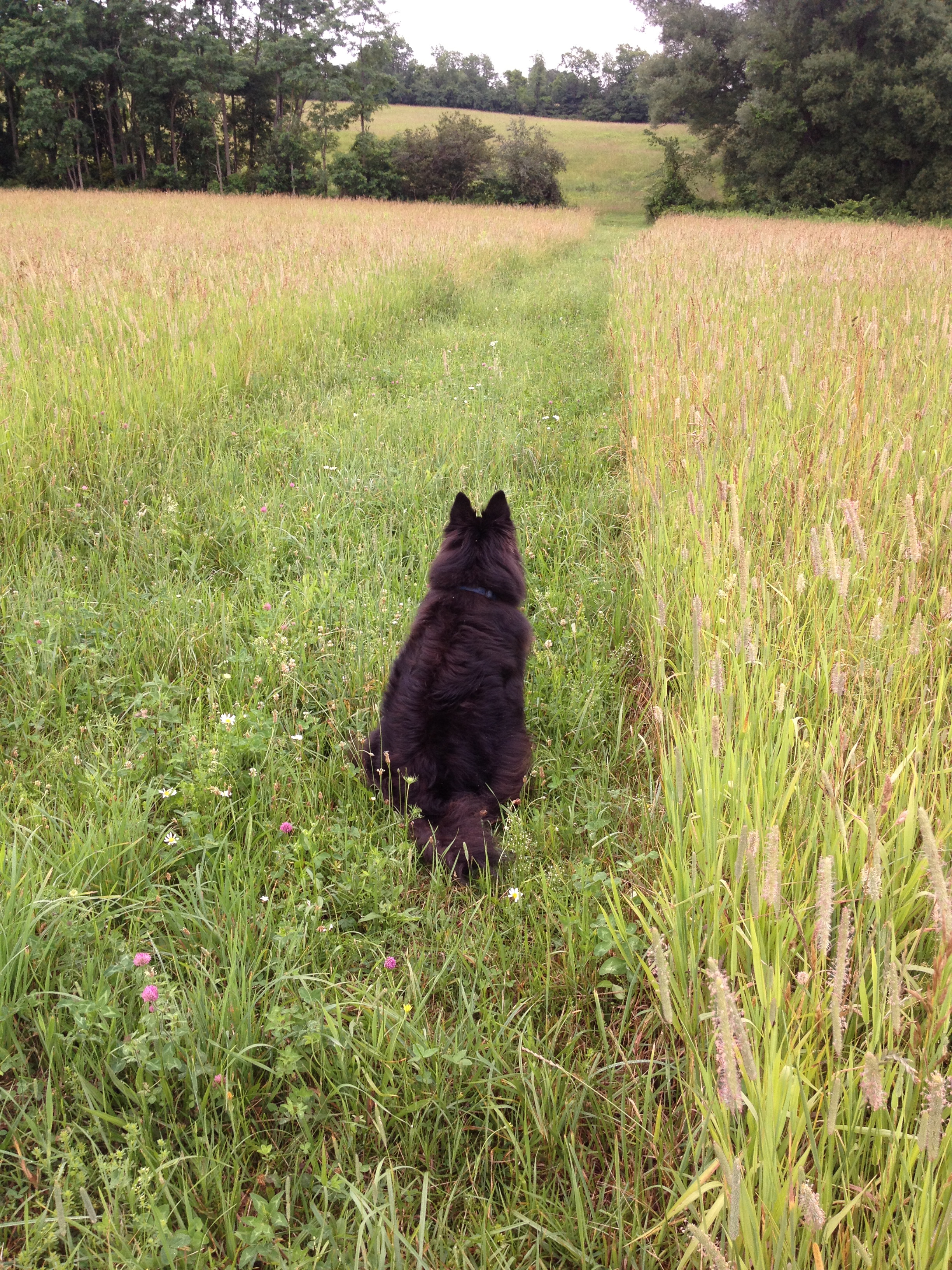
David, Belle (black speck), and Daisy (Jack's dog) in Bobolink Alley

David, Belle (black speck), and Daisy (Jack’s dog) in Bobolink Alley

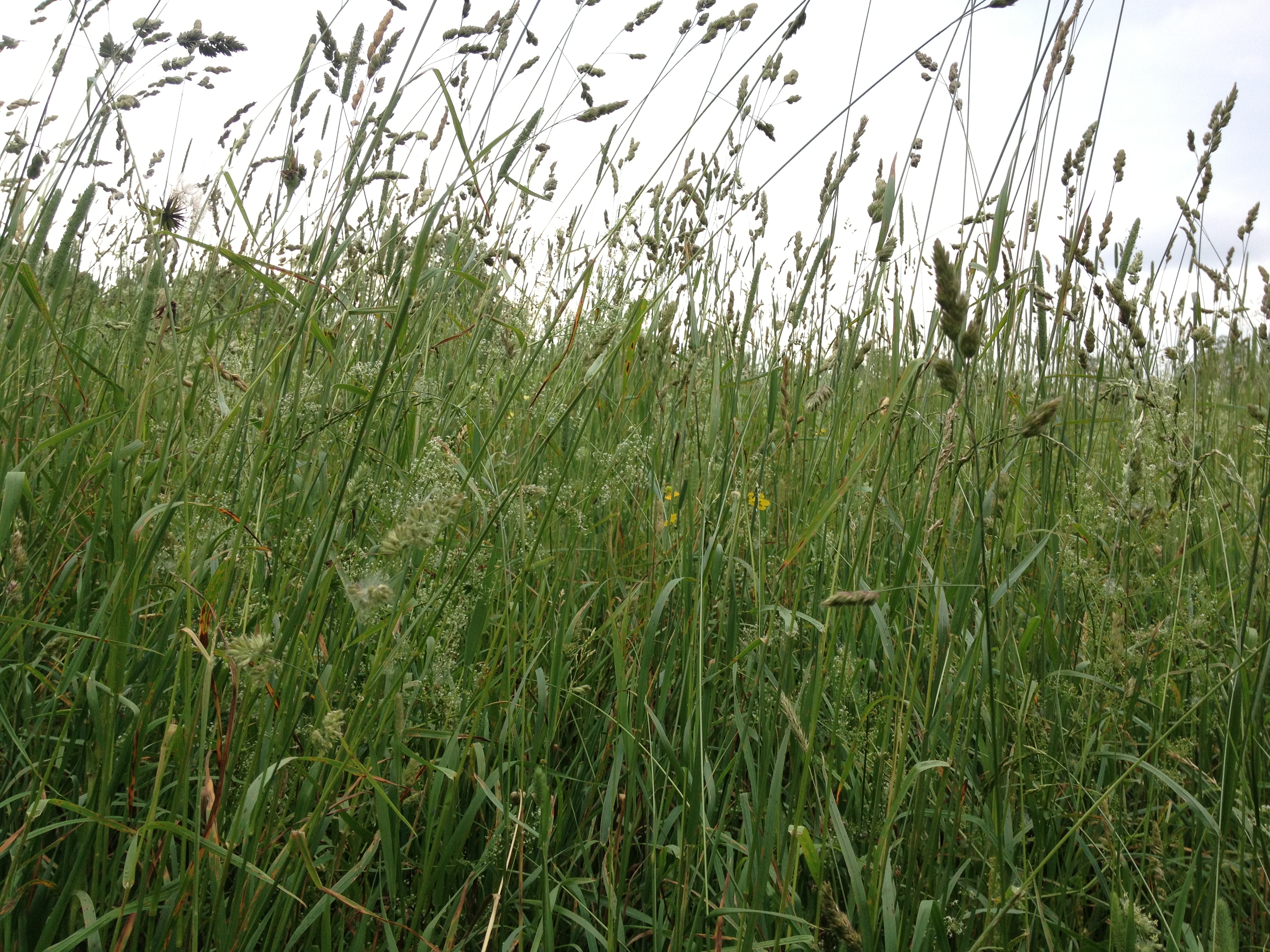
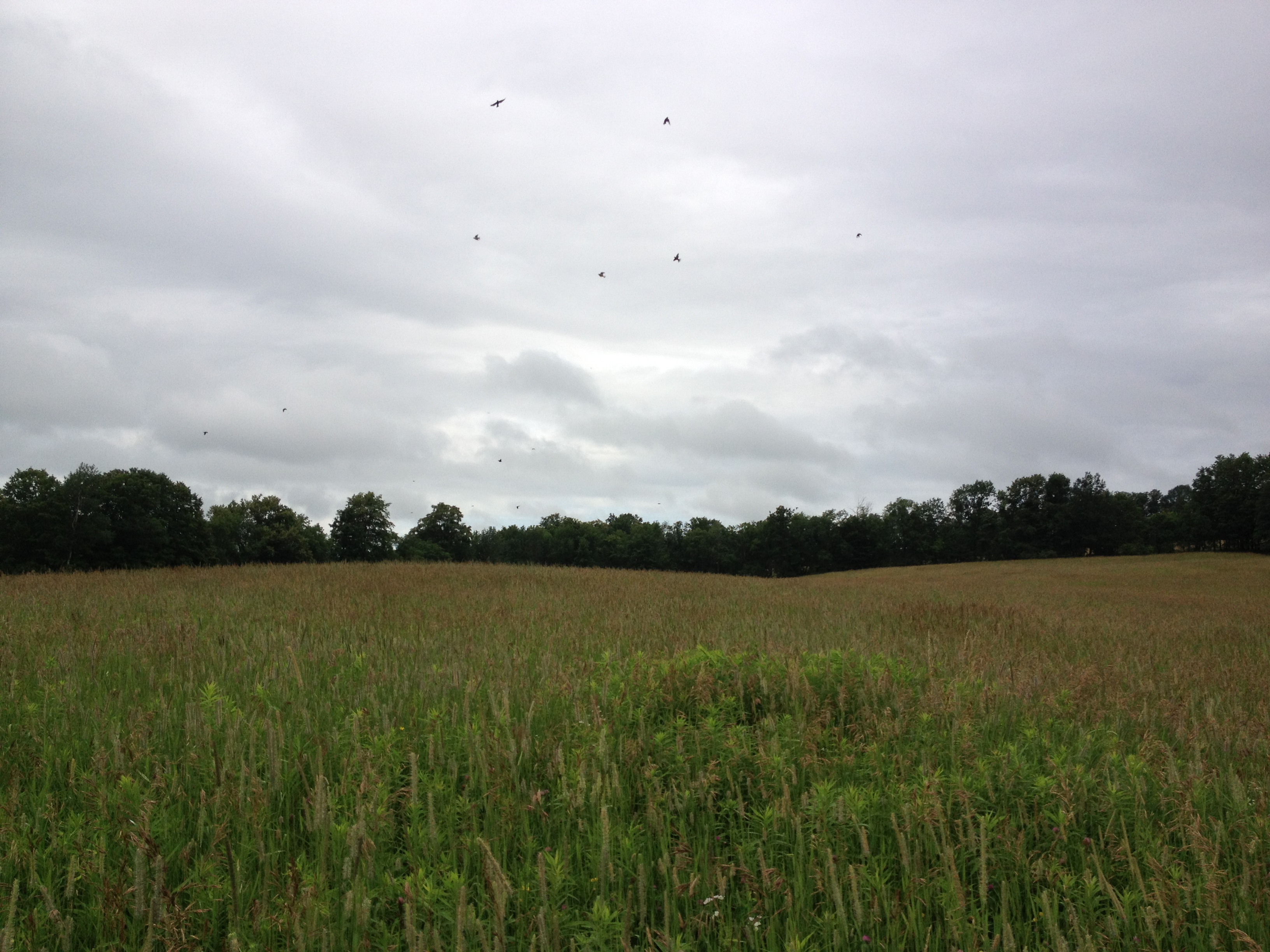
It is not easy to “get up close and personal” with a bobolink. Bobolinks nest on the ground in the dense undergrowth of hayfields. A hayfield can look serene, a sea of gently waving grasses, but if I make a little noise walking down Bobolink Alley with Belle the dog, suddenly dozens of bobolinks fluff out of the field, swirl and circle to assess the danger, before settling down, invisible once again. They are social and live in loose groups called chains (e.g., like a herd of elephants). The males are polygamous, deigning only to feed the young of their primary female, but other members of the chain help in feeding the young that are not their own.

My husband and I want to keep track of progress in these invisible bobolink nurseries in order to allow the nesting and fledging to proceed without harm. Bobolinks arrive in northern North America and Canada in May. About nine weeks later, mid-July, after fledging their young, they start their journey back to wintering grounds, the pampas of South America. This life cycle is at odds with recent agricultural practices of haying much earlier than in the early 1900s, to reap high-nutrient hay and to harvest several times a season. Mowing too early means loss of nests with eggs; mowing not at all means loss of the only habitat for which they are adapted to build nests. They need grassland. Not shrubland, nor brushland. The Bobolink Project, subtitled “Helping Farmers Protect Grassland Birds,” has organized for the purpose of mediating a compromise between the needs of farmers and the needs of bobolinks.[i]

The bobolink has been called the upside-down bird because of the noteworthy nature of the male’s mating attire. Unlike most North American birds, which are dark on top and light underneath, the mating male bobolink has a dark belly and a prominent “buffy yellow” patch on the back of the head and several bright white patches on the upper wings. While some commentators, like Professor David Spector, author of “Bobolinks: The Poets’ ‘Rowdy Bird’’ has called the attire a “clownish plumage,”[ii] I think that I might make the analogy to P. G. Wodehouse’s young men in love, who often present themselves in a whimsical sartorial manner (e.g., Young Men in Spats).  Certainly not classically beautiful like a bluebird, but distinctively bobolinkish. The female bobolink is described as a “buffy yellow brown” (musicofnature.org) or “large pale grassland sparrow” (Spector). “Buffy” seems a word that describers of birds use very freely. I would describe the female as being various shades of medium brown. I would say that the male’s yellow head patch, which is somewhat like the human Mohawk hairstyle, is cream yellow, not buffy yellow! The feathers seem to stick straight up, and the shape of the patch on the rear half of the head is odd.
IMG_3853

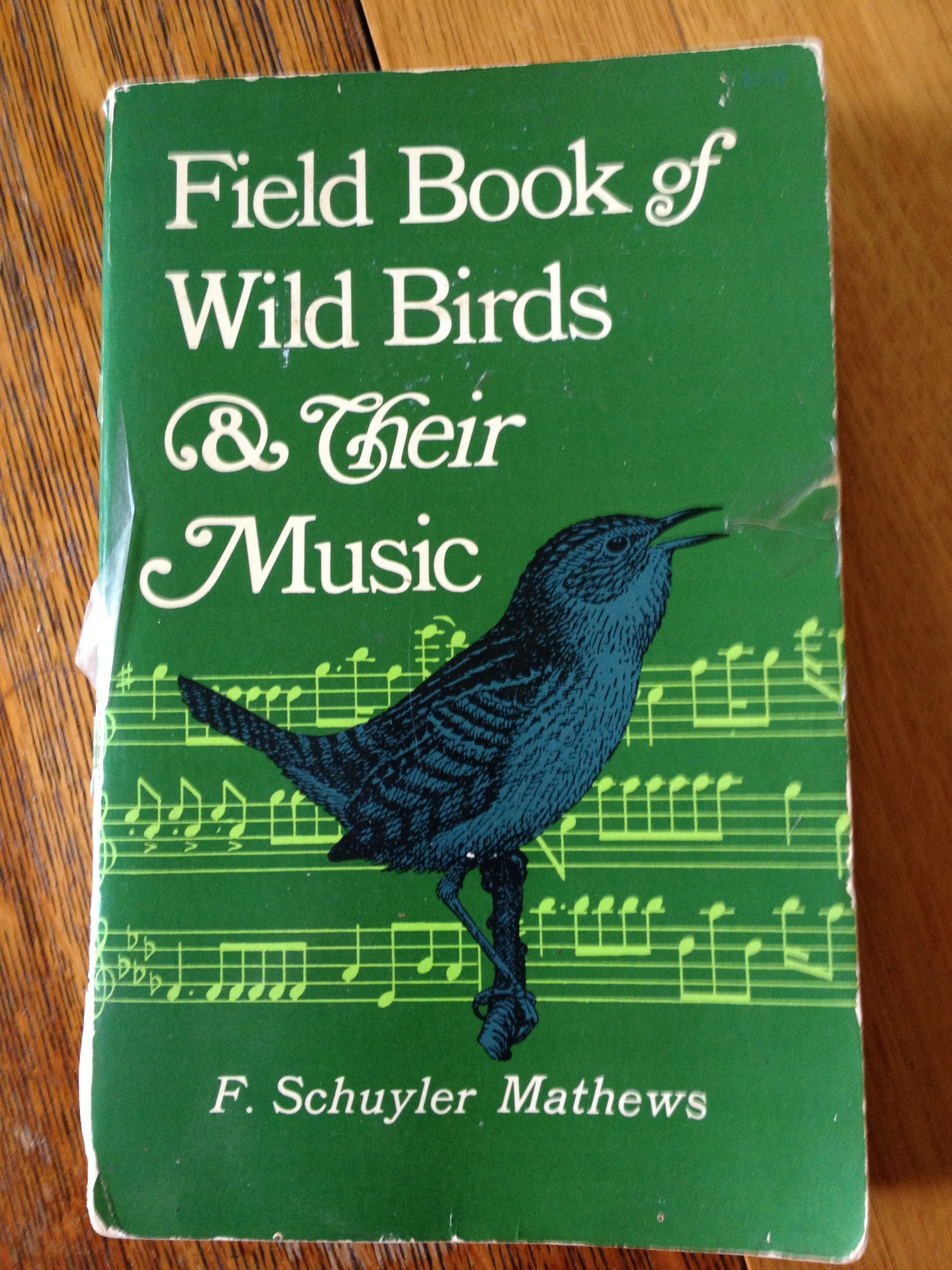
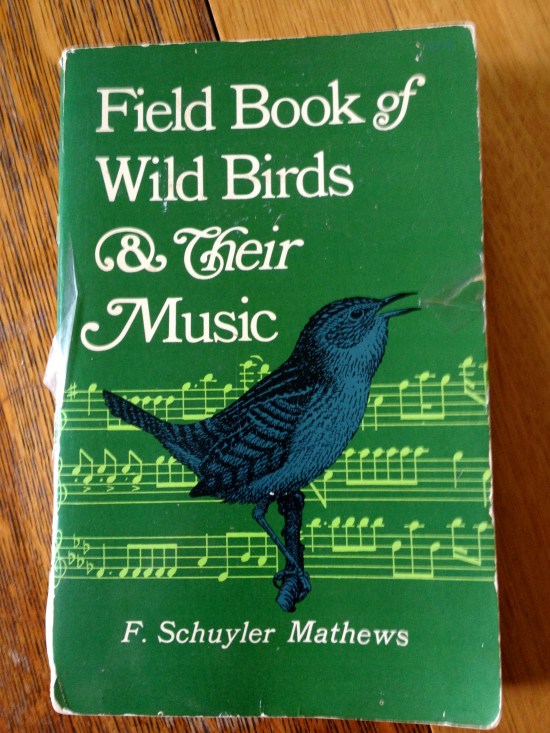
(On the subject of buffyness, I may be amiss. I have never observed a dead specimen closely, which is not a bad thing of course, but it is hard to evaluate the color of feathers from a great distance [which is why Audubon shot the birds he wished to paint]. I decide to check out the great bird song musicologist F. Schuyler Mathews, a source I greatly respect. While his major focus is bird song as music, he does describe the physical attributes of the birds. I find that he uses the words buff and buffy to describe both male and female bobolinks.[iii] He says the male’s head patch is “corn-yellow” and the middle of the back is  “cream-buff” and the female is “brown streaked with buff above” and the “head [is] dark sepia with a central line of green-buff; lower parts pale yellowish buff graded to buff-white”! I take back what I said. The word “buff” or “buffy” is used extensively to describe birds. I have been a plant watcher all my life, rather than a bird watcher, and buff and buffy are rarely if ever used in plant description. However—my husband and I once had an argument about the color of meadows in Highland County in winter sunlight. I said the meadows were tawny [meaning lion-colored] and he said they were dun, a word that sounded a little blah, depressing, and unevocative to me.]

The polygamous habit of the male bobolink necessitates a lot of energetic behavior. A pair of males will erupt out of a quiet hayfield for a competitive chase, settle down, and then erupt all over again, and again, and so on. Professor Spector writes that “A careful study of a meadow with displaying male bobolinks can provide occasional glimpses of [William Cullen] Bryant’s ‘modest and shy’ female that resembles a large, pale, grassland sparrow. She is all business, with no amusing antics. The male, too, of course, is all business, with his plumage, song, and display suited to attracting females—not to amusing us. The humor and clownishness we see is our perception, not hers.” One wonders about the female bobolink’s powers of perception. What does she perceive when she is not the primary female? But perhaps she is the primary female for another male, while being an accessory female for a different male? I am sure that there have been many studies of the mating behavior of bobolinks and it is all very interesting and complicated. But the difficulties of collecting accurate data about who is mating with whom in the bottom of a dense hayfield must be enormous!
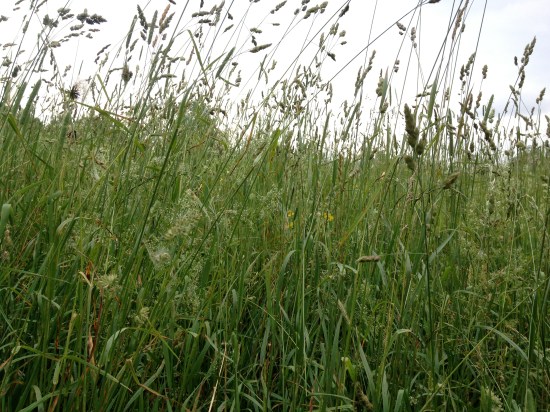
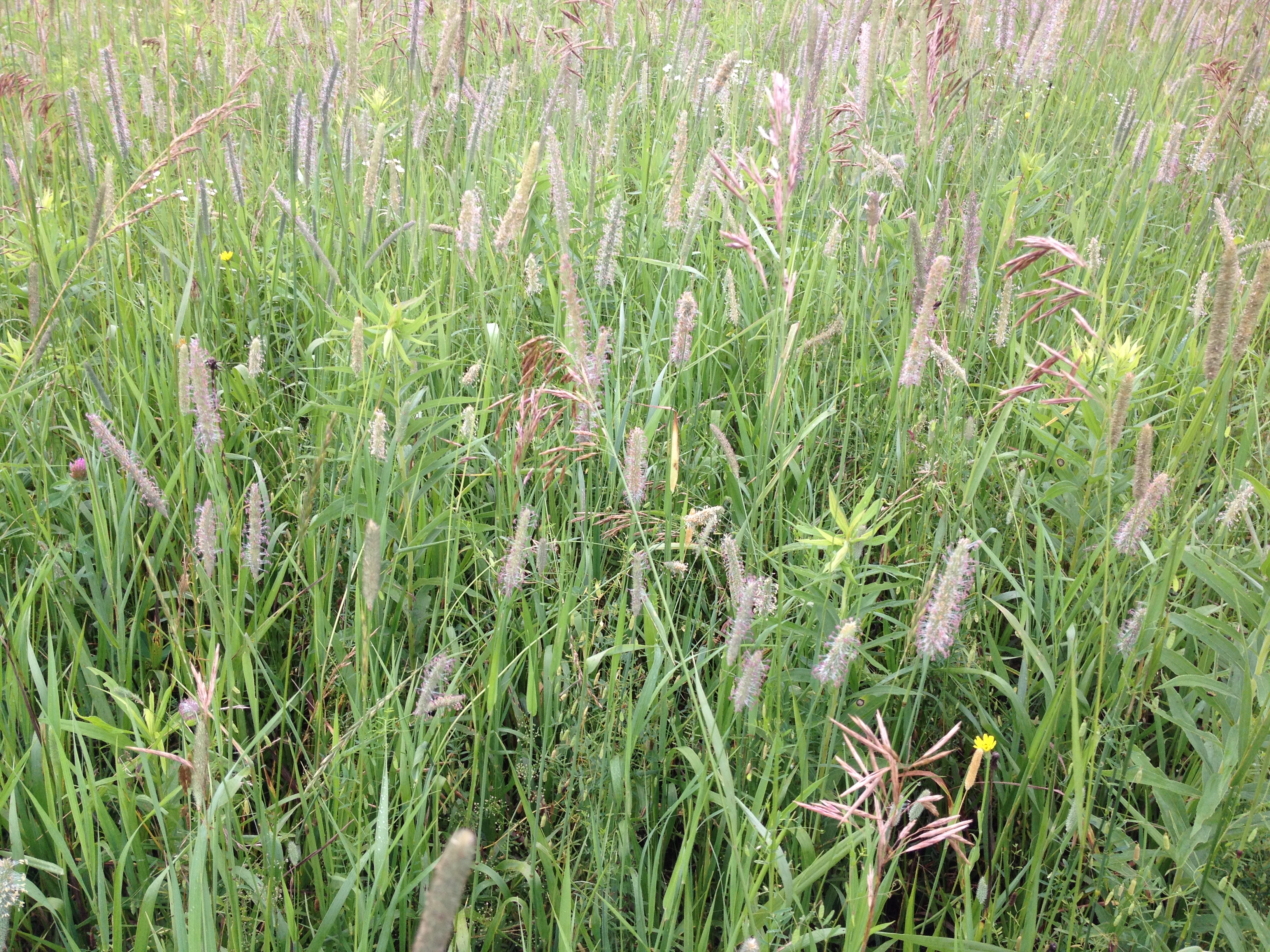
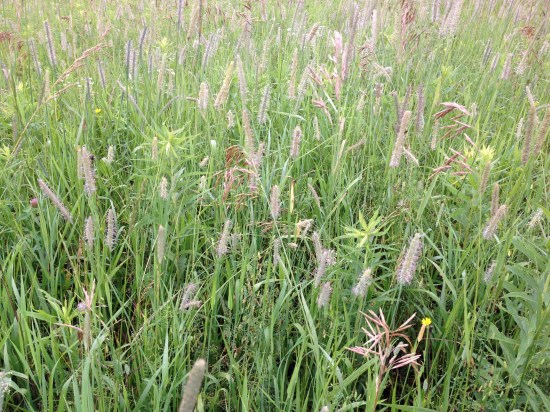
Dense hayfield in which much is going on that is invisible to the human eye.

Dense hayfield in which much is going on that is invisible to the human eye.

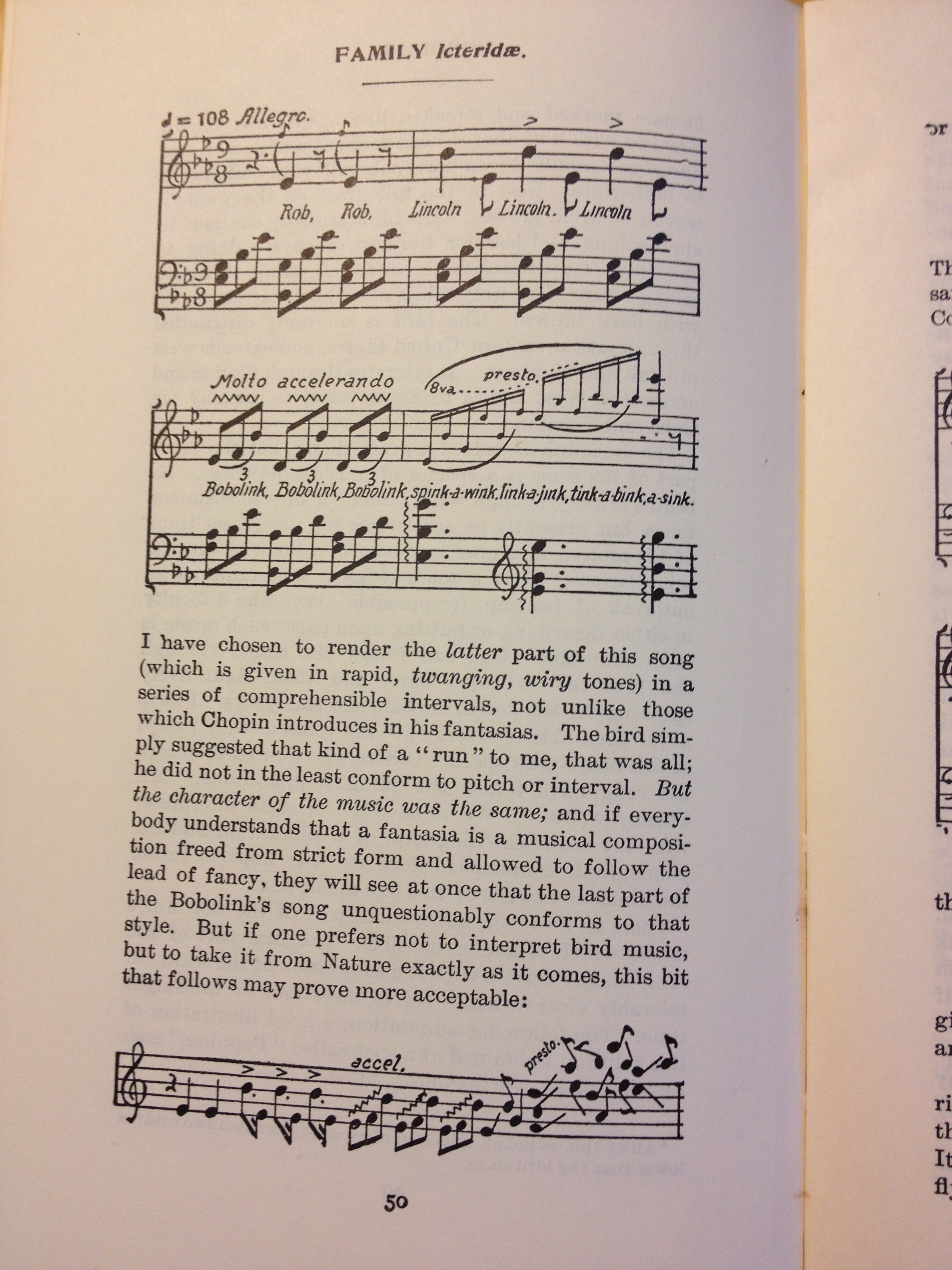
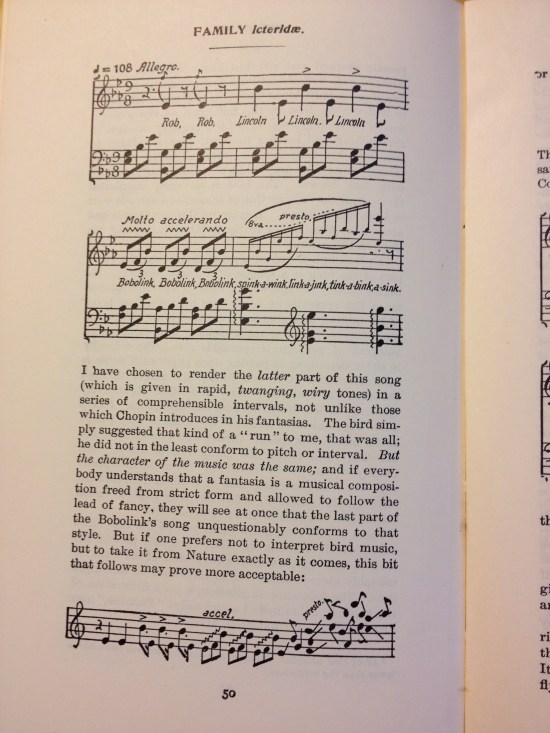
Male bobolinks can sing. Ecstatically. F. Schuyler Mathews, the bird song musicologist I referred to above, writes that “The Bobolink is indeed a great singer, but the latter part of his song is a species of musical fireworks. He begins bravely enough with a number of well-sustained tones, but presently he accelerates his time, loses track of his motive, and goes to pieces in a burst of musical scintillations. It is a mad, reckless song-fantasia, an outbreak of pent-up, irrepressible glee” (p. 49, Dover edition).  Another description of its song is “a bubbling delirium of ecstatic music that flows from the gifted throat of the bird like sparkling champagne” (musicofnature.org). The human ear can hardly comprehend the sequence of sounds.  I stood in Bobolink Alley a few days ago as a male flew around me. As he flew I turned, and as I turned he circled. Soon I was dizzy. Perhaps that’s the best way to “see” a bobolink, like a spinning top, the scents of the grasses, the clover, the milkweed, the teasel, the vetches, all of it mingling with the male bobolink’s exuberance.
IMG_3649

Mathews compares male bobolink’s song to Chopin!

I am always remembering connections to my natal territory in Vinegar Hollow. Bobolinks are related to red-winged blackbirds and meadowlarks, birds that also nest on the ground in hayfields. Once my father came rushing from the orchard meadow, his face solemn and concerned. “Elizabeth,” he said, “come with me. I have something to show you.” I was known, as a young girl, as the resident naturalist. He brought me to Roy, the mower, who stood looking at a patch on the ground. It was a meadowlark’s nest that had been chomped by the blades of the tractor. Some of the eggs lay smashed, oozing yellow yolk. What could I do? I realized that they wanted me to help by witnessing and mourning the destruction of the nest and the distress of the mother circling overhead.

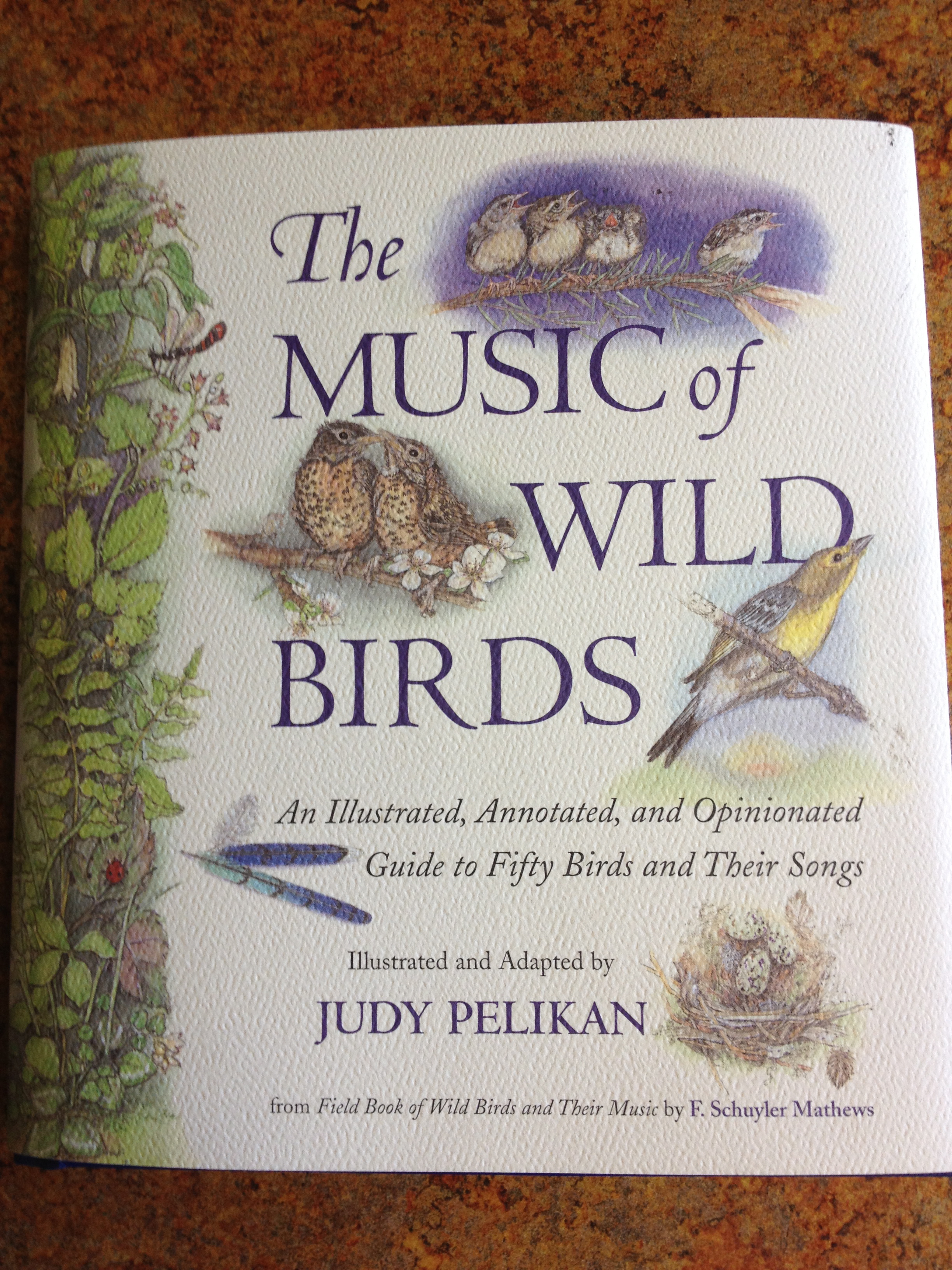
So, a mower at Seven Fields is standing ready, and the bobolinks are about to leave on an incredible journey. It has been recorded that one female bobolink travelled 1,100 miles  in one day (wiki). They will come back next May after a 12,5000 mile round trip. I hope. My husband has pointed out to me that they have a characteristic, and unusual, flying style. While most birds flap their wings in a near 180 degree arc, bobolinks never (rarely?) raise their wings above the plane of their body, creating a 90 degree arc.  F. Schuyler Mathews is critical of this flying style: “The Bobolink is a distinctive meadow character. He rises from the grass with a great deal more wing-action than the shortness of his flight would seem to demand. It is evident by the constant flipping of the wings that flying is an effort with him, where it is not effort at all with the Barn Swallow. Perhaps his constant foraging in the meadow grass has put him out of practice on the wing” (51-51). Mathews suggests that proof of their shaky flying is that they take the shortest route to South America, hugging land, Cuba and the Yucatan, rather than going over the ocean! Mathews is known for being opinionated, but this criticism is going too far!! Judy Pelikan has illustrated an expurgated version of F. Schuyler Mathews’ original Field Book, published in 2004 by Algonquin Press.
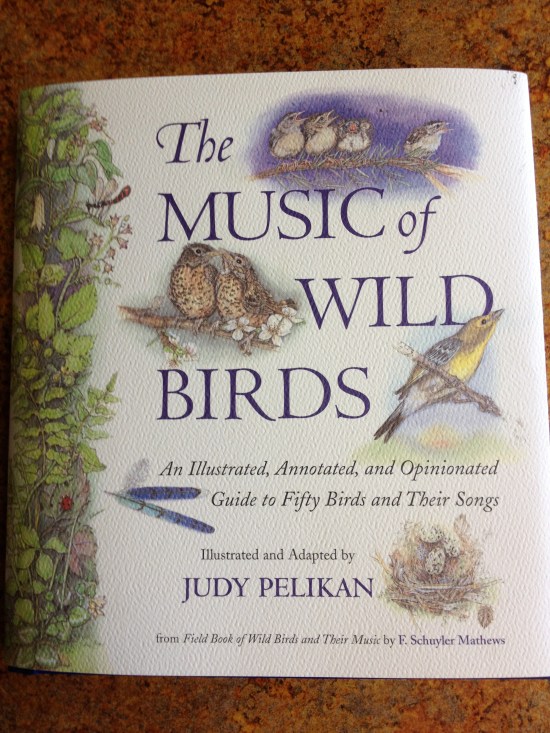
Beautifully illustrated (and expurgated) edition of Mathews' text.

Beautifully illustrated (and expurgated) edition of Mathews’ text.

Bobolinks will be called by other names in different places on their journey:  ricebirds in the South where they are shot for their love of rice, and butterbirds in Jamaica where they are eaten because they have gotten fat on rice. Sympathetic sorts, like poets, write about bobolinks, rather than shooting or eating them. Emily Dickinson observed bobolinks in the hayfields around her home in New England (“the Bobolink is gone, the Rowdy of the Meadow”)[iv]and Gertrude Stein, who wintered in South America, made an enigmatic reference to bobolinks in her famous poem “Susie Asado,” a tribute to a flamenco dancer (which made her lover Alice jealous).[v] The line is “a bobolink is pins,” which is not supposed to make any literal sense, but rather musical sense. The entire poem is aflash with “musical scintillations,” to use Mathews’ phrase about the male bobolink’s song. The poem is almost meant to be read as a bird song.
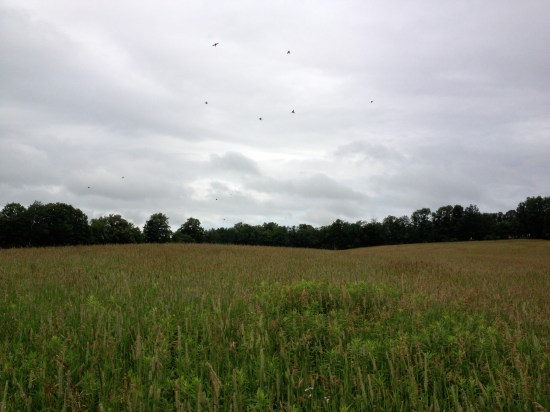
Fledglings in the sky.

Fledglings in the sky.

I want to be sure that the bobolinks are really ready. My husband and I have sighted groups of fledglings, intermingled young redwing blackbirds and young bobolinks, flitting to the hedgerows, but they are still descending to nestle in their invisible homes in the central parts of the hayfields in the evening. I am worried they don’t want to leave.

Bobolinks: listen for the mower and go.
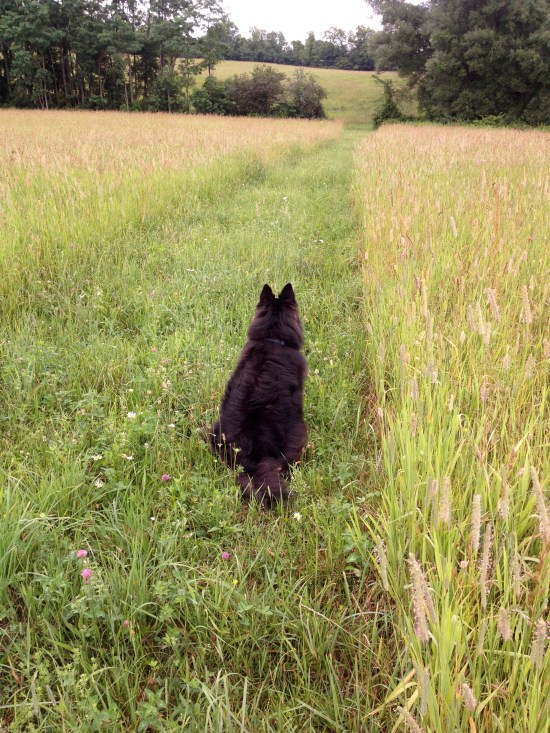
Belle the dog in Bobolink Alley.

Belle the dog in Bobolink Alley.


[ii] Available online, published in the Daily Hampshire Gazette, a column entitled “Earth Matters,” a biweekly column from the Hitchcock Center for the Environment.

[iii] Field Book of Wild Birds and their Music (1909), Dover edition.

[iv] See reference in footnote 2.