A New Year’s reset in Vinegar Hollow

The view from the top of the Peach Tree Hill looking south. The Pine Tree Hill is first on the left with the graveyard just visible to the right of two red maples my mother planted, the Hill with No Name is in the middle, and Stark’s Ridge stretches south with the blasted cucumber at the end of the hilltop pasture.

We are in Vinegar Hollow for our New Year’s reset. The mountains are quiet, the stars are multitudinous at night, and one can wander, browsing the Earth–like cows, finding nourishment from the landscape. The woodchopper and the naturalist writer lean in to their favorite activities, all the while keeping the fire going.

Fire made by David Fernandez.

I like to observe the waking up of the day here in the hollow from my desk in front of the sliding glass doors. Although it’s a cold spot in the winter, I can survey the scene as I take my first sips of coffee. The cloud cover on January 1st was a moody blue-gray (not unlike the shoulder feathers of the Blue Jay, see below) intermixed with eyelets of blue. The first visitors to the garden yard are Blue Jays. I have never been particularly attentive to Blue Jays, dismissing their squeaky voices in favor of the smaller more delicate songbirds. However, after several mornings of Blue Jay watching, I become full of admiration for their grace and energetic behavior. Each morning a flock of about 9-10 birds arrive in a great hurry. They forage around the yard, pecking like chickens at leaf piles. Each peck tosses up a dance of leaves. They may be searching for remaining beechnuts because 2023 was a mast year, meaning there was a bumper crop.

The beech on the right and the red spruce on the left. The lawn between and beyond is the foraging ground of the Blue Jays (Photograph: Douglas Fernandez).

After a certain amount of ground-level activity they swoop up onto the slenderest branches of the beech and the wispy dangling branches of the red spruce, pause a bit, and then plummet to the ground for more foraging. Their choreography is erratic and hectic. Three or four of them visit the small watering hole/bird bath formed by the roots of the beech. Usually there is water in it, which small songbirds regularly visit in the summer, but now after a droughty fall, it is dry. After the Blue Jays are well into their morning routines, European Starlings in small murmurations appear in the background swooping en masse over the garden yard into the orchard meadow. My eyes are dazzled by the almost vertical falls of the Blue Jays in the forefront of my field of view and the horizontal movements of the European Starlings in the background. The arrivals and departures of the Blue Jays are sudden. In one moment I see them in the distance swirling together into the walnut tree in the sinkhole by the driveway, an astonishing display of speedy choreography. In the next they are off, with the European Starlings following in the same direction. And soon they are all back for round 2, sometimes round 3, but after these excursions they are gone for the day, probably off to the various water troughs placed around the farm, which are gravity fed by overflow from the spring on the mountain.

The plumage of the Blue Jay is best admired when the individual is caught at rest (Cyanocitta cristata, Corvidae) (photographic source: Wikimedia Commons, photographer Jongsun Lee).

The Blue Jays looked identical to me, which I knew was a failure in discernment. Nature does not create generic organisms. Every individual is uniquely different. So I decided to study, with the aid of the photograph above, the plumage of the Blue Jay. On the photograph I could observe at my leisure the dramatic feather patterns–the black bars that separate rectangles of the different shades of lavender-blue, the white belly and “underpants” ( birder term), and the white accents at the ends of certain feathers. Google helped me find a youtube video called “How to Tell Blue Jays Apart,” which beautifully illustrates how the black markings around the eyes and on the head enabled “Lesley the Bird Nerd” to distinguish the individuals at her bird feeder. She also noticed idiosyncratic traits like wing flicking. In other research I learned that Blue Jays communicate via a huge number of calls, among them 1) the jeer, 2) the pump handle, 3) the bell, and 4) various alert calls, like the toolili, which sounds quite melodious. Discerning bird calls by ear has never been my forte, however.

The days pass quickly. On the first day we visit the graveyard on top of Pine Tree Hill, which needs a lot of maintenance for the next round of inhabitants. We find strands of rusty barbed wire that have broken and are flopping about, certainly a hazard for the cows. We see the evidence of one cow who has made inroads into the plot searching for forbidden fruit. With fingers frozen in the cold, we try to fasten strands of barbed wire into the gaping holes. I have ordered primrose seeds (the common primrose, the oxlip, and the cowslip) and look forward to bringing the seedlings in the spring. On day 2 we walk to Stark’s Ridge to see the remaining cucumber tree of the pair that dominated the hilltop for so long.

The cucumber tree (Magnolia acuminata) at dawn (Photograph: David Fernandez).

Its partner is on the ground. On day 3 we walk straight up the Peach Tree Hill and then down into the snake woods, always a place of mystery and discovery. The path winds around sink holes filled with leaves, and vines climb to the tops of slender trees reaching for the light, threatening to and in some cases dragging them down. As a partisan of trees, I am dismayed by the power of wild grape vines to dominate trees. Sometimes two or three trees are tied together at their tips by vines.

The New Year’s reset is brief. On day 4 we have household maintenance issues and must go to town on errands. Day 5 is departure time. It is best to leave early for the 9-hour drive back to Ithaca, but there is a snafu. A pick-up truck with a large attachment has blocked the driveway by the barn. My husband went out to investigate and I continued indoor tasks. When he did not reappear and I heard animated conversation, I investigated. The large attachment was a cattle hoof trimming apparatus. It is a unique structure, partly devised by the owner himself, an exuberant person who went about his work while chatting enthusiastically despite the frosty air.

Pickup truck with unique apparatus attached for trimming hooves of cattle, more frequently used in dairy cattle than in beef cattle.

Mike’s cows do not in general need hoof trimming, a practice more common in dairy cows. This cow belonged to his grandson and had been transported from Stanton to Mustoe to be closer to the owner of the device. I missed the actual ‘operation’ but apparently the cow is coaxed into the apparatus, fastened in tightly, and then turned on her side so that the hooves are presented to the trimmer for easy trimming. The cow walks off eventually, presumably feeling much more stable on her feet. 

Sadly I missed this drama, but I noticed something that I would not have seen if the cow trimming machine had not been blocking our path. As I opened the gate from the garden area to the pasture, I observed that the lichens that copiously colonize  fence rails (epiphytic lifestyle) on the farm were covered in frost. In my research for a book called Moss and Lichen to be published by Reaktion Books in winter/spring 2024, I came across several studies about the ability of lichens to harvest water through ice nucleation. At higher temperatures formation of ice crystals requires nucleating particles, in this case those found on the ruffled surface of the lichens. It was about 28–30 degrees F.

Soon I was going from one fence rail to another trying to capture the beauty of the ice-crystal-encrusted lichens. Lichens are often described as “encrusting” their substrates, but here they were being encrusted themselves with little turrets of crystals showing the etch lines of their construction. There are biological reasons why nature specializes in encrusting topographies. Lynn Margulis, famous for greatly expanding our view of symbiosis, offered the statistic that the world contains 1014  tonnes of lichens (Symbiotic Planet, 1998), though noting that it is “notoriously” hard to provide an accurate estimate of the total mass of lichens in the world. They live everywhere on many substrates, natural and manmade, and frequent places not easily visited by humans. Although adapted for drought tolerance, lichens need water to photosynthesize and grow. Soon the morning sun would be hitting the fence rails, melting the ice crystals and immersing the lichens in films of water.

Sometimes I learn about the hollow through the eyes of Mike, who as I have mentioned grazes his cattle at the farm. This trip he tells me that he was near the top of the Peach Tree Hill on his four-wheeler checking on his cows, when he observed a curious tableau. A mama bear was halfway down the hill on the eastern flank with several cubs, heading over to a convenient gate into the Stanley Hiner place. Several calves began chasing the cubs, who, seemingly enjoying the chase, would stop and start. Each time the cubs stopped, the calves stopped. Meanwhile Mama bear left her cubs to play and headed over to Stanley’s place. Mike said that Mama bear would find her cubs in due time after the play date.

I could come here for a thousand years and always find something arresting to observe in the beauty and behavior of the multitudinous life forms on Earth.
On the longevity of pear trees

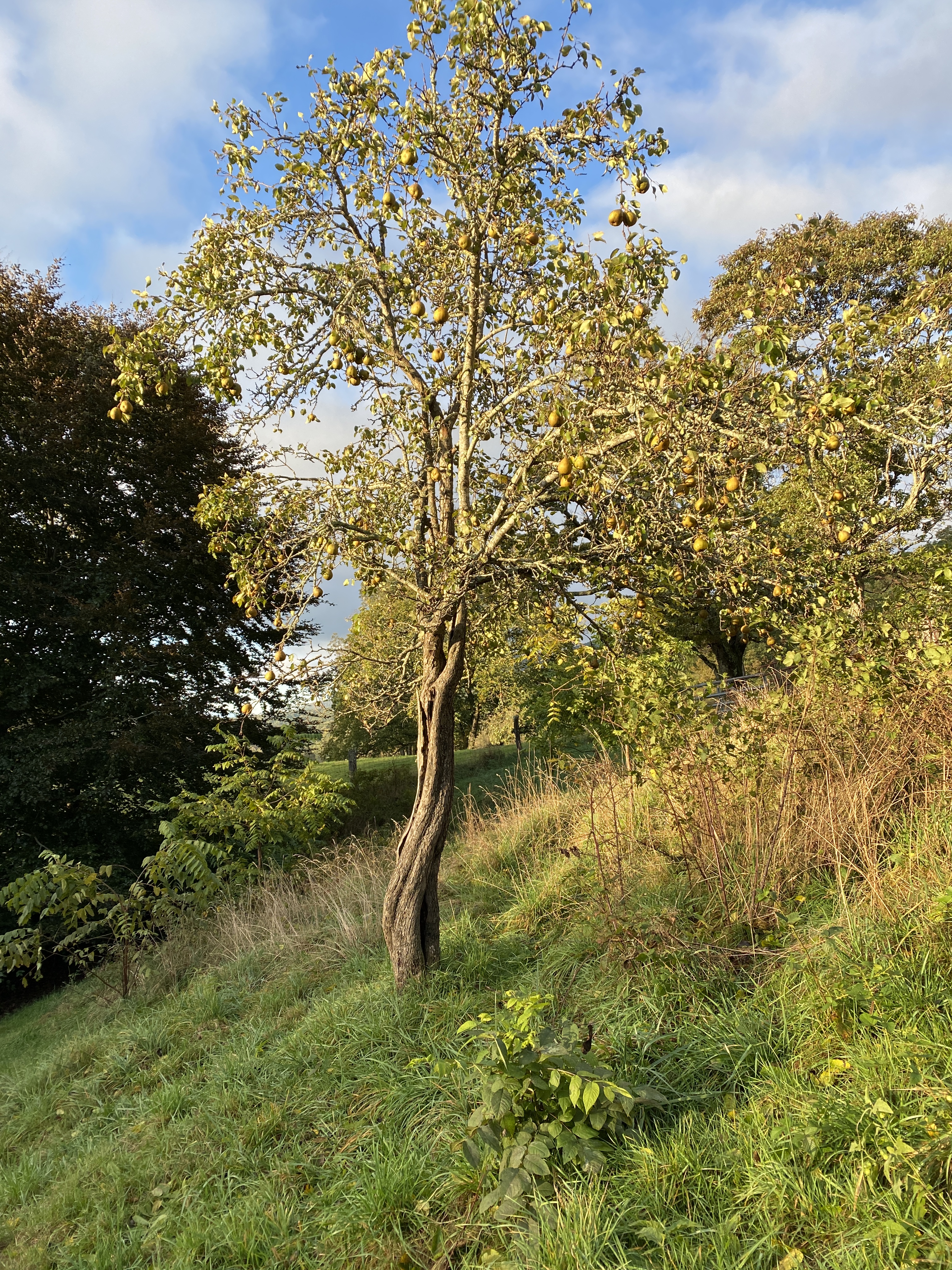
On a recent trip to Vinegar Hollow I made a point of reacquainting myself with an old friend. It is out of my usual view, perched on a steep little hillside up above the root cellar. The pasture around it is deeply rutted by cow trails and tough tussocks of tall grasses. It takes some effort to come face to face with this friend, as one is either looking up at it or looking down upon it. Since I was very young, it has looked very old, but now I am catching up in age, and it seems to be reversing course, looking younger. I have never seen a more bountiful crop of pears even though August and September were droughty. The pears are large, green gold, gleaming in the sun, holding on tightly. They cannot be pulled off easily. They seem to prefer to fall on their own terms.

The leaves, branches, and pears play with the sunlight.

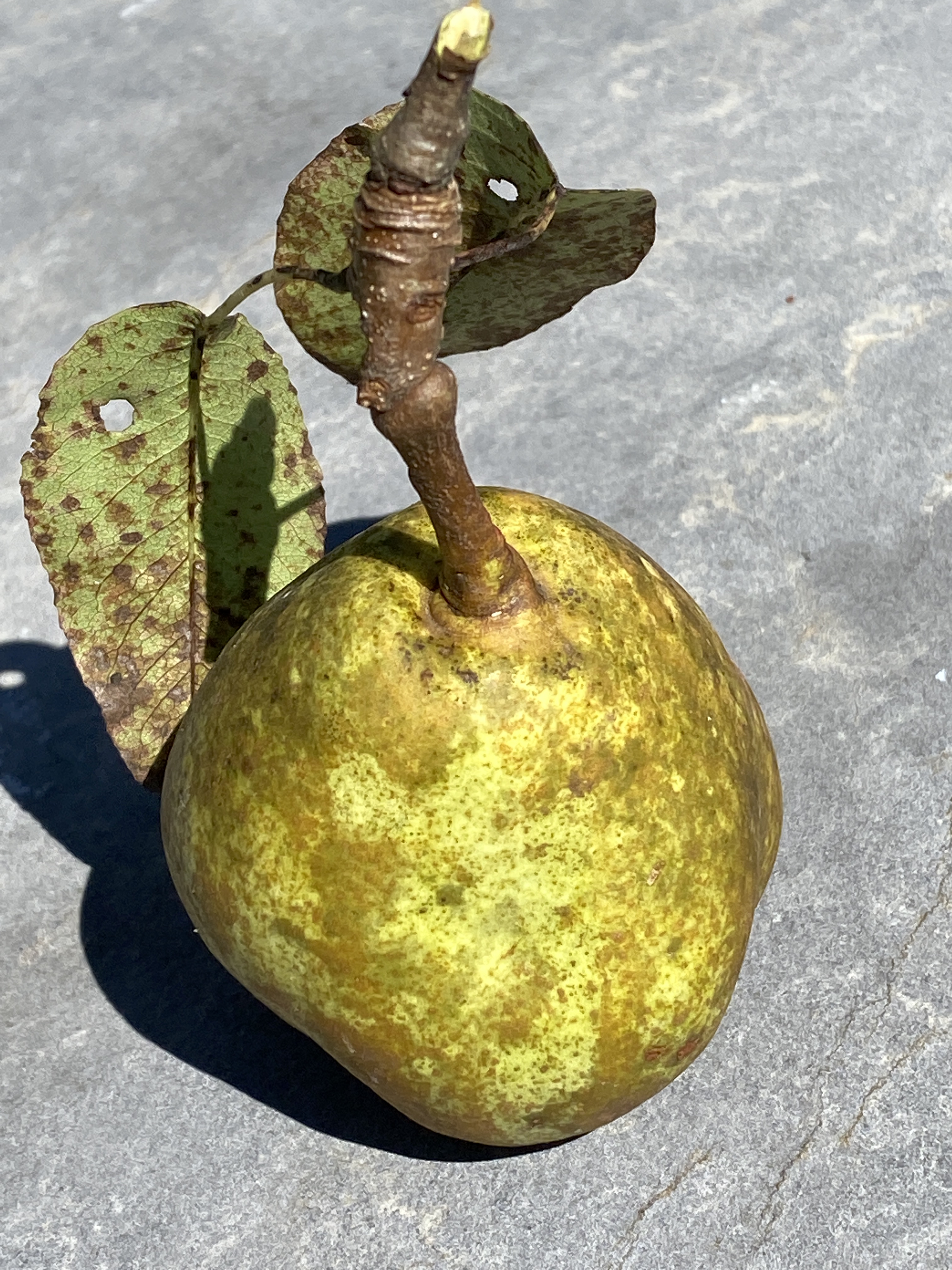
Each pear is a work of art with a myriad of spots and speckles and blemishes, documenting the history of growth day by day. I pick a few from the ground and photograph them. Each one is perfect in a slightly different way.

Green and gold.
Most of a pear’s nutrients are in or just below the skin, so all these blemishes are nutritious.

There is no one alive now to tell me how this lone pear tree came to be here. Since I am almost three-quarters of a century, I would say it must be at least 100 years old. Its trunk has always had been braided, existing on twining remnants of a once vigorous tree hollowed out by age. Wild pears apparently are round, so this tree with pear-shaped pears came from cultivated stock. There is a Peach Tree Hill on the farm, named for a small orchard of peach trees set on its steep hillside. Grooves of the orchard rows on the hillside were visible for years after the trees had died. The early farmers had to work very hard to grow any crops on this rocky limestone land, which is best suited for livestock grazing. There is no lore about a Pear Tree Hill in this hollow, but perhaps I can start a story and name this little slope the Pear Tree Hill. 

I am amazed that this fragmented trunk can still pull enough nutrients from the ground to nourish so many pears.

Curious about the longevity of pear trees, I went to the internet. It seems that wild pears (Pyrus communis subsp. pyraster) can live several hundred years. I came across an “obituary” for UK’s Cubbington Pear, said to be at least 250 years old. It was felled to make way for a high-speed railway line (HS2) despite a 10-year protest by environmentalists and local activists.  Billions of pounds have been allocated to the HS2 project, but even so costs spiral and the line to Leeds has already been scrapped. I also came across a recent story with an environmentalist angle: “Environmentalists advocate for ancient pear garden in Lanzhou, China.” The orchard is part of a park that is over 600 years old. One of the pear trees is said to be 400 years old. Numbers have dwindled from 13,000 to 9,000 due to use of the trees as building materials and lack of replanting. 

A visitor to Lanzhou’s pear garden who had visited the garden as a child recalls this impression in 2021:

The same pear orchard, I came to watch it again after twenty years, but I never thought that it moved my heartstrings so much. Is it the so-called three stages that must be experienced in life: seeing the mountain is a mountain, seeing the mountain is not a mountain, seeing the mountain is still a mountain. The realm of life is constantly sublimated with the precipitation of the years, thick and beautiful.

There is some awkwardness in the phrasing for an English-speaker, probably because the text has been translated from the Chinese, but I love the description of the “precipitation” of years as “thick and beautiful.” Also, I was interested in what he said about ways of seeing a mountain in different stages of life. I puzzled but felt I was missing something, so I asked Google to enlighten me with this search term: “seeing a mountain three stages of life.’ I found the Three Mountain Problem was posed in the 9th century by Qingyuan Weixin, which D. T. Suzuki translated in 1926 as “Before a man studies Zen, to him mountains are mountains and waters are waters; after he gets an insight into the truth of Zen through the instruction of a good master, mountains to him are not mountains and waters are not waters; but after this when he really attains to the abode of rest, mountains are once more mountains and waters are waters.”

Vincent Van Gogh painted several pear trees. The angular trunk of this pear tree is similar to the one in Vinegar Hollow.

So, are we to understands that in our youth we see with wonder and clarity, while in our middle years our view is limited because we live in our heads beset by the fears and anxieties associated with earning a living and caring for family, and then in the final stage of life we can, in the best of all possible worlds, become fully attentive again (enlightened)–a mountain is a mountain rather than something vastly symbolic or useful for other purposes than being a mountain? Maybe we can even think like a mountain (see Aldo Leopold’s Thinking Like A Mountain” . A few days ago I heard a news item about the lack of restoration, which had been promised, for the mountain top removal that occurred in West Virginia during coal mining. From an environmental point of view, one might like to see the thought that part of being attentive is to accept the mountain as a mountain and let it be. 

When I returned to Ithaca, I brought one of the pears to my neighbor and friend, little Fran, who is 99 years old. She is a musician, poet, and writer. I always give her pears, real ones and once a pear Christmas ornament. I always tell her she is like a pear, not an apple for sure, but definitely a pear. At 99, she is just like the pear of Pear Tree Hill. She is finding it hard to believe that she is still worthwhile and beautiful, but I tell her that she is like the pear tree. I will go back in November and climb the steep little hill. Maybe the bear has visited the tree and eaten the drops. Earlier this fall Mike told me not to worry if I saw a young bear sitting under the walnut tree where I park my car, which is not too far from the pear tree. He says that the bear eats walnuts whole, hull and all. He says that you can hear the clicking, crunching sound from pretty far away. And, yes, this little bear will come for the pears. Bears have such sweet tooths! This reminds me to add a note about the two fairy tale apple trees in the orchard that I wrote about in my last blog. I suggested it would take a hook and ladder truck to get at the apples. Mike says the bear spends half the day aloft in those trees eating the apples! Walnuts, pears, and apples—perfect provisions for winter!

In any event, I have certainly been inattentive to this pear tree. Luckily, there is some time left I hope for our relationship to continue. I remember how years ago when I was young, my father and I happened to come back from a walk and pass by the little tree. I asked how it could still be alive because of the hollowed-out trunk. He said he didn’t know but smiled knowingly. It was clear to me that he loved the tree. What can I learn from the pear tree? That longevity can be beautiful, that I am fortunate to know that a tree that has been a friend of my youth now will be a friend of my old age. I wish very much that it will outlive me and be a friend in my hereafter. It looks likely that my tree will do so. In September 2022, fruit was picked from a pear tree in northeastern Turkey said to be 1100 years old. Anatolia is thought to be the home of the pear. Conditions in Vinegar Hollow may be similarly conducive to longevity. I am also heartened by this quote from Virginia Woolf’s To the Lighthouse (it was in the magazine Taproot that came to my mailbox this weekend):

And all the lives we ever lived and all the lives to be are full of trees and changing leaves.